

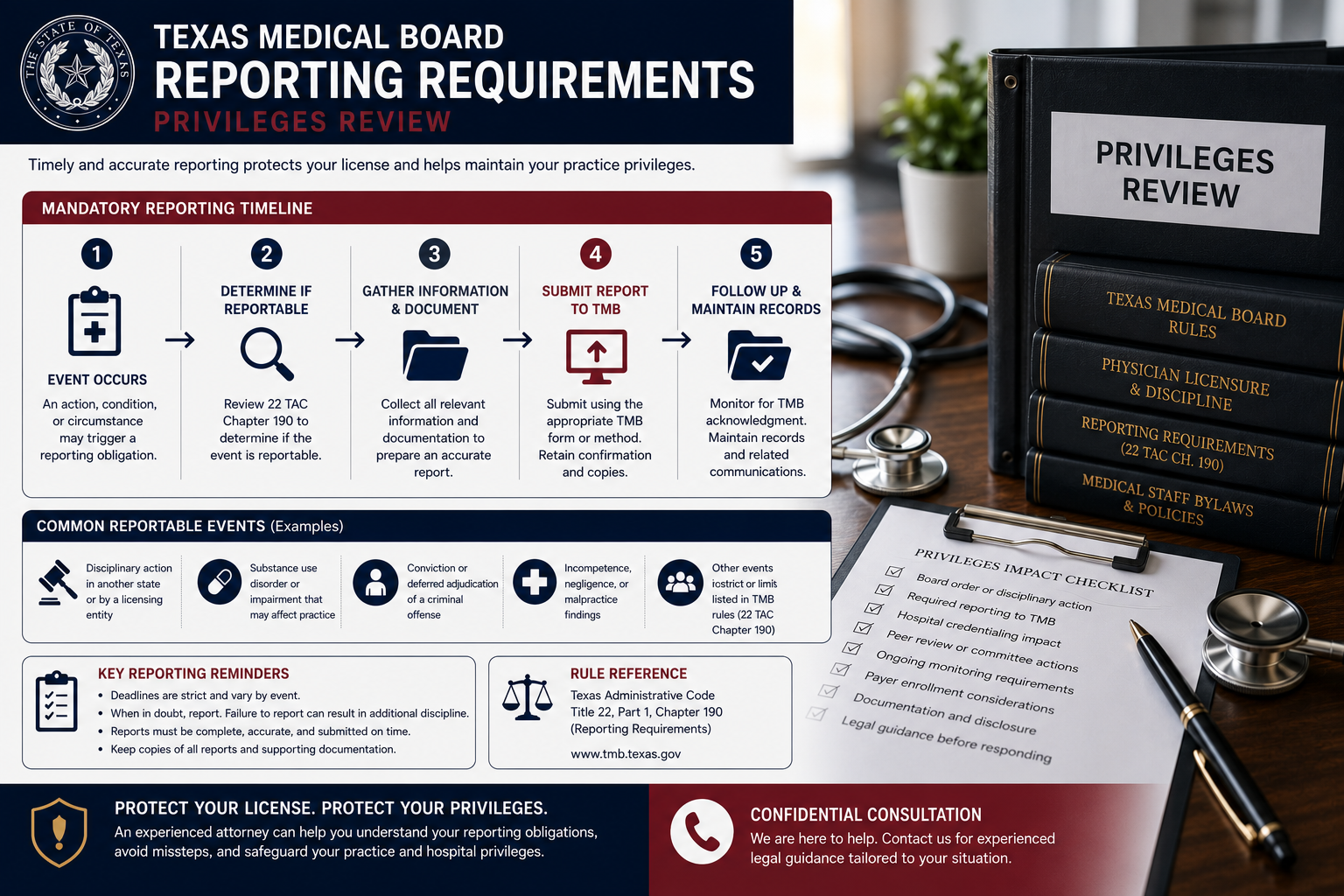
How TMB Discipline May Affect Reporting, Credentialing, and Privileges
Expert Texas Medical Board Reporting Compliance Services
Navigate every mandatory reporting obligation under Texas law with confidence and precision.
Why TMB Reporting Compliance with the Medical Practice Act is Critical for Your Practice
The Texas Medical Board enforces strict reporting requirements under the medical practice act (Texas Occupations Code, Chapters 160 and 164) to safeguard patients and uphold professional standards. Reporting guidelines vary based on the type of incident and who is reporting, and some obligations depend on the board’s review and consideration of the information provided. When physicians, health care organizations, and insurers fulfill these obligations accurately and on time, the entire system of professional oversight functions as intended. Failure to comply can result in serious consequences-from administrative fines to license revocation, and there is no general exception for matters that were handled internally once a reportable event occurs.
- Legal Protection: Avoid penalties, board discipline, and civil liability by meeting every reporting deadline. Under § 160.055, sanctions may be imposed on any person-physician, insurer, or healthcare entity-who fails to report required events.
- Patient Safety: Mandatory reporting helps protect public health and safety. Healthcare professionals must report if a physician poses a continuing threat to public welfare, ensuring dangerous practice patterns are identified early.
- Professional Standards: Accurate disclosure of disciplinary information maintains the integrity of healthcare delivery across Texas and reinforced public trust in the profession.
- Regulatory Compliance: Meets state laws under the medical practice act and related statutes, including requirements to submit data to the national practitioner data bank (NPDB). HB 1998 (2023) now requires TMB to run a continuous query with the NPDB for each licensee.
Professional compliance services ensure your practice meets every reporting obligation with proper oversight and accountability-so you can focus on patient care rather than regulatory concern.
Our TMB Reporting Services
Health Care Organizations and Facility Reporting
We provide comprehensive guidance for hospitals, clinics, ambulatory surgical centers, and other health care organizations on their mandatory reporting obligations. From peer review committee documentation to adverse privilege actions, our team helps facility administrators develop tracking systems, identify who must review and present reportable matters before submission, standardize what constitutes a reportable event, and submit reports in accordance with TMB timelines. Hospitals are required to report actions that impact a physician's clinical privileges for more than 14 days—and we ensure those reports are completed accurately every time, even if the facility has not yet announced a final internal employment decision.
Individual Practitioner and National Practitioner Data Bank Reporting
Physicians and other licensed professionals face a range of personal reporting duties-criminal convictions, malpractice claims, license actions in other jurisdictions, address changes, and more, and self-reporting duties can also be triggered during the present licensure period by events in Texas or other jurisdictions. We assist practitioners with timely updates to the TMB Online Profile System, ensuring all required events are disclosed within the statutory period. Whether you need help understanding what must be reported or navigating a complex situation involving investigations, our consultation services are designed to keep your licensure secure.
Top 10 Texas Medical Board Disciplinary Actions Reporting Requirements
- Peer Review Actions: Medical peer review committees must report to TMB when a peer review results in an adverse impact on clinical privileges for more than 14 days. Healthcare employers must report adverse clinical privilege actions lasting more than 14 days under § 160.002. Mandatory reporting includes adverse actions by hospitals, making this one of the most consequential categories of disclosure.
- Malpractice Claims and Settlements: Reports involving certain malpractice claims must be submitted to the Texas Medical Board. Insurers must report when a lawsuit is filed against an insured physician or when a settlement occurs under § 160.052. There is no monetary threshold under Texas law-any liability claim ending in a lawsuit or settlement is reportable regardless of compensation amount.
- Criminal Convictions: Physicians must report any felony convictions to the board, as well as Class A or B misdemeanors and Class C misdemeanors involving moral turpitude, within 10 days of the event. Pleas of no contest and deferred adjudication also fall within this obligation.
- License Actions in Other States: If any professional licensing authority in another jurisdiction takes action against a physician's license, that event must be reported to TMB within 10 days. These instances are tracked and may expand the scope of a TMB investigation.
- Impairment Issues: Healthcare professionals in Texas must report impairment due to drugs or alcohol. Professionals must report colleagues whose impairment threatens patient safety, including intoxication. Section 160.004 addresses the duty to report impaired physicians, and rehabilitation or substance abuse treatment may be ordered as part of the resolution.
- Patient Care Concerns: Significant departures from acceptable standards of care-whether identified through complaints, peer review, or other sources-must be reported. Reports to the Texas Medical Board must include specific events affecting patient safety or professional conduct.
- Surrender of Privileges Under Investigation: When a physician surrenders clinical privileges while under investigation for incompetence or improper professional conduct, this must be reported even if no formal disciplinary actions occur. The board uses this data to determine whether further inquiry is warranted.
- Professional Society Membership Actions: If membership or standing in professional societies or organizations is adversely affected as a result of peer review, that allegation-related outcome is reportable under Subchapter A of Chapter 160.
- Hospital Privilege Actions: Denial, restriction, modification, or revocation of hospital privileges triggers reporting obligations. These events, once reported, become part of the physician's profile and may be transmitted to the national practitioner data bank.
- Board Orders and Disciplinary Actions: Texas Medical Board requires reporting of certain disciplinary actions. A Board Order is the formal public discipline document issued by the Texas Medical Board after the disciplinary hearing process and published for public access. It can grant, deny, or modify medical licenses and may also require a physician to pay an administrative fine when applicable. Under § 164.060, the board must notify known hospitals on the first working day after a board order is issued and provide written notice to other known facilities within 30 days.
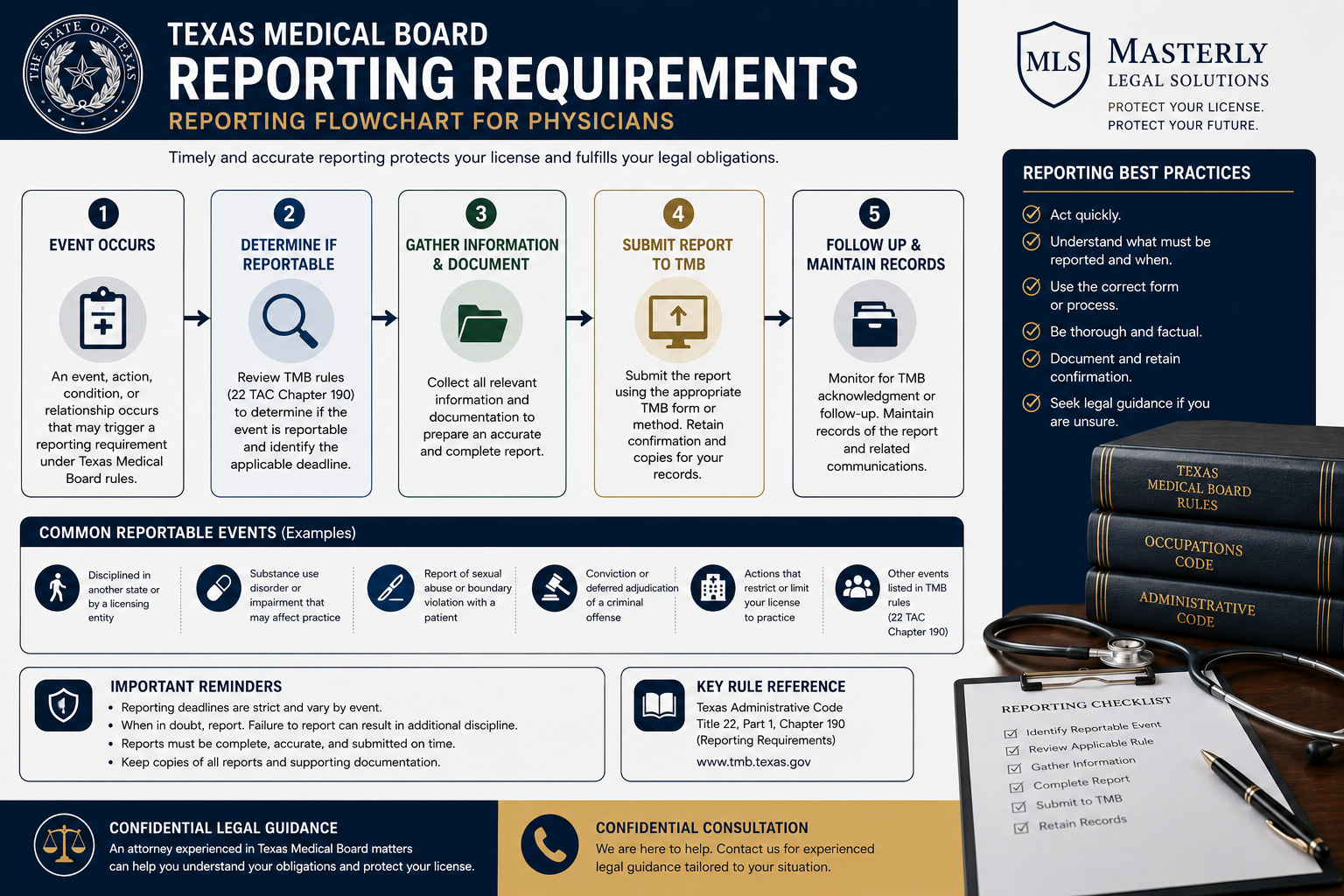
Our TMB Reporting Process
Step 1: Incident Assessment
We evaluate whether the incident meets TMB reporting criteria under Texas law. Our team will determine whether the event constitutes a reportable occurrence-whether it's a peer review action, malpractice settlement, criminal conviction, or disclosure of impairment. We identify the applicable reporting timeframes: 10 days for convictions and address changes, 14 days as the threshold for adverse privilege actions, and 30 days for malpractice claims and settlements. Texas Medical Board investigations can lead to dismissal, remedial plans, or formal litigation, so early and accurate assessment is essential. The TMB receives approximately 9,000 complaints per year, and the average investigation takes roughly six months to complete-making prompt engagement with the process critical.
Step 2: Documentation Preparation
We gather all required documentation and evidence for the TMB report, including the documents called for by the applicable reporting category. Under § 160.053, reports must include the name of the insured physician, the date of the incident, the nature of the claim, the court's name and address in lawsuits, the amount of any settlement or judgment, copies of expert reports filed under § 74.351 of the Civil Practice & Remedies Code, and identification of the insurer. For peer review reports, required elements include the nature and duration of the adverse action, the circumstances of any investigation, and whether the physician surrendered privileges in lieu of formal proceedings. We ensure every form is completed accurately using TMB's Claims Report format or an equivalent that meets all required elements under 22 TAC § 176.2.
Step 3: Report Submission
Reports must be submitted within 30 days of the event for most categories. We ensure proper submission through the TMB online portal or by mail, verifying that all information provided meets statutory requirements. Texas law prohibits anonymous complaints to the Texas Medical Board, but identities are kept confidential-and good-faith reporters are granted immunity from civil liability under § 160.010. Physicians can report confidential patient information to law enforcement if a threat is imminent, but all other reporting channels follow standard confidentiality provisions.
Step 4: Follow-up and Compliance
We monitor report status and respond to any TMB inquiries or requests for additional information. Our team maintains detailed records of all submitted reports for compliance purposes and helps you update your physician profile as events are resolved. With the passage of HB 1998, attention to record management has expanded-voided disciplinary actions must now be removed or revised from profiles, and continuous NPDB queries mean that any gap in reporting is more likely to be detected.
Frequently Asked Questions
What is the deadline for submitting TMB reports?
Reports must be submitted within 30 days of the event for most categories, including malpractice claims and settlements under § 160.053. Physicians must report criminal convictions, pleas, deferred adjudication, incarceration, and address changes within 10 days under Rule 162.2. For peer review actions, the trigger is whether the adverse effect on privileges exceeds 14 days-at which point the peer review committee's obligation to report is activated. Healthcare professionals must report notifiable diseases to the Texas Department of State Health Services, and physicians must report suspected child abuse or neglect within 24 hours. Any person suspecting child abuse or neglect must report it regardless of professional privilege.
Who is required to report to the Texas Medical Board?
Multiple categories of respondents carry mandatory reporting duties. These include medical peer review committees, hospitals and health care organizations, malpractice insurers, individual physicians, and employees of healthcare entities involved in credentialing. Healthcare professionals must report specified communicable diseases according to Texas law. Insurers must file reports when lawsuits are filed or settlements occur; physicians must self-report when uninsured or covered by a non-reporting carrier. The authority to investigate and enforce these requirements rests with the board, which may refer cases for formal hearing when warranted.
What are the penalties for failing to report?
Under § 160.055, sanctions for failure to report can include administrative penalties, orders requiring a respondent to pay an administrative fine, license suspension, or revocation. Section 160.056 also establishes civil liability-meaning individuals harmed by non-reporting could pursue legal action. Beyond direct penalties, non-compliance may result in adverse NPDB entries, loss of hospital privileges, and reputational damage that is limited only by the scope of public disclosure, with Board Orders making public discipline terms available for public access. The validity of your practice depends on consistent, accurate reporting.
Request a Strategy Review Focused on the Administrative and Reporting Consequences
A Texas Medical Board matter does not always end when the investigation is closed. Reporting obligations, credentialing decisions, hospital privileges, employer disclosures, and insurance participation may continue to affect your professional future for years.
Masterly Legal Solutions provides experienced legal representation for physicians navigating Texas Medical Board reporting requirements, TMB NPDB reporting, and physician credentialing after discipline. We help physicians evaluate issues involving hospital privileges, payer enrollment, employer disclosure, proposed board order terms, and self-reporting responsibilities so they can make informed decisions while protecting their careers.
Masterly Legal Solutions
Website:
https://www.masterlylegal.com/
Phone:
(972) 236-5051







Teacher Rights When Assaulted by a Special Needs Student: Safety, Reporting and Investigation Issues

Looking for Legal & Business Solutions? Contact Us Now
Fill in the form or call us to set up a meeting





