

Small Estate Affidavit in Texas: Requirements, Limits, and Steps
When a loved one dies without a will and leaves a modest estate, the family often wants to know whether a full probate administration is really necessary. In many cases, Texas offers a simplified procedure for certain estates: the small estate affidavit. Understanding how the small estate affidavit Texas courts accept works can save a family time and money. A small estate affidavit in Texas lets the decedent's heirs collect and transfer certain probate property without waiting for a court to appoint an executor or administrator, as long as the estate qualifies and the judge approves the affidavit.
This article explains what the Texas small estate affidavit is, which estates qualify, what the affidavit must contain, how the filing and court approval process works, and when a different probate procedure may be the better fit. It is written for families who want to understand the legal process before they talk with the court clerk or a lawyer. It is general information and does not constitute legal advice about any particular estate.

What Is a Small Estate Affidavit in Texas?
A small estate affidavit is a sworn statement, filed with the probate court, that describes the decedent's estate assets, debts, and heirs. Chapter 205 of the Texas Estates Code creates this simplified probate procedure. Under Texas Estates Code Section 205.001, the distributees of a decedent who dies intestate are entitled to the estate without waiting for the appointment of a personal representative, if the statutory requirements are met.
In plain terms, the small estate affidavit is a court-approved document that gives the heirs legal authority to collect money and personal property that belonged to the decedent. Once the court approves the affidavit, the heirs can present a certified copy to banks, financial institutions, employers, and other institutions holding estate property, such as bank accounts, final wages, or vehicles. In this way it is a tool to transfer probate property and transfer property to heirs in qualifying estates.
Texas Law Help describes small estate affidavits as an alternative to a full probate administration that is available only in limited circumstances ( TexasLawHelp.org). The small estate affidavit generally works best in specific circumstances: the estate is small, the heirs agree, and there is no real property other than a qualifying homestead. It is designed for qualifying intestate estates, not for every family that wants to avoid formal administration.
Who Can Use a Small Estate Affidavit?
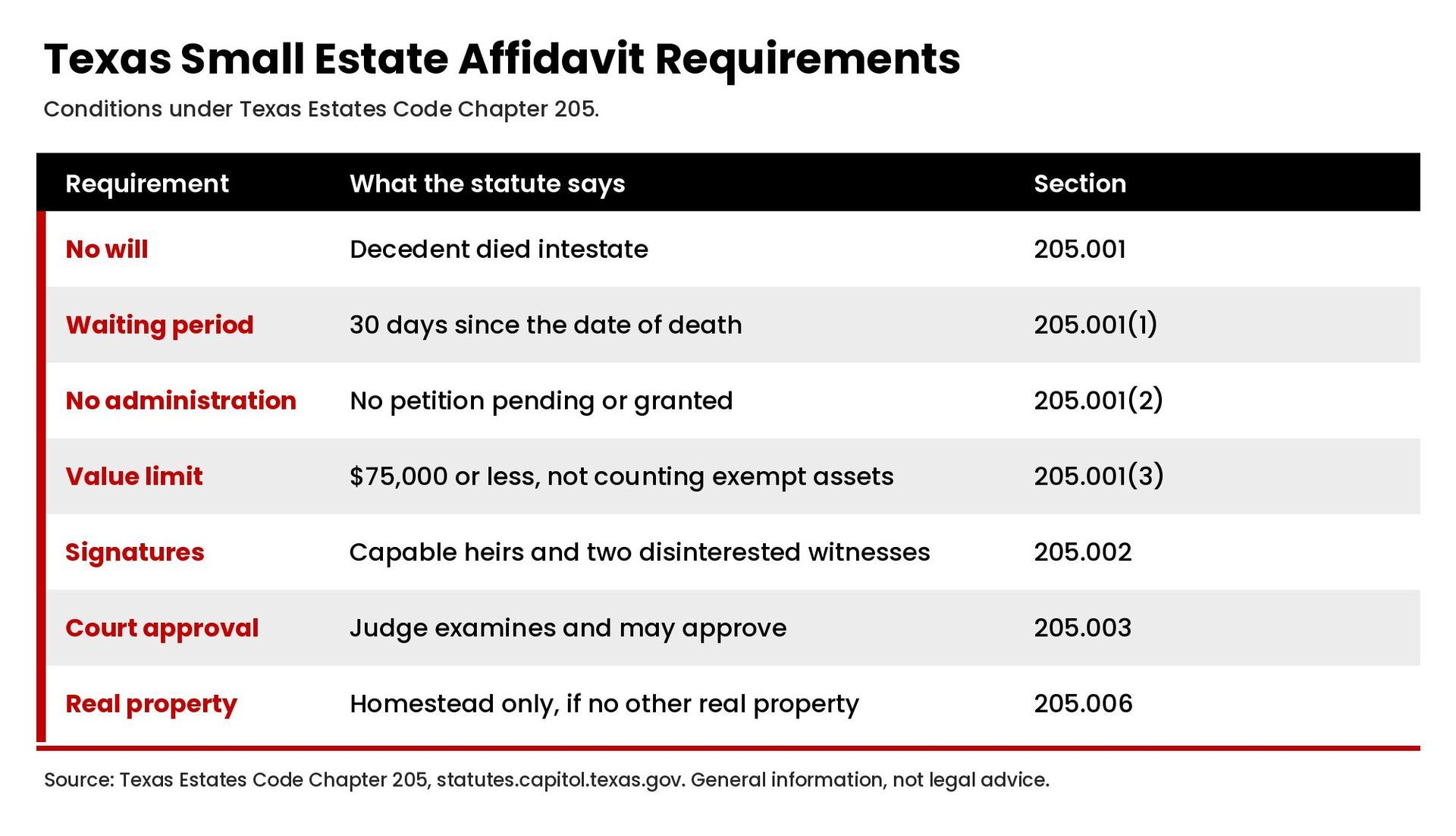
Section 205.001 sets out the conditions. A Texas small estate affidavit may be used only if all of the following are true:
- The decedent died intestate. The procedure applies only to intestate estates, meaning the decedent died without a valid will.
- At least 30 days have passed since the date of the decedent's death. This waiting period gives time for creditors and family members to come forward.
- No petition for the appointment of a personal representative is pending or has been granted. If someone has already opened an estate administration, the small estate affidavit is not available.
- The estate assets, excluding homestead and exempt property, do not exceed $75,000 on the date of the affidavit.
- The estate assets exceed the known liabilities , not counting debts secured by homestead and exempt property.
- The affidavit is filed with the clerk of the court that has jurisdiction and venue of the estate.
- The judge approves the affidavit.
- The distributees provide certified copies of the approved affidavit to the people who hold or owe estate property.
The $75,000 limit has applied since September 1, 2017, when the Legislature raised it from $50,000 (H.B. 2271, 85th Legislature). The Texas State Law Library summarizes the same requirements and notes that all the heirs must agree.
The estate must have no valid will
If the decedent died with a valid will, the small estate affidavit is not the right tool. Section 205.008 states that the chapter does not affect the disposition of property under a will or other testamentary document. Families with a valid will usually look at other options, such as probate of the will as a muniment of title or an independent administration. A lawyer can help identify which probate procedure fits.
Understanding the $75,000 limit
The value test looks at the estate assets on the date of the affidavit, not on the date of death. Homestead and exempt property are left out of the calculation. Non-probate property also does not count, because it passes outside the estate. Non-probate property can include:
- Payable on death (POD) or transfer on death (TOD) accounts
- Life insurance with a named beneficiary
- Retirement accounts with a named beneficiary
- Property held in a trust
- Joint accounts with a right of survivorship
Texas Law Help also notes that pension benefits, IRAs, and insurance benefits are generally treated as exempt, but that determining which property is exempt can be complicated ( TexasLawHelp.org).
Homestead, Exempt Property, and Real Property
Three categories of property create most of the confusion in small estate cases: the homestead, other exempt property, and real property.
Exempt property
Section 205.009 of the Texas Estates Code ties "homestead" and "exempt property" to the property that would be eligible to be set aside under Section 353.051 if the estate were being administered. That includes the homestead for the surviving spouse and minor children, and certain personal property listed in Texas Property Code Section 42.002(a) for the surviving spouse, minor children, unmarried adult children remaining with the family, and incapacitated adult children. Section 205.002(b) requires the list of estate assets to indicate which assets the applicant claims are exempt.
Homestead property
Homestead property that qualifies does not count toward the $75,000 limit. Under Section 205.006, if the decedent's homestead is the only real property in the estate, title to the homestead may be transferred under the small estate affidavit. The approved affidavit must be recorded in the deed records of the county where the homestead is located so it appears in the property records.
The Texas State Law Library and Texas Law Help both explain that this homestead transfer generally applies when the homestead passes to the surviving spouse or minor children. When other family members are the heirs, the court may require a different probate procedure.
Other real property
Except for a qualifying homestead, the small estate affidavit does not transfer title to real property (Section 205.008(b)). If the decedent owned land, a rental house, or other real property that is not a qualifying homestead, the family will likely need another legal process, such as a determination of heirship or an estate administration, to transfer real property.
What the Affidavit Must Include
Section 205.002 sets the statutory requirements for the affidavit itself. The small estate affidavit must:
- Be sworn to by two disinterested witnesses. These are people who know the family history but do not inherit from the estate.
- Be sworn to by each distributee who has legal capacity. Each adult heir signs.
- Include the natural guardian or next of kin of any minor distributee , or the guardian of any incapacitated distributee, if warranted by the facts.
- Show that the conditions in Section 205.001 exist , including the 30 days since the decedent's death, no pending petition, and the $75,000 limit.
- List all known estate assets and liabilities , marking which assets are claimed as exempt.
- Give the name and address of each distributee.
- State the relevant family history facts concerning heirship that show each distributee's right to receive estate property.
The family history section matters because the decedent's heirs are determined by Texas law, not by family preference. When someone dies intestate, Chapter 201 of the Texas Estates Code determines who inherits and in what shares, including how community property, separate property, and homestead property pass to a surviving spouse and children. The affidavit must describe marriages, children, and other relatives clearly enough for the judge to confirm who the heirs are.
How the Small Estate Affidavit Process Works
Each probate court has specific rules, and every county handles the details a little differently, but the general legal process looks like this.
- Confirm the estate qualifies. Gather a list of everything the decedent owned and owed, and identify what is homestead, exempt, or non-probate property.
- Find the right court. The affidavit must be filed in the court with jurisdiction and venue of the estate. Texas Law Help notes that this is usually the county where the decedent lived at the time of death.
- Get the court's small estate affidavit form. Many county courts publish their own small estate affidavit form and checklist. Use the form the court prefers, since some courts reject affidavits that do not follow local requirements.
- Collect signatures. Each distributee with legal capacity and two disinterested witnesses sign under oath, usually before a notary or the clerk.
- File the affidavit and pay the filing fee. Texas Law Help reports that a filing fee applies in every Texas county. Check with the county clerk for the current amount.
- Wait for court approval. Once the court approves the affidavit, the heirs may act on it. Under Section 205.003, the judge examines the affidavit and may approve it if it conforms to the requirements of the chapter. Some courts decide on the papers; others set a hearing.
- Distribute certified copies. Under Section 205.004, the distributees must give a copy certified by the court clerk to each person who owes money to the estate, holds estate property, or acts as a registrar or transfer agent for estate assets.
- Record the affidavit if a homestead is involved. File the approved affidavit in the county deed records to transfer title to the homestead.
Once approved, the affidavit is kept as a local government record or recorded in the clerk's small estates records (Section 205.005).
Protection and Responsibility Under the Affidavit
Section 205.007 explains why banks and other financial institutions are willing to rely on an approved affidavit. A person who pays or transfers property under the affidavit is released to the same extent as if the payment were made to a personal representative, and is not required to investigate the truth of the statements in it.
That protection shifts responsibility to the people who sign. Each person who executed the affidavit is liable for damage or loss that arises from a payment or transfer made in reliance on it. The distributees also remain answerable to anyone with a prior right and accountable to any personal representative appointed later. Accuracy matters: leaving out an heir or a debt can create personal liability.
If a bank or other holder refuses to honor an approved affidavit, Section 205.007(d) allows the distributees to bring an action to recover the property on proof of the facts required in the affidavit.
When a Different Probate Procedure May Fit Better
A small estate affidavit is useful, but it is not the right fit for every estate. In many probate cases, a formal administration is required. A different probate procedure is often needed when:
- The decedent left a valid will.
- The estate value, excluding homestead and exempt property, is more than $75,000.
- Debts exceed the assets.
- The decedent owned real property other than a qualifying homestead.
- The heirs disagree, or an heir cannot be located.
- A minor or incapacitated heir is involved and the court will not approve the affidavit. Texas Law Help notes that some courts will not approve an affidavit if any heirs are minors.
- Someone needs legal authority to manage the estate, sell property, or deal with creditors over time.
Common alternatives in Texas probate, often handled through the probate court in the county where the decedent lived, include probate of a will as a muniment of title, an independent administration, a dependent administration, and an application to determine heirship. Each has its own requirements, costs, and timeline, and a full probate administration is sometimes the most protective option for a family.
Planning Ahead to Avoid These Questions
Many of the problems small estate cases solve can be avoided with planning. A current will, beneficiary designations, payable on death accounts, and tools such as a revocable living trust can reduce the probate property a family has to deal with later. Life changes such as marriage, divorce, or a new child are good moments to update an estate plan. Our estate planning page explains the planning services Masterly Legal Solutions offers.
Frequently Asked Questions
Do I need an attorney for a small estate affidavit in Texas?
Texas does not require an attorney to prepare a small estate affidavit, and many county courts publish forms for self-represented families. However, a court can reject an affidavit that does not meet the statutory requirements, and the filing fee may not be refunded. A lawyer can review whether the estate qualifies and whether the affidavit is complete.
Can you file a small estate affidavit without a lawyer?
Yes. Families can file a small estate affidavit without a lawyer by using the county's form, gathering the required signatures, and filing with the court clerk. Because local requirements vary, it helps to call the clerk first and read the court's checklist.
How long does a small estate affidavit take in Texas?
The affidavit cannot be filed until at least 30 days after the decedent's death. After filing, timing depends on the county, the court's docket, and whether a hearing is required. No timeline is guaranteed.
How much does a small estate affidavit cost in Texas?
The main cost is the court filing fee, which varies by county, plus the cost of certified copies and any recording fees for a homestead. Texas Law Help describes the typical filing fee as a few hundred dollars. Check with the county clerk for current fees.
Can a small estate affidavit transfer a house?
Only in limited cases. Under Section 205.006, it can transfer title to the decedent's homestead if the homestead is the only real property in the estate, and the affidavit must be recorded in the county deed records. It does not transfer title to other real property.
Talk With a Lawyer About Your Situation
Every estate is different, and the right probate procedure depends on the decedent's property, debts, and family. If you are unsure whether an estate qualifies for a small estate affidavit, or if the family has questions about heirship, exempt property, or a homestead, contact Masterly Legal Solutions to request a consultation. This article provides general information about Texas law and is not legal advice. Reading it does not create an attorney-client relationship, and no particular result is promised.
Andrew Rhoden, Esq. is a lawyer with Masterly Legal Solutions, 3838 Oak Lawn Avenue, Suite 1000, Dallas, Texas 75219, licensed in Texas, North Carolina, and the District of Columbia.







Looking for Legal & Business Solutions? Contact Us Now
Fill in the form or call us to set up a meeting