

Temporary Managing Conservatorship in Texas: What Parents Should Know
When parents separate, or when a family faces a sudden crisis, someone has to make decisions for a child while the case is still pending. In Texas, that interim authority is often set out in a temporary managing conservatorship order. Temporary orders can decide where a child primarily lives, who makes medical and education decisions, and who pays temporary support, sometimes for many months before a final order is signed.
This guide explains what temporary managing conservatorship means under Texas law, how Texas courts decide temporary orders, the difference between sole managing conservatorship and joint managing conservatorship, how temporary orders work when the Texas Department of Family and Protective Services is involved, and what parents should understand before a temporary orders hearing. It is general information, not legal advice about any specific family.

What Is Temporary Managing Conservatorship?
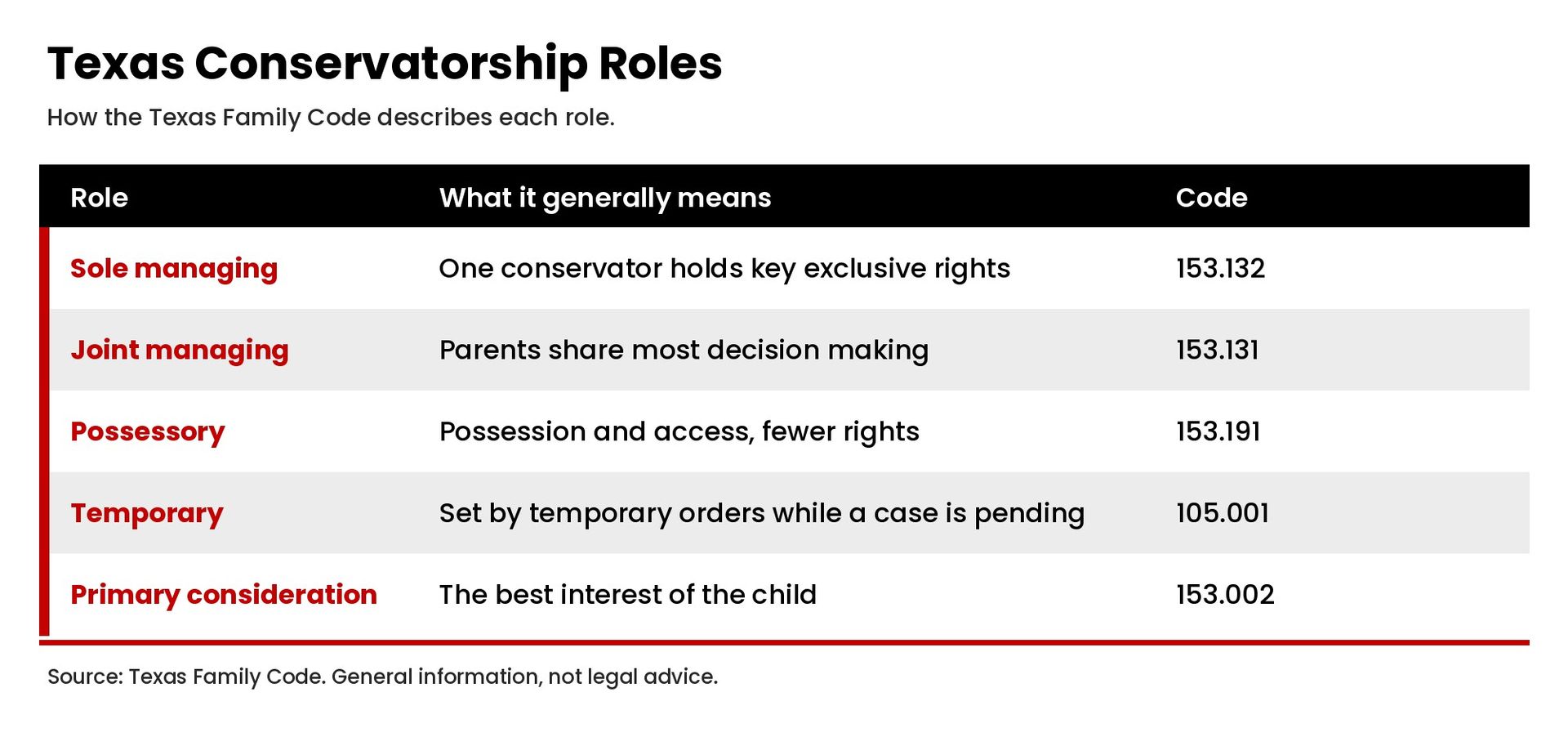
Many people search for information about child custody or legal custody, but Texas law does not use the word "custody" in its statutes. Instead, the Texas Family Code uses the term conservatorship. A managing conservator has legal authority to make major decisions for a child. A possessory conservator generally has the right to possession of and access to the child, often under a visitation schedule, but fewer decision making rights.
A temporary managing conservatorship is an appointment that lasts while a case is pending. Under Texas Family Code Section 105.001, in a suit affecting the parent child relationship (often called a SAPCR), the court may make a temporary order for the safety and welfare of the child, including an order:
- for the temporary conservatorship of the child;
- for the temporary support of the child;
- restraining a party from disturbing the peace of the child or another party;
- prohibiting a person from removing the child beyond a geographical area identified by the court; or
- for payment of reasonable attorney's fees and expenses.
In plain terms, a temporary court order creates a working arrangement covering where the child lives, how custody decisions are made, and who pays support for the family until the court enters final Texas conservatorship orders, or until the parties reach an agreement the court approves.
Who Can Be Appointed Temporary Managing Conservator?
Under Texas Family Code Section 153.005, a managing conservator must be a parent, a competent adult, the Texas Department of Family and Protective Services, or a licensed child placing agency. The court may appoint a sole managing conservator or joint managing conservators, and if the parents are or will be separated, the court must appoint at least one managing conservator.
In most family law cases, the temporary managing conservators are the parents, and the parent appointed managing conservator with the right to designate the child's residence is often informally called the primary parent. In other cases, a grandparent or other relative may ask to be named temporary managing conservator, and in child protection cases the Department may be appointed.
The Best Interest of the Child Standard
The child's best interest is the court's primary consideration. Texas Family Code Section 153.002 states that the best interest of the child shall always be the primary consideration of the court in determining the issues of conservatorship and possession of and access to the child. That standard applies to temporary orders as well as final orders.
When the court weighs a child's best interest, Texas courts apply a broad standard and often look to the factors in Holley v. Adams, 544 S.W.2d 367 (Tex. 1976), when evaluating a child's best interest. These factors include:
- the child's desires;
- the child's present and future emotional and physical needs;
- any emotional and physical danger to the child now and in the future;
- the parenting abilities of the individuals seeking custody;
- the programs available to assist those individuals;
- the plans for the child by those individuals;
- the stability of the home or proposed placement;
- acts or omissions of a parent that may indicate the existing relationship is not a proper one; and
- any excuse for those acts or omissions.
TexasLawHelp.org notes that in determining best interest, the court will look at anything that may have an influence on the child's life. Evidence about the child's safety, family violence, the child's education, the child's physical health, and the child's emotional development is usually central.
Parental Presumption and Joint Managing Conservatorship
Texas law starts with presumptions in favor of parents.
Parental presumption. Under Texas Family Code Section 153.131(a), a parent shall be appointed sole managing conservator, or both parents shall be appointed joint managing conservators, unless the court finds that appointing the parent would not be in the child's best interest because it would significantly impair the child's physical health or emotional development.
Joint managing conservatorship presumption. Section 153.131(b) creates a rebuttable presumption that appointing the parents as joint managing conservators is in the child's best interest. A finding of a history of family violence involving the parents removes that presumption. These presumptions protect parental rights, but they can be overcome by evidence.
Joint managing conservatorship means the parents share decision making about most issues. It does not mean the child's time is split equally. In most joint conservatorship orders, one parent is given the exclusive right to designate the child's primary residence, and the other parent has possession under a schedule and may be ordered to pay child support. Most joint managing conservatorship orders also allocate specific rights, such as decisions about the child's education or medical care, to one parent or both.
Sole Managing Conservatorship
Sole managing conservatorship gives one person the exclusive right to make many major decisions for the child. Under Texas Family Code Section 153.132, unless limited by court order, a parent appointed sole managing conservator has exclusive rights that include:
- designating the child's primary residence;
- consenting to invasive medical, dental, and surgical treatment;
- consenting to psychiatric treatment and psychological treatment;
- receiving child support payments for the child;
- representing the child in legal action;
- making decisions concerning the child's education; and
- applying for, renewing, and maintaining possession of the child's passport.
Some parents describe sole managing conservatorship as "full custody," though Texas law does not use that term. A sole managing conservatorship order does not automatically end the other parent's relationship with the child. Under Section 153.191, a parent who is not appointed a managing conservator is generally appointed a possessory conservator unless the court finds that would not be in the child's best interest and that parental possession or access would endanger the child's physical or emotional welfare.
When sole conservatorship may be considered
Sole conservatorship cases often involve safety concerns such as family violence, substance abuse, neglect, a parent's long absence from the child's life, or a parent's inability to cooperate on major decisions. Under Section 153.004(b), the court may not appoint joint managing conservators if credible evidence is presented of a history or pattern of past or present child neglect, or physical or sexual abuse by one parent directed against the other parent, a spouse, or a child. The court considers whether a joint conservatorship would significantly impair the child's physical health or emotional development, and decides each child's case based on the evidence presented.
How Temporary Orders Work in a Custody Case
Each county and court may have its own procedures, but a typical custody case moves through these steps:
- Filing the petition. A party files a suit affecting the parent child relationship, or a divorce that includes children, and may ask for temporary orders.
- Temporary restraining order. In some cases the court issues a temporary restraining order at the start of the case to preserve the status quo until a hearing.
- Temporary orders hearing. Under Section 105.001(b), orders for temporary conservatorship, temporary support, or attorney's fees generally may be rendered only after notice and a hearing. Some courts require mediation first.
- Temporary orders. The court appoints temporary managing conservators, sets the child's primary residence, establishes a possession schedule, and may order temporary support.
- Discovery, mediation, and final hearing. The case proceeds toward agreement or a final hearing or trial, and the court enters a final order. The court can reach different conclusions about joint conservatorship or sole managing conservatorship at that stage.
Several points about temporary orders are important. Temporary orders are not subject to interlocutory appeal (Section 105.001(e)). Violating a temporary order is punishable by contempt (Section 105.001(f)). And although temporary orders are not final, the arrangement in place while the case is pending can shape the child's routine for a long time. Preparing carefully for the temporary orders hearing matters.
Attorney ad litem and other appointments
In some custody cases the court may appoint an attorney ad litem to represent the child, an amicus attorney to assist the court, or order a social study. These appointments vary by case and by court.
Temporary Managing Conservatorship in Child Protection Cases
The phrase temporary managing conservatorship is also used in cases brought by child protective services. When the Texas Department of Family and Protective Services files a suit and takes possession of a child in an emergency, the court may appoint the Department as temporary managing conservator.
Key timelines in these cases are set by statute:
- Full adversary hearing. Under Texas Family Code Section 262.201, a full adversary hearing must be held not later than the 14th day after the child was taken into possession, unless the court grants a permitted extension.
- Right to counsel. Before that hearing, the court must inform each unrepresented parent of the right to an attorney and, if the parent is indigent and opposes the suit, the right to a court appointed attorney.
- One year dismissal date. Under Section 263.401, unless trial has begun or an extension is granted, the court's jurisdiction over the Department's suit terminates on the first Monday after the first anniversary of the temporary order appointing the Department as temporary managing conservator. The court may extend the case for up to 180 days only if it finds extraordinary circumstances and that continuing the appointment is in the child's best interest.
These cases move quickly, and the stakes for parental rights are high. For more on how these cases affect families, see our article on how CPS decisions impact custody, visitation, and family autonomy.
Preparing for a Temporary Orders Hearing
Parents who understand the process are better prepared to present their side clearly. Practical steps include:
- Gather records. School records, medical records, and documents showing who handles the child's daily care can help the court understand the child's life.
- Show stability. Evidence of where the child lives, a stable home, routine, and plan for the child's residence and schooling is often relevant.
- Focus on the child. Keep the focus on the child's best interest rather than on conflict with the other parent.
- Follow existing orders. Comply with any temporary restraining order and pay any temporary support ordered.
- Be careful with communication. Texts, emails, and social media posts can become evidence.
Frequently Asked Questions
What is the difference between temporary and final managing conservatorship?
A temporary managing conservatorship lasts while the case is pending and is set by temporary orders. A final order is entered at the end of the case after agreement or trial. The court can make a different decision in the final order.
Can permanent managing conservatorship be reversed in Texas?
A final conservatorship order can be modified, but only under the standards in Texas Family Code Section 156.101. Generally, the modification must be in the child's best interest and the circumstances of the child, a conservator, or another affected party must have materially and substantially changed since the order was rendered, or another statutory ground must apply.
What not to say during a custody battle?
Parents should avoid statements that disparage the other parent in front of the child, threats, and social media posts about the case. Anything said in texts, emails, or online may be offered as evidence. Talk with a lawyer before discussing the case with anyone other than your attorney.
Does joint managing conservatorship mean equal time?
No. Joint managing conservatorship concerns shared decision making. Possession schedules are set separately, and one parent usually has the right to designate the child's primary residence.
Does a temporary order affect child support?
Yes, it can. Section 105.001 allows the court to order temporary support of the child while the case is pending. The amount is usually based on the Texas child support guidelines.
Talk With a Lawyer About Your Family's Situation
Every family is different, and temporary orders can shape a child's life for months. A family law office can review the facts, the child's physical health and safety needs, and the options available. If you have questions about temporary managing conservatorship, sole managing conservatorship, or a pending custody case, contact Masterly Legal Solutions to request a consultation, or review our legal services. This article provides general information about Texas law and is not legal advice. Reading it does not create an attorney-client relationship, and no particular result is promised.
Andrew Rhoden, Esq. is a lawyer with Masterly Legal Solutions, 3838 Oak Lawn Avenue, Suite 1000, Dallas, Texas 75219, licensed in Texas, North Carolina, and the District of Columbia.







Looking for Legal & Business Solutions? Contact Us Now
Fill in the form or call us to set up a meeting