

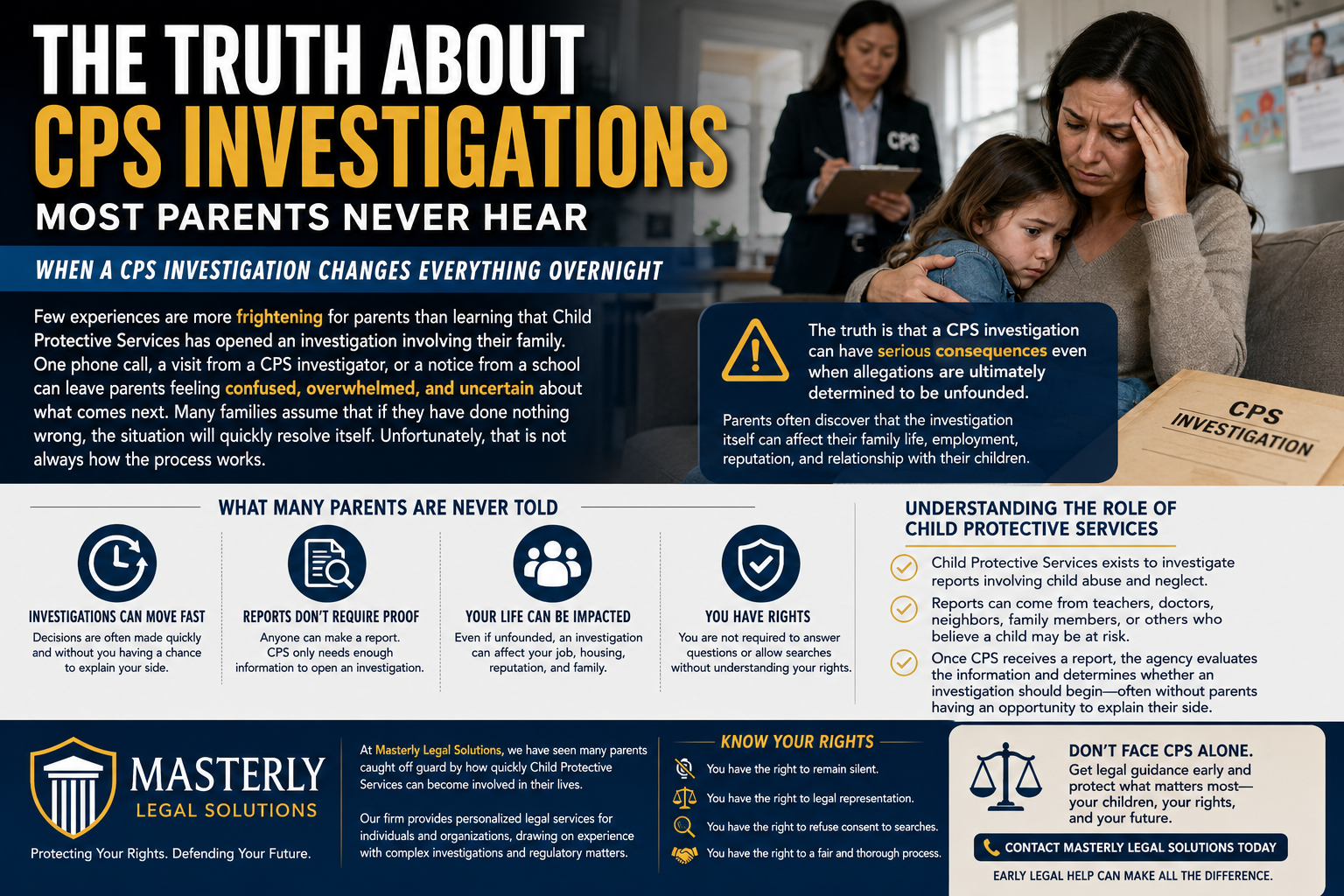
The Truth About CPS Investigations Most Parents Never Hear
When a CPS Investigation Changes Everything Overnight
Few experiences are more frightening for parents than learning that Child Protective Services has opened an investigation involving their family. One phone call, a visit from a CPS investigator, or a notice from a school can leave parents feeling confused, overwhelmed, and uncertain about what comes next. Many families assume that if they have done nothing wrong, the situation will quickly resolve itself. Unfortunately, that is not always how the process works.
The truth is that a CPS investigation can have serious consequences even when allegations are ultimately determined to be unfounded. Parents often discover that the investigation itself can affect their family life, employment, reputation, and relationship with their children. Understanding your rights and obligations is essential from the very beginning.
At Masterly Legal Solutions, we have seen many parents caught off guard by how quickly Child Protective Services CPS can become involved in their lives. Our firm provides personalized legal services for individuals and organizations, drawing on experience with complex investigations and regulatory matters. The information below discusses what many parents are never told about CPS investigations, how these cases develop, and why obtaining legal assistance early can make a significant difference.
Understanding the Role of Child Protective Services
Child Protective Services exists to investigate reports involving child abuse and neglect. The agency is tasked with helping protect children who may be at risk of harm. While this mission is important, the process can become complicated when reports are based on misunderstandings, incomplete facts, or false allegations.
Many parents assume CPS only becomes involved in extreme situations. In reality, CPS receives reports concerning a wide range of issues. A report may come from a teacher, doctor, neighbor, family member, or another individual who believes a child may be in danger.
Once CPS receives a report, the agency evaluates the information and determines whether an investigation should begin. This initial decision often occurs without the parents having an opportunity to explain their side of the story.
The Reality Behind CPS Investigates Reports
One fact many parents never hear is that CPS investigates reports, not proven facts. The existence of an investigation does not mean that abuse occurred. It simply means someone made allegations that triggered agency involvement.
Unfortunately, many parents assume investigators have already concluded that wrongdoing occurred. This misunderstanding can create panic and lead families to make decisions that harm their position later.
The purpose of an investigation is to gather information. During this stage, CPS workers attempt to determine whether there is evidence supporting claims of abuse or neglect. Investigators may interview children, parents, relatives, teachers, medical professionals, and others connected to the family.
Because these interviews can significantly impact the outcome of a case, it is important for parents to understand the legal processes involved before speaking extensively with investigators.
Why Innocent Families Become the Subject of Investigations
One of the most surprising truths about CPS is that many investigations involve families who never expected agency involvement.
Parents may become the subject of an investigation due to:
- Custody disputes between parents
- Misunderstandings involving medical treatment
- Reports made by disgruntled family members
- School concerns regarding a child's behavior
- Anonymous allegations
- Accidental injuries mistaken for abuse
- Conflicts during divorce proceedings
In some situations, a report may be entirely false. In others, the reporting party may genuinely believe a child is at risk despite lacking complete information.
Regardless of the circumstances, CPS typically treats every report seriously until evidence proves otherwise.
The First Contact With a CPS Caseworker
The first interaction with a CPS caseworker often determines the direction of the investigation. Many parents feel pressured to answer questions immediately because they believe refusing cooperation will make them appear guilty.
While cooperation is important, parents should also understand that they have rights. Statements made during initial conversations can become part of the agency record and may later influence CPS findings.
A CPS caseworker may request interviews, documents, photographs, or access to the home. Parents should approach these requests carefully and seek guidance from an experienced attorney whenever possible.
Understanding your rights before providing information can help avoid unnecessary complications.
Home Visits Are More Important Than Many Parents Realize
Home visits are a common part of many CPS cases. During these visits, CPS workers evaluate living conditions and look for signs that children may be unsafe.
Many parents assume investigators are only checking for cleanliness. In reality, home visits may involve observations regarding supervision, sleeping arrangements, food availability, medication storage, and interactions between family members.
Even minor issues can sometimes be misinterpreted when viewed without proper context. Parents should understand what investigators are looking for and how observations may be documented.
A single home visit can become an important factor in determining whether further action will occur.
What Happens During Interviews With Children
Parents are often surprised to learn that CPS may interview children separately from adults. Investigators frequently speak with children at school or another location without extensive advance notice to parents.
The goal is to obtain information directly from the child without outside influence. However, children may misunderstand questions or provide incomplete responses that create confusion.
Young children especially may have difficulty understanding timelines, events, or complex situations. Statements that appear concerning on paper may not accurately reflect what actually occurred.
These realities make it important for parents facing allegations to obtain legal representation as early as possible.
The Difference Between Allegations and Evidence
One of the most important truths about CPS investigations is that allegations are not evidence.
Unfortunately, many parents feel as though they must prove their innocence from the beginning. In reality, investigators should gather relevant information before reaching conclusions.
Evidence may include:
- Medical records
- School records
- Witness statements
- Photographs
- Expert evaluations
- Police reports
- Documentation from social services
The existence of allegations alone should not determine the outcome of a case. However, parents often discover that early misunderstandings can influence how investigators interpret later information.
When Medical Professionals Become Involved
Medical professionals frequently play a major role in CPS cases. Doctors, nurses, and hospitals are mandatory reporters who must report suspected child abuse when concerns arise.
In some situations, medical providers may observe injuries they believe are inconsistent with explanations provided by parents. This can trigger an investigation even when injuries resulted from accidents.
Medical records often become central evidence during investigations. Understanding how these records are interpreted can be critical when responding to allegations.
Parents should never assume that a medical misunderstanding will automatically resolve itself without legal guidance.
School Reports Can Trigger Investigations
Schools often serve as a major source of reports to Child Protective Services.
Teachers, counselors, administrators, and school personnel are generally required to report suspected child abuse or neglect. A report may arise from statements made by a child, unexplained injuries, attendance concerns, behavioral issues, or observations regarding family circumstances.
Many parents are shocked to learn that comments made by a child at school can trigger an investigation. Children may describe situations inaccurately or omit important details.
Once a report is made, CPS generally proceeds with its own investigation regardless of whether the reporting individual had complete information.
The Relationship Between CPS and Police
Parents frequently ask whether CPS and police work together. The answer is often yes.
Certain allegations involving abuse or neglect may trigger both a CPS investigation and a criminal investigation. In those circumstances, information gathered by one agency may influence the other.
This creates significant legal concerns. Statements made to a CPS investigator could potentially impact criminal proceedings. Likewise, statements made to police may affect CPS findings.
Families facing allegations involving both agencies should seek immediate legal assistance from an attorney familiar with these complex situations.
Criminal Prosecution Is Not Required for CPS Action
Many parents assume that CPS cannot act unless criminal charges are filed. This is not true.
Child Protective Services operates under different standards than criminal courts. Even if criminal prosecution never occurs, CPS may still take action based on its own findings.
This distinction surprises many families. A parent may avoid criminal charges yet still face challenges involving custody, visitation, or agency intervention.
Understanding the difference between criminal law and CPS proceedings is critical when developing a defense strategy.
The Impact of CPS Findings on Your Future
Many parents focus only on getting through the immediate investigation. However, CPS findings can have long-term consequences.
Depending on the circumstances, findings may affect:
- Employment opportunities
- Professional licenses
- Child custody disputes
- Foster care decisions
- Future CPS investigations
- Family court proceedings
Some findings can remain part of agency records for extended periods. This is why challenging inaccurate findings is often essential.
Parents should never assume that a case ending without removal of children means there are no lasting consequences.
How Child Custody Issues Become Complicated
A CPS investigation can significantly affect child custody matters.
Family courts often consider CPS involvement when evaluating the best interests of children. Even unresolved allegations may become a topic during custody hearings.
In contentious divorce cases, allegations sometimes emerge during disputes over custody. While some concerns may be legitimate, others may stem from conflict between parents.
An experienced attorney can help ensure that custody decisions are based on evidence rather than assumptions or unsupported claims.
When CPS Requests a Safety Plan
One aspect of investigations that surprises many parents is the request for a safety plan.
A safety plan may require certain actions, such as limiting contact between specific individuals and children, attending services, or allowing temporary placement with family members.
Many parents believe signing a safety plan is mandatory. In reality, these agreements can have significant legal implications and should be carefully reviewed.
Before agreeing to any plan, parents should fully understand their rights and obligations.
Understanding Foster Care Placement Decisions
In some cases, CPS may seek removal of children from the home. When this occurs, placement decisions become a central issue.
The agency generally seeks arrangements that protect children while maintaining stability whenever possible. Family members are often considered before placement with unrelated foster care providers.
However, removal decisions are serious and can dramatically affect a family. Parents should understand that removal does not automatically mean permanent loss of parental rights.
Prompt legal representation is often critical when removal proceedings begin.
What Many Parents Do Wrong During an Investigation
Fear often causes parents to make mistakes that complicate their cases.
Common mistakes include:
- Arguing with investigators
- Providing inaccurate information
- Destroying records or evidence
- Posting details online
- Ignoring requests from CPS
- Signing documents without understanding them
- Failing to consult an attorney
While emotions are understandable, strategic decisions are usually more effective than emotional reactions.
A calm and informed approach often produces better outcomes.
Administrative Hearings and Appeals
Not every CPS decision is final.
In some situations, parents may challenge CPS findings through administrative hearings. These proceedings provide opportunities to dispute conclusions and present evidence.
Administrative hearings can involve detailed legal processes. Success often depends on preparation, documentation, witness testimony, and understanding procedural requirements.
Parents should not assume unfavorable findings cannot be challenged.
Why Written Records Matter
Documentation can become one of the strongest tools available to families.
Keeping records may help establish timelines, preserve communications, and provide context for disputed events.
Useful records may include:
- Medical records
- School communications
- Text messages
- Emails
- Photographs
- Calendars
- Witness information
When disputes arise regarding what occurred, documentation often becomes highly valuable.
How Family Members Influence CPS Cases
Family members can play a major role in investigations.
Relatives may provide information, offer temporary placements, or serve as witnesses. In some situations, family members may support parents. In others, they may contribute to allegations.
Because family dynamics are often complex, parents should approach these situations carefully.
Statements from relatives can significantly affect agency decisions and court proceedings.
The Importance of Responding to a Written Request
Throughout an investigation, parents may receive a written request for information, records, or participation in services. Knowing how to contact Masterly Legal Solutions’ Texas offices can make it easier to get timely guidance when these requests arrive.
Ignoring these requests can create additional complications. However, responding without understanding legal implications can also be risky.
An attorney can review requests, determine what information is relevant, and help ensure responses protect the family's interests.
Every communication should be approached thoughtfully.
CPS Requirements Are Not Always Simple
Many families assume CPS requirements are straightforward. Unfortunately, the process can be confusing.
Requirements may involve evaluations, counseling, parenting classes, home assessments, drug testing, or other services. Parents often struggle to understand what is mandatory versus recommended.
Misunderstanding expectations can lead to additional allegations of noncompliance.
Legal guidance can help families navigate these obligations more effectively.
How Juvenile Court Proceedings Work
When CPS seeks court involvement, cases often proceed through juvenile court.
These proceedings can address issues involving custody, placement, services, and parental rights. Judges review evidence and determine appropriate actions based on applicable law.
Court hearings may occur over an extended period. Multiple appearances and ongoing compliance requirements are common.
Having legal representation during these proceedings can help ensure parents understand their rights and options.
Facing Allegations Does Not Mean Losing Your Rights
Perhaps the most important truth parents never hear is that facing allegations does not mean losing parental rights.
Parents maintain important legal protections throughout the investigation process. While CPS has significant authority, that authority is not unlimited.
Understanding these rights can help families make informed decisions rather than reacting out of fear.
Early intervention often provides the greatest opportunity to protect both parents and children.
Why a CPS Defense Attorney Can Make a Difference
A CPS defense attorney provides more than courtroom representation. Legal counsel can help families understand the investigation, communicate effectively, review evidence, and develop strategies for protecting their interests.
The earlier an attorney becomes involved, the greater the opportunity to address misunderstandings before they escalate.
Many parents wait until court proceedings begin before seeking help. By then, important decisions may already have been made. Educators in particular benefit from education law counsel that understands TEA investigations and school proceedings before issues escalate.
Working with a knowledgeable lawyer early can often place families in a stronger position.
The Value of Experienced Legal Representation
Every CPS case involves unique circumstances. What works in one situation may not work in another.
An experienced attorney understands how CPS investigations unfold, how evidence is evaluated, and how to navigate legal matters involving families and children.
Legal representation can help parents respond effectively to allegations, challenge inaccurate information, and protect their rights throughout the process.
When the future of your family is at stake, informed guidance can make a meaningful difference.
Protecting Your Family Starts With Understanding the Process
The truth about CPS investigations is that they are often far more complicated than most parents realize. Child Protective Services has an important responsibility to protect children, but investigations can also place tremendous pressure on families who are trying to navigate unfamiliar legal processes.
Understanding how investigations work, recognizing potential risks, and obtaining timely legal assistance can help parents protect their interests and make informed decisions. Law firms that routinely handle independent internal investigations and compliance-focused probes bring additional perspective on evidence gathering and documentation that can be valuable in CPS-related matters. Whether allegations involve suspected child abuse, child neglect, abuse or neglect concerns, custody disputes, or misunderstandings, every decision made during the investigation can affect the outcome.
Families should never assume that the process will simply work itself out. Taking proactive steps, gathering relevant information, and consulting an attorney can help ensure that their side of the story is properly heard.
How Child Support and Court Orders Can Affect CPS Cases
Many parents are surprised to learn that issues involving child support and existing court orders can become relevant during a CPS investigation. While Child Protective Services primarily focuses on the safety and well-being of children, investigators often review family circumstances that may affect a child's living environment. Existing custody arrangements, visitation schedules, and court orders may be examined to better understand the family's situation.
In some cases, disputes regarding child support or custody can contribute to allegations being reported to CPS. Parents should ensure they comply with all applicable court orders while an investigation is ongoing. Families who have already worked with an estate planning attorney to organize wills, trusts, and related documents often find it easier to demonstrate stability and clear intentions regarding their children. Failure to follow a court order could create additional legal complications that may impact custody or other family law matters.
The Role of the Texas Department and the Importance of Legal Expertise
Child Protective Services operates under the authority of the Texas Department responsible for investigating reports involving child abuse and neglect. Because these cases involve detailed procedures, regulations, and legal requirements, many parents find the process more complex than expected. Understanding how the agency operates can be challenging without professional guidance.
When CPS becomes involved, the well-being of your kids is often at the center of every decision being made. An attorney with substantial expertise in CPS matters can help families navigate investigations, hearings, and communications with the agency. For educators or school personnel, working with an education lawyer experienced in teacher defense and school investigations can be especially important when CPS concerns overlap with employment or licensure issues. Whether meeting with investigators in their office or responding to requests for information, experienced legal counsel can help parents make informed decisions and protect their rights throughout the process.
Why Choosing the Right Law Office Matters in a CPS Case
When Child Protective Services becomes involved with your family, selecting the right law office can be one of the most important decisions you make. Many families also need guidance with trust-based estate planning to protect assets and provide for children’s futures, which can intersect with CPS concerns about long-term stability. CPS investigations often involve strict deadlines, complex legal processes, and decisions that can affect parental rights, child custody, and the future of your family. Without proper guidance, parents may unknowingly make statements or decisions that negatively impact their case.
A law office experienced in CPS matters can help families understand their rights, respond appropriately to allegations, and navigate interactions with CPS workers and investigators. Legal counsel can also assist with preparing for hearings, gathering relevant information, and challenging inaccurate CPS findings when necessary. Having skilled legal representation allows parents to focus on protecting their children while ensuring their interests are properly defended throughout the investigation and any related court proceedings.
Why Working With an Experienced Law Firm Can Be Critical
A CPS investigation can quickly become overwhelming, especially when parents are unfamiliar with the legal system. Working with an experienced law firm can provide valuable guidance during every stage of the process. Attorneys can explain legal requirements, communicate with investigators, review evidence, and help families understand the potential consequences of various decisions.
An established law firm can also assist with court proceedings, administrative hearings, and disputes involving custody or parental rights. In addition, many families turn to the same firm for essential legal documents such as wills, trusts, and powers of attorney that protect children and clarify decision-making authority outside of CPS proceedings. Having experienced legal representation often allows families to approach the situation with greater confidence and a clearer understanding of their options. Early intervention by legal counsel can frequently make a significant difference in the outcome of a case.
What Happens After CPS Receives a Report of Abuse or Neglect
Many parents are unaware of what occurs after CPS receives a report involving alleged abuse or neglect. Once the report is submitted, the agency conducts an initial assessment to determine whether the allegations warrant an investigation. Depending on the nature of the concerns, a CPS investigator may contact parents, conduct interviews, review records, or perform home visits.
Not every report results in findings against a parent, but every allegation should be taken seriously. When CPS receives information suggesting possible abuse or neglect, investigators are required to gather facts and evaluate the safety of the children involved. Understanding this process and seeking legal guidance early can help families respond effectively while protecting their rights and interests throughout the investigation.
Speak With a CPS Lawyer San Antonio Families Can Trust
When Child Protective Services becomes involved in your life, uncertainty can quickly turn into fear. Questions about parental rights, custody, investigations, hearings, CPS findings, and potential court proceedings can leave parents feeling overwhelmed and unsure where to turn.
At Masterly Legal Solutions, our law firm understands how stressful CPS cases can be for parents and family members. Whether you are dealing with allegations of child abuse, alleged abuse, child neglect, abuse and neglect concerns, home visits, administrative hearings, or a juvenile court matter, our team is prepared to provide the legal assistance and representation you need. We also assist educators by defending against educator misconduct investigations and protecting teaching licenses when CPS or school-based allegations threaten their careers. For many parents, planning ahead with powers of attorney for children’s healthcare and decision-making can further safeguard their family’s stability during and after an investigation. A CPS lawyer San Antonio families trust can help explain your options, evaluate your circumstances, and develop a strategy designed to protect your family and your future.
If you have questions about a CPS investigation, CPS caseworker communications, foster care concerns, child custody issues, or any related legal matters, contact Masterly Legal Solutions today at (972) 236-5051 for a free initial consultation. We will take the time to listen, answer your questions, and help you understand the next steps available to you. The sooner you consult with an attorney, the sooner you can begin protecting what matters most.
Disclaimer: This article is provided for educational and informational purposes only. It does not constitute legal advice and should not be relied upon as legal guidance. Every CPS case involves unique facts and circumstances. Reading this article does not create an attorney-client relationship with Masterly Legal Solutions. If you need legal advice regarding Child Protective Services, parental rights, child custody, or any related matter, you should consult directly with a qualified attorney regarding your specific situation.




Looking for Legal & Business Solutions? Contact Us Now
Fill in the form or call us to set up a meeting





