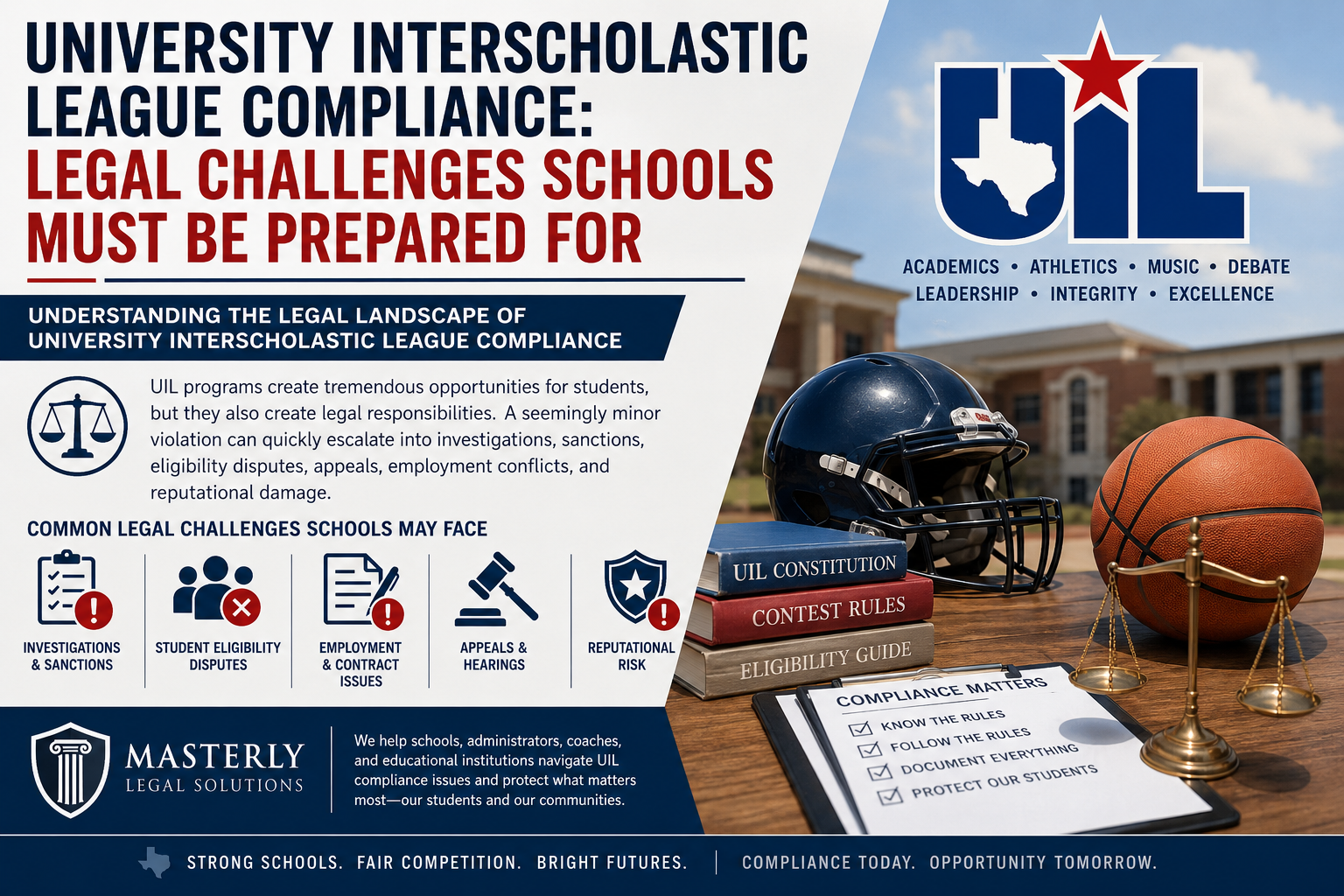
University Interscholastic League Compliance: Legal Challenges Schools Must Be Prepared For
Understanding the Legal Landscape of University Interscholastic League Compliance
Across Texas, extracurricular activities play a major role in shaping the educational experience of students. From athletics and UIL academics to music contests and public school debate programs, these opportunities help students develop leadership skills, teamwork, discipline, and academic achievement. The University Interscholastic League (UIL) has long served as the governing authority for many of these activities, establishing rules and standards that participating schools must follow throughout the school year.
While UIL programs create tremendous opportunities for students and schools, they also create legal responsibilities. Administrators, coaches, athletic teachers, sponsors, and school districts frequently encounter compliance issues that can result in investigations, sanctions, eligibility disputes, appeals, employment conflicts, and reputational damage. In many situations, schools discover that a seemingly minor violation can quickly escalate into a significant legal matter.
The University Interscholastic League operates under the auspices of the University of Texas and has become the largest inter school organization of its kind in the world. The organization oversees thousands of member schools throughout Texas, regulating academics, athletics, music, and other activities. Because of its size and authority, compliance with UIL rules is critical for every school that wishes to compete at the regional and state level.
At Masterly Legal Solutions, we assist schools, administrators, coaches, and educational institutions facing UIL compliance concerns, including high school sports programs navigating UIL Texas regulations. Whether a district is responding to an investigation, reviewing student eligibility questions, managing employment issues, or preparing appeals, experienced legal guidance can help reduce risk and protect the interests of both schools and students.
The History and Purpose of the University Interscholastic League
The University Interscholastic League was created through the University of Texas at Austin to provide leadership and structure for academic and athletic competition among Texas schools. Since its beginning, the organization has expanded significantly and now governs a broad range of activities involving students from elementary grades through high school.
Today, the university interscholastic league oversees numerous programs that allow schools compete in academics, athletics, music, debate, and other educational contests. These events promote achievement while encouraging schools to maintain high standards of conduct and fairness.
The UIL continues to evolve as educational priorities change. New technologies, increased community engagement, growing student populations, and changing educational expectations have all influenced the way the organization operates. Despite these changes, compliance with UIL rules remains a top priority for participating schools.
Why UIL Compliance Matters
Many educators focus primarily on helping students succeed in competition. However, compliance is equally important because violations can lead to serious consequences for both students and schools.
When schools fail to comply with UIL regulations, they may face:
- Student disqualification
- Forfeiture of contests
- Loss of awards and medals
- Restrictions on participation
- Administrative investigations
- Public scrutiny
- Employment disputes
- Appeals proceedings
Even unintentional violations can have lasting effects on students, athletic programs, and school reputations. As a result, proactive legal guidance is often the most effective way to avoid compliance problems before they occur.
Student Eligibility Issues Remain One of the Most Common Challenges
Among all UIL matters, student eligibility disputes are among the most frequent. Student eligibility rules exist to ensure fairness among participating schools and protect the integrity of competition.
Schools must carefully monitor eligibility requirements involving enrollment, grades, attendance, residency, age restrictions, transfers, and other criteria established by UIL rules. Failure to properly verify eligibility can result in sanctions against both students and schools.
Administrators frequently face difficult situations when students transfer from other schools, move between districts, or experience changes in residency status. Determining whether a student remains eligible often requires a careful review of records and supporting documentation.
Because eligibility decisions can directly impact opportunities to advance to regional and state tournaments, schools should approach these matters with caution and legal oversight.
Transfer Students and Residency Investigations
Transfer-related investigations are particularly challenging for Texas schools. The UIL closely examines whether transfers occurred for athletic purposes or other prohibited reasons.
Questions often arise regarding:
- Family moves
- Guardianship arrangements
- Athletic recruitment concerns
- Residency verification
- Enrollment documentation
When concerns emerge, schools may be required to provide extensive records and explanations. These investigations can become time-consuming and stressful for administrators who are already managing daily educational responsibilities.
Masterly Legal Solutions helps schools prepare documentation, respond to inquiries, and navigate UIL disputes and investigations while protecting the interests of students and educational institutions.
Academic Eligibility and Grade Verification
Academic eligibility requirements are designed to reinforce the importance of educational performance. Students must maintain certain grades to remain eligible for many activities.
Mistakes involving grade calculations, reporting procedures, or eligibility determinations can create significant compliance concerns. Schools must establish reliable systems to verify academic standing and ensure consistency across programs.
Because UIL academics programs involve thousands of students each year, accurate reporting is essential. Administrative oversight and periodic reviews can help reduce the likelihood of errors that may result in sanctions or appeals.
Athletic Compliance Challenges Facing Texas Schools
Athletics remain one of the most visible aspects of UIL competition. Football, basketball, baseball, softball, volleyball, track, and numerous other sports attract widespread attention from students, parents, and communities.
Because of this visibility, athletic compliance issues often receive significant scrutiny. Athletic departments must carefully monitor recruiting restrictions, eligibility standards, practice schedules, coaching conduct, and competition requirements.
When violations occur, consequences can extend beyond a single game. Schools may lose the ability to advance in state tournaments or face disciplinary measures that affect entire athletic programs.
Recruiting Violations and Competitive Advantages
One of the primary goals of the UIL is to maintain fairness among schools. Recruiting violations can undermine that objective and create concerns regarding competitive balance.
Schools must avoid actions that could be interpreted as improper recruitment of student-athletes. Even well-intentioned communications can sometimes trigger investigations if they appear to influence enrollment decisions.
Administrators should provide ongoing training for coaches, athletic teachers, boosters, and volunteers regarding recruitment restrictions. Preventive education is often the best defense against allegations of misconduct.
Practice and Training Restrictions
UIL regulations establish limitations on practice schedules, training activities, and coaching interactions during specific periods of the school year.
Violations can occur when schools:
- Exceed permitted practice hours
- Conduct unauthorized activities
- Allow prohibited coaching interactions
- Fail to follow seasonal restrictions
Although these violations may seem minor, they can result in disciplinary action. Schools should regularly review policies to ensure ongoing compliance.
Booster Club and Community Engagement Concerns
Community engagement is one of the strengths of Texas educational programs. Parents, businesses, alumni, and community members often provide valuable support for athletics, music, and academic contests.
However, booster club activities can create legal and compliance risks if not properly monitored.
Potential concerns include:
- Improper benefits for students
- Unauthorized fundraising
- Recruiting assistance
- Gifts or incentives
- Financial reporting issues
Schools should establish clear guidelines governing booster organizations and ensure all participants understand UIL requirements.
Public School Debate and Academic Contest Compliance
The UIL is widely known for athletics, but its academic programs are equally important. Public school debate, speech events, writing competitions, mathematics contests, and other UIL academics programs help students develop valuable skills that prepare them for college and future careers.
Academic contests are governed by detailed rules regarding participation, eligibility, contest procedures, and advancement.
Failure to comply with these requirements may affect students' ability to compete or advance through regional and state level competitions.
Music Contests and Performing Arts Regulations
Music contests represent another significant component of UIL activities. Thousands of students participate annually in band, choir, orchestra, and other performing arts programs.
Schools must ensure compliance with regulations governing rehearsals, performances, classifications, and contest participation.
Music educators often focus primarily on preparing students for competition, but administrative oversight remains essential. Legal issues can arise when procedural requirements are overlooked or misunderstood.
Classification and Enrollment Disputes
UIL classifications determine how schools are divided for competition purposes. These classifications are largely based on enrollment figures.
Accurate enrollment reporting is critical because classification affects competitive opportunities and conference assignments. Errors can result in disputes regarding placement, eligibility, and competition fairness.
Schools should maintain detailed records and verify enrollment data before submission. Proper documentation can help prevent disputes and support compliance efforts.
Employment Law Issues Connected to UIL Programs
Many schools do not immediately associate UIL compliance with employment law. However, teachers and administrators often need education law attorneys because coaches, sponsors, athletic directors, and administrators frequently encounter workplace issues connected to UIL activities.
Employment disputes may involve:
- Performance evaluations
- Contract concerns
- Investigations
- Disciplinary actions
- Workplace misconduct allegations
- Retaliation claims
When employment issues intersect with UIL investigations, schools must carefully navigate both educational regulations and employment law obligations, particularly when facing UIL disciplinary defense proceedings.
Masterly Legal Solutions assists educational institutions with employment-related matters while minimizing legal exposure and protecting organizational interests.
Internal Investigations and Administrative Reviews
When allegations of rule violations emerge, schools often conduct internal investigations before responding to external inquiries.
An effective investigation requires:
- Collection of records
- Witness interviews
- Policy reviews
- Documentation analysis
- Fact verification
Without a structured process, schools risk overlooking important evidence or creating inconsistencies that complicate future proceedings.
Professional legal guidance can help ensure investigations remain thorough, objective, and defensible, especially when they may lead to UIL appeals requiring experienced representation.
Responding to UIL Investigations
Receiving notice of a UIL investigation can be overwhelming for administrators. The organization may request extensive records, communications, eligibility documentation, and other materials.
Schools should respond promptly while ensuring accuracy and completeness. Inconsistent or incomplete responses can create additional challenges and potentially increase scrutiny.
Legal counsel can assist with document preparation, strategic communication, and response management throughout the investigative process.
The Importance of Maintaining Accurate Records
Records often determine the outcome of compliance disputes. Whether addressing eligibility questions, enrollment concerns, appeals, or employment matters, documentation serves as the foundation for decision-making.
Important records may include:
- Enrollment documentation
- Grade reports
- Attendance records
- Residency information
- Competition results
- Personnel files
- Communication records
Schools that maintain organized records are typically better positioned to defend their actions during investigations.
Appeals and Administrative Hearings
Not every compliance dispute ends with an initial determination. Schools may have opportunities to pursue appeals when they believe a decision was incorrect or unsupported by available evidence.
Appeals require careful preparation and presentation. Schools must often demonstrate that they followed applicable rules and procedures while providing supporting documentation.
Because appeal outcomes can significantly affect students and programs, experienced legal representation is often beneficial during these proceedings.
Leadership Responsibilities for Administrators and Coaches
School leadership plays a critical role in UIL compliance. Administrators and coaches establish the culture that influences how rules are interpreted and followed throughout an organization.
Effective leadership involves more than enforcing regulations. It requires providing guidance, education, accountability, and oversight to ensure all stakeholders understand their responsibilities.
Schools that prioritize compliance as part of their organizational culture often experience fewer investigations and disputes.
Managing Risks Associated With State Tournaments and Regional Competition
Advancing to regional and state tournaments is an exciting achievement for students and schools. However, increased visibility often brings increased scrutiny.
Schools competing at higher levels should carefully review eligibility requirements, records, and compliance procedures before major events.
A proactive review can identify potential concerns before they develop into serious legal issues that affect participation or recognition.
How Technology Has Changed Compliance Responsibilities
Technology has transformed educational administration. Electronic records, digital communications, social media platforms, and online reporting systems have created new opportunities and new risks.
Schools must consider how technology affects:
- Eligibility verification
- Record retention
- Communication practices
- Investigations
- Public perception
Improper use of technology can sometimes create compliance challenges that did not exist in previous generations.
Diversity, Equity, and Fair Participation
Modern educational institutions place significant emphasis on diversity and equal opportunities. UIL programs should provide fair access and participation opportunities for all eligible students.
Schools must balance compliance obligations with broader educational goals related to inclusion and fairness.
Policies should be reviewed regularly to ensure consistency with evolving legal standards and educational expectations.
Understanding Conference Structures and Regional Divisions
UIL conferences and regional assignments are designed to create competitive balance among schools with similar characteristics.
Schools are divided based on factors such as enrollment and classification. Understanding these structures helps administrators prepare for compliance requirements associated with competition.
Accurate reporting and communication remain essential to avoiding disputes regarding conference placement and eligibility.
Protecting School Reputation During Compliance Disputes
Investigations and allegations can affect public perception regardless of the eventual outcome. Schools should approach compliance matters carefully to protect both their reputation and the interests of students.
Communication strategies should emphasize transparency, professionalism, and accuracy. Premature statements or incomplete information can complicate an already difficult situation.
Legal guidance can help schools navigate sensitive matters while minimizing unnecessary exposure.
Lessons Schools Can Learn From Other States
Although the UIL is unique to Texas, educational institutions across other states face similar compliance challenges involving athletics, academics, and extracurricular activities.
Examining trends from around the world of educational competition can provide valuable insights regarding risk management, policy development, and investigative procedures.
Many successful programs share common characteristics, including strong leadership, consistent training, accurate records, and proactive compliance measures.
The Relationship Between the University of Texas and UIL Governance
The University Interscholastic League remains connected to the University of Texas at Austin and operates under the authority associated with that relationship. This connection has helped provide leadership and organizational structure for generations of Texas students.
Because the UIL functions under the auspices of the university, schools should recognize the significance of its governance structure and compliance expectations.
Understanding this relationship helps administrators appreciate the seriousness of investigations, appeals, and enforcement actions.
Building a Long-Term Compliance Strategy
Compliance should not be treated as a once-per-year exercise. Instead, schools should develop comprehensive strategies that operate throughout the school year.
Effective compliance programs often include:
- Staff training
- Policy reviews
- Internal audits
- Documentation procedures
- Investigation protocols
- Employment law reviews
These measures can reduce risk while supporting educational excellence.
How Masterly Legal Solutions Helps Schools Navigate UIL Challenges
Educational institutions face increasing pressure to manage compliance obligations while continuing to serve students and communities effectively. When legal issues arise, schools need experienced counsel that understands both educational operations and regulatory requirements.
Masterly Legal Solutions assists schools with:
- UIL compliance reviews
- Student eligibility disputes
- Internal investigations
- Employment law matters
- Administrative hearings
- Appeals preparation
- Policy development
- Risk management strategies
- Documentation reviews
- Training and compliance education
Our team works closely with administrators, athletic departments, academic sponsors, and school leadership to identify concerns before they become costly legal problems.
Whether a school is responding to an investigation, preparing for state contests, addressing employment issues, or reviewing compliance procedures, experienced legal guidance can make a significant difference.
Protecting Students, Programs, and Educational Institutions
The success of UIL programs depends on more than victories, awards, recognition, or advancement to state level competition. Long-term success requires integrity, accountability, and a commitment to compliance, supported by legal guidance focused on UIL learning and sport.
Schools that invest in proactive legal support are often better positioned to protect students, maintain eligibility, preserve program integrity, and respond effectively when challenges arise.
By developing strong compliance systems and seeking professional guidance when necessary, educational institutions can continue providing valuable opportunities for students while reducing legal risks.
The Role of the Texas Education Agency in School Compliance
While the University Interscholastic League operates under the auspices of the University of Texas, school administrators must also remain aware of the broader regulatory environment established by the Texas Education Agency. The Texas Education Agency oversees public education throughout Texas and often serves as a source of guidance on matters affecting schools, educators, and students, including TEA investigations that threaten educator licenses. Although UIL and the Texas Education Agency have different responsibilities, compliance issues can sometimes overlap when investigations involve student records, educator conduct, or district policies. Schools should ensure that their compliance efforts address both UIL requirements and applicable educational regulations.
Leadership Oversight and Accountability in UIL Programs
Successful compliance programs require strong leadership at every level of a school district. From superintendents and principals to athletic directors and department heads, administrators play an important role in ensuring UIL rules are followed, and many benefit from Texas legal support tailored to educators. In some organizations, a vice president or other senior executive may oversee compliance initiatives and risk management efforts. Regardless of title, leadership must establish clear expectations, provide ongoing training, and promote accountability throughout the school year. A proactive approach often reduces the likelihood of violations and strengthens institutional integrity.
Understanding Official UIL Branding and Publications
School officials frequently rely on official resources when interpreting UIL regulations and procedures. Whether reviewing eligibility requirements or preparing for contests, administrators should ensure they are using current and accurate materials. Official publications may include educational resources, forms, and guidance documents that feature the image of white crest associated with UIL branding. Schools should avoid relying on unofficial sources and instead consult authoritative materials when questions arise regarding compliance obligations.
Avoiding Confusion With Third-Party Athletic Resources
Many coaches and athletic departments use online platforms to track scores, rankings, and schedules. While these tools can be valuable, schools should remember that they do not replace official UIL guidance. For example, some athletic programs reference websites displaying the MaxPreps logo which spells out rankings, statistics, and competition results. Although such information may be useful for planning and analysis, compliance decisions should always be based on official UIL rules and documentation rather than third-party sources.
The Importance of Reviewing Every Subject of a Compliance Investigation
When a compliance concern arises, schools should carefully identify the subject of the investigation before taking corrective action. Misunderstanding the scope of an inquiry can result in incomplete responses and additional scrutiny. Whether the issue involves student eligibility, athletic recruiting, employment practices, or academic contests, administrators should gather relevant records and facts before reaching conclusions. Thorough preparation often improves outcomes and helps schools respond more effectively.
Recognition, Winners, and Maintaining Fair Competition
UIL competitions celebrate excellence across athletics, academics, debate, and music. Students who become winners at the district, regional, and state level often receive recognition for years of dedication and hard work. Protecting the integrity of competition ensures that awards, medals, and honors are earned fairly. Schools that maintain strong compliance programs help preserve confidence in results and support the continued success of students participating in UIL activities, just as colleges and universities rely on higher education compliance and governance counsel to support their own programs.
Compliance Challenges Across Every TX Region
Texas is a large and diverse state, and compliance issues can arise in any TX community regardless of size or location. Schools in urban centers, rural communities, and rapidly growing suburbs face unique challenges when managing eligibility, enrollment, and competition requirements. Each region may encounter different operational concerns, but the obligation to comply with UIL rules remains consistent throughout the state. Schools should adopt compliance strategies that address both statewide regulations and local circumstances.
Building School Spirit While Maintaining Compliance
UIL activities create excitement, pride, and a strong sense of community engagement. Athletic competitions, academic contests, and music performances often bring together students, families, and supporters in a positive environment. Maintaining compliance does not diminish the fun associated with these activities; instead, it helps ensure that all participants compete on a level playing field. Strong compliance practices support the spirit of fair competition while protecting schools from unnecessary legal risks.
Why Schools Should Regularly Review the UIL Rule Page
One of the most effective ways to prevent compliance problems is to stay informed about rule updates and procedural changes. Administrators, coaches, and sponsors should regularly review each relevant page of official UIL resources to ensure they understand current requirements. Policies may change over time, and relying on outdated information can increase the risk of violations. Regular reviews help schools remain compliant and better prepared for investigations, appeals, and competition-related challenges.
UIL Academics and the Importance of Rule Compliance
While many people associate the University Interscholastic League with athletics, UIL academics represents one of the most significant educational programs available to Texas students. Through academic contests in subjects such as mathematics, science, writing, journalism, speech, and public school debate, students have opportunities to demonstrate knowledge and compete at district, regional, and state level events. Because these competitions involve strict eligibility and participation requirements, schools must carefully monitor compliance throughout the school year. Failure to follow UIL rules can affect student participation, advancement opportunities, and the overall integrity of academic competition.
High School Programs Face Increasing Compliance Responsibilities
High school administrators, coaches, teachers, and academic sponsors face growing responsibilities when managing UIL activities. As participation continues to increase across Texas, schools must ensure that eligibility requirements, enrollment records, grades, and competition procedures are properly documented and maintained. High school programs often operate under significant public attention, particularly when teams or academic competitors advance to regional and state tournaments. By implementing strong compliance procedures and seeking legal guidance when concerns arise, schools can better protect students, preserve competitive opportunities, and reduce the risk of investigations or appeals, particularly when they involve teacher-focused education law representation.
Speak With Masterly Legal Solutions About UIL Compliance Matters
When questions arise regarding UIL rules, student eligibility, investigations, appeals, employment concerns, or compliance obligations, obtaining experienced legal guidance early can help prevent small issues from becoming major problems.
Masterly Legal Solutions works with schools, administrators, coaches, and educational organizations throughout Texas to address complex compliance challenges. Whether you are facing an active investigation, reviewing records, responding to allegations, or seeking preventive guidance, our team is prepared to help you evaluate your options and protect your institution.
Contact Masterly Legal Solutions today at (972) 236-5051 for a free consultation. We can answer your questions, discuss your concerns, and help your school develop practical strategies for navigating University Interscholastic League compliance matters with confidence.
Disclaimer: This article is provided for educational and informational purposes only. It is not legal advice and should not be relied upon as a substitute for obtaining legal counsel regarding specific facts or circumstances. Reading this article does not create an attorney-client relationship with Masterly Legal Solutions. Schools, administrators, coaches, employees, and individuals facing UIL-related issues should consult qualified legal counsel regarding their particular situation.







Looking for Legal & Business Solutions? Contact Us Now
Fill in the form or call us to set up a meeting