

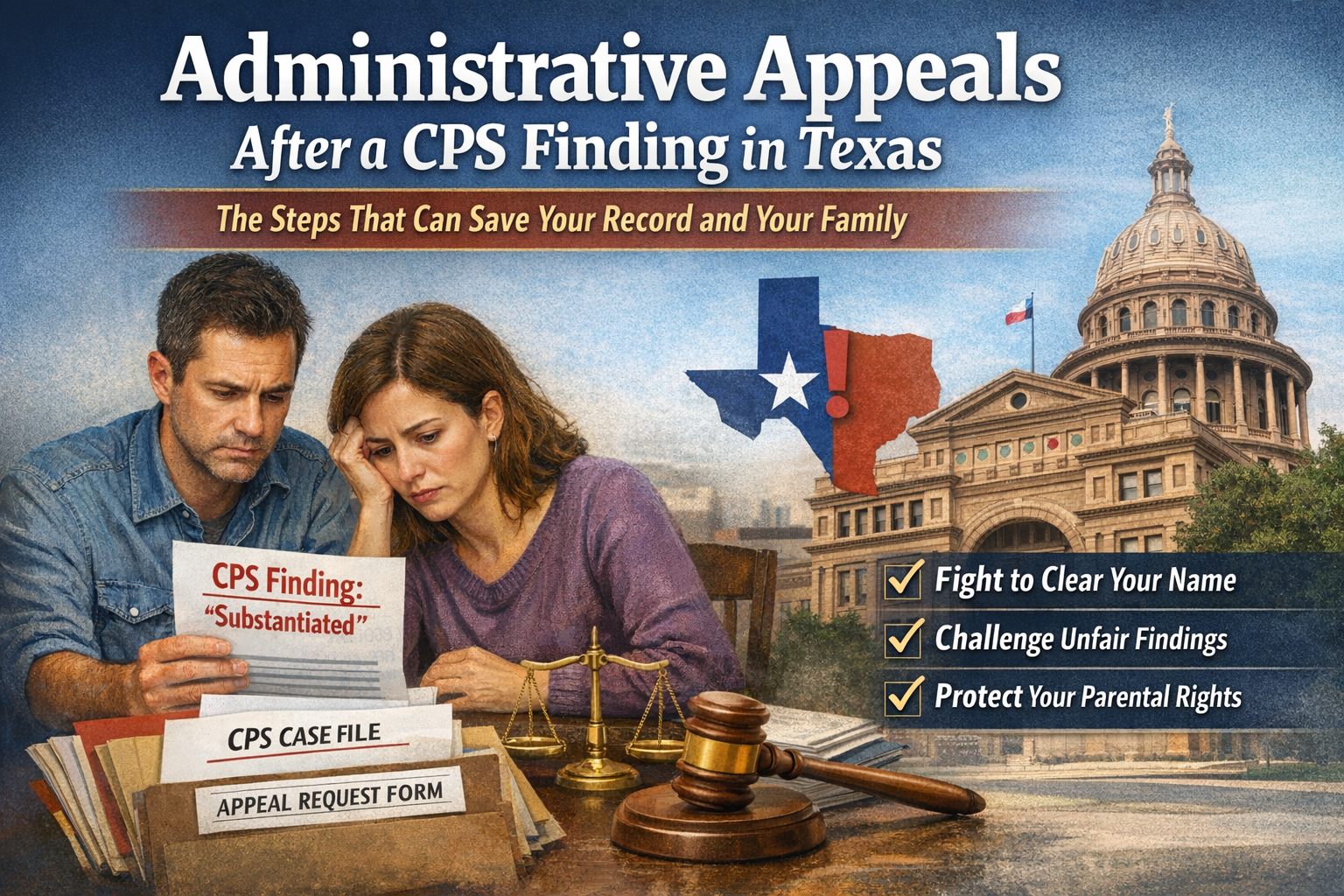
Administrative Appeals After a CPS Finding in Texas: The Steps That Can Save Your Record and Your Family
A CPS finding can land like a punch you didn’t see coming. One day you are trying to keep life normal for your child, and the next you are staring at paperwork that makes it sound like your family has been labeled forever. Even if you cooperated, even if you followed the safety plan, even if the investigation felt rushed and unfair, a finding can still appear in the CPS case file. For many parents, the fear is not only “What happens now?” but “How long will this follow me?”
If you feel trapped between protecting your child’s safety and protecting your own name, you are not alone. The child protective services system moves quickly, and it often feels like CPS workers hold all the power. But in Texas, administrative appeals exist for a reason. When CPS determines a finding that you believe is wrong or overstated, the appeal process can be the step that protects your record, your parental rights, and your family’s future.
At Masterly Legal Solutions, we help families respond strategically after CPS investigations lead to findings that threaten reputations, jobs, and custody. This article explains the administrative appeal process in plain language, with practical steps you can take. It also explains why legal representation can matter early, because deadlines and paperwork can decide outcomes before you ever step into a courtroom.
What a “CPS Finding” Means in Real Life
A CPS finding is the agency’s conclusion after an investigation process. It may suggest abuse or neglect occurred, that neglect occurred, or that there is reason to believe a child faced serious harm or immediate danger. Even when the child remains at home, the finding can still become part of your CPS case record. That record can affect future CPS investigations, employment background checks, and custody discussions in family law matters.
Parents often assume a CPS finding is the same as a criminal conviction. It is not. But it can still create long-term consequences because it becomes a formal agency decision. That is why the administrative appeal matters, even if you think the case will close soon.
A finding can also shape how CPS decides future steps, including whether to pursue court order restrictions, voluntary placement, or juvenile dependency court involvement. The sooner you understand what the finding means, the sooner you can protect your record and your family’s life.
Why Administrative Appeals Matter More Than Most Families Realize
Many families hear “appeal” and think it is optional, complicated, or pointless. In reality, an administrative appeal may be the best chance to challenge a CPS finding without waiting for larger court proceedings. Once the finding becomes established, it can follow you for years and influence how CPS workers interpret your family in the future. Appeals can be a key part of risk assessment because they challenge the agency’s conclusions about risk factors and immediate risk.
Administrative appeals also matter because CPS investigations sometimes rely on incomplete witness statements or rushed assumptions. A CPS investigator may summarize facts in a way that doesn’t reflect your child’s home accurately. When you appeal, you create a formal opportunity to correct the record with facts, context, and documentation.
Even if you ultimately win in court later, a CPS record can still cause damage in the meantime. Administrative appeals can limit that harm. They can protect your well being by reducing the stress of living with an agency label you believe is unfair.
The CPS Investigation Process in Texas and How Findings Happen
The cps investigation process often begins with initial contact from child protective services. That contact may happen through a home visit, a phone call, or contact at your child’s school. During the investigation stage, CPS workers gather information through interviews, documents, and observations. They may ask about your child’s education, your child’s care, and your child’s basic needs.
CPS investigations typically involve looking for signs of child abuse, physical abuse, sexual abuse, domestic violence, or other safety issues. They may also consider criminal history, mental health concerns, or prior reports of suspected child abuse. The agency may develop a safety plan and ask family members to follow certain steps to keep the child safe.
At the end of the investigation process, CPS determines whether the allegations are supported. The CPS case file will reflect what the agency believes, even if you disagree. This is why an appeal can be essential to protect your record.
The CPS Investigation Timeline and Why Speed Creates Mistakes
Families often ask about the cps investigation timeline because it feels like decisions happen before they can catch their breath. The timeline can vary, but what stays consistent is the pressure on CPS workers to close cases and document outcomes. That pressure can lead to broad conclusions based on limited evidence. It can also lead to misunderstandings, especially when families are overwhelmed and not communicating clearly.
In fast-moving cases, CPS believes it must act quickly to protect a child’s safety. That focus can be appropriate in true emergencies, but it can also lead to overreactions in borderline cases. When CPS decides a finding, it is often based on a snapshot of your family, not the full story. That snapshot can be misleading.
An appeal is the parent’s chance to slow the picture down. It can help show the fuller reality of the child welfare situation. It can also challenge assumptions about future abuse that are not supported by facts.
What the Texas Family Code Has to Do With CPS Appeals
The Texas Family Code plays a major role in how child protective services handles investigations and court involvement. It also impacts parental rights, safety plans, and court order procedures. Families do not need to memorize the Texas Family Code, but they do need to understand that CPS is required to operate within legal rules. Those rules matter when a CPS case moves toward juvenile dependency court or when a court hearing is scheduled.
Administrative appeals are part of the system’s checks and balances. When CPS determines a finding, the Texas Family Code and related regulations help define what procedures must be followed. If procedures were not followed, an appeal may highlight those problems. That can be especially important when the finding could affect employment, licensing, or custody.
A knowledgeable legal team can help families understand what legal protections may apply. It can also help ensure that appeal steps align with required procedures. That legal representation can make the difference between a dismissed appeal and a meaningful review.
Administrative Appeal Basics: What You Are Really Challenging
An administrative appeal usually challenges the agency’s finding and the basis for that finding. It can also challenge whether CPS workers correctly interpreted evidence, correctly assessed risk factors, or correctly applied policies. You are not required to prove perfection as a parent. You are challenging whether the agency’s conclusion is fair, supported, and correctly documented.
Appeals can also challenge how the agency classified an alleged perpetrator. In some cases, a parent or caregiver is labeled as the alleged perpetrator without careful consideration of context. That label can follow you across future cases. This is why appeals can be essential even when the child is still with you.
Families often feel intimidated by agency processes. But the appeal is a structured chance to respond. It is not about arguing with the CPS investigator emotionally. It is about correcting the record professionally.
What Happens If You Do Nothing After a CPS Finding
Doing nothing can be costly. When a CPS finding is left unchallenged, it can remain in the CPS case record and affect future decisions. If another report happens years later, CPS workers may treat the prior finding as proof of risk, even if the new report is weak. That can increase the risk assessment and lead to stronger interventions.
A finding can also affect jobs that involve children, vulnerable adults, or background screening. It may impact family law disputes where one parent uses the finding in court proceedings. It can also affect voluntary services decisions because the agency may push more aggressive requirements.
Families sometimes think administrative closure means everything goes away. But administrative closure does not always erase the finding. An appeal may be the only practical way to protect your record.
Early Steps to Take After You Receive a CPS Finding
The first step is to read the paperwork carefully and identify deadlines. Appeals often have strict time limits, and missing them can end your options. The second step is to gather documents, messages, and records that support your timeline and show protective steps. The third step is to speak with legal counsel before submitting statements.
Here are actions many families consider early:
- Request copies of relevant CPS records when permitted
- Write down a timeline while details are fresh
- Gather proof of services provided, counseling, or parenting classes
- Collect school records or proof of child’s education engagement
- Document safety plan compliance and home visit dates
- Identify supportive family members and community resources
These steps help you prepare for an appeal in a structured way. They also help you stay calm by focusing on action rather than fear.
The Safety Plan: How It Helps and How It Can Be Misused
A safety plan is often used to address safety concerns during CPS investigations. In some cases, the plan is reasonable and helps keep the child safe while the investigation continues. In other cases, the plan becomes overly restrictive and creates a record that implies guilt. Families sometimes agree to a safety plan under pressure, without understanding how it may later be used.
A safety plan may involve supervision, restricted contact, or temporary custody arrangements. It may also involve voluntary placement or voluntary services that change the child’s placement temporarily. The plan can protect the child’s safety, but it must be followed carefully because violations can be used against you.
During an appeal, safety plan compliance can be important evidence. If you followed the plan consistently, that supports your claim that you acted responsibly. It can also counter claims of immediate danger or immediate risk.
Voluntary Placement and Temporary Custody: Know the Difference
Voluntary placement is sometimes presented as a cooperative option. CPS may suggest that a child stay with relatives or another caregiver temporarily. Parents may agree because they fear foster care, even if they believe removal is unnecessary. Temporary custody can also occur through court proceedings when the agency seeks a court order.
These decisions can shape the CPS case. They can influence juvenile dependency court involvement and long-term outcomes. If you are being pressured into voluntary placement, you should understand the risks. A decision made in fear can create a record that is hard to undo.
Administrative appeals can address findings, but they may not automatically undo placement decisions. This is why early legal representation matters. You want a coordinated strategy that protects both your record and your child’s placement.
Juvenile Dependency Court and Administrative Appeals: How They Interact
Juvenile dependency court is where CPS seeks court orders that affect custody, visitation, and services. Many parents assume appeals only matter if they are already in court. But administrative appeals can still matter because the agency’s report and findings can influence court hearing decisions. Judges often rely on the written record when assessing the child’s safety and risk.
If your case enters juvenile dependency court, the appeal can help challenge the credibility of the agency’s findings. It can also highlight weaknesses in the investigation process. In some situations, the appeal record becomes part of the broader court proceedings.
Parents should not treat the appeal as separate from court strategy. These processes can overlap in timing and impact. Having legal counsel ensures that your appeal does not conflict with your court approach.
The Role of CPS Workers and Why Their Notes Carry Weight
CPS workers document everything, and their notes often become the official narrative. That narrative can be influenced by limited time, heavy caseloads, and subjective impressions. A CPS investigator might interpret a messy home as neglect, or interpret stress as evasiveness. Those interpretations can appear in the CPS case file as though they are proven facts.
That does not mean CPS workers are always wrong. Many are doing difficult work in hard circumstances. But the system is not perfect, and mistakes happen. Appeals exist because the system recognizes that errors can occur.
Your job in an appeal is to address the record calmly and clearly. You are not attacking a person. You are challenging conclusions and protecting your family.
Risk Assessment: What CPS Evaluates and What You Can Prove
Risk assessment is a structured way CPS evaluates potential harm. CPS looks at risk factors like prior history, domestic violence concerns, household stability, and whether an alleged perpetrator has access to the child. They also look at protective factors such as stable caregivers, support families, and community resources.
In an appeal, you can provide proof that risk was misunderstood or overstated. You can document stable routines, child’s education engagement, medical care, and safe supervision. You can also document how your family addressed concerns immediately.
Risk assessment is not only about the past. It is about the present and future safety of the child. Showing consistent protective actions can lower perceived risk level.
Abuse or Neglect Findings and the Stakes for Your Record
Abuse or neglect findings can follow a parent for years. They can affect future CPS investigations and influence how professionals view your child’s family. These findings can also affect family law disputes and custody decisions. That is why “abuse or neglect” is not just a label, it is a long-term risk.
When the allegation involves child abuse or neglect, the appeal becomes even more important. It can be the difference between a record that permanently damages your credibility and a record that reflects the truth. If the finding involves child abuse, physical abuse, sexual abuse, or sexual exploitation, you must be careful because a criminal investigation may be connected.
If you are facing serious allegations, do not navigate this alone. Legal representation can protect you from accidental admissions and help build a strong record.
Domestic Violence Complications in CPS Findings
Domestic violence is a common factor in CPS investigations, even when the child is not directly harmed. CPS may view exposure to domestic violence as a safety concern that affects the child’s well being. Sometimes the parent seeking help is treated as though they are at fault for the situation. That can feel deeply unfair.
If domestic violence is part of your CPS case, your appeal may need to address the agency’s assumptions carefully. You may need to show steps taken to protect the child safe environment, such as separation, protective orders, counseling, or safe housing. These actions can be part of your safety plan record.
The goal is to demonstrate that the child’s safety is prioritized and that the risk factors are being managed. Clear documentation can be powerful during an appeal.
Court Order Decisions and the Risk of Child’s Removal
When CPS believes a child is in immediate danger, it may seek a court order for removal. Child’s removal is one of the most traumatic outcomes families face. It can lead to foster care placement and prolonged court proceedings. Even when removal does not occur, the threat can push parents into decisions they do not fully understand.
An administrative appeal does not always stop a removal decision on its own. But it can strengthen your position by challenging the underlying finding. It can also support later arguments that the agency overstated the risk. That can matter in juvenile dependency court reviews.
Parents should treat any removal threat as urgent. Immediate legal counsel can help protect the child’s placement and reduce long-term damage.
The CPS Process Can Feel Like It Never Ends
The cps process is emotionally exhausting. Families feel watched, judged, and overwhelmed by paperwork. They may feel like every decision is a test. Even after the investigation stage, families may be required to complete services or follow strict rules.
Administrative appeals can be empowering because they give you a formal way to push back. They allow you to challenge the narrative instead of accepting it. They also show that you are engaged and serious about protecting your child and your record.
This is not about “winning against CPS.” It is about making sure the official record reflects reality. It is about protecting your family’s future.
How Legal Representation Helps in Administrative Appeals
Legal representation matters because appeals involve deadlines, procedures, and strategic communication. Families often hurt their own case by submitting emotional statements or incomplete documents. An attorney can help you organize evidence, respond professionally, and avoid risky admissions.
Legal counsel can also help you interpret CPS documentation and identify weaknesses. They can help you address witness statements, missing evidence, or procedural issues. They can also coordinate with family law strategy if custody issues exist.
Parents often search for legal aid or resources like the Texas Legal Services Center, and those resources can help some families. But when the stakes are high, individualized legal representation is often necessary. You need a strategy tailored to your CPS case, not general advice.
The Role of Family Law Strategy When CPS Is Involved
CPS involvement often intersects with family law matters. Custody disputes, divorce, and visitation conflicts can increase CPS reporting and intensify investigations. Sometimes one parent uses CPS involvement to gain leverage. That can create extra stress and uncertainty.
When family law issues exist, your appeal strategy must be coordinated. The CPS case record can affect court proceedings. It can influence a judge’s view of parental rights and parenting capacity. A careful approach can protect your record and your legal position.
This is another reason an experienced attorney can matter. You want a unified plan that protects your family across systems.
When a CPS Finding Involves a Criminal Case Risk
Some CPS findings overlap with criminal investigation risks, especially when there are allegations of suspected abuse, suspected child abuse, sexual abuse, or serious harm. A CPS finding can sometimes trigger or strengthen a criminal case. It can also affect how police interpret allegations.
If criminal case risk exists, you must be careful with every statement. You should not try to explain everything to CPS workers without legal counsel. An appeal can still be important, but it must be handled strategically.
Legal representation is essential in these situations. Your attorney can help protect you while still focusing on the child’s safety. The goal is to protect your record without creating criminal exposure.
The Practical Steps Families Should Take Before Filing an Appeal
Before you file, you need preparation. You should understand what finding you are challenging, why it is wrong, and what evidence supports your position. You should also gather documents that show compliance with protective services recommendations and your safety plan.
Practical steps often include:
- Creating a detailed timeline of initial contact and key events
- Listing all CPS investigators and CPS workers involved
- Documenting every home visit and communication
- Collecting proof of services provided and appointments
- Identifying supportive family members who can speak to stability
- Gathering school records that support child’s education consistency
- Saving texts or emails that show cooperation and safety efforts
These steps help you present a clear picture. They also reduce the chance you submit a rushed and incomplete appeal.
Why Evidence Matters More Than Emotions in an Appeal
It is completely normal to feel angry or heartbroken. But the appeal process is driven by evidence, not emotion. Evidence includes records, timelines, service completion, and credible explanations. A well-structured appeal focuses on facts and supports those facts with documentation.
Even when the agency’s report feels unfair, your strongest response is calm professionalism. That approach strengthens credibility. It also makes it easier for the reviewer to see weaknesses in the original investigation results.
A well-prepared appeal can provide clarity that the original CPS investigation did not capture. It can show the real story of your child’s home and your protective steps.
What “CPS Investigation Michigan” Searches Usually Mean for Texas Families
Some parents search online for cps investigation michigan while living in Texas, often because they are reading stories from friends, relatives, or online groups. It is easy to get confused because state systems share similar language but operate under different laws. In Texas, the Texas Family Code and Texas agency procedures govern your case, not Michigan’s system.
If you are pulling information from other states, be careful. Advice that applies elsewhere may not apply to Texas timelines, court order procedures, or appeal steps. Getting local legal counsel helps you avoid mistakes caused by mismatched information.
Even if the stories feel familiar, your case must be handled under Texas rules. That is why personalized legal representation matters.
Protecting Your Child’s Safety While Protecting Your Record
Parents sometimes feel like they must choose between protecting their record and protecting the child’s safety. In reality, the best strategies do both. Appeals are not about denying safety concerns. They are about ensuring the record is accurate and fair. They are about preventing exaggerated findings that can harm your family long term.
A strong appeal can show that you took safety seriously. It can document compliance with the safety plan and protective services recommendations. It can show how you used family and community resources to stabilize the home. It can also show that the child’s safety was addressed without unnecessary labels.
This balanced approach is often the most persuasive. It shows responsibility, not defensiveness. It supports the child safe environment while protecting parental rights.
Administrative Closure and Why It Still Might Not Be Enough
Families often celebrate administrative closure because it sounds like the CPS case is over. In some situations, administrative closure ends the investigation without court involvement. But closure does not always erase the finding. The record may still reflect agency conclusions that follow you.
That is why appeals can still matter even after closure is discussed. The question is not only “Is the case closed?” The question is “What does the record say about my family?” If the record is damaging, your future remains vulnerable.
An appeal can help change that record. It can help ensure the CPS case file reflects a fair assessment. That can protect you from future problems.
Child Protective Investigations and Why the Details Matter
Child protective investigations move fast, and early impressions often shape the entire cps case. During these reviews, CPS workers gather information through interviews, records, and observations to evaluate a child’s safety and decide what protective services may be needed. Because the agency is documenting everything, even small misunderstandings can become “facts” in the file. That’s why it matters to stay calm, track timelines, and get legal representation early so the record reflects what actually happened.
Child and Family Services and the Support Families Actually Need
Many parents hear “child and family services” and assume it only means taking children away, but the system can also involve family services designed to stabilize the home. Depending on the case, child and family services may include parenting education, counseling, substance treatment referrals, supervised visitation planning, or help connecting to community programs. These support services can be offered as voluntary options or required through court order conditions, and the way you accept, document, and complete them can influence your appeal and long-term record. When handled strategically, services can help demonstrate safety-focused progress without creating unnecessary admissions.
Child Protective Services CPS and What the Agency Is Trying to Document
Child protective services cps is focused on building a written record that explains why the agency acted and what it believes about risk to the child. That record can include what CPS says occurred, how it believes the child’s home is functioning, and what safety plan steps are in place. Because the file may later be reviewed in juvenile dependency court or during future cps investigations, it’s important to treat communications like evidence. Having legal counsel helps families respond professionally, provide relevant documents, and avoid statements that could be misunderstood.
Alleged Abuse and Why Language and Timing Can Decide Outcomes
In many cases, the issue begins with alleged abuse, which may be based on a report that is incomplete, exaggerated, or misunderstood. Once that label appears in a cps case, the agency may treat it as credible until proven otherwise, especially when investigating allegations involves emotional interviews and conflicting witness accounts. Parents often make the mistake of rushing to “explain everything” in a way that creates inconsistencies or accidental admissions. A careful, evidence-based approach helps you address alleged abuse claims while protecting your record and your parental rights.
The Texas Department’s Role and Why Procedures Matter
Many families say “CPS” without realizing the decisions and paperwork often trace back to the Texas department that oversees child welfare and reporting structures. That matters because agencies must follow procedures, timelines, and documentation rules, especially when a finding could impact your employment, custody, or future background checks. If the Texas department’s processes were not followed correctly, that issue may become important during administrative appeals or court proceedings. A structured response—supported by legal representation—can help identify errors and protect your family from unfair outcomes.
Family Services and Support Services That Can Strengthen Your Case
When CPS recommends family services, it may be aimed at reducing risk factors and keeping the child safe in the child’s home. These may include counseling, parenting classes, supervised contact arrangements, or referrals for housing and stability resources. Completing support services in a documented, consistent way can help show the agency—or a reviewer during an appeal—that the family responded responsibly and prioritized the child’s safety. The key is doing services thoughtfully, with guidance, and without agreeing to statements that incorrectly suggest guilt.
How Masterly Legal Solutions Helps Families Challenge CPS Findings
At Masterly Legal Solutions, we help families respond after CPS investigations create findings that threaten reputations and stability. We help you understand the CPS process, identify what CPS workers documented, and build a clear appeal strategy. We focus on protecting the child’s safety while also protecting your parental rights and future.
We also understand that these cases affect real life. They affect your child’s placement, your work, and your emotional well being. Our approach is structured and compassionate, because families need both strength and clarity during this time. If you feel overwhelmed, we help you build a plan you can follow step by step.
When you have legal representation early, you can avoid common mistakes that weaken appeals. You can present evidence clearly and communicate in a way that supports the best outcome. That is what we aim to provide.
Contact Masterly Legal Solutions for a Free Consultation
A CPS finding can feel like your name has been stamped with a label you didn’t earn. It can follow you into future CPS investigations, family law disputes, and decisions about your child’s placement. Administrative appeals are not just paperwork—they can be the step that saves your record and protects your family’s future, especially when the CPS case file tells a story you know is incomplete.
Masterly Legal Solutions helps parents challenge CPS findings with a focused strategy built on evidence, timelines, and careful communication. If you are worried about juvenile dependency court, a court order, a safety plan, foster care risks, or whether CPS workers misunderstood your situation, we’re ready to help you take the next step with confidence. Even if you’ve been searching online for answers like “cps investigation michigan,” you deserve guidance tailored to Texas procedures and the Texas Family Code.
Call (972) 236-5051 for a free consultation. We will listen to what happened, explain your options, and help you protect your record and your family.
Disclaimer: This article is for educational purposes only and does not constitute legal guidance or legal advice. Every CPS case is different, and you should consult a qualified attorney regarding your specific circumstances.



Teacher Rights When Assaulted by a Special Needs Student: Safety, Reporting and Investigation Issues



Looking for Legal & Business Solutions? Contact Us Now
Fill in the form or call us to set up a meeting