
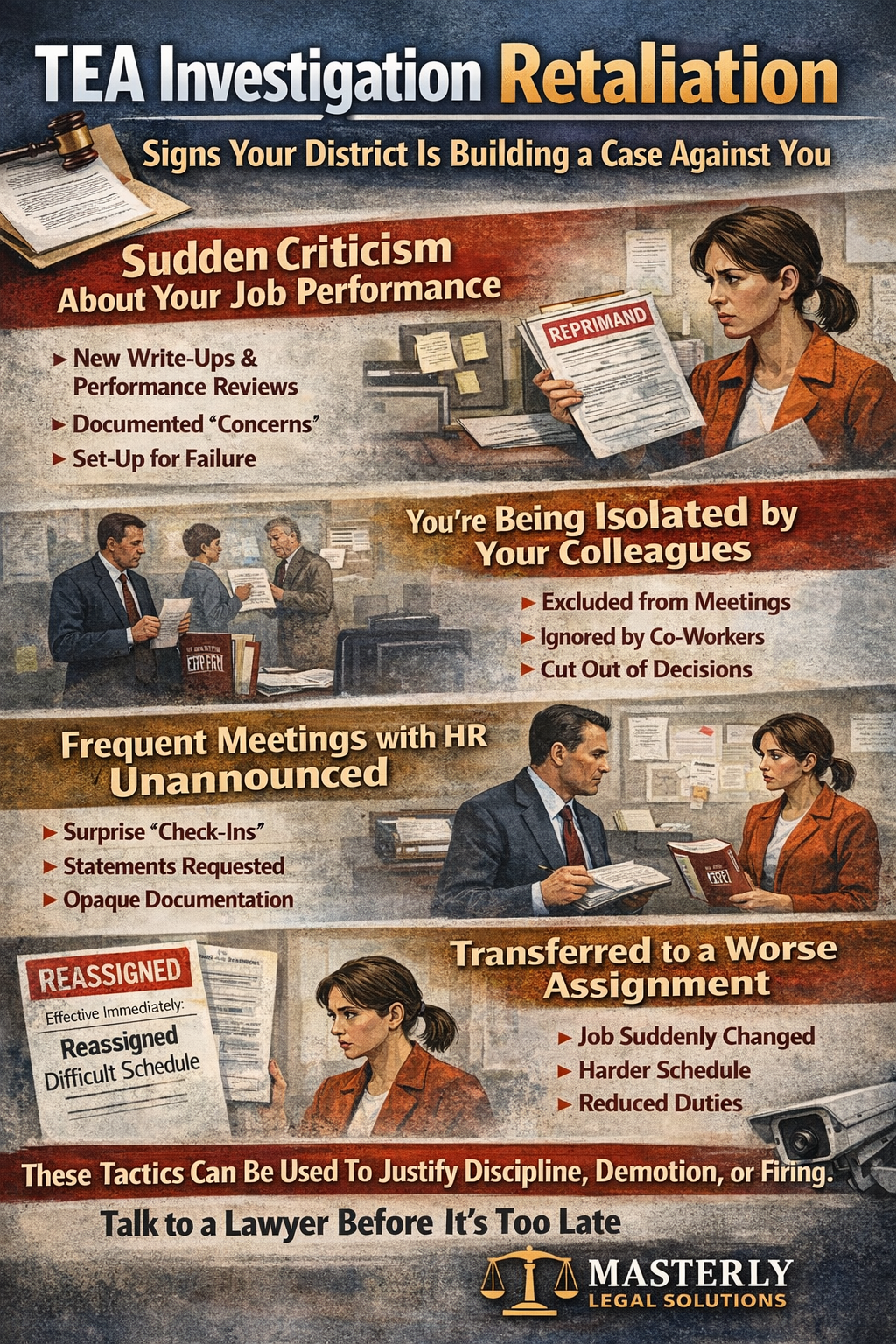
TEA Investigation Retaliation: Signs Your District Is Building a Case Against You
You can feel it before anyone says it out loud. The tone changes. Emails get shorter. Meetings happen without you. Someone from human resources suddenly wants a “quick check-in,” and the conversation feels less like support and more like a setup. For many educators, this is the moment they realize a TEA-related situation is no longer just “district business.” It’s becoming personal.
At Masterly Legal Solutions, we work with educators who feel blindsided when a TEA issue turns into workplace retaliation. A district might say it’s “standard procedure,” “just documentation,” or “only an internal review.” But if you’ve recently spoken up, reported misconduct, or participated in an investigation, you may be dealing with retaliation that is being carefully disguised as policy enforcement. The most stressful part is that many employees don’t recognize what’s happening until the employer has already built a paper trail.
This article explains the warning signs that your district may be building a case against you after a TEA-related issue. We’ll break down what retaliation looks like in real life, how it connects to discrimination claims, and what you can do to protect your career. If you have legitimate fears that your employer is setting you up for discipline, nonrenewal, or wrongful termination, you are not overreacting. You may be seeing the early stages of a retaliation case unfold in real time.
Why Retaliation Often Shows Up During TEA-Related Investigations
When TEA investigations happen, districts go into defense mode. Leadership becomes focused on liability, public perception, and internal control. In that environment, districts sometimes treat employees as “risk factors” instead of professionals. That is where workplace retaliation often begins.
A district may retaliate against employees who raise concerns, question decisions, or cooperate with investigators. Even if you acted professionally and in good faith, the district may view you as a threat to their narrative. The more pressure leadership feels, the more likely retaliatory acts can happen behind the scenes. These situations are not rare, and they often target educators who were simply trying to do the right thing.
Workplace retaliation is especially common when an employee’s report creates discomfort for leadership. Once a district worries about exposure, they may shift attention toward controlling the people who might speak up. That can lead to discipline, isolation, and subtle punishment. If your role has changed suddenly, it may be time to take the situation seriously.
What “Building a Case” Really Means in a School District Setting
When educators hear the phrase “building a case,” they often imagine something dramatic. In reality, it usually looks quiet, procedural, and slow. The employer starts collecting documentation, gathering statements, and creating a record that makes discipline look justified. The employee often doesn’t realize it until the file is already thick.
Building a case often involves turning small issues into “patterns.” A late email becomes “insubordination.” A classroom management concern becomes “performance failure.” A disagreement becomes “unprofessional conduct.” The district may also start documenting your job performance in a way that feels unfamiliar or unfair.
In many employment law matters, this is the moment where the timeline matters most. A case can be built in weeks if the employer is motivated. If you wait too long, the paper trail becomes harder to challenge. This is why talking to an employment lawyer early can change the outcome.
The Connection Between Retaliation and Protected Activity
Retaliation is not just “being treated unfairly.” Legally, retaliation often involves an employer punishing an employee because the employee engaged in protected activity. Protected activity can include reporting discrimination, participating in an investigation, requesting reasonable accommodations, or refusing to participate in illegal acts. Many employees don’t realize they were protected until after the retaliation begins.
If you made a complaint, gave a statement, or cooperated with TEA or internal investigators, you may have engaged in protected activity. If the district then changes your work conditions, disciplines you, or threatens your job, the connection matters. That connection can form the basis of a retaliation claim. A viable retaliation claim often depends on timing, documentation, and how the district treated you compared to others.
This is why “good faith belief” is so important. You don’t have to be correct about every detail to be protected. If you reasonably believed misconduct occurred and reported it appropriately, the law may protect you. When the employer retaliated anyway, the situation can become serious quickly.
Common Retaliation Myths That Trap Educators
Many employees assume retaliation only counts if they are fired. That’s not true. Workplace retaliation can happen through smaller actions that build over time. It can involve reassignments, isolation, denial of opportunities, or constant monitoring. These patterns can be just as damaging as termination.
Another myth is that you have to “prove” the district’s motive immediately. In reality, retaliation cases are often proven through patterns, timing, and inconsistent treatment. A district rarely admits they retaliated. Instead, they provide excuses like “budget,” “student needs,” or “policy compliance.” The key is whether those reasons are legitimate or pretext.
A final myth is that reporting concerns is always safe. While most anti discrimination laws prohibit retaliation, enforcement depends on evidence. If you report something and then go silent, the employer may move quietly. That’s why documentation is critical. The earlier you act, the more options you may have.
Early Warning Sign: Sudden “Concern” About Your Job Performance
One of the most common signs a district is building a case is a sudden shift in how your job performance is treated. You may have years of positive feedback, then suddenly you’re “under review.” Administrators may start pointing out small issues that were never raised before. You might receive unexpected criticism in writing.
This shift often happens after a complaint, report, or TEA-related interview. The timing matters because it suggests motive. The district may claim it is simply accountability. But if the district never addressed these concerns before, it can be suspicious. A sudden focus on documentation often means the employer is preparing for adverse action.
If you are being written up repeatedly, don’t assume it will stop on its own. That paper trail can be used to justify discipline, nonrenewal, or wrongful termination. An employment lawyer can help you respond strategically instead of emotionally. Your response matters more than you think.
Early Warning Sign: You’re Being Isolated From Your Campus Team
Retaliation doesn’t always look like yelling or threats. Sometimes it looks like silence. You stop being invited to meetings. You are left out of decisions. Your input is no longer requested. A co worker might suddenly avoid you because they were warned not to speak to you.
Isolation is a powerful tool because it weakens your support system. It also makes you look irrelevant or “out of the loop.” Over time, isolation can be used to justify reassignment or removal. In workplace retaliation cases, isolation is often part of the pattern that shows intent.
Isolation can also create a hostile work environment, especially when it’s paired with gossip or suspicion. Many employees feel humiliated when they realize they’re being treated differently. That emotional impact is real, and it can affect performance. Unfortunately, the employer may then use that impact as “proof” you are struggling.
Early Warning Sign: Human Resources Suddenly Gets Involved
When human resources gets involved unexpectedly, pay attention. HR may schedule meetings that feel vague or rushed. They may ask for written statements, timelines, or explanations. They may also ask questions that feel designed to trap you into admitting fault.
HR often works to protect the employer, not the employee. That doesn’t mean every HR professional is unfair, but it does mean you should be careful. If HR is collecting information, it may be complaint based, meaning they are responding to a report or preparing documentation. They may already have a goal in mind before the meeting begins.
If HR asks you to sign anything, slow down. Signing documents without legal guidance can lock you into a version of events that hurts you later. A workplace retaliation attorney can help you understand what you are agreeing to. This is especially important when very short deadlines are involved.
Early Warning Sign: You’re Being Moved Into a Worse Assignment
A reassignment can be framed as “operational need,” but it can still be retaliation. Being moved to a harder schedule, a more difficult campus, or a role with less support can be an adverse employment action. Even if your pay stays the same, the change can damage your career and mental health. Many employees experience this as punishment.
Retaliation often shows up through subtle changes to workload. You might lose planning time. You might get more challenging students without support. You might lose leadership duties or coaching roles. Over time, the district can claim you “couldn’t handle it,” even though the situation was engineered.
If you were moved shortly after reporting discrimination or cooperating in a TEA matter, timing matters. The district may claim it was unrelated. But patterns can reveal the truth. These are the moments where documenting dates and communications becomes important evidence.
Early Warning Sign: Discipline Starts Appearing Out of Nowhere
Many educators are shocked when they receive disciplinary paperwork for issues that were never raised before. This can include memos, corrective action plans, or sudden “investigation findings.” Sometimes the district labels it as “policy violations.” Sometimes they call it “professional conduct concerns.” Either way, it may be retaliation.
Disciplinary action is often used to justify future termination. Once it’s in your file, the employer can rely on it later. Even if the discipline feels unfair, it becomes part of the narrative. The district may also pressure you to accept blame or apologize.
If discipline follows your protected activity, you may have a retaliation claim. This is especially true if others did the same thing and were not punished. In workplace retaliation patterns, inconsistent discipline is a major red flag. An employment lawyer can help you evaluate whether the discipline is legitimate or retaliatory.
Early Warning Sign: You’re Being Pressured to “Resign Quietly”
Some districts don’t want the conflict of a termination. Instead, they pressure employees to resign. They may suggest it’s “best for everyone.” They may offer vague promises of a neutral reference. They may even imply that resigning will stop the investigation.
This pressure can be workplace retaliation in disguise. It can also be a strategy to avoid accountability. If you resign, the district may claim the issue was resolved voluntarily. That can weaken your ability to challenge what happened. It can also impact your future employment options.
If you are being pushed toward resignation, pause and get legal guidance. Resigning without understanding the consequences can be a costly mistake. In many employment disputes, resignation is not the safest option. A retaliation lawyer dallas professionals trust can help you assess the risk and negotiate smarter options.
How Retaliation Connects to Discrimination in Schools
Retaliation and discrimination often overlap. A teacher might report workplace discrimination, and then the district retaliates. Or a teacher might be treated unfairly because of age discrimination, gender discrimination, or sexual orientation, and then punished for speaking up. These patterns can create discrimination claims that become more serious over time.
Discrimination can be obvious, but it can also be subtle. It can show up through unequal discipline, unfair evaluations, or being denied opportunities. Employer's discrimination is often hidden behind “performance” language. But if the treatment is inconsistent, the pattern can support an employment claim. This is especially important when the district is under TEA pressure.
Unlawful discrimination is prohibited under federal and state laws. The civil rights act, title protections, and state law frameworks work together to protect employee rights. When districts ignore those rules, the consequences can be serious. That is why many educators turn to dallas employment lawyers when things escalate.
Sexual Harassment Complaints and Retaliation Risk
Sexual harassment complaints are one of the most common triggers for retaliation. Employees may report inappropriate comments, unwanted attention, or boundary violations. After reporting, the employee may suddenly become the “problem” instead of the behavior being addressed. That is a classic retaliation pattern.
Workplace retaliation after sexual harassment reports can include isolation, discipline, reassignment, or termination threats. It can also involve co worker hostility, rumors, or subtle punishment. Many employees experience emotional distress and fear after reporting. The district may claim they are “investigating,” but still treat the reporting employee unfairly.
If you reported sexual harassment and then faced negative treatment, you may have a retaliation claim. The equal employment opportunity commission may be involved in certain cases. A workplace retaliation attorney can help you understand timelines and options. The earlier you act, the stronger your position may be.
Pregnancy Discrimination Act and Retaliation in Education
The pregnancy discrimination act exists because employees have historically been punished for pregnancy-related needs. In school settings, this can show up as criticism for medical leave, doctor appointments, or limitations. Some districts treat pregnant employees as “inconvenient.” That is unacceptable.
Retaliation may happen when an employee requests accommodations or leave. The district may suddenly question commitment or reliability. They may reduce responsibilities or isolate the employee. These actions can be discriminatory and retaliatory, depending on the circumstances.
Pregnancy-related retaliation can also connect to hostile work environment patterns. Comments, gossip, and unfair expectations can create stress. If the district punishes you for pregnancy-related needs, you may have legal options. Employment law protections can apply even when the employer tries to frame it as “scheduling issues.”
Disabilities Act, Medical Leave, and Reasonable Accommodations
Educators with medical conditions are protected under the disabilities act. They may also have rights under the medical leave act, depending on eligibility. These protections matter when a district begins building a case. Some employers retaliate when employees request help, leave, or modifications.
Reasonable accommodations may include schedule adjustments, modified duties, or support tools. The district must consider accommodations unless it creates undue hardship. Employers sometimes refuse accommodations without real analysis. Then they punish the employee for struggling without support.
Medical leave can also trigger retaliation. Employees may return from leave and find their role changed or their evaluations worse. That can be a sign the employer is building a case. If you requested medical leave or fmla leave and then faced punishment, it may not be a coincidence. A strong legal strategy can help protect you.
Retaliation Claim Basics: What You Must Be Able to Show
A retaliation claim often requires showing a few key elements. You engaged in protected activity. The employer took an adverse employment action. And there is a connection between the two. That connection is often proven through timing and patterns.
A viable retaliation claim can be strengthened by documentation. Emails, evaluations, and meeting notes can show what changed. Witness statements can help if others saw retaliation. Many employees assume they have no evidence, but often the evidence is already there. You just need to organize it.
Retaliation cases also involve understanding the employer’s stated reasons. If the employer claims “performance,” you compare it to past evaluations. If they claim “policy,” you compare enforcement across staff. The goal is to show inconsistency. That inconsistency is often what proves retaliation.
What Counts as an Adverse Employment Action
An adverse employment action is not limited to termination. It can include demotion, suspension, pay reduction, or significant changes to job duties. It can also include transfers that harm your career. In schools, adverse action can look like removing leadership roles, changing grade levels, or cutting support.
Even subtle actions can matter if they affect your career path. Losing a stipend or losing opportunities can be adverse. Being assigned unfair workloads can be adverse. Being targeted for discipline can be adverse. These actions are often used to pressure employees to quit.
When the district is building a case, adverse action may happen in steps. First a warning, then a plan, then a write-up, then a termination threat. Each step can be used to justify the next. That is why early legal guidance matters.
Retaliation Complaint Patterns Districts Use to Look “Legitimate”
Districts rarely retaliate in obvious ways. Instead, they use patterns that look procedural. They schedule repeated meetings. They request repeated statements. They demand compliance with unclear expectations. Then they claim the employee failed to meet standards.
This is why a retaliation complaint must be approached carefully. It is not just about feelings—it’s about patterns. A complaint based approach can show the district’s behavior over time. It can also show that the employee acted professionally while the employer escalated.
Some districts also use performance improvement plans as weapons. They create unrealistic expectations. They set vague standards. They then claim the employee failed. This can be a setup for wrongful termination. Dallas employment lawyers often see this pattern in workplace retaliation cases.
When the Employer Retaliated by Changing Your Schedule or Pay
Schedule changes can be retaliation. Sudden changes to work hours can disrupt family life and stability. They can also create stress that affects performance. Some employees are assigned extra duties without support. Others are denied overtime or pressured into unpaid overtime.
Pay issues can also arise, including disputes over minimum wage or stipend eligibility. While many educators are salaried, some staff roles involve hourly work. If your pay is being manipulated after protected activity, that can be a serious red flag. The district may claim it’s budgeting, but patterns matter.
These actions can also be tied to broader employment law concerns. Wage manipulation can be part of retaliation. It can also be part of discrimination. The key is whether the change happened because you spoke up. If so, it may support a retaliation claim.
Workplace Policies Can Be Used as Weapons
Workplace policies are supposed to create structure and fairness. But during retaliation, policies can be used selectively. The district may suddenly enforce rules that were ignored for years. They may discipline you for things others do daily. This selective enforcement is often a key sign of workplace retaliation.
Policies can also be vague. Terms like “professionalism” and “tone” can be used against employees unfairly. If your employer is building a case, they may rely on subjective policies. That makes it harder for employees to defend themselves without documentation.
The best defense is clarity. Ask for written expectations. Keep copies of policies. Track how rules are applied to others. This can become important evidence later. It can also support your position if the employer denies retaliation.
Retaliation in the Form of Reputation Damage
Some retaliation is not about paperwork. It’s about reputation. The district may spread subtle messages that you are “difficult.” They may warn others not to talk to you. They may encourage isolation. This can destroy morale and professional standing.
Reputation damage can also involve false accusations. A district may imply misconduct without evidence. They may suggest you are under investigation even when you are not. This can create stress and anxiety. It can also affect future job opportunities.
This kind of workplace retaliation is harder to prove, but it is real. If you notice rumors or sudden coldness, document it. Track who said what and when. Even small details can matter. Many employees underestimate how much reputation damage affects outcomes.
How Retaliation Leads to Wrongful Termination
Wrongful termination can be the final step in a retaliation pattern. The district builds documentation, creates discipline, and then ends employment. They claim it was performance-based or policy-based. But the real reason may be retaliation for protected activity.
Wrongful termination claims often involve timing. If you were terminated soon after reporting discrimination or cooperating with TEA, the connection matters. If you had positive evaluations before, that matters too. If others were treated differently, that matters. These patterns can support a legal claim.
Employees often feel powerless when termination happens. But you may have options. Employment law provides protections, and state and federal laws may apply. The key is acting quickly. Very short deadlines can apply in employment disputes.
The Role of the Texas Labor Code in Retaliation Cases
The texas labor code can play a major role in retaliation and employment disputes. It may provide frameworks for employee protections and complaint procedures. It also interacts with federal law standards. Understanding how these rules apply can be complicated, especially when districts move quickly.
State law can also impact where claims are filed and what processes apply. Some cases involve the texas workforce commission. Others involve federal agencies like the equal employment opportunity commission. The right path depends on the facts.
This is why it helps to speak with an employment lawyer who understands both state law and federal standards. Dallas employment lawyers often evaluate cases by looking at timelines, documentation, and procedural steps. A clear plan matters when the employer is building a case.
Federal Law, Federal Agencies, and TEA-Related Retaliation
Even though TEA is a state agency, federal law still matters in retaliation cases. Federal and state laws often overlap in workplace discrimination and retaliation issues. Title-based protections, civil rights standards, and disability protections can apply in school settings. These laws protect employees even when the employer is a district.
Federal agencies may become involved depending on the claim. The equal employment opportunity commission is often central for discrimination claims. In some cases, federal employees have different rules, but the core protections still shape workplace expectations. Schools are not exempt from these standards.
State and federal laws also shape how retaliation is defined. Retaliation can involve direct punishment or subtle patterns. Employers often try to hide retaliation behind policy enforcement. But patterns can still be proven. Legal strategy is about turning those patterns into evidence.
What Makes a Viable Retaliation Claim Stronger
A viable retaliation claim becomes stronger when the story is clear and documented. Timing is one of the biggest factors. If negative treatment starts right after protected activity, it suggests motive. If the district’s reasons shift over time, it suggests pretext.
Consistency matters too. If the employer changes their explanation, that can be powerful evidence. If they claim “performance,” but your records show strong performance, that matters. If they claim “policy,” but others violated the same policy without discipline, that matters.
A retaliation claim also becomes stronger when the employee acts professionally. Emotional responses can be used against you. Staying calm, documenting facts, and following procedure can protect you. Many employees feel powerless, but evidence changes everything. Important evidence often comes from the employee’s own records.
Punitive Damages and What Employers Risk When Retaliation Is Proven
When retaliation is proven, the employer can face serious consequences. In some cases, the outcome may include punitive damages. Punitive damages are meant to punish particularly harmful conduct and discourage it in the future. Not every case qualifies, but the possibility increases the stakes.
Retaliation can also lead to settlement negotiations. Employers may want to avoid public exposure or legal costs. A strong case can give the employee leverage. This is why early legal guidance matters. The stronger your documentation, the stronger your negotiating position.
Even when a case doesn’t go to trial, the employer still faces risk. They may face reputational damage, financial exposure, and internal disruption. Many districts want cases resolved quietly. That creates opportunity for strategic outcomes. A workplace retaliation attorney can help you pursue the best path.
What to Do Immediately If You Suspect Workplace Retaliation
If you suspect workplace retaliation, do not wait for the district to “be fair.” Employee waits often lose leverage because the employer keeps building the case. Your goal is to protect yourself while staying professional. You do not need to panic, but you do need a plan.
Here are steps that help protect employee rights:
- Save emails, evaluations, and meeting notes
- Write down dates of key events and conversations
- Track who said what and when, including any co worker witnesses
- Avoid discussing the situation casually at work
- Request expectations in writing when duties change
- Do not sign statements without reviewing them carefully
These steps can strengthen a retaliation claim later. They also help you stay grounded and focused. Many employees feel overwhelmed, but organization creates clarity. The employer may try to rush you with very short deadlines. Slow down and protect your position.
Why Talking to an Employment Lawyer Early Changes Everything
Educators often contact an employment lawyer only after termination. By then, the district may already control the narrative. But when you act early, you can protect your record and stop escalation. Early advice can also prevent mistakes in interviews and statements.
An employment lawyer can help you identify patterns of workplace retaliation and discrimination. They can also help you prepare for HR meetings. They can advise you on how to respond without giving the employer ammunition. This is especially important when the employer is participating in a TEA-related review.
At Masterly Legal Solutions, we take these cases seriously because careers are on the line. Educators don’t deserve to be punished for doing the right thing. If the district is building a case, you deserve support. Dallas employment lawyers can help you see the bigger picture and protect your future.
Why Dallas Employment Lawyers Are Often Called Too Late
Many dallas workers try to “wait it out.” They hope the district will calm down. They believe cooperation will protect them. But workplace retaliation often gets worse, not better. By the time many employees call, the case is already built.
This is not because employees are careless. It’s because educators are trained to be problem-solvers. They assume they can fix misunderstandings. But districts often operate like institutions, not like individuals. Once the employer decides you are a liability, the process becomes mechanical.
Dallas employment lawyers see the same pattern repeatedly. The district documents, disciplines, and isolates. Then they push resignation or termination. If you recognize the pattern early, you can interrupt it. Early legal strategy can protect your record and reduce risk.
How Masterly Legal Solutions Approaches Retaliation Cases
At Masterly Legal Solutions, we don’t treat retaliation as “just workplace drama.” We treat it as a serious legal issue that can affect your license, your income, and your future. We focus on facts, timelines, and documentation. We help you identify the difference between normal management and retaliation patterns.
We also understand that many educators are dealing with stress, fear, and uncertainty. You may be trying to keep teaching while being targeted. You may be worried about your family, your finances, and your professional identity. That emotional weight is real. Our job is to help you move forward with clarity and confidence.
We approach each case with strategy. We look at protected activity, adverse employment action, and employer motive. We evaluate whether discrimination claims may also apply. We prepare you for meetings and decisions. Most importantly, we help you protect your career.
TEA Investigation Retaliation Can Follow You if You Don’t Address It
Retaliation doesn’t always stop when the investigation ends. It can continue quietly. You may be denied opportunities. You may be labeled unfairly. You may face future discipline based on a biased record. This is why addressing retaliation matters.
Workplace retaliation can also impact your future employment options. A negative narrative can follow you. A district may provide subtle signals to future employers. Even if you leave, the damage can linger. That is why you should not ignore early signs.
A strong response can protect your future. Documentation can correct the narrative. Legal action can create accountability. A retaliation claim can also help stop the behavior. If you feel targeted, you deserve support. You deserve protection under employment law.
When Employment Act Protections Apply and Why Timing Matters
Even when a district claims its actions are “standard procedure,” the employment act and other employment laws can still apply if you are being targeted unfairly. At our law firm, Masterly Legal Solutions, we often see cases where employer retaliation begins quietly, especially after the employer participating in a TEA-related investigation starts looking for someone to blame. Retaliation and employment discrimination can overlap in ways that feel confusing at first, but the patterns become clearer when you review the timeline, emails, and sudden changes in treatment. That is why scheduling an initial consultation is so important—getting answers dallas sooner can help you protect your record before the district’s paper trail grows.
Special Situations That Can Increase Retaliation Risk in Schools
Certain employee circumstances can increase the chances of unfair treatment during investigations, including situations involving military service, extended absences, or workplace misunderstandings tied to outside responsibilities. We also see concerns when educators are connected to medical care institutions for ongoing treatment or support, because employers sometimes treat health-related needs as a “problem” instead of a protected issue. For full time employees, retaliation can be especially damaging because it can affect income stability, benefits, and long-term career growth. With several decades of combined experience supporting professionals through high-stakes employment conflicts, our team understands how quickly these cases can escalate—and how important it is to act early when warning signs appear.
Contact Masterly Legal Solutions for a Free Consultation
If you believe your district is building a case against you after a TEA-related issue, don’t wait until it becomes irreversible. Workplace retaliation often starts quietly, then escalates fast, especially when an employer is trying to protect itself. Whether you’re seeing sudden discipline, isolation, shifting job expectations, or pressure to resign, you may be facing a situation where early legal guidance makes a real difference.
At Masterly Legal Solutions, we help educators and professionals who need a retaliation lawyer dallas employees can rely on when careers are on the line. If you’re considering a retaliation claim, worried about wrongful termination, or need support from a workplace retaliation attorney who understands how districts build paper trails, we’re ready to help. Call (972) 236-5051 for a free consultation, and let’s talk about your situation, your options, and the strongest next step to protect your future.
Disclaimer: This article is for educational purposes only and does not constitute legal advice or legal guidance. Every case is different, and reading this article does not create an attorney-client relationship. For legal advice about your specific circumstances, contact Masterly Legal Solutions directly.




Teacher Rights When Assaulted by a Special Needs Student: Safety, Reporting and Investigation Issues



Looking for Legal & Business Solutions? Contact Us Now
Fill in the form or call us to set up a meeting