Houston ISD Admits Procurement Policy Violation
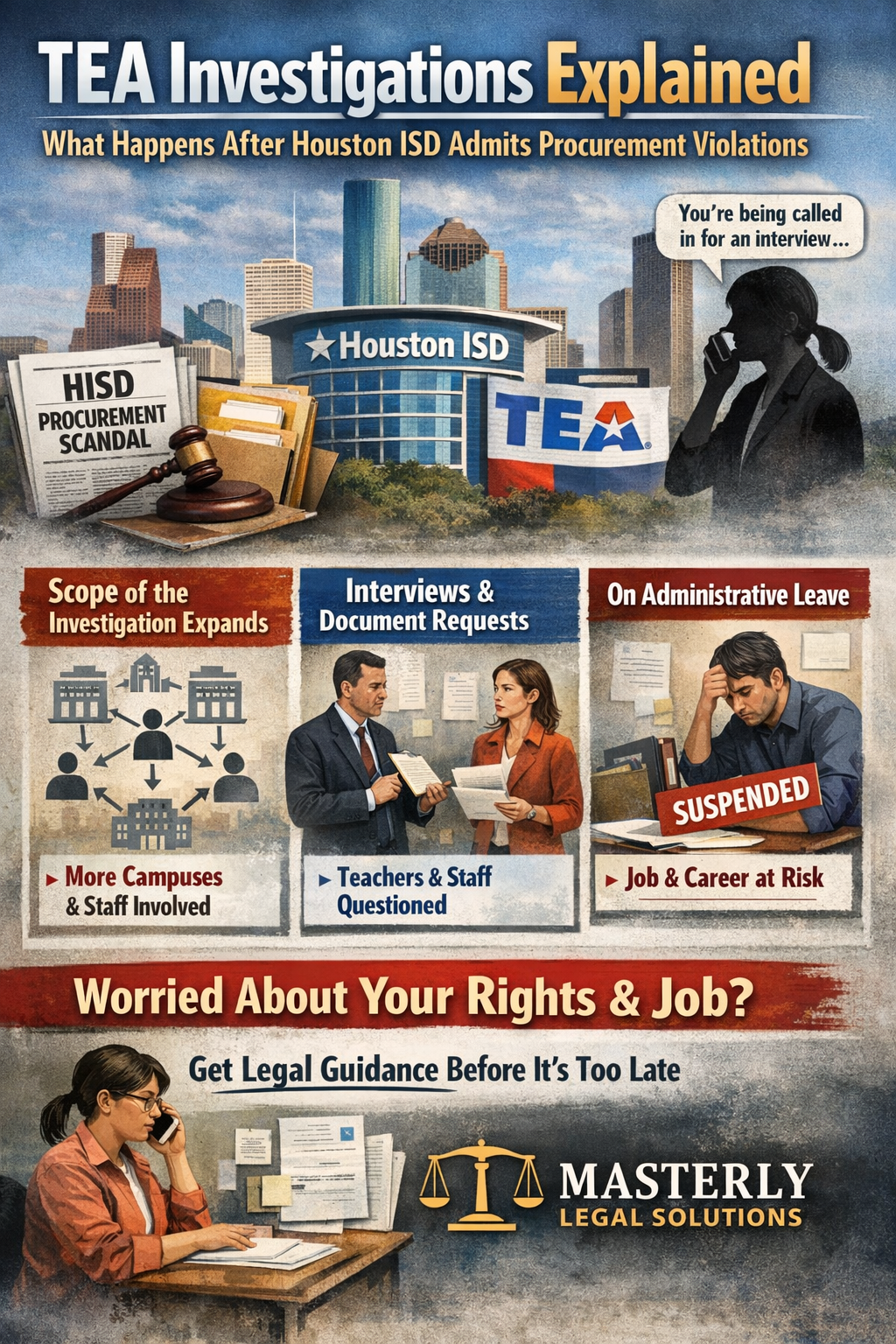
When a major school district publicly admits procurement violations, it doesn’t just create headlines—it can trigger a chain reaction inside the public education system. That kind of admission often becomes the starting point for deeper reviews, more interviews, and broader scrutiny. And while the public discussion usually focuses on leadership decisions, the reality is that individual employees can get pulled into the process fast. Many teachers and campus-level professionals are contacted without warning, even if they had nothing to do with the purchasing process.
At Masterly Legal Solutions, we know that TEA activity can expand quickly after public admissions. Once investigators begin looking for patterns, accountability, and documentation, the scope of a case can widen beyond the original allegation. That expansion can affect people in procurement roles, administrators, and sometimes employees who were simply copied on emails or present during meetings. Even if you believe you did everything right, you still need to understand what a TEA investigation looks like and how it can affect your career.
This article breaks down what the TEA investigation process typically involves, why investigations expand after public admissions, and what educators should do if they receive a call, email, or request for an interview. We also explain how workplace rights, legal protections, and federal and state laws may apply when an employer takes action during a sensitive investigation. If you’ve been placed on administrative leave or you’re worried your job is at risk, the right legal guidance can help you respond strategically instead of emotionally.
Why the Houston ISD Admission Matters to TEA Investigations
Public admissions change the tone of an investigation. When a district admits procurement violations, TEA may view the issue as confirmed enough to warrant deeper analysis. That doesn’t automatically mean everyone is guilty of wrongdoing, but it does mean TEA may look harder at how decisions were made. In these situations, TEA often looks for systemic breakdowns, not just one bad decision.
A public admission also creates urgency for officials who want to show accountability. That can increase the likelihood of interviews, document requests, and internal disciplinary steps. The district may also attempt to control the narrative by acting quickly against employees. Unfortunately, speed can sometimes lead to unfair outcomes for individual employees.
In practical terms, the Houston ISD admission can become a reference point that expands the investigation. It may influence how TEA views internal controls, training practices, and compliance culture. Even educators outside purchasing departments may be questioned if their campus budgets, vendors, or programs are connected. That is why this issue is not “just administrative”—it can become personal very quickly.
What TEA Investigations Typically Focus On After Procurement Violations
Procurement violations often raise concerns beyond money. They can suggest failures in oversight, approval processes, or ethical boundaries. TEA may want to know whether a district’s procedures were followed and whether anyone benefited from improper purchasing activity. In many cases, TEA also evaluates whether district leadership responded appropriately once concerns were raised.
A TEA investigation may examine whether contracts were awarded fairly, whether vendors were vetted properly, and whether staff were pressured into signing approvals. It can also include reviewing communications and meeting notes. Even routine messages can be interpreted as suspicious when investigators are trying to build a timeline.
It’s also common for TEA to assess the workplace culture around compliance. If employees felt they couldn’t speak up, that becomes a major red flag. That is where issues like retaliation and protected activity can come into play. Educators should understand that even if they did not commit any violation, they can still become a key part of the investigation.
How TEA Investigations Expand After Public Admissions
Investigations often expand because admissions create momentum. Once the district confirms wrongdoing, TEA may assume there are additional issues not yet discovered. The agency may ask broader questions, request more records, and widen the scope to include multiple campuses or departments. That expansion can happen quickly and quietly.
In many cases, the first round of questions is limited to procurement officials. Then TEA may start looking at who approved spending, who signed off on purchases, and who benefited from vendor relationships. The investigation may also include “why” questions, such as why policies were not followed and who had authority to override them. As a result, more employees become involved.
For teachers, the risk is often indirect. A teacher might be contacted because of grant spending, classroom materials, program contracts, or vendor-funded initiatives. Teachers may be asked what they knew, when they knew it, and what they observed. Even innocent answers can be misinterpreted if not handled carefully.
Who Gets Contacted During a TEA Investigation
Many educators assume TEA only contacts administrators. That is not always true. TEA can contact teachers, coordinators, specialists, and campus employees who were involved in budgets, purchasing requests, or vendor relationships. Sometimes TEA contacts individuals simply because their name appears in an email chain.
Employees can also be contacted as potential witnesses. You might be asked to verify whether policies were followed, whether a supervisor pressured staff, or whether you saw anything concerning. In some cases, TEA may want to test whether people’s stories match. That can place a lot of stress on individual employees.
It’s important to remember that TEA investigations can involve interviews, written statements, and documentation requests. Teachers may feel caught off guard and pressured to respond quickly. But responding quickly without a plan can create problems later, especially if your words are used out of context.
The First Signs You May Be Involved in a TEA Investigation
Some people only find out they are involved when they receive an email requesting a meeting. Others learn about it when they are asked to provide documents or answer questions. A few educators discover it when they are suddenly placed on administrative leave. The earlier you recognize the signs, the better prepared you can be.
Common early warning signs include unusual meetings with HR, requests for emails, or sudden changes to job assignments. You might also notice a supervisor acting nervous or distant. Sometimes co workers begin asking questions because rumors spread quickly in a workplace. Even if you are not accused of misconduct, you may still be treated like a risk.
Another major warning sign is being asked to provide a written statement. Many employees think a statement is “just clarifying things,” but it can become evidence. If your employer later denies what was said verbally, your written words may be used to justify adverse actions. That is why it is important to approach any statement carefully.
What Happens When a District Starts Internal Reviews Alongside TEA
Districts often run internal reviews at the same time TEA is investigating. This can include internal audits, compliance checks, and interviews by district personnel. In many cases, HR and legal teams will move quickly to gather information. That can create pressure on employees to cooperate immediately.
Internal investigations can lead to disciplinary measures even before TEA finishes its work. That is one reason employees may face administrative leave early. The district may claim it is a neutral step, but administrative leave can still damage employee morale and reputation. It can also create fear and confusion among workers.
Employees should understand that internal investigators may not be neutral. Their role is often to protect the employer and reduce liability. If the employer denies wrongdoing publicly, internal actions may be used to show they are “taking it seriously.” Unfortunately, that can lead to rushed employment decisions that harm individual employees.
Administrative Leave and What It Really Means for Educators
Administrative leave is often presented as “standard procedure.” Employers may claim it is not discipline and that it is temporary. But for many educators, administrative leave feels like a public accusation. It can isolate the employee, disrupt work hours, and create anxiety about job security.
Even when leave is paid, it can still have consequences. Your colleagues may assume the worst, and rumors can spread fast. You may lose access to email systems and teaching resources. You may also be told not to contact co workers, which can make it difficult to gather information.
Administrative leave can also be the first step toward termination. In some cases, it is used as a holding pattern while the employer builds a case. That is why it is important to treat it seriously and seek legal guidance early. A proactive response can protect your career and your professional reputation.
Why Teachers Are Often Contacted Without Warning
Teachers are often contacted without warning because TEA and districts move quickly when they suspect risk. Once procurement issues become public, officials may rush to gather statements. Teachers can be viewed as accessible sources of information, especially if they were involved in programs tied to vendors. Even being copied on a purchase-related email can bring attention.
Teachers may also be asked about workplace culture and whether employees were encouraged to follow laws and policies. Investigators want to know if staff felt pressure to comply with questionable decisions. They may ask whether you ever raised concerns or whether reporting discrimination or misconduct was discouraged. Those questions can be uncomfortable and emotionally draining.
Some educators assume they can “clear things up” by speaking casually. But interviews are not casual, even if the tone feels friendly. Your words can be used to support or contradict someone else’s version of events. That is why preparation matters.
The Role of Documentation in TEA Investigations
Documentation is one of the biggest factors in TEA investigations. Investigators often rely on paper trails to confirm timelines and responsibilities. This can include purchase orders, vendor contracts, email approvals, and internal policy documents. Even small details can become important.
Employees should understand that documentation is not always interpreted fairly. A simple email saying “approved” can be seen as decision-making authority, even if you were only acknowledging receipt. A meeting invite can be used to suggest you were involved in planning. That is why context matters.
If you are asked to provide documents, you should respond carefully. You should not delete anything or attempt to “clean up” records. Doing so can create serious consequences. A better approach is to stay organized and get legal support so you understand your responsibilities and legal protections.
Interviews, Statements, and the Risk of Misinterpretation
Interviews are one of the most stressful parts of an investigation. Employees often feel like they must answer immediately. They may worry that refusing to speak will make them look guilty. But rushing into an interview can lead to mistakes, contradictions, or unclear answers.
A written statement can be even riskier. Once it is submitted, it becomes permanent. If you later remember details differently, it may look like dishonesty. Investigators may also compare statements across multiple witnesses. If your wording differs, they may assume someone is lying.
It’s also important to recognize that investigators may ask questions in a way that leads you to a conclusion. They may phrase questions as if a fact is already proven. If you agree without realizing it, you may unintentionally confirm something you don’t actually know. That is why careful communication matters.
How Employment Contracts and Policies May Affect Your Rights
Some educators have employment contracts that define expectations and disciplinary procedures. Others work under district policies and state agency rules. These documents can impact what happens during an investigation. They may affect timelines, hearing rights, and how discipline is handled.
Employment contracts may also include clauses about cooperation, confidentiality, and conduct. Employees should understand what they signed and what policies apply. Even if you are not accused of wrongdoing, the employer may claim you violated a policy by how you responded. That can create additional problems.
Policies can also impact whether you are reassigned to a less desirable position or removed from leadership roles. Even temporary changes can affect your career path. If the employer frames the change as “operational,” it may still be harmful. Understanding the rules helps you respond strategically.
Workplace Discrimination Risks During High-Pressure Investigations
When investigations happen, stress levels rise. In that environment, workplace discrimination can increase. Some employees become targets because of personality conflicts, office politics, or bias. Others are treated unfairly because they are seen as “easy to blame.” Investigations can create a convenient excuse for bad employment practices.
Workplace discrimination can show up in many forms. It may include being singled out, excluded, or treated differently than other staff. It may also involve harsher discipline for certain employees. When an employer is under pressure, fairness can be the first thing to disappear.
Employees should understand that discrimination is not always obvious. It can be subtle, like being removed from a desirable position or being assigned extra scrutiny. It can also involve harassment, rumors, or unfair performance reviews. If you suspect discrimination, documenting what happens can be important.
Protected Classes and Common Discrimination Concerns in Schools
Educators are protected under various federal and state laws. These laws protect employees from discrimination based on certain characteristics. Common protected areas include national origin, sex discrimination, and age discrimination. In some cases, immigration status may also create complicated issues, especially when misinformation spreads.
Age discrimination can occur when older educators are treated as “replaceable” or blamed for institutional problems. Gender discrimination can show up when leadership assumes certain employees are less credible. Sexual orientation discrimination may occur through subtle hostility, exclusion, or biased discipline. These issues often become worse during investigations because fear makes people act recklessly.
The discrimination in employment act and age discrimination in employment protections exist for a reason. Educators should not be treated unfairly because of who they are. Title VII also plays a major role in discrimination and retaliation claims. Understanding these protections helps employees recognize when something is wrong.
Direct Discrimination vs. Subtle Discrimination
Direct discrimination is when someone is treated differently because of a protected trait in an obvious way. For example, if a supervisor makes comments about age discrimination or openly treats someone differently because of national origin, that can be direct discrimination. It can be easier to identify, but it is not always easy to prove without evidence.
More often, discrimination is subtle. It may look like being passed over for job assignments or being blamed for mistakes others made. It can include being isolated, monitored, or criticized unfairly. It can also show up through inconsistent discipline where one employee is punished and another is not.
Subtle discrimination can be harder to confront because the employer may deny bias. They may claim it was about performance or policy. That is why careful documentation matters. A pattern of unfair treatment can support a discrimination claim even when no one admits it.
Harassment and Hostile Work Environments During Investigations
Harassment can increase when investigations are public. Employees may gossip, accuse, or treat someone like they are guilty. Supervisors may act cold or aggressive. A workplace can become hostile quickly, especially when rumors spread. That environment can harm mental health and professional confidence.
Harassment can include inappropriate comments, intimidation, or humiliation. It may also involve retaliation, like being excluded from meetings or denied support. Even if the harassment is not sexual, it can still be unlawful if it is based on protected characteristics. Title VII can apply in harassment situations when the conduct is tied to discrimination.
Employees should not be expected to tolerate harassment just because an investigation is happening. Schools are still workplaces, and laws protect employees. If harassment becomes severe or persistent, it may create legal exposure for the employer. Knowing your rights can help you decide how to respond.
Retaliation: The Most Common Hidden Issue in School Investigations
Retaliation is one of the most common issues in employment cases. It often happens when an employee speaks up or cooperates with an investigation. Retaliation occurs when an employer punishes someone for engaging in protected activity. That punishment can be obvious, like termination, or subtle, like negative performance reviews.
Retaliation can include being moved into a less desirable position or losing leadership responsibilities. It can also involve changes in work hours, increased scrutiny, or unfair discipline. Sometimes retaliation is done quietly so it looks like “normal management.” But patterns often reveal the truth.
Schools and districts may claim they are simply “protecting operations.” But if actions are tied to reporting discrimination or cooperating with investigators, it may be unlawful. Laws prohibit retaliation, and employees have legal protections against it. Understanding retaliation helps you recognize when your employer crosses the line.
What Counts as Protected Activity in the Workplace
Protected activity includes actions like reporting discrimination, participating in an investigation, or requesting reasonable accommodations. It can also include filing a complaint about harassment or workplace discrimination. Even informal reports to supervisors may qualify. Many employees don’t realize they have rights until retaliation begins.
Protected activity can also include refusing to participate in wrongdoing. If you refuse to approve improper purchases or you raise concerns about violations, that may be protected. Whistleblower laws may also apply in certain circumstances. These laws protect employees who report misconduct in good faith.
It is important to understand that protected activity does not require you to “prove” the wrongdoing. You only need to have a reasonable belief that something is wrong. Employers sometimes try to punish employees for speaking up. But the law is designed to protect those who act responsibly.
Reporting Discrimination the Right Way During a Sensitive Investigation
Reporting discrimination during a TEA investigation can feel risky. Employees worry they will be labeled a troublemaker. They may fear retaliation or job loss. But staying silent can allow discrimination to continue. The key is reporting discrimination in a careful, documented way.
Employees should follow district procedures when possible. Reporting through HR or designated channels can create a record. Written complaints are often stronger than verbal ones. If you are concerned about retaliation, documenting your report can help protect you later.
You should also avoid emotional language that can be twisted against you. Focus on facts, dates, and specific incidents. Describe what happened and how it affected your work. This approach can strengthen your credibility and protect you if the employer denies wrongdoing.
The Equal Employment Opportunity Commission and Discrimination Claims
The equal employment opportunity commission plays a major role in employment discrimination cases. In many situations, employees must go through the EEOC process before filing certain lawsuits. This process can involve submitting a charge, providing documentation, and responding to employer statements. It is not a quick process, but it can be powerful.
Employees often feel intimidated by the process. They may worry they will face retaliation or be blacklisted. But the EEOC exists to enforce laws protect employees from discrimination and retaliation. Title VII, the americans with disabilities act, and other federal law protections can be part of this process.
If you are considering filing a claim, legal guidance matters. A well-prepared charge can make a major difference. It can also help you avoid mistakes that weaken your case. The earlier you get advice, the better your strategy can be.
Disabilities, Reasonable Accommodations, and Undue Hardship
Educators with disabilities are protected under the disabilities act and the americans with disabilities act. These laws require employers to provide reasonable accommodations when appropriate. That could include adjustments to schedules, duties, or workplace arrangements. During investigations, these rights do not disappear.
Sometimes districts act like accommodations are inconvenient. They may claim it creates undue hardship. But undue hardship is not just inconvenience—it must be significant difficulty or expense under the law. Employers must engage in a good faith process to explore accommodations. Ignoring requests can create legal exposure.
Employees should document accommodation requests in writing. They should also keep records of responses. If an employer denies the request, they should explain why. If the employer refuses to discuss it, that may be a problem. These protections exist to keep employees from being pushed out unfairly.
Medical Leave Act, FMLA Leave, and Job Protected Leave
Many educators don’t realize that job protected leave may apply when serious health issues arise. The medical leave act and FMLA leave can provide protections for eligible employees. This may apply to your own condition or a family member’s condition. During stressful investigations, medical issues often increase, and leave becomes necessary.
FMLA leave can protect your job while you address health needs. It can also help prevent wrongful termination based on absences. However, you must follow the proper process and provide required documentation. Employers sometimes push back, but employees still have rights.
Employees should not be shamed for using leave. Taking leave is not misconduct. It is a legal right in many situations. If the employer treats leave as a reason for discipline, that can raise serious concerns. A careful strategy can help protect you.
Family Responsibilities and Workplace Bias
Family responsibilities can sometimes create workplace tension. Some educators are treated unfairly because they need flexibility for childcare or elder care. Others are judged for taking leave or adjusting schedules. During investigations, these biases can worsen because management wants quick compliance.
Employees with family responsibilities may be targeted as “less committed.” They may be denied opportunities or pushed into less desirable position assignments. That kind of treatment can be discriminatory depending on the circumstances. It can also be tied to gender discrimination in certain cases.
Educators should not be punished for having a personal life. Schools rely on dedicated workers, but dedication does not mean sacrificing everything. If you notice bias connected to family responsibilities, document it. Patterns matter when building a case.
Immigration Status, National Origin, and Unfair Targeting
National origin discrimination is a serious issue in workplaces, including schools. During investigations, employees may face unfair assumptions based on accent, background, or cultural differences. Immigration status can also become a point of misinformation or harassment. Even when immigration status is irrelevant to the investigation, rumors can spread.
Employees may be treated differently in interviews or discipline decisions. They may be spoken to more harshly or questioned more aggressively. That is not acceptable. Federal and state laws protect employees from national origin discrimination. Title VII is often central in these cases.
If you believe you are being targeted because of national origin, take it seriously. Keep records of comments, actions, and comparisons to how others are treated. Even small details can matter. Legal protections exist to stop unfair treatment and retaliation.
Overtime Pay, Work Hours, and Compensation Concerns
Investigations can disrupt normal work hours. Employees may be asked to stay late for meetings or complete extra tasks. Sometimes they are pressured to work without proper compensation. Overtime pay issues can arise, especially for staff who are not exempt employees.
Compensation disputes can become part of broader workplace conflict. If an employer is under pressure, they may cut corners. That can create wage and hour problems. Employees should track their hours and keep records of extra duties.
Even if overtime pay is not the main issue, it can reflect broader employment practices. A workplace that ignores wage rules may also ignore discrimination protections. Patterns of unfair treatment can connect. Documentation is always important.
Occupational Safety and Emotional Stress During Investigations
Occupational safety is not only about physical hazards. Investigations can create intense stress, anxiety, and emotional strain. Employees may fear losing their job or reputation. They may also face harassment, threats, or intimidation. In extreme cases, stress can lead to physical harm or serious health issues.
Employers have responsibilities to maintain a safe workplace. That includes addressing threats, harassment, and hostile environments. If co workers engage in intimidation, management should intervene. Ignoring it can create liability.
Employees should not assume they must endure unsafe conditions. If you feel threatened or harassed, report it. Document what happens and when. If management fails to act, that can strengthen your position. Your safety matters, even in a high-pressure environment.
How Employers Use Investigations to Justify Adverse Actions
Adverse actions can include suspension, demotion, reassignment, or termination. Employers may use investigations as justification for these actions. They may claim the employee violated policy or failed to cooperate. In some cases, the employer denies wrongdoing but still punishes employees to appear decisive.
This is where wrongful termination concerns arise. If an employee is fired unfairly, the employer may try to frame it as “investigation-related.” But if the real reason is discrimination or retaliation, the termination may be unlawful. Employment discrimination and retaliation cases often involve these tactics.
Employees should also watch for changes in job assignments. Being removed from a desirable position or placed in a less desirable position can be a warning sign. These actions can harm your career even if you keep your job. Legal guidance can help you evaluate what is happening.
Performance Reviews and Sudden Paper Trails
During investigations, some employers begin creating a paper trail. Employees who previously had positive feedback may suddenly receive negative performance reviews. This can be used to justify discipline or termination later. It can also be used to defend against claims of discrimination or retaliation.
A sudden shift in evaluations should raise concern. If your performance was not an issue before, ask why it is now. Request clarification in writing when appropriate. Keep copies of prior evaluations and praise emails. Those documents can help prove the change is unfair.
Employers sometimes use vague language in reviews to make it hard to challenge. They may say you have “attitude issues” or “communication problems.” These claims can be subjective and discriminatory. If you believe the review is unfair, legal support can help you respond.
Settlement Negotiations and Strategic Resolution Options
Not every case ends in a hearing or lawsuit. Some cases resolve through settlement negotiations. This can include resignation agreements, reinstatement, or negotiated terms that protect your record. Settlement negotiations can be an important option when you want to protect your future career.
Employees should not assume settlement means weakness. Sometimes it is the smartest move. It can allow you to move forward without prolonged conflict. It can also prevent future discrimination by forcing the employer to change behavior. The key is negotiating from a position of strength.
Having legal guidance during negotiations matters. Employers often have attorneys and HR professionals guiding them. Employees deserve the same level of protection. A well-prepared approach can help you avoid signing something harmful. Your future matters, and the terms should reflect that.
How State Laws and Local Laws Shape Educator Rights
Educators in Texas are impacted by state laws, local laws, and state and local laws that shape employment relationships. State agency rules also play a role, especially when certification and professional discipline are involved. These rules can affect timelines, reporting, and procedures. Understanding them is critical when TEA is involved.
State laws may also impact how investigations are conducted and what rights employees have. Federal law provides baseline protections, but state laws can add additional requirements. Local laws may also apply depending on the district and circumstances. These layers can be confusing, especially under stress.
This is why employees should not rely on assumptions. What you “heard” from co workers may be wrong. Policies can change, and interpretations can vary. Getting legal guidance can help you understand your options. It can also help you avoid mistakes that harm your case.
Federal Employees vs. School District Employees: Why It Still Matters
While most educators are not federal employees, federal protections still matter because many workplace laws are federal. Title VII, the civil rights act, and the americans with disabilities act apply broadly. These federal protections help define what employers can and cannot do. Even when the workplace is local, the legal standards often come from federal law.
Federal and state laws often work together. For example, discrimination protections may come from both federal and state sources. The discrimination in employment act and age discrimination in employment protections are federal-based standards that shape workplace fairness. These protections can apply even when the employer is a local district.
Understanding federal protections can also help employees recognize violations. If your employer claims “this is just how we do it,” that doesn’t mean it’s legal. Laws protect employees even when employers act aggressively. Your rights do not disappear because the employer is under pressure.
Employment Act, Civil Rights Act, and Title VII in Plain Language
Many educators hear terms like employment act, civil rights act, and title vii but don’t know what they mean. These laws exist to protect employees from discrimination in the workplace. They also help prevent retaliation against those who report discrimination or harassment. These protections are essential when investigations create chaos.
Title VII is a key part of workplace discrimination law. It addresses discrimination based on race, color, religion, sex discrimination, and national origin. It also plays a role in harassment and retaliation cases. The civil rights act provides a broader foundation for workplace fairness.
These laws are not just technical rules. They impact real careers, real paychecks, and real reputations. When employers ignore them, employees can suffer serious harm. Knowing these protections helps you respond with confidence. It also helps you recognize when to seek legal help.
Employment Lawyers and Labor and Employment Lawyers: When to Call
Many educators wait too long to contact employment lawyers. They hope the issue will blow over. They assume the employer will be fair. But once an investigation begins, decisions can happen fast. That is why early legal guidance is often the safest approach.
Labor and employment lawyers can help you understand your rights, respond to interviews, and protect your professional record. They can also help you recognize discrimination, harassment, and retaliation patterns. If you are facing wrongful termination risk, legal support can be critical. Even small steps early can prevent bigger damage later.
At Masterly Legal Solutions, we help educators approach investigations with strategy and calm. You don’t have to guess what to say or do. You don’t have to face the employer alone. The goal is to protect your career and your future.
What to Do If Your Employer Denies Unfair Treatment
It is common for an employer denies wrongdoing, even when the employee has strong evidence. Employers may claim they followed policy and treated everyone equally. They may deny discrimination, deny retaliation, or deny harassment occurred. That denial can feel frustrating and invalidating.
The best response is to focus on facts and documentation. Keep records of emails, schedules, assignments, and comments. Track changes in treatment and compare how others were treated. This helps show patterns of workplace discrimination. It also supports your credibility if the case escalates.
Employers often rely on employees giving up. They expect people to feel overwhelmed and resign. But legal protections exist for a reason. Laws protect employees when employers cross the line. A structured approach can help you hold the employer accountable.
How to Protect Yourself During a TEA-Related Investigation
If you are contacted during a TEA investigation, you should take the situation seriously. Even if you are not accused of wrongdoing, your words and actions matter. Staying calm and organized is the best first step. Panic often leads to mistakes.
Here are smart steps employees can take early:
- Keep your communications professional and factual
- Save copies of relevant documents and emails
- Write down timelines while your memory is fresh
- Avoid gossiping with co workers about the investigation
- Do not assume the employer is protecting you
- Seek legal guidance before signing statements or agreements
These steps can protect your career and reduce risk. They also help you respond with confidence. You don’t have to be defensive—you just have to be prepared.
Avoiding Future Discrimination and Career Damage After the Investigation
Even after an investigation ends, employees may face future discrimination. Some educators are labeled as “problems” simply because they were involved. Others are quietly pushed out over time. This is why your response during the investigation matters. The goal is not just survival—it is protecting your long-term career.
Employees should watch for changes in treatment after the case ends. This includes job assignments, evaluations, and opportunities. If you are excluded or punished, document it. Retaliation can happen months later, not just immediately. Retaliation cases often involve delayed patterns.
Educators should also focus on restoring their professional standing. That may include requesting clarification letters, correcting records, or negotiating terms. A proactive approach can prevent lasting harm. Your reputation is valuable, and it deserves protection.
When Investigations Turn Into Employment Discrimination Cases
Sometimes a TEA investigation is only the beginning. If the employer responds unfairly, the situation can become an employment discrimination issue. This can involve discrimination based on age, national origin, sex discrimination, or other protected areas. It can also involve retaliation for protected activity. These cases can escalate quickly.
Employment discrimination cases often involve a mix of factors. There may be discrimination, harassment, and retaliation happening at the same time. There may also be wrongful termination threats. Employers may try to justify actions as “investigation-related,” but the law still applies. Federal and state laws protect employees even in chaotic situations.
If you believe the employer is using the investigation as an excuse to remove you, take it seriously. You may have more rights than you think. Legal protections exist to prevent abuse of power. The sooner you get advice, the more options you may have.
What Masterly Legal Solutions Wants Educators to Remember
If you take nothing else from this article, remember this: investigations expand after public admissions, and educators often get pulled in without warning. Even if you did nothing wrong, you can still face stress, isolation, and career risk. Administrative leave can feel like the ground disappears under your feet. And unfair workplace decisions can happen fast.
You do not have to handle this alone. The workplace can become unpredictable when the employer is under pressure. Discrimination and retaliation can rise, even when the original issue had nothing to do with you. Laws protect employees, but those protections only help if you use them wisely. A careful, strategic response can protect your job, your license, and your future.
At Masterly Legal Solutions, we believe educators deserve respect and fairness. You’ve worked hard to build your career, and you shouldn’t lose it because of someone else’s mistakes. If you are being questioned, isolated, or treated unfairly, now is the time to take action. Getting the right support early can make all the difference.
Retaliation Complaint Options and What They Can Lead To
If you believe retaliation has occurred, filing a retaliation complaint may be one of the most important steps you can take to protect your career and your rights. These cases are often employee based, meaning the facts, timeline, and documentation you personally experienced can shape whether the claim is taken seriously. When retaliation is proven, the consequences for an employer can be significant, and in some cases, the outcome may include financial accountability such as punitive damages. At Masterly Legal Solutions, we help educators understand how to document retaliation properly, avoid common mistakes, and take action in a way that strengthens their position instead of putting their job at greater risk.
Contact Masterly Legal Solutions for a Free Consultation
If you’ve been contacted about a TEA investigation, placed on administrative leave, or you feel your employer is preparing to take adverse actions against you, we encourage you to reach out sooner rather than later. These situations move quickly, and what you say in the early stages can shape what happens next. A free consultation can help you understand your options, your legal protections, and what steps to take to protect your career.
At Masterly Legal Solutions, we work with educators who feel blindsided by sudden interviews, HR meetings, discipline threats, and investigation pressure. Whether you’re facing retaliation, harassment, workplace discrimination, or fear of wrongful termination, we are here to help you respond with clarity and confidence. Call (972) 236-5051 for a free consultation, and let’s talk about what’s happening and how to protect your future.
Disclaimer: This article is for educational purposes only and does not constitute legal advice or legal guidance. Every situation is different, and reading this article does not create an attorney-client relationship. For legal advice about your specific circumstances, contact Masterly Legal Solutions



Teacher Rights When Assaulted by a Special Needs Student: Safety, Reporting and Investigation Issues



Looking for Legal & Business Solutions? Contact Us Now
Fill in the form or call us to set up a meeting