Administrative Hearings vs. HR Interviews: What Educators Don’t Realize About TEA Cases

March 24, 2026

Educators across Texas often assume that a workplace conversation is just that—a conversation. In reality, when a complaint is tied to a TEA investigation, even a routine HR interview can quietly transform into something much more serious. Many professionals in frisco tx and across north texas only realize the stakes when it is already too late.


At Masterly Legal Solutions, our law firm has seen how these situations unfold. Teachers, administrators, and staff members frequently underestimate how statements made early in the process can shape outcomes in administrative hearings, employment actions, and even future litigation. With experience in employment law, civil litigation, and complex legal issues, our legal team understands the procedural traps that can impact your career, your certification, and your job security.


The Hidden Divide Between HR Interviews and Administrative Hearings


Why These Processes Are Not the Same

Many educators believe HR interviews are informal and administrative hearings are formal. While that is technically true, the reality is far more complex. HR interviews often act as the foundation for what later becomes evidence in a formal proceeding.


In employment law, early statements can be used to establish patterns, intent, or credibility. What seems like a routine discussion may later be referenced in state and federal courts, including administrative tribunals connected to TEA cases.


How Educators Misinterpret HR’s Role

Human Resources departments are not neutral advocates. Their role is to protect the institution. That means their priorities may not align with protecting individual employee rights.


Educators in frisco tx often assume HR is there to “help,” but in reality, HR is documenting information that could be used in disciplinary proceedings, termination decisions, or even referrals to regulatory bodies.


What Happens During an HR Interview


The Interview Is a Record-Building Tool

Every statement you make during an HR interview can be documented. These records can later be introduced in administrative hearings or other legal process stages.

Even minor inconsistencies can be used against you. This is especially true in cases involving workplace discrimination, sexual harassment, or allegations of domestic violence.


Common Missteps Educators Make

Educators often walk into HR interviews without preparation. This creates risk. Some of the most common mistakes include:

  • Speaking without understanding the full allegation
  • Trying to “clear things up” too quickly
  • Providing unnecessary details that complicate the narrative
  • Assuming honesty alone will protect them


Even in family law matters like child custody disputes, professionals understand that statements matter. The same principle applies here.


Administrative Hearings: A Different Battlefield


The Formal Nature of TEA Proceedings

Administrative hearings are structured, evidence-driven, and governed by procedural rules. Unlike HR interviews, they resemble courtroom proceedings.

These hearings may involve:

  • Witness testimony
  • Cross-examination
  • Documentary evidence
  • Legal arguments from a trial attorney


Professionals trained in trial advocacy and trial practice understand that preparation is critical.


Why Early Statements Carry Weight

Statements made during HR interviews often become part of the evidentiary record. This means your words can follow you into the hearing.

Our law firm has handled numerous cases involving TEA investigations and educator license defense, where early statements shaped the outcome long before the hearing even began.


Procedural Traps Educators Rarely See


Trap One: Assuming Informality Means Safety

An HR interview may feel casual, but it is part of a structured legal process. Anything said can later be used in administrative proceedings or even civil litigation.


Trap Two: Not Understanding Fiduciary Duty

Educators often have obligations tied to fiduciary duty. This includes responsibilities toward students, parents, and institutions.

Misstatements or omissions during interviews can be framed as breaches of that duty.


Trap Three: Underestimating Documentation

Documentation is everything. HR records, emails, and written statements can be compiled into a case file that follows you into hearings.


Trap Four: Waiting Too Long to Seek Legal Help

Many educators delay contacting a law firm until formal proceedings begin. By then, the record is already established.


The Role of Legal Representation in TEA Cases


Why You Need a Trial Attorney Early

Engaging a trial attorney early can make a significant difference, especially when you need legal protection for teachers navigating complex regulations. Professionals with extensive litigation experience understand how to navigate both informal and formal stages.


Our legal team focuses on protecting educators at every step, from HR interviews to administrative hearings.


How Legal Strategy Changes Outcomes

An experienced trial counsel will:

  • Evaluate the allegations
  • Prepare you for questioning
  • Control the narrative early
  • Identify risks before they escalate


This approach is common in business litigation, commercial disputes, and even personal injury cases. The same strategy applies here.


Comparing TEA Cases to Other Legal Areas


Lessons from Family Law and Employment Law

In tx family law, early statements can impact child custody, property division, and outcomes involving domestic violence claims.

Similarly, in employment law, statements can influence retaliation claims, employment discrimination, and investigations by the equal employment opportunity commission, making specialized legal advocacy for educators facing misconduct allegations critical.


Overlapping Legal Principles

Across different practice areas, the same rules apply:

  • Statements create evidence
  • Evidence shapes outcomes
  • Early strategy matters


Whether it is criminal defense, personal injury, or family law matters, preparation is key.


The Importance of Legal Expertise


Why Specialized Knowledge Matters

TEA cases involve a unique intersection of administrative law, employment law, and regulatory compliance, often requiring expert legal support for teachers and schools. This requires a high level of legal specialization.


Professionals with a law degree and background in civil trial law understand how these elements interact.


Experience in State and Federal Courts

Cases may escalate beyond administrative hearings into federal courts or even reach the supreme court level in certain circumstances.

Our trial lawyers are experienced in representing clients across multiple jurisdictions.


Real Risks Educators Face


Career and Certification Consequences

A TEA investigation can impact:

  • Teaching certification
  • Employment status
  • Future job opportunities


Even allegations alone can affect your reputation.


Exposure to Additional Legal Issues

In some cases, educators may face parallel issues involving similar challenges described in legal insights for teachers and education professionals:

  • Criminal defense
  • Civil litigation
  • Claims related to deceptive trade practices


These risks highlight the importance of early intervention.


Why Educators in Frisco TX Must Be Cautious


Local Trends and Enforcement

Educators in frisco tx are seeing increased scrutiny in workplace investigations. School districts are more proactive in documenting complaints and escalating issues.


The Role of Frisco Lawyers

Experienced frisco lawyers understand the local landscape. They are familiar with regional policies, administrative procedures, and expectations within north texas, and how they intersect with legal support for educators facing TEA-related issues.


How Our Law Firm Supports Educators


A Comprehensive Legal Approach

At Masterly Legal Solutions, our law firm provides:

  • Strategic guidance during HR interviews
  • Representation in administrative hearings
  • Defense in related civil litigation matters


Our legal team brings an in depth understanding of TEA processes and offers expert legal guidance for teachers during investigations.


Leadership and Experience

Our founding and managing member has built a reputation for representing clients in complex cases. With experience across practice areas including employment law, family law, and business law, as well as education law legal services for teacher license defense, we provide well-rounded support.


Our attorneys include professionals trained at institutions like baylor university and baylor law school, holding a juris doctor and maintaining active membership with the state bar and collin county bar association.


The Value of Early Legal Strategy


Protecting Your Position from the Start

The earlier you involve a law firm, the better your chances of controlling the narrative. This is true in commercial litigation, white collar litigation, and TEA cases alike.


Building a Strong Defense

A proactive approach allows your trial counsel to:

  • Preserve evidence
  • Address inconsistencies
  • Prepare for hearings


This strategy reflects the same discipline used by top trial lawyers in high-stakes cases.


What Sets Our Legal Team Apart


Commitment to Representing Clients

We focus on representing clients with precision, strategy, and care. Whether dealing with family law matters, employment law disputes, or administrative hearings, our goal is to protect your future.


Broad Experience Across Practice Areas

Our practice areas include:

  • Family law and tx family law
  • Employment law and workplace investigations
  • Personal injury and civil litigation
  • Business law and business formation


This diverse background allows us to approach TEA cases with a comprehensive perspective.


Understanding the Bigger Picture


How One Case Can Impact Your Future

A TEA case does not exist in isolation. It can influence your ability to work, your professional reputation, and even personal matters like family dynamics.


The Need for Compassionate Guidance

Facing an investigation can be overwhelming. Our law firm provides compassionate guidance and unwavering support throughout the process.


Protecting Yourself from Procedural Mistakes


Key Takeaways for Educators

Educators should remember:

  • HR interviews are not informal conversations
  • Statements can be used later in hearings
  • Early legal advice is critical


These principles apply across all areas of law, from criminal defense to employment law.


When to Contact a Law Firm


Recognizing the Right Time

If you are contacted by HR regarding an investigation, that is the time to seek legal advice. Waiting until an administrative hearing is scheduled can limit your options.


The Advantage of Local Experience

Working with frisco lawyers who understand the nuances of frisco tx and north texas can provide a strategic advantage.
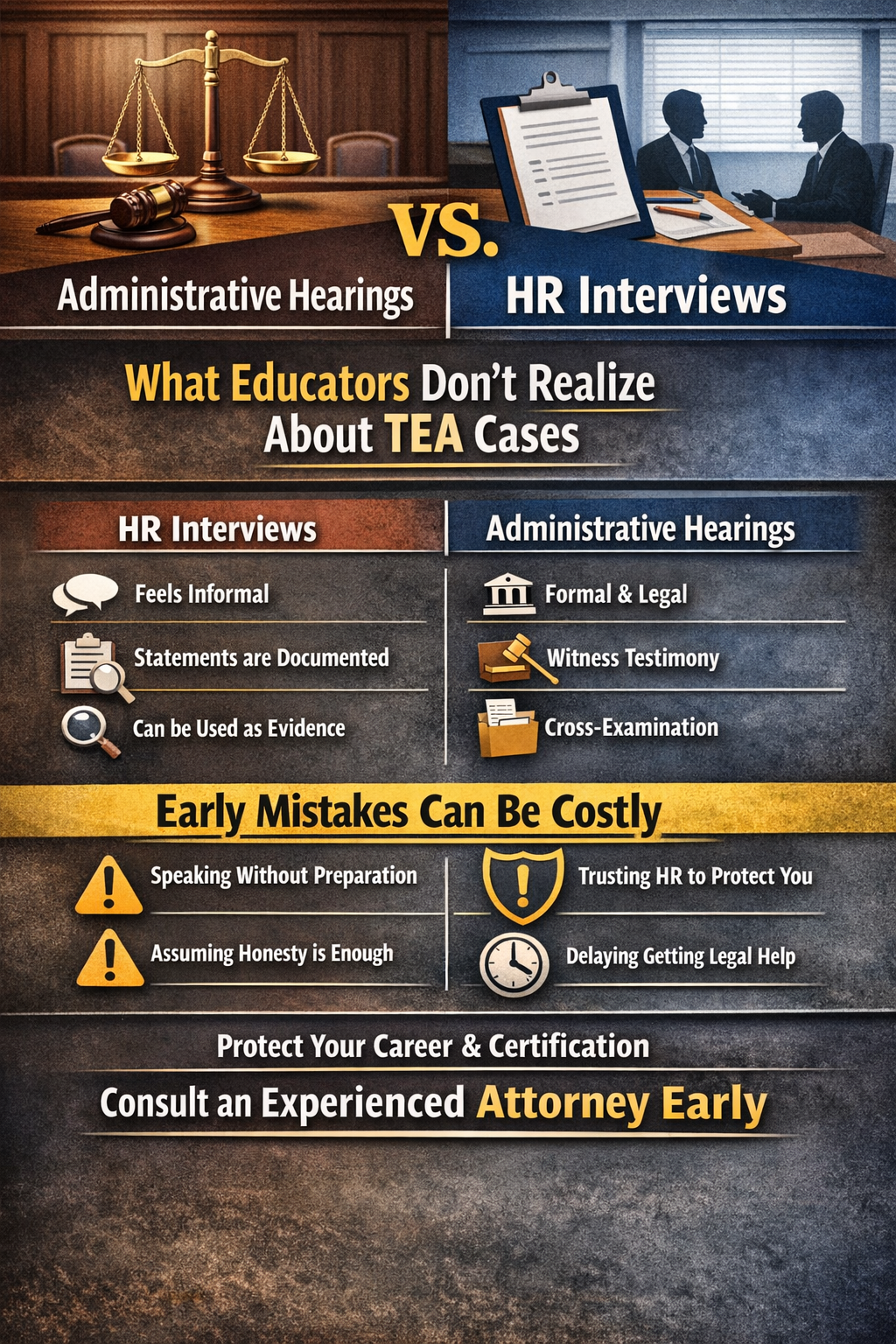
Administrative Hearings vs. HR Interviews infographic showing a split design: a courtroom with a judge’s gavel representing formal administrative hearings on one side, and an office HR meeting scene on the other. The graphic explains that HR interviews may feel informal but are documented and can be used as evidence, while administrative hearings involve formal legal procedures like witness testimony and cross-examination. It highlights common mistakes such as speaking without preparation and trusting HR to protect you, and emphasizes that early legal guidance is critical to protect an educator’s career and certification.


Experience That Extends Beyond the Classroom and Courtroom

At Masterly Legal Solutions, our background reflects a broad and dynamic legal foundation. Our team has collaborated with respected professionals, including frisco family law attorneys, and worked alongside an experienced associate attorney and seasoned employment law attorney on complex matters. Drawing insight from firms like freeman law, our lead counsel has developed a strong reputation for handling sensitive cases with precision. With guidance influenced by a former law professor and compliance awareness shaped by standards of the texas board, our approach reflects both academic depth and real-world application. Our exposure to diverse jurisdictions, including matters connected to the united states virgin islands, enhances our ability to adapt strategies across different legal environments.


Leadership, Credentials, and Strategic Advantage

Our managing attorney, who has experience as a dual credentialed attorney cpa, brings a unique perspective to each case, especially when financial or professional risks are involved. As professionals who have built their own firm, we understand the importance of reputation, structure, and long-term protection. Our team includes board certified professionals who possess a deep understanding of how procedural missteps can impact outcomes, and how TEA teacher license defense and Title IX issues can affect an educator’s career. We leverage advanced litigation technology to analyze evidence and strengthen defense strategies, ensuring our clients are fully prepared at every stage.


Protecting Educators from Complex and Overlapping Legal Issues

Educators facing TEA cases may also encounter overlapping concerns that resemble those seen in the divorce process, fathers rights enforcement, or disputes involving false accusations. These situations require careful navigation, as allegations—whether in the workplace or personal life—can quickly escalate and affect both professional and personal standing. Our experience allows us to identify risks early, provide strategic guidance, and ensure that our clients are protected from the consequences of misinterpretation or incomplete information.


Contact Masterly Legal Solutions for Guidance

If you are an educator facing an HR interview or a TEA-related administrative hearing, you do not have to navigate the process alone. At Masterly Legal Solutions, we understand how quickly these situations can escalate and how important it is to take the right steps early.


Our team is committed to representing clients with diligence and strategy, helping protect your career, your certification, and your future. Whether you are dealing with workplace allegations, procedural concerns, or complex legal issues, including those requiring an education law attorney for teachers and administrators, we are here to help you move forward with confidence.


Call us today at (972) 236-5051 to schedule your free consultation. We will take the time to listen, answer your questions, and provide clarity on your next steps. If you are searching for an attorney frisco educators trust, our team is ready to stand by your side and provide the unwavering support you deserve.


Disclaimer: This article is provided for educational purposes only and does not constitute legal advice. Every situation is unique, and you should consult a qualified attorney for guidance regarding your specific circumstances.
(972) 236-5051
November 5, 2026
A complaint at a Texas charter school can quickly place an educator's employment, professional reputation, and future career opportunities at risk. A written allegation, unexpected leave notice, or contract dispute may leave teachers and staff unsure about their rights or what the school can legally require. Unlike traditional public school districts, Texas charter schools operate under different governance and employment rules. These differences can affect how investigations proceed, whether an employee has certain contract protections, and which grievance procedures apply. Understanding texas charter school educator investigation rights is important for certified teachers, administrators, and noncertified employees facing workplace allegations. A charter school investigation may involve internal policies, employment agreements, state education regulations, or professional certification concerns. The applicable rules depend on the school's structure and the employee's position. Masterly Legal Solutions provides legal guidance for Texas educators facing investigations, employment disputes, and professional disciplinary concerns. Early consultation allows an attorney to examine the relevant documents, identify possible deadlines, and assess the educator's legal options before important decisions are made. How Charter School Governance and Employment Documents Differ From Traditional Districts Texas open-enrollment charter schools are public schools, but their employment relationships do not automatically follow the same rules as independent school districts (ISDs). Traditional school districts generally employ certain educators under probationary, term, or continuing contracts governed by the Texas Education Code. These arrangements provide statutory rights and procedures that may apply to contract renewal, termination, or other employment decisions. Charter schools often operate differently. Some charter schools use written employment agreements with specific terms. Others employ staff under at-will arrangements, subject to applicable laws and contractual limits. As a result, an educator should not assume that the protections available to an ISD teacher automatically apply to a charter school position. Why Charter School Employment Agreements Matter A charter school's governing documents, employment agreement, and adopted policies may help determine: Whether employment is at-will or governed by a fixed-term agreement. Who has authority to investigate or make employment decisions. What procedures apply to employee complaints or discipline. Whether an employee has internal appeal or grievance rights. How contract renewal, nonrenewal, or termination decisions are handled. Whether specific notice requirements or deadlines apply. The school's legal structure also matters. An open-enrollment charter school, a district-authorized charter campus, and a campus operated through a district partnership may involve different legal arrangements. Charter schools are not simply private schools. They operate within Texas public education and remain subject to applicable state and federal requirements. However, public school s tatus does not automatically provide every employment protection available in a traditional district. Masterly Legal Solutions c an review the educator's employment relationship and applicable school policies to determine which legal protections may apply to the dispute. Early Steps After an Educator Misconduct Complaint, Temporary Removal, or Written Allegation An educator may first learn about an investigation through an email from human resources, a meeting request, a written complaint, or a notice of temporary administrative leave tied to alleged educator misconduct. Sometimes, the notice provides little information about the allegations, including claims involving abuse, and being placed on leave is not a final determination. The school may ask for a written statement, request an interview, restrict campus access, or place the employee on leave while reviewing the complaint. These actions can create serious uncertainty, which is why immediate legal review is often critical. Why an Investigation Notice Deserves Legal Attention Temporary removal does not automatically mean an employee has committed misconduct. Schools may use administrative leave while collecting information or reviewing complaints involving alleged educator misconduct or suspected abuse. However, the terms of that leave may affect compensation, benefits, access to records, and employment status, and leave is not a final determination. An attorney may need to determine whether the notice is consistent with the employee's agreement, applicable policies, and due process protections. Legal review is especially important when the allegations involve: Student safety or inappropriate conduct. Professional boundary concerns. Workplace harassment, discrimination, or civil rights complaints. Failure to follow school policies. Alleged contract violations or performance concerns. Misuse of school resources or confidential information. Conduct that could trigger a report to the Texas Education Agency. Certified educators may face concerns beyond their current employment. Certain misconduct allegations can lead to review by the Texas Education Agency (TEA), and the available evidence may affect possible action involving the State Board for Educator Certification (SBEC) and an educator's certificate. Noncertified employees may also face state-level employment eligibility concerns in certain misconduct cases. An internal school investigation and a state regulatory investigation are separate matters. Their legal standards, procedures, and possible consequences may differ, especially where Texas law, state law, or school district reporting requirements may require a principal or superintendent to provide notice, ensure a report is filed within seven business days, or address related reports while administrators comply with agency rules. Obtaining legal advice before providing a detailed written response can help an educator understand which process is involved, protect process rights, prepare for possible disciplinary actions or administrative hearings, and assess whether allegations tied to children, special education services, procedural errors, or other issues could expand beyond an internal employment matter. What to Preserve: Contract, Handbook, Assignment, Communications, and Notices Texas charter school educator investigation rights often depend on documents that explain the employee's responsibilities, the school's policies, and the decisions made during an investigation. A legal consultation becomes more useful when counsel can examine reliable records rather than relying only on verbal descriptions. Several categories of documents may be especially important. Employment Contracts and Appointment Documents Signed contracts, offer letters, renewal agreements, and employment amendments can establish the terms of the working relationship. These records may show whether employment is at-will, whether notice provisions apply, and what contractual obligations exist. They can also help counsel evaluate allegations involving contract violations or termination. Employee Handbooks and Governance Policies Employee handbooks may explain workplace conduct rules, investigation procedures, grievance processes, and disciplinary standards. The version in effect when the relevant events occurred may be particularly important. An attorney can examine whether the school's actions are consistent with applicable policies and whether those policies create enforceable obligations. Job Assignments and Performance Records Job descriptions, assignment letters, duty schedules, evaluation records, and previous performance notices may help explain an educator's responsibilities. These materials can provide context when an allegation concerns supervision, workplace expectations, professional duties, or performance. Emails, Messages, and Written Communications Relevant communications may include messages from administrators, human resources personnel, supervisors, and other individuals involved in the matter. Dates, wording, and context may help establish a timeline. Educators should preserve records they are legally permitted to retain. They should not access restricted systems, remove confidential student information, or forward protected records to personal accounts without proper authorization. Investigation Notices, Disciplinary Actions, and Contract Actions Written allegations, leave notices, meeting invitations, disciplinary letters, proposed separation agreements, and termination notices may establish important facts and deadlines. These documents can help counsel determine whether immediate legal action or a timely response may be necessary. Related reports or other evidence tied to the communication chain may also matter when evaluating the investigation timeline, response, and any resulting disciplinary actions, including situations where school action may continue after a resignation. Preserving records does not mean collecting every school document . It means identifying relevant, lawfully accessible information while respecting student privacy and confidentiality requirements. Masterly Legal Solutions can help educators determine which materials are relevant to their legal circumstances and whether additional records should be requested through appropriate procedures. Questions for Counsel Before a Written Statement or Grievance Decision An educator may feel pressure to respond immediately after receiving an allegation. However, statements made during an employment investigation can become part of the school's decision-making record. In some circumstances, information may also be reviewed by outside agencies. Before responding, legal counsel can examine the allegations, the employment relationship, and any deadlines. Does the Charter School Have Authority to Take the Proposed Action? A lawyer can review whether the relevant administrator or governing body has authority under the school's policies and employment arrangements. The review may also address whether required notices or procedures apply. Is a Written Statement Required? The answer depends on the applicable employment terms, policies, and legal circumstances. Counsel can assess the request, the scope of the allegations, and the potential consequences of providing a statement. The goal is to make an informed decision without overlooking an existing duty to cooperate or respond. Is a Formal Grievance the Appropriate Response? Not every employment dispute follows the same grievance route. Texas charter schools may maintain their own employee complaint procedures, with specific filing requirements and deadlines. TEA directs many local employment concerns to the school or charter operator's internal grievance process rather than handling the underlying workplace dispute itself. Missing an applicable deadline can limit available options. An attorney can review whether a grievance, contractual claim, agency complaint, or another legal process may be appropriate. Could the Investigation Affect Professional Certification or Texas Education Agency Reporting? Certified educators should consider whether the allegations may involve TEA or SBEC review. An employment decision and a certification matter can have different consequences. Counsel can evaluate the relationship between these proceedings and help determine what representation or response may be needed.  Why Legal Representation Matters Before a Decision An employment investigation can involve several connected issues, including contracts, workplace policies, regulatory duties, and professional reputation. Without a careful legal review, an educator may misunderstand which procedures apply or overlook a significant provision in an employment agreement. Masterly Legal Solutions provides individualized legal guidance based on the educator's documents, allegations, and professional circumstances. The firm can assess applicable rights, explain available legal options, and assist with appropriate responses or proceedings based on the scope of representation.
Texas paraprofessional misconduct investigation and legal defense.
November 4, 2026
Facing a Texas paraprofessional misconduct investigation? Understand allegations, reporting requirements, and how experienced legal counsel can protect your rights.
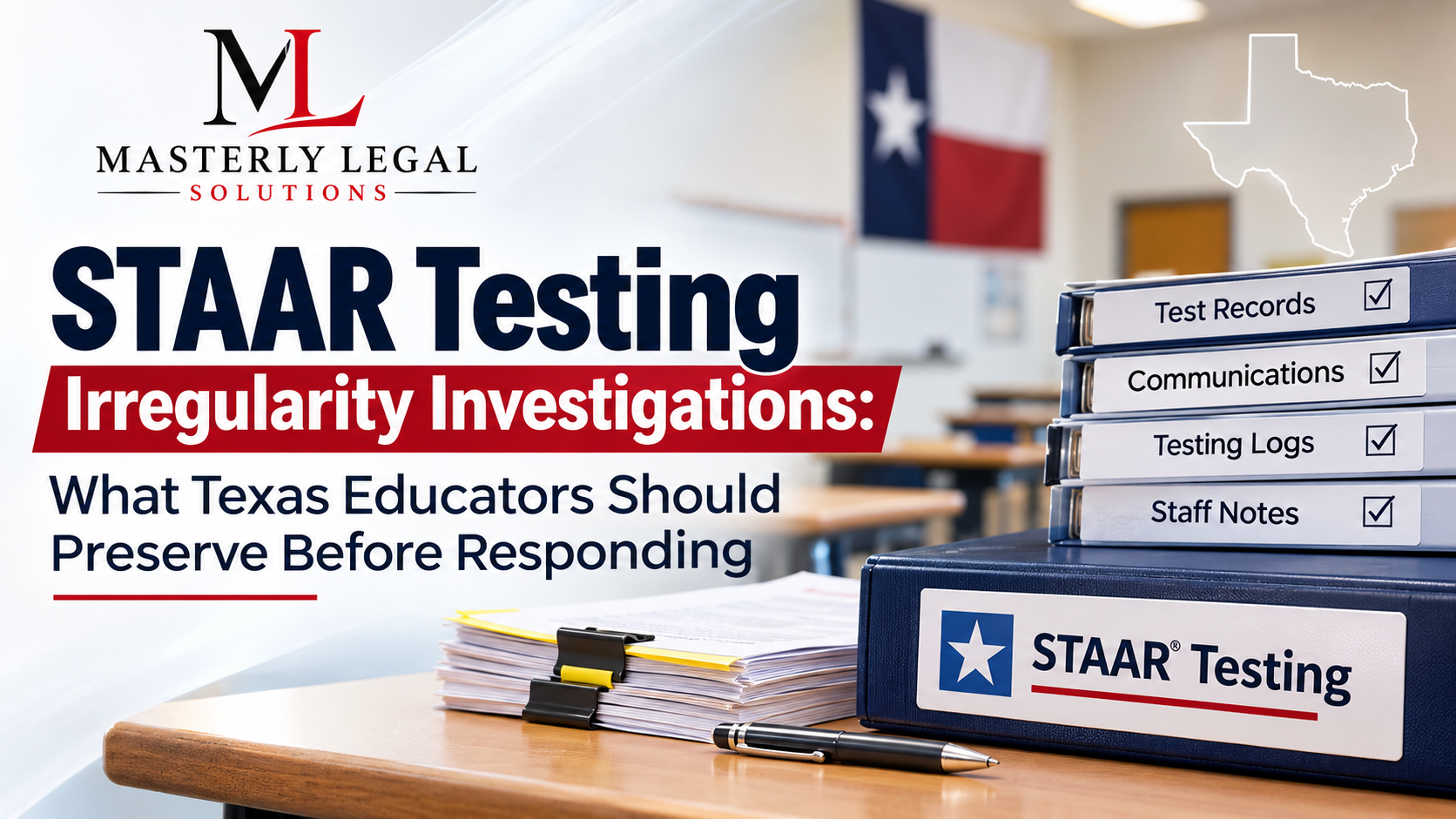
STAAR testing irregularity investigation involving Texas educators and test security allegations.
November 3, 2026
Facing a STAAR testing irregularity investigation? Masterly Legal Solutions defends Texas teachers, coordinators, and campus administrators facing allegations.
Business ethics training on workplace policies and compliance.
October 26, 2026
Business Ethics Training: Turn workplace policies into defensible practices. Explore compliance, employee conduct, and training needs with Masterly Legal Solutions.
Misappropriation of funds legal guidance and financial records review.
October 21, 2026
Understand what misappropriation of funds involves, how to preserve financial records, and when to seek experienced legal guidance before taking appropriate action.
NIL law, athlete contracts, and school compliance guidance
October 20, 2026
Explore NIL law in school athletics, institutional compliance, contract concerns, and when schools may need experienced legal guidance to protect their interests.
Texas Medical Board complaint, physician license defense, and legal guidance.
October 19, 2026
Texas Medical Board Complaint. Convert licensed physicians facing TMB complaint notices. Explore practical next steps and request a confidential consultation.
Title IX lawyer consultation, case review, and legal guidance.
October 19, 2026
Learn when a Title IX lawyer can help with allegations, interviews, case preparation, legal options, and next steps toward a confidential legal consultation.

Looking for Legal & Business Solutions? Contact Us Now

Fill in the form or call us to set up a meeting

(972) 236-5051
A black and white drawing of a straight line on a white background.