
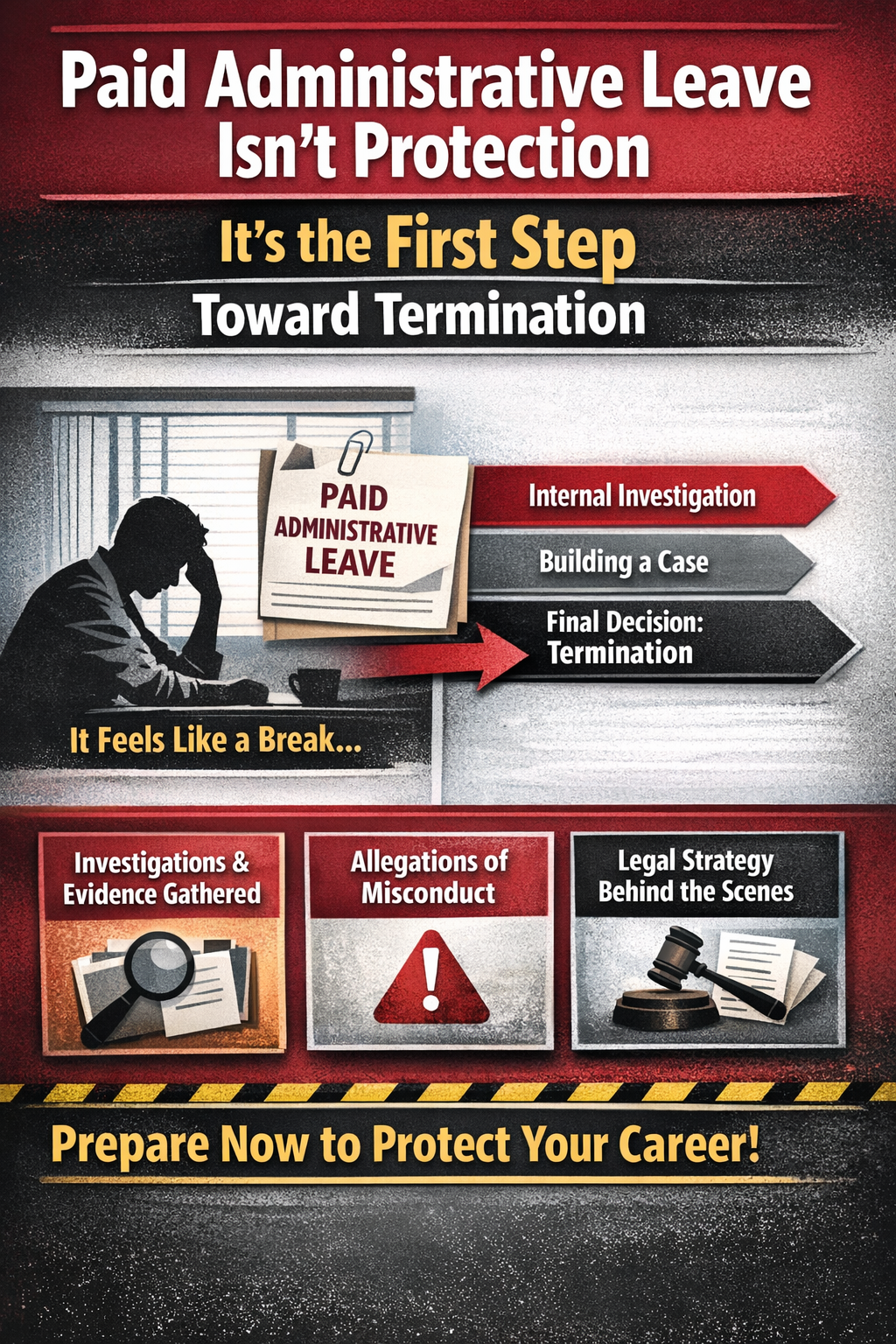
Paid Administrative Leave Isn’t Protection It’s the First Step Toward Termination
For many educators, being placed on paid administrative leave feels like a temporary pause—a chance to step away while things are sorted out. It may even seem like a benefit, especially when your pay and benefits continue during that period. But what most professionals don’t realize is that this step is often the beginning of a much more serious process that can lead directly to termination.
At Masterly Legal Solutions, our law firm has seen firsthand how quickly a situation can escalate. What begins as a routine inquiry can evolve into a wrongful termination claim, allegations of misconduct, or even accusations tied to illegal activity. Understanding what is really happening behind the scenes can make the difference between protecting your career and losing your job.
Why Paid Administrative Leave Is Often Misunderstood
The Illusion of Protection
When an employer places an employee on administrative leave, it can feel like a neutral decision. However, this action is rarely taken without purpose. In many cases, it signals that the employer has already begun an internal investigation.
This stage allows the employer to gather evidence, conduct interviews, and evaluate whether further action—such as termination—is justified. While it may appear routine, it is often a strategic step that aligns with the employer’s interests and may involve outside counsel for internal investigations.
What Employers Are Really Doing
During this time, your employer is not simply waiting. Instead, they are often conducting an independent internal investigation. Instead, they are:
- Collecting statements from a co worker or supervisor
- Reviewing documentation and past conduct
- Evaluating potential violations of policy or regulation
- Preparing for possible legal action
In many wrongful termination cases, the groundwork is laid during this early period, not after the decision to terminate is made, and organizations may rely on comprehensive employment law services to manage their risk.
How Administrative Leave Leads to Termination
The Escalation Process
Most employees do not realize that administrative leave is often the first step in a structured process. The progression may look like this:
- Placement on administrative leave
- Internal investigation and reporting
- Findings that suggest a violation of public policy or workplace rules
- Final decision involving termination
At each stage, the employer is building a case that can justify terminating the employee.
When It Turns Into Wrongful Termination
If the termination is based on illegal reasons, such as workplace discrimination, sexual harassment allegations without strong evidence, or retaliation for protected activity, it may give rise to a wrongful termination claim.
However, proving a wrongful termination claim requires careful analysis under state law and applicable regulation. This is where an experienced employment lawyer becomes critical.
Understanding Constructive Discharge and Forced Resignation
What Is Constructive Discharge
In some situations, an employee quits rather than being formally terminated. This is known as constructive discharge or constructive termination.
A reasonable person in the same circumstances would feel that the working conditions were so severe that continuing the job was not possible. This may include:
- A hostile work environment
- Ongoing retaliation
- Unreasonable demands or expectations
These situations can lead to a forced resignation, even when the employee technically chose to leave.
How Employers Create Pressure
Employers may generally avoid direct termination and instead create intolerable working conditions that push the employee to resign. This tactic is often referred to as constructive dismissal.
In these cases, the worker’s resignation may still qualify as a wrongful discharge if it can be shown that the employer acted with improper intent.
The Role of Public Policy in Termination Cases
What Is a Violation of Public Policy
A violation of public policy occurs when an employer takes action against an employee for reasons that go against established law or societal standards. This is a key factor in many wrongful termination cases.
Examples include situations where employers fail to follow sound HR consulting and compliance practices:
- Firing an employee for refusing to engage in illegal activity
- Retaliating against a worker for reporting misconduct
- Terminating someone for participating in a protected activity
These actions can form the basis of a wrongful termination claim.
Why Public Policy Matters
Courts and a jury will often evaluate whether the employer’s conduct violated established public policy. If the jury believes the termination was motivated by improper reasons, the employee may recover damages.
This can include punitive damages in cases involving serious misconduct.
Common Scenarios That Lead to Legal Claims
Workplace Investigations and Allegations
An employee placed on administrative leave may be under investigation for various reasons, including issues that intersect with higher education law and Title IX compliance:
- Allegations of sexual harassment
- Claims of workplace discrimination
- Issues involving employment discrimination
- Concerns related to employing undocumented workers
These cases can quickly escalate into formal proceedings.
Example of Escalation
For example, a teacher in san antonio texas school districts may be placed on administrative leave following a complaint, raising questions similar to those in forced resignation and constructive discharge cases. During the investigation, the employer gathers statements and reviews policies.
If the findings suggest a violation, the employer fired the individual. The employee may then pursue a wrongful termination claim, arguing that the decision was based on illegal reasons.
The Legal Process Behind Termination
What Must Be Proven
To succeed in a wrongful termination claim, the employee must prove several elements:
- The termination occurred
- The employer’s conduct was improper
- The action violated public policy or state law
This requires evidence, documentation, and a clear legal strategy.
The Role of a Jury
In many cases, a jury will evaluate whether a reasonable employee would have acted similarly under the same circumstances. The perspective of a reasonable person plays a significant role.
Why Timing Matters in These Cases
Early Action Can Change Outcomes
Many employees wait too long before seeking help. By the time they contact an employment attorney, the employer has already built a strong case.
Early intervention allows your legal team to:
- Review the facts
- Preserve critical evidence
- Guide your responses during reporting and interviews
The Risk of Waiting
Delaying action can weaken your ability to prove a claim. It may also limit your options for pursuing legal action.
The Impact of Employer Decisions on Your Career
Long-Term Consequences
A termination can affect more than your current job. It can impact:
- Future employment opportunities
- Professional reputation
- Financial stability
In some cases, it may also lead to claims of emotional distress.
How Employers Justify Termination
Employers will often argue that their decisions were based on legitimate interests. They may cite:
- Policy violations
- Performance concerns
- Workplace conduct issues
Understanding how to challenge these arguments is essential.
Special Considerations in Complex Cases
Issues Involving Undocumented Workers
Cases involving undocumented workers or allegations of employing undocumented workers can introduce additional complexity. These matters often involve overlapping regulation and legal standards.
Jurisdictional Differences
The outcome of a case may vary depending on the jurisdiction. For example, laws in san francisco may differ from those in Texas.
How Masterly Legal Solutions Can Help
Strategic Legal Representation
Our Texas law firm, Masterly Legal Solutions, led by a seasoned founding partner, focuses on protecting professionals at every stage of the process. We understand the nuances of employment law and how to address complex termination issues.
A Focus on Results
We work to:
- Analyze your situation
- Identify potential violations
- Build a strong legal strategy
Our goal is to protect your rights and help you move forward, much like our general counsel services for businesses that proactively manage legal risk.
Taking Control of Your Situation
What You Should Do Immediately
If you are placed on administrative leave, it is critical to take action. Consider whether workplace policies and expectations in your employee handbook drafted by legal counsel are being applied fairly, and:
- Consulting an employment lawyer
- Documenting all communications
- Avoiding statements that may harm your case
Protecting Your Future
The sooner you act, the more options you have. Early guidance can help you avoid mistakes that may impact your case.
Speak With a Legal Team That Understands What’s at Stake
If you have been placed on paid administrative leave, it is important to understand that this may not be a temporary pause—it could be the beginning of a serious process that leads to termination. Waiting and hoping the situation resolves on its own can put your career, reputation, and future at risk.
At Masterly Legal Solutions, we focus on helping professionals navigate complex investigations, defend against wrongful termination, and respond to employer actions that may involve a violation of public policy. Our approach is proactive, strategic, and tailored to your unique situation.
Call us today at (972) 236-5051 for a free consultation. We are here to listen, evaluate your situation, and help you take the next step with confidence. The earlier you seek guidance, the better positioned you are to protect your rights and your career.
Disclaimer: This article is for informational purposes only and does not constitute legal advice. Every case involves unique facts and legal considerations. You should consult with a qualified attorney regarding your specific situation.








Looking for Legal & Business Solutions? Contact Us Now
Fill in the form or call us to set up a meeting