
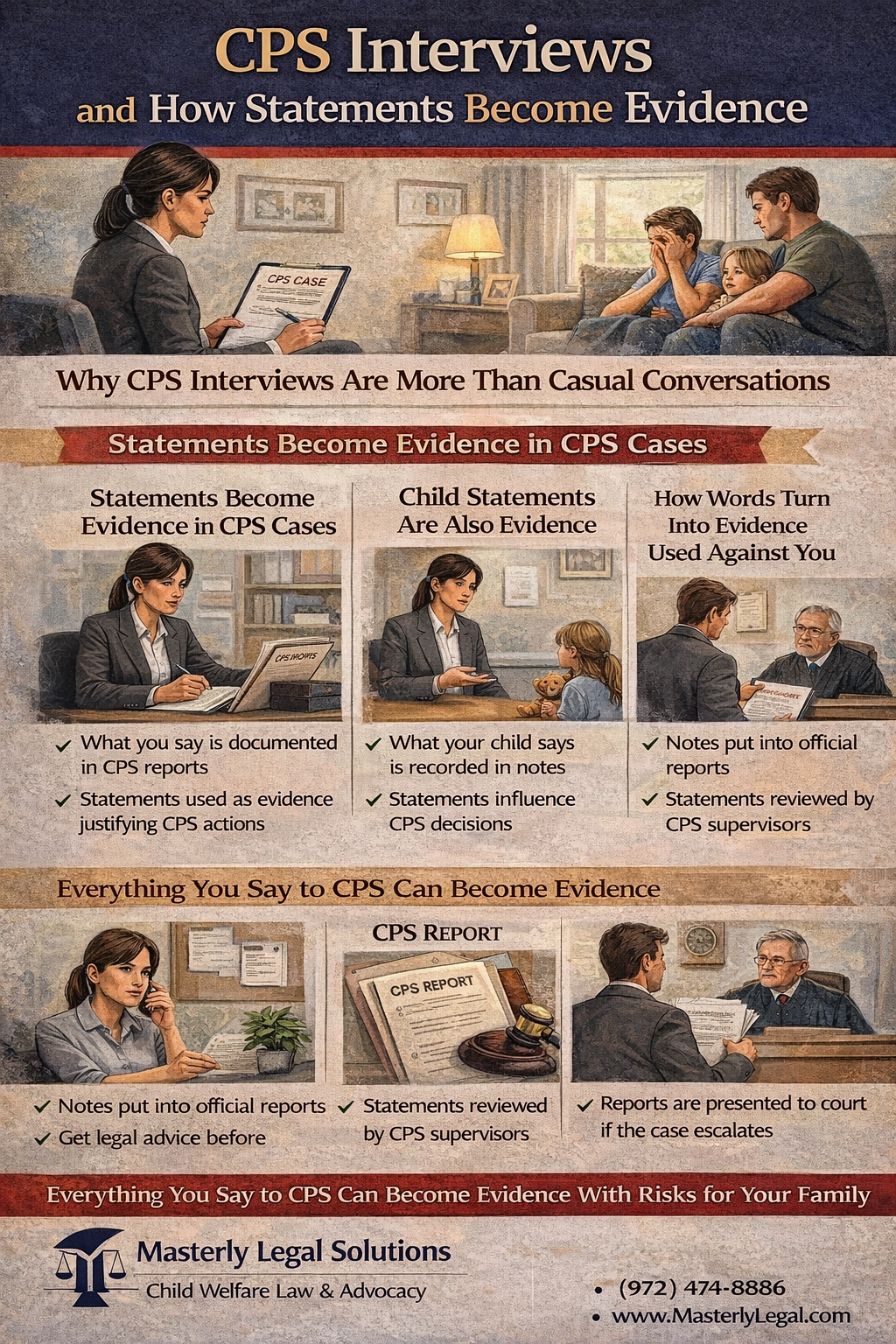
CPS Interviews and How Statements Become Evidence
When families are first contacted by CPS, the experience can feel sudden and overwhelming. A phone call, a knock at the door, or a request to talk often comes without warning, leaving parents unsure of what to say or do. Many people assume that cooperating fully and speaking openly will make the situation go away faster. What most families do not realize is that CPS interviews are not casual conversations, and statements made early can become evidence that shapes the entire case.
At Masterly Legal Solutions, we help families understand how CPS interviews work and why words matter so much during a CPS investigation. Our role is to provide clarity, protect parental rights, and guide families through a process that can otherwise feel confusing and intimidating. Understanding how interviews turn into evidence is one of the most important steps families can take to protect their family life.
Understanding the Purpose of CPS Interviews
CPS interviews are a central part of child protective services investigations. These interviews are designed to gather information, assess risk, and determine whether allegations of abuse or neglect require further action. While the stated goal is ensuring child safety, the process is also about documentation and decision-making.
A CPS caseworker uses interviews to form impressions and build records. These records often guide how CPS determines next steps, including whether court intervention is needed.
Why CPS Interviews Carry So Much Weight
Unlike informal conversations, CPS interviews are structured with intent. Everything said may be written down, summarized, or included in official reports. Even small details can be interpreted as signs of abuse or neglect.
Families often underestimate how statements can be framed later. What feels like a harmless explanation can become part of the evidence used in CPS cases.
Who Conducts CPS Interviews
Most interviews are conducted by a CPS caseworker acting on behalf of child protective services CPS. In some situations, additional professionals may be involved, especially if safety concerns are raised. These individuals are trained to ask questions that help them assess risk.
Although they may appear friendly or supportive, they represent a government agency with authority to investigate.
The Role of Investigating Reports
CPS investigations usually begin with reports made to protective services. These reports may come from schools, medical professionals, neighbors, or other mandated reporters. Investigating reports is the first step in the cps investigation process.
Families are often not told exactly what was reported, which makes interviews even more stressful.
How Statements Are Documented
During a CPS interview, the caseworker takes notes that later become part of the official record. These notes are not transcripts but summaries written from the investigator’s perspective. Once recorded, these statements can follow a family throughout the investigation.
Records created early may be relied on by supervisors, attorneys, or even a judge if the case escalates.
Statements as Evidence in CPS Cases
Statements made during interviews are often treated as evidence. They may be used to support allegations of child abuse or neglect, even if the family disagrees with how the statements are interpreted. This is especially true in neglect cases, where definitions can be broad.
Evidence does not have to be physical to influence a case. Verbal statements alone can shape outcomes.
Why Parents Feel Pressured to Talk
Parents often feel an intense urge to explain themselves. Fear, stress, and concern for the child’s well being can lead to oversharing. Many parents believe silence will make them look guilty.
In reality, thoughtful and informed communication is far more protective than speaking impulsively.
Interviews Involving the Child
CPS interviews frequently include the child, sometimes separately from the parent. These interviews are intended to assess child safety and potential abuse or neglect. Children may be asked questions in ways that influence their responses.
Statements made by a child can carry significant weight in juvenile dependency proceedings.
How Child Statements Are Used
What a child says during an interview may be summarized in reports and shared across the agency. These summaries can influence whether CPS determines that abuse or neglect occurred. They may also affect custody decisions.
Families should understand how important it is for these interviews to be handled carefully.
The Impact on Parental Rights
CPS interviews directly affect parental rights. Statements may be used to justify safety plans, supervision requirements, or removal. Parents who are unaware of their rights may unintentionally weaken their position.
Protecting parental rights requires understanding the process and seeking appropriate assistance.
When Allegations Involve Abuse or Neglect
Allegations of abuse or neglect increase the seriousness of CPS involvement. Child abuse, child abuse and neglect, and abuse or neglect allegations are taken very seriously by protective services. Interviews in these cases are often more detailed and intense.
Even unproven accusations can lead to extended investigation and oversight.
Neglect Cases and Broad Interpretations
Neglect cases often rely heavily on interviews rather than physical evidence. Issues related to supervision, medical care, or living conditions may be explored through questioning. Families may not realize how broad neglect definitions can be.
Statements explaining daily routines or decisions can later be framed as neglect.
Child Safety and CPS Authority
CPS operates with the authority to act when child safety is believed to be at risk. Ensuring child safety is the agency’s stated mission. However, the way safety concerns are identified is often subjective.
Interviews are one of the primary tools used to assess risk.
When Interviews Lead to Court Involvement
If CPS believes there is sufficient evidence of abuse or neglect, court intervention may follow. Statements made during interviews may be presented in court filings or hearings. A court order may be requested based on these records.
At that point, the stakes increase significantly for families.
The Role of the Court and the Judge
In juvenile dependency cases, a judge relies heavily on CPS reports. These reports often summarize interviews rather than include full context. The judge may never hear directly from the family unless proceedings advance.
This makes early interview statements extremely important.
How Criminal Charges Can Arise
In some cases, CPS interviews overlap with law enforcement involvement. Statements made to CPS may later be shared if criminal charges are considered. Families may not realize this connection exists.
This is one reason legal representation early in the process is so important.
CPS Interviews Across Counties
CPS investigations may involve more than one county. Families in Orange County or other counties may find their records shared across jurisdictions. County involvement can complicate proceedings.
Statements follow the case regardless of location.
Regional Confusion and Out-of-State Searches
Families sometimes search terms like “cps charlotte nc” or look to southern california resources when trying to understand the process. This reflects how confusing CPS involvement can feel. However, CPS rules and practices are state-specific.
Working with professionals who understand local CPS procedures is essential.
The Importance of Legal Representation
Legal representation helps families navigate CPS interviews strategically. An experienced attorney can explain what questions mean and how responses may be used. This guidance helps protect both the parent and the child.
A cps defense attorney focuses on administrative strategy rather than fear-driven responses.
How CPS Defense Works During Interviews
CPS defense involves preparing families for interviews and advising on communication. A cps attorney helps clients understand their rights and responsibilities. This approach reduces the risk of harmful statements.
CPS defense is proactive, not reactive.
Choosing the Right Defense Attorney
Working with a defense attorney who has a proven track record in child protective services cases matters. Experience with cps cases and juvenile dependency proceedings allows for informed guidance. Families benefit from working with an experienced attorney who understands CPS conduct.
This knowledge leads to stronger, more compelling arguments when needed.
Supporting Families Through the Process
CPS involvement affects the entire family. Stress, fear, and uncertainty can disrupt family life and routines. Support and counseling may be recommended or required.
Professional support helps families stay focused and stable during investigations.
Protecting the Child and the Family
The goal of CPS defense is to protect children while also protecting families from unnecessary disruption. Protecting the child does not mean accepting every allegation without question. It means ensuring fairness and accuracy.
Families deserve balanced treatment.
How Evidence Is Evaluated
Evidence in CPS cases includes interviews, reports, and records. These records may be reviewed multiple times throughout proceedings. What is written early often carries forward.
Understanding this helps families take interviews seriously.
The Role of Records and Documentation
CPS maintains detailed records on each case. These records may affect future investigations or services. Families should be aware that records do not disappear when a case closes.
Statements live on in the file.
When Foster Care Becomes a Risk
In extreme cases, CPS may recommend foster care placement. This usually follows concerns identified through interviews and reports. Families often feel blindsided by how quickly this can happen.
Early defense helps reduce this risk.
The Responsibilities of CPS and Families
CPS has responsibilities to investigate and protect youth. Families have responsibilities to cooperate appropriately while protecting their rights. Understanding both sides helps balance the process.
Clear communication and guidance are key.
Why Early Assistance Matters
Seeking assistance early can change the direction of a case. Families who wait until court proceedings begin have fewer options. An initial consultation provides clarity and direction.
Early action often leads to better outcomes.
How Masterly Legal Solutions Helps
At Masterly Legal Solutions, we are committed to guiding families through CPS interviews and investigations. Our services focus on preparation, strategy, and protection. We work on behalf of clients to defend parental rights and family stability.
Our approach is administrative, proactive, and family-focused.
Taking the Next Step With Confidence
Understanding how CPS interviews become evidence empowers families. Knowledge reduces fear and improves decision-making. With the right guidance, families can navigate CPS involvement with greater confidence.
You do not have to face this process alone.
Contact Masterly Legal Solutions for a Free Consultation
If you or your family are involved in a CPS investigation, the statements made during interviews can shape the entire case. Masterly Legal Solutions offers a free consultation to help families understand the CPS interview process, protect their rights, and respond appropriately. Our team is dedicated to providing clear guidance and strategic CPS defense services designed to support families during this challenging time. Contact us at (972) 236-5051 to schedule your free consultation and get the answers you need.
Disclaimer: This article is for informational purposes only and does not constitute legal guidance or legal advice. Reading this content does not create an attorney-client relationship. For advice specific to your situation, including matters related to higher education law services, consult a qualified attorney.

Teacher Rights When Assaulted by a Special Needs Student: Safety, Reporting and Investigation Issues

Looking for Legal & Business Solutions? Contact Us Now
Fill in the form or call us to set up a meeting