

DAEP in Texas: What Parents Should Know Before the Placement Conference
By Andrew Rhoden | Masterly Legal Solutions
Disciplinary Alternative Education Program (DAEP) in Texas: The Short Answer
A DAEP in Texas is a Disciplinary Alternative Education Program where students receive instruction outside their regular classroom following certain disciplinary incidents. Before placement, Texas law requires a conference for covered removals, giving students notice of the reasons and an opportunity to respond. Parents or guardians are included in this important discussion about their child's education.
Receiving a call that your child may be sent to a DAEP can be upsetting. You may disagree with the school's account, worry about missed classes, or wonder when your child can return to their regular campus.
The placement conference is an important point in the process. Understanding what the school must consider, how long the placement may last, and what happens to your child's schoolwork can help your family make informed decisions.
Masterly Legal Solutions helps Texas families understand DAEP placement decisions, review school discipline concerns, and evaluate their legal options before important meetings.
What a DAEP Is and How It Differs from Regular School Discipline
A DAEP is an alternative educational setting within Texas public education, adopted under the Safe Schools Act in 1995, for students removed from their regular classrooms because of certain conduct, as defined by state law.
Under Texas Education Code § 37.008, school districts must provide disciplinary alternative education programs that:
- Operate outside the student's regular classroom.
- Separate assigned students from students who are not in the program.
- Focus on English, math, science, social studies, and self-discipline.
- Address educational and behavioral needs.
- Provide supervision and counseling.
DAEPs typically use a stricter, more supervised setting with smaller class sizes than a regular school campus. The statute also requires districts to provide training for teachers in behavior management. Unlike detention or a brief suspension, DAEP placement changes the student's instructional setting for an assigned period to maintain academic continuity, address behavior, and help create a path that keeps students in school rather than pushing them toward dropping out of high school.
For families, this difference matters. A child may have to attend another campus, follow a different daily schedule, or adjust to unfamiliar teachers and classmates.
DAEP Placement Under the Texas Education Code Is Different From Expulsion
A DAEP placement does not automatically mean a student has been expelled.
Texas law treats disciplinary alternative education placements and expulsions under separate provisions of Chapter 37.
For a family facing DAEP placement, the immediate concern is whether the proposed placement follows the law and district policy, how the decision was reached, and what the student will experience during the assignment.
The district's student code of conduct also matters because it sets rules for disciplinary decisions and placement periods.
[CONFIRM: The district's current DAEP handbook, assigned campus, daily schedule, and any additional campus restrictions.]
Parents seeking a broader understanding of school disciplinary procedures can also read Student Discipline Cases: What Families Should Understand About Due Process.
How Student Discipline Decisions Affect DAEP Placement in Texas
Student discipline in Texas can involve several responses, including in school suspension, out of school suspension, or placement in a Disciplinary Alternative Education Program (DAEP). When disruptive or unruly behavior occurs, a teacher or principal may review the incident, the available evidence, and its effect on the teacher's ability to maintain a safe learning environment. This process applies to students at different grade levels, including elementary school, although age-related legal restrictions may affect the disciplinary options available. Schools may consider whether conduct was threatening, abusive, or disruptive to normal classroom operation. Incident reports, a discipline log, witness statements, and communication with parents or other persons involved may provide important details about what happened. Families can also ask about school contacts and available resources to better understand the placement decision. Masterly Legal Solutions helps parents review disciplinary concerns, understand applicable Texas education laws, and evaluate their options when a DAEP placement is proposed.
Who Can Be Placed in a DAEP and What Parents Can Ask at the Conference
Not every school rule violation requires DAEP placement.
Texas Education Code § 37.006 identifies conduct that may require or permit removal to a disciplinary alternative education program under state law.
Depending on the circumstances, qualifying conduct may involve certain assaults, threats, drug-related violations, harassment of school employees when the statutory conditions are met, or other offenses identified by law.
Some placements are mandatory when statutory conditions are met. Others are discretionary, meaning school administrators may place students based on repeated violations under the student code of conduct and other misbehavior, while exercising discretion under the law and district rules.
This distinction can affect how a family evaluates the school's decision.
What Happens During the DAEP Placement Conference?
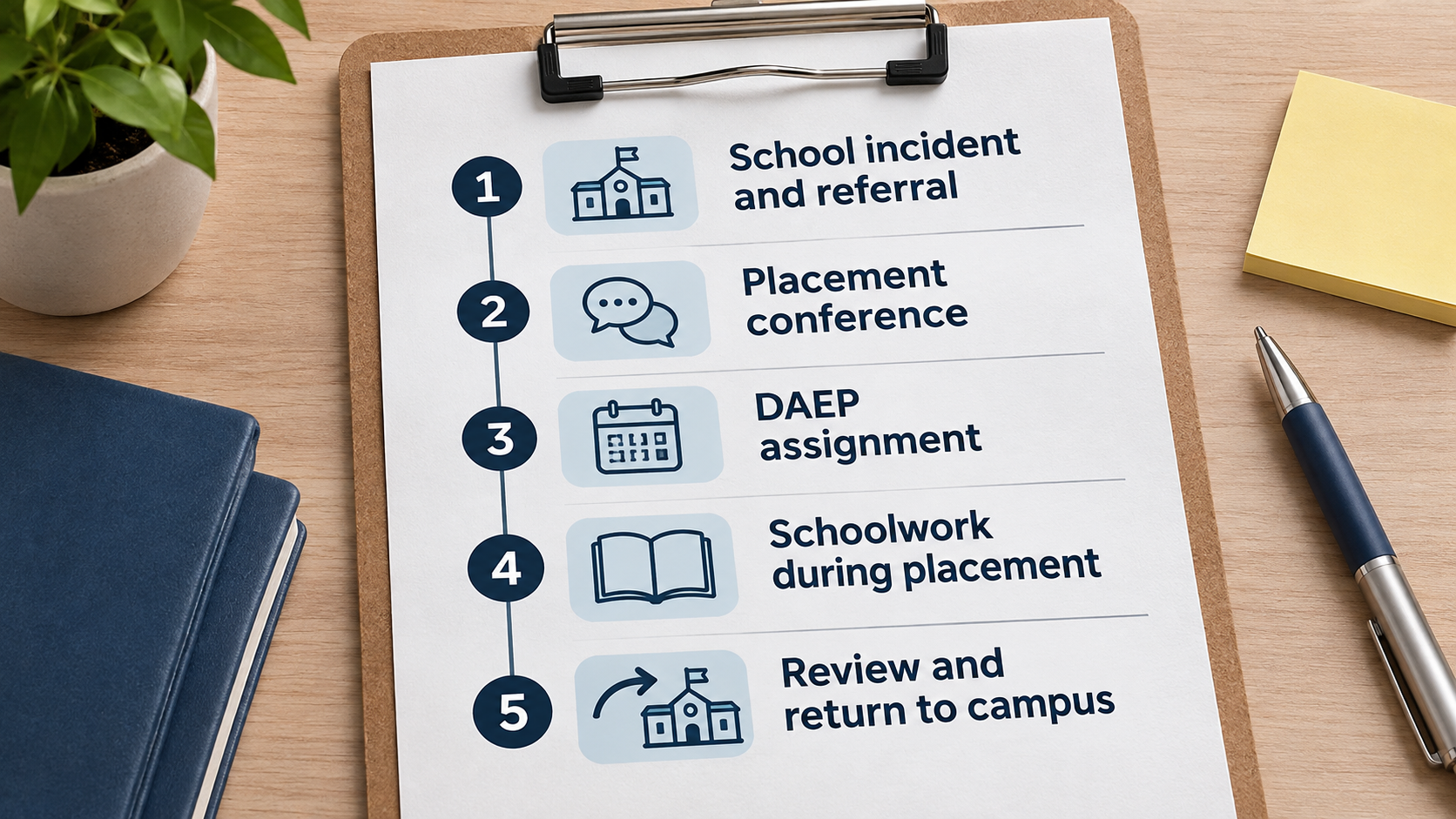
Under Texas Education Code § 37.009(a), the campus behavior coordinator or another appropriate administrator must schedule a conference no later than the third class day after certain student removals.
The conference involves the appropriate school administrator, the student, a parent or guardian, and the teacher who removed the student, if applicable.
At the conference, the student is entitled to:
- Written or oral notice explaining the reasons for removal.
- An explanation of the basis for the removal.
- An opportunity to respond to the stated reasons.
The school may proceed after valid attempts to obtain the required participants' attendance, even if everyone does not attend.
A conference is therefore an important opportunity for the student's account and relevant circumstances to be considered, but attendance alone does not determine the outcome.
What Parents Can Ask Before a Placement Decision
Parents may want clarification about the exact conduct alleged when a student is accused of misconduct, the school rule or law being applied, and the facts supporting the recommendation, and they can consult the district's Student Code of Conduct before or after the conference.
Other important questions include whether the school considered the student's explanation, whether the placement is mandatory or discretionary, how school administrators used that discretion when it was available, and how long the proposed assignment will last.
Texas Education Code § 37.009(a) requires consideration of several factors before certain disciplinary decisions, including:
- Whether the student acted in self-defense.
- The student's intent or lack of intent.
- The student's disciplinary history.
- Whether a disability substantially affected the student's ability to understand the wrongfulness of the conduct.
These factors matter even when a disciplinary action is mandatory. An accusation alone should not control the outcome if the facts are disputed or the conduct falls close to the line between minor misbehavior and a more serious offense.
A family may disagree with the school's description of an incident or believe relevant information was overlooked. Families may consult an education attorney to assess the facts and applicable law.
When a Student Has an IEP or Section 504 Plan
A proposed DAEP placement may raise additional concerns for students with disabilities.
Depending on the student and the length or pattern of removal, federal disability protections may require further review. A student with an IEP must continue receiving the services required by that plan during DAEP placement.
For example, certain disciplinary changes in placement involving students eligible under the Individuals with Disabilities Education Act require a manifestation determination review.
Families can learn more in Manifestation Determination Review: What Parents Should Know Before the Meeting.
An attorney can help a family understand how DAEP placement rules interact with the student's educational services and disability protections, including whether disability-related disruptive behavior requires closer review before removal decisions are finalized.
Length of DAEP Placement, Schoolwork, and Return to Campus
One of the first questions parents ask is how long their child will remain in a DAEP.
Texas does not establish one standard placement length for every student. Instead, placements can last from a few weeks to an entire school year, depending on the reason a student was involved and the district's code of conduct.
If the placement or its length is decided in proceedings before the school board or its designee, families may also have an appeal path to the board of trustees under district procedures. CONFIRM WITH LOCAL COUNSEL OR DISTRICT POLICY An appeal can provide a second chance to contest the placement, especially when the family disputes the facts or the length.
How Long Can a DAEP Placement Last?
Under Texas Education Code § 37.009, placement periods are subject to specific requirements.
When placement will extend beyond 60 days or the end of the next grading period, whichever comes earlier, parents or guardians must receive notice and an opportunity to participate in a proceeding before the school board or its designee.
Special findings are required for placement beyond the school year. Placement generally cannot exceed one year unless the district makes a qualifying determination following review.
Students in a DAEP must also receive periodic reviews of their academic and placement status at intervals of no more than 120 days. If a student is suspended before or during the process, separate rules may still govern how instruction and services are handled. Parents often worry their child will fall behind, and students in DAEPs are prohibited from participating in extracurricular activities during the assignment.
During these reviews, the student or parent must have an opportunity to present reasons for returning to the regular classroom or campus. That matters because limits on coursework and separation from other students can make reentry harder. Academic disruption can also increase the risk that some students disengage or drop out of high school if support is weak.
[CONFIRM: The district's standard assignment periods, placement-day calculation, local review procedures, and any available appeal process.]
What Happens to Schoolwork During DAEP Placement?
Parents often fear that an alternative placement will cause their child to fall behind.
Texas Education Code § 37.008 requires DAEP programs to address students' educational needs and provide instruction in core subjects.
Section 37.008(l) also requires districts to offer students an opportunity to complete coursework before the next school year. Because a DAEP is typically separate from a student's regular school setting, this may involve distance learning, summer school, or another available method at a different campus or dedicated program site.
The district cannot charge students for courses provided under that subsection.
Parents must receive written notice explaining the district's obligation to provide an opportunity to complete graduation coursework, including available methods.
However, this does not mean every elective or regular campus course must be offered in exactly the same format.
[CONFIRM: The district's course offerings, credit-transfer practices, assignment access, grading policies, and available academic support.]
For high school students, placement reviews must also address progress toward graduation requirements.
Returning to the Regular Campus
Returning from DAEP may involve more than completing an assigned number of days.
Texas Education Code § 37.023 establishes transition requirements for covered students returning from alternative education programs.
These include notice of the release date, coordination with school personnel, and a personalized transition plan.
The plan must address recommendations for educational placement and provide parents with information about requesting an initial special education evaluation.
The goal is to address the student's educational needs during the move back to the regular classroom.
[CONFIRM: The district's reentry meeting requirements, attendance expectations, and procedures for resuming regular classes.]
When Families Talk With an Education Attorney About DAEP Placement
A DAEP recommendation can affect a student's education, daily routine, and confidence at school.
Parents may feel pressure to respond quickly, especially when a conference is already scheduled.
Legal guidance may be helpful when the facts are disputed, the proposed placement is lengthy, or the family is uncertain whether the school has followed the required procedures, and legal representation can also strengthen a student's appeal or board review presentation when a DAEP decision is contested.
This may matter when a child was caught in a disputed incident, faces lengthy placement, or the family believes the school overreached or used its discretion in a way that feels like abuse rather than fair discipline for school trouble.
An attorney may also help when a child has an IEP, a Section 504 plan, or educational needs that make a change in placement especially concerning.
How Masterly Legal Solutions Helps Families
Masterly Legal Solutions provides legal guidance to families navigating school discipline and education-law matters.
Depending on the circumstances, the firm's assistance may include reviewing disciplinary notices, examining the school's stated reasons for placement, evaluating the student code of conduct, and explaining the procedures that apply.
The firm can also help families understand potential concerns involving academic services, disability protections, and available review options.
Additional background on related education-law issues is available in From IEP Disputes to License Suspension: A Special Education Law Attorney Can Intervene Immediately.
Every case depends on its facts, governing law, and district policies. Legal representation does not mean a placement will be canceled or shortened, but it can help families understand the process and make informed choices.
Frequently Asked Questions About DAEP in Texas
How long can a student stay in a DAEP in Texas?
There is no single placement period for every Texas student. The duration depends on the disciplinary reason, applicable law, and district rules. Texas Education Code § 37.009 provides requirements for longer placements, periodic reviews, and certain placements extending beyond the school year or one year.
Can parents attend the DAEP placement conference?
Yes. Texas Education Code § 37.009(a) includes a parent or guardian among the participants in the required conference. However, the conference may proceed without every participant when valid attempts have been made to obtain attendance. The conference is the family's first line of defense in correcting the record before a placement decision is finalized. The student must receive notice of the reasons for removal and an opportunity to respond.
Does a DAEP placement go on a student's record?
A DAEP placement creates a disciplinary placement order. Under Texas Education Code § 37.008(j), that order must be shared with a receiving Texas school district when a student transfers before completing the placement.
Whether and how the placement appears in other educational records depends on applicable recordkeeping rules and district practices.
[CONFIRM: District record-retention procedures, access to disciplinary records, and policies governing disclosures.]
Request a Confidential Consultation With Masterly Legal Solutions
If your child is facing DAEP placement in Texas after a disciplinary incident, or is involved in a possible placement decision, understanding the school's position before the placement conference can help your family approach the situation with greater clarity.
Masterly Legal Solutions helps parents evaluate disciplinary concerns, understand education-law requirements, and consider the legal options available for their child's circumstances, including addressing school-discipline issues before they escalate into longer removals from regular school.
Call (972) 236-5051 to consult before the placement conference or any available appeal about your child's DAEP placement concerns.
This article provides general legal information and does not constitute legal advice. Texas education laws, school district policies, and student discipline procedures may change. DAEP placement decisions, student rights, and available legal options depend on individual circumstances and applicable regulations.







Looking for Legal & Business Solutions? Contact Us Now
Fill in the form or call us to set up a meeting