
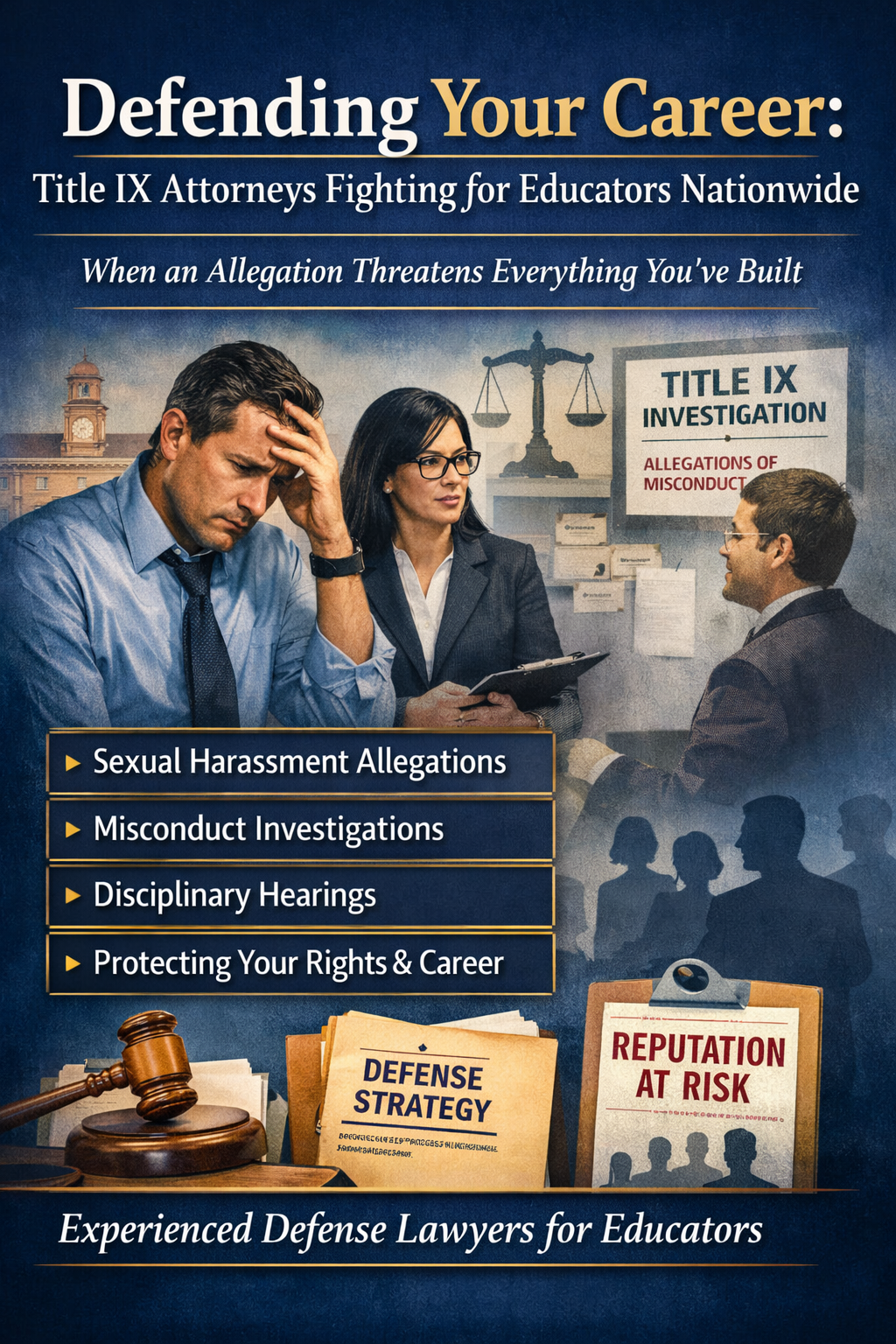
Defending Your Career: Title IX Attorneys Fighting for Educators Nationwide
Title IX Defense Lawyers Protecting Educators' Careers Nationwide
If you are a professor, instructor, coach, dean, or staff member who has just learned about a Title IX complaint or investigation involving you, the next few decisions you make will define the trajectory of your career. This page is specifically for respondents-educators and higher-education professionals accused of Title IX violations-not general Title IX information and not athletics compliance content.
Title IX was enacted in 1972 to prevent sex discrimination in any education program or activity receiving federal financial assistance. It applies to all federally funded educational institutions, and it covers a range of allegations including sexual assault, sexual harassment, and retaliation claims. Title IX also prohibits discrimination based on sexual orientation and gender identity. A finding against you in a Title IX investigation can result in termination, loss of tenure, reporting to state licensing boards, and permanent damage to your reputation on future background checks. Findings from Title IX investigations can impact future employment opportunities for years, following you across institutions and states.
Legal representation is crucial during Title IX investigations. Title IX proceedings typically conclude within 60 days, and many institutions target completion of their investigation phase within 30 to 60 business days. That compressed timeline means you cannot afford to wait. Masterly Legal is a national Title IX defense law firm that represents educators and university employees in campus-based investigations and parallel criminal matters.
If you are facing Title IX allegations, contact Masterly Legal now at (972) 236-5051 to schedule a confidential Title IX defense consultation before critical deadlines pass.
How We Evaluate and Select the Right Title IX Defense Lawyer
Not every attorney is suited for Title IX defense for educators. The campus investigation process operates under its own procedural rules, evidentiary standards, and political dynamics that differ sharply from criminal court or traditional employment disputes. What follows are the criteria that matter most to faculty and staff-experience with institutional politics, tenure rules, faculty handbooks, and parallel criminal exposure.
Core Criteria that Matter for Educators
When selecting a title ix defense attorney, educators should evaluate the following:
- Experience with Title IX defense for faculty, staff, and graduate employees (not just students).
- Familiarity with the 2020 Title IX regulations and awareness of the 2024 rule that was issued and then vacated in January 2025, creating ongoing regulatory uncertainty. Understanding federal regulations is crucial for Title IX defense lawyers due to these evolving guidelines.
- Ability to handle both campus investigations and parallel criminal or civil risk, including coordination between a criminal investigation and institutional proceedings.
- Understanding of tenure, promotion, and academic-governance procedures, because universities must follow their own published procedures during Title IX investigations.
- Track record resolving Title IX cases quietly to protect reputation and future employability.
- Capacity to work nationwide and adapt to different institutional policies-public, private, religious, research universities, community colleges, and K-12 districts.
- Communication style: responsiveness, clarity, and willingness to prepare you for interviews and hearings.
- Transparent fee structures covering investigations, hearings, and appeals.
The rest of this page uses these same criteria to explain why Masterly Legal is positioned as a leading option for respondents in Title IX matters.
Best Title IX Defense Options for Educators and Higher-Ed Professionals
This is not a ranking of generic law firms. It is a comparison of the realistic paths educators consider when facing a Title IX complaint. The three main options are:
- Going through the title ix process alone or with a non-lawyer advisor present.
- Working with a general employment or criminal defense lawyer without Title IX focus.
- Retaining a specialized title ix defense lawyer such as Masterly Legal.
The subsections below compare these options based on outcomes, risk, and control over your professional future.
1. Facing a Title IX Investigation Without a Lawyer
This means relying on a union representative, a trusted colleague, or simply following the guidance of the school's title ix coordinator and the title ix office without independent legal counsel. You attend interviews, respond to requests, and hope the process treats you fairly.
Why This Path Seems Attractive
- No out-of-pocket legal fees. You rely on institutional "support" and internal HR or faculty-association advice.
- A belief that innocence will be obvious once you tell your side of the story.
- An assumption that long service, awards, or a prior clean record will protect against a finding.
Best For
This route is rarely advisable, but some educators choose it when the allegation is clearly outside Title IX jurisdiction and the institution appears poised to dismiss quickly, or when robust union protections provide automatic legal representation and the stakes are relatively low.
Key Strengths
- No direct attorney cost.
- The process may feel less adversarial if the educator believes school administrators are supportive.
- Faster steps if you comply with every request without strategic delay or challenge.
Serious Limitations
- No strategic control over the record that will later follow you to other institutions or licensing bodies.
- Risk of making damaging statements during initial interviews that could be used in later criminal or civil cases. Accused students and accused educators alike have limited rights compared to criminal court defendants-there is no right to remain silent without consequence in many institutional processes.
- Misunderstanding of procedural rights, including evidence review, the right to cross examine witnesses, and strict appeal deadlines.
- Power imbalance with trained title ix investigators, outside counsel for the institution, and school officials working against an unrepresented respondent.
- Inability to identify due process violations or bias that might justify a challenge. Schools must provide written notice of allegations to both the complainant and the respondent, and the standard of evidence in Title IX cases is preponderance of the evidence-meaning "more likely than not." Without counsel, you may not know how to use these protections.
Students and educators alike face severe sanctions like suspension or expulsion for Title IX violations. Going without a lawyer puts your entire academic career at risk.
2. Using a General Employment or Criminal Defense Lawyer
This common path involves hiring the same counsel who handles employment contracts, workplace grievances, or criminal charges, even if they have minimal campus Title IX experience.
Why It Seems Like a Good Fit
- An existing relationship with counsel who already knows your employment file or local criminal courts.
- Comfort with an attorney who has handled sexual harassment or sexual assault cases, even if not in campus administrative settings.
- A belief that "a good trial lawyer can do any hearing."
Best For
- Cases where the primary risk is criminal prosecution and criminal liability, and the campus case is clearly secondary.
- Smaller private schools with less formal Title IX procedures that resemble traditional employment investigations.
Key Strengths
- Stronger understanding of gathering evidence and cross-examination than going alone.
- Ability to coordinate strategy with any parallel criminal investigation.
- Experience negotiating settlements and severance agreements that may accompany case resolution.
Possible Limitations
- Limited familiarity with the specific 2020 Title IX regulations and campus grievance procedures. Schools must investigate sexual harassment allegations under Title IX following detailed procedural requirements, and Title IX investigations must include a live hearing for both parties at postsecondary institutions.
- May underestimate how different campus hearings are from criminal court, including rules on relevance, the role of an advisor present at hearings, and evidentiary standards.
- Risk of missing school-specific deadlines for evidence submissions, witness lists, and appeals.
- Less experience managing reputational issues in academic communities and scholarly associations.
- Potential conflict between employment-law strategies and protecting your long-term academic track record.

3. Working with a Dedicated Title IX Defense Lawyer (Masterly Legal)
Masterly Legal is a dedicated Title IX defense option focused on educators, title ix administrators, and higher-education professionals nationwide. A title ix defense lawyer specializes in representing individuals accused of Title IX violations, and this law firm combines education-law knowledge, campus-misconduct experience, and criminal-defense insights tailored to complex Title IX cases.
Why This Option Stands Out
Dedicated Title IX defense lawyers understand:
- The unique procedural rules at colleges, universities, and K-12 systems, including how Title IX applies to every educational institution that receives federal funding.
- How to protect both immediate employment interests and long-term career prospects, because Title IX proceedings can affect a person's academic record and future career opportunities.
- How to coordinate campus strategy with potential criminal or civil exposure without sacrificing either.
Masterly Legal's practice is built around education law and campus misconduct. It is not a side practice area.
Best For
- Tenured professors accused of sexual harassment, hostile environment, or boundary violations with college and university students or supervisees.
- Lecturers, adjuncts, and graduate instructors facing Title IX complaints tied to classroom conduct, office hours, or research supervision at a graduate school or undergraduate level.
- Coaches and athletic staff accused of alleged title ix violations unrelated to athletics compliance, such as sexual misconduct or retaliation.
- Deans, title ix coordinators, and senior administrators accused of mishandling reports or retaliating against complainants.
- K-12 school employees and staff investigated by districts and sometimes simultaneously by licensing boards.
Key Strengths of Masterly Legal's Title IX Defense
- Nationwide Title IX defense for educators, with familiarity across major university systems and private colleges.
- During Title IX proceedings, a defense lawyer can act as an advisor or advocate, and Masterly Legal provides detailed policy and evidence review before any interview or written response is submitted.
- Title IX defense lawyers assist with evidence gathering and preservation for respondents, and the team helps prepare clients for hearings and manage communication with university officials.
- Title IX defense lawyers guide clients through complex campus protocols and investigations from start to finish throughout the entire process.
- A defense lawyer ensures due process is respected during Title IX investigations, including procedural challenges when schools deviate from their own policies or federal regulations.
- Defense lawyers ensure fair hearings and basic due process protections are upheld, and they protect respondents' title ix rights at every stage.
- Title IX defense lawyers help with appeals against unfavorable decisions during campus proceedings, including filing OCR complaints or pursuing litigation when warranted.
- Coordination with employment and licensing consequences, including internal grievance procedures, faculty senate processes, and board reviews.
- Ongoing availability to address reference letters, future applications, and disclosure obligations.
Possible Limitations
- Attorney fees are higher than going without counsel or relying solely on a union representative.
- Some institutions may become more formal when a strong external defense presence appears, though this often produces a fairer hearing process.
- In rare cases, criminal law strategy and Title IX strategy may require difficult choices about testifying or sharing relevant documentation and present evidence.
- Initial consultations can help you weigh these trade-offs before committing.
Quick Comparison of Title IX Defense Paths for Educators
This section helps educators quickly see the potential consequences and benefits of each path. Title IX complaints can lead to suspension or expulsion. Students and educators may face emergency removal from educational programs, and Title IX violations can result in loss of scholarships or financial aid.
- Going Through Title IX Alone – Best only when allegations are clearly outside jurisdiction and stakes are minimal. Highest risk of unintentional self-harm to your academic career through damaging statements or missed deadlines.
- General Employment/Criminal Counsel – Best when the key threat is a parallel criminal case or traditional employment dispute, but may miss Title IX-specific nuances around sexual violence policies, campus hearing protocols, and appeal windows.
- Dedicated Title IX Defense Lawyer (Masterly Legal) – Best for most educators facing serious Title IX allegations, institutional politics, or long-term career and licensing risks. Provides the deepest understanding of how a Title IX violation affects an educator's future and the strongest protection of civil rights throughout the process.

How to Choose the Right Title IX Defense Lawyer as an Educator
Once you decide to get specialized help, you still need to pick the right firm. This section walks through the key decision factors. While the guidance is general, it naturally aligns with what Masterly Legal delivers.
Choose Based on Your Role and Risk Level
Your position affects the type of experienced title ix attorney you need:
- Tenured versus non-tenure-track faculty face different stakes. Tenure and promotion committees may factor Title IX findings into future evaluations, and a tenured biology professor at a public research university faces a different political landscape than an adjunct at a private liberal arts college.
- If you hold administrative or supervisory responsibilities-department chair, program director-you face additional exposure to retaliation or climate claims from both the complainant and other school officials.
- K-12 educators face additional risks: state licensing-board or certification consequences, and in states like Texas, districts must report educator misconduct allegations to licensing boards within 48 hours.
Choose Based on Campus and Jurisdiction Complexity
- Large public systems with detailed Title IX codes and union involvement require counsel who understands the interplay between federal civil rights law, collective bargaining, and institutional governance.
- Private colleges and religious institutions have unique codes of conduct and contractual obligations that may differ from federal law.
- Multi-campus systems or online educational programs where jurisdiction and "education program or activity" boundaries are unclear require a title ix lawyer who has navigated ambiguous applicability questions.
Ask potential lawyers about prior experience with similar institutions and jurisdictions.
Choose Based on Strategy, Communication, and Fit
Educators should evaluate whether a title ix attorney:
- Explains the title ix process-notice, investigation, evidence review, fair hearing, appeal-in plain language.
- Responds quickly during initial contact, since Title IX investigations typically conclude within 60 days and deadlines are strict.
- Is candid about both strengths and weaknesses in the case.
- Creates comfort discussing sensitive allegations and personal history, since credibility is central to how title ix claims are resolved.
Treat the consultation as a chance to test how the lawyer will collaborate with you throughout the investigation. A title ix investigation attorney who listens carefully during a first call will likely do the same when preparing you to present evidence at a hearing.
Which Defense Option Is Best for You as an Educator?
- Choose a dedicated Title IX defense lawyer like Masterly Legal if you are a faculty member or administrator facing Title IX allegations of sexual harassment, boundary violations, hostile environment, unwelcome sexual conduct, domestic violence, sexual violence, date rape, or retaliation.
- Choose a combined Title IX and criminal-defense approach (which Masterly Legal can coordinate) if there is any risk of law-enforcement involvement, criminal charges, or overlapping criminal investigation.
- Choose union or internal representation plus external counsel if you work in a strongly unionized K-12 or higher-ed setting and need both contractual and ix defense aligned.
In nearly all serious cases, consulting with a title ix investigation attorney early provides clarity-even if you ultimately decide not to retain counsel. The federal government holds institutions accountable for how they handle these matters, and you deserve someone who understands the stakes as well as the institution does.
Contact Masterly Legal at (972) 236-5051 for a confidential, nationwide Title IX defense consultation.
Frequently Asked Questions About Title IX Defense for Educators
These FAQs are tailored to faculty, staff, and higher-ed professionals facing Title IX proceedings-not students accused of misconduct and not athletics-only issues.
What should I do in the first 48 hours after being notified of a Title IX complaint? Do not contact the complainant. Preserve all relevant documentation-emails, texts, evaluations, and correspondence. Do not submit written statements without legal counsel. Contact a title ix defense attorney immediately, because the investigation timeline is already running.
Can my university immediately suspend or remove me from teaching? Students and educators may face emergency removal from educational programs under certain conditions. Under the 2020 regulations, emergency removal requires an individualized safety and risk analysis. Administrative leave is different from emergency removal, and a lawyer can challenge or modify interim measures that are punitive rather than protective.
Will a Title IX finding follow me if I move to another institution or state? Yes. Personnel files, reference checks, and required disclosure questions on applications at other institutions can carry the finding forward. Findings from Title IX investigations impact future employment opportunities regardless of whether criminal charges were ever filed. Schools must investigate sexual harassment allegations, and the results become part of your professional record.
How does a Title IX investigation differ from a criminal investigation? The standard of evidence in Title IX cases is preponderance of the evidence-"more likely than not"-far lower than criminal court's "beyond a reasonable doubt." Accused individuals in Title IX proceedings have limited rights compared to criminal defendants. Statements made to institutional investigators can be used in criminal proceedings, making legal counsel essential from the start. The investigation must also consider the school's obligation to protect students and ensure every person equal access to education free from sex based discrimination and sex discrimination.
What are common outcomes for educators after a Title IX case? Potential consequences range from written reprimand and mandatory training to removal from roles, termination, and non-renewal. Students accused in related contexts face severe sanctions like expulsion in Title IX cases, and educators face parallel career-ending outcomes. A student's academic and professional future is affected, and so is an educator's. Negotiated resolutions are possible when defense counsel intervenes early.
Can I appeal an adverse Title IX decision? Yes. Accused students and educators can appeal decisions based on procedural errors, new evidence, or conflict of interest and bias. Appeal deadlines are strict-often 5 to 10 business days. An experienced title ix attorney can identify grounds and frame an appeal effectively. Schools must provide written notice of allegations to both the complainant and respondent, and failures in that notice can become appeal grounds.
Does Masterly Legal represent educators nationwide? Yes. Masterly Legal provides nationwide Title IX defense, coordinating with local counsel when needed and handling remote representation through the entire process.
How soon should I contact a title ix defense attorney? As soon as you learn of a complaint, an informal concern, or a "pre-charge" inquiry from a title ix coordinator. Accused students and educators have the right to an advisor present during hearings under the Education Amendments and current title ix regulations, but preparation must begin well before the hearing itself. Every day without legal guidance is a day you risk making an avoidable mistake. The institution has actual knowledge of the complaint and is already building its record-you need someone building yours.

Final Thoughts: Protecting Your Career with the Right Title IX Defense Lawyer
The stakes for educators and higher-ed professionals in Title IX investigations are career-defining. A finding can cost you tenure, your teaching position, your professional license, and your reputation across an entire field. Title IX defense lawyers are important for navigating the high-stakes nature of these investigations, and the difference between a well-defended case and a preventable disaster often comes down to timing and expertise.
Choosing a specialized title ix defense attorney rather than going alone or relying solely on general counsel gives you the strongest chance of protecting what you have built. Masterly Legal exists as a national resource focused on defending educators' careers, reputations, and futures-from the first notice through resolution and beyond.
Schedule a confidential consultation with Masterly Legal about your specific Title IX matter. Call (972) 236-5051 today. Early advice can prevent avoidable mistakes and shape a stronger defense from the very beginning.
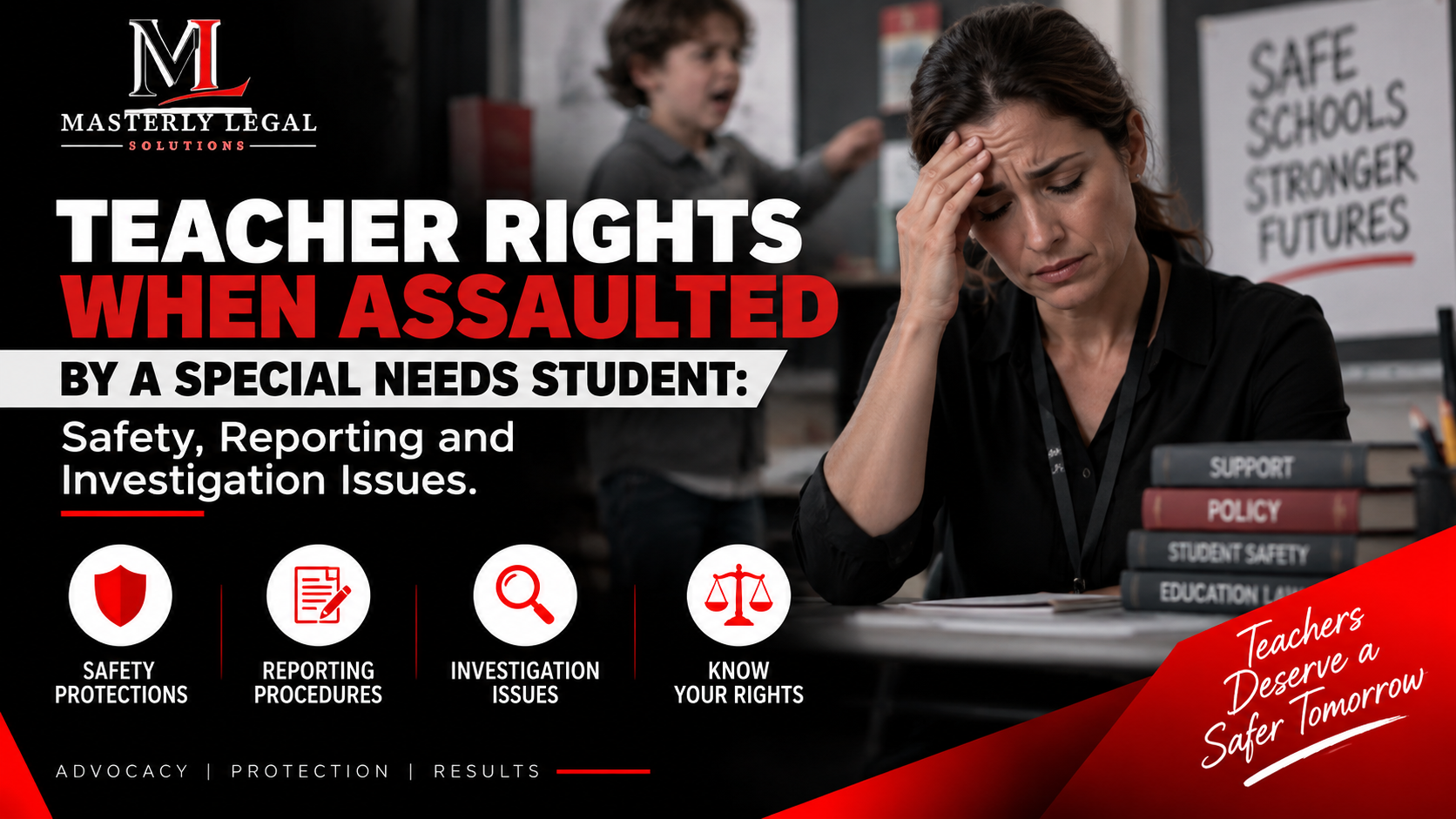
Teacher Rights When Assaulted by a Special Needs Student: Safety, Reporting and Investigation Issues

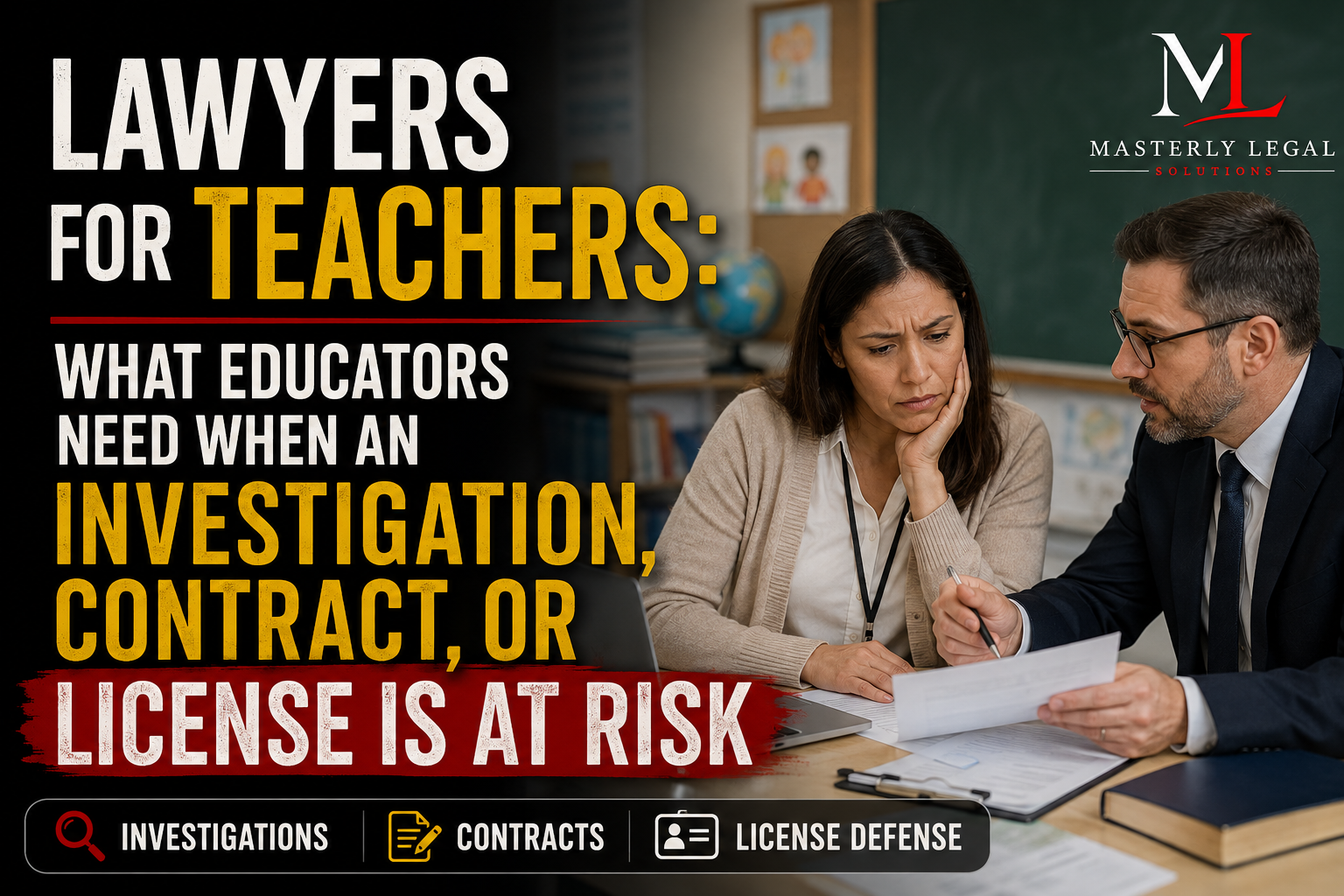




Looking for Legal & Business Solutions? Contact Us Now
Fill in the form or call us to set up a meeting