

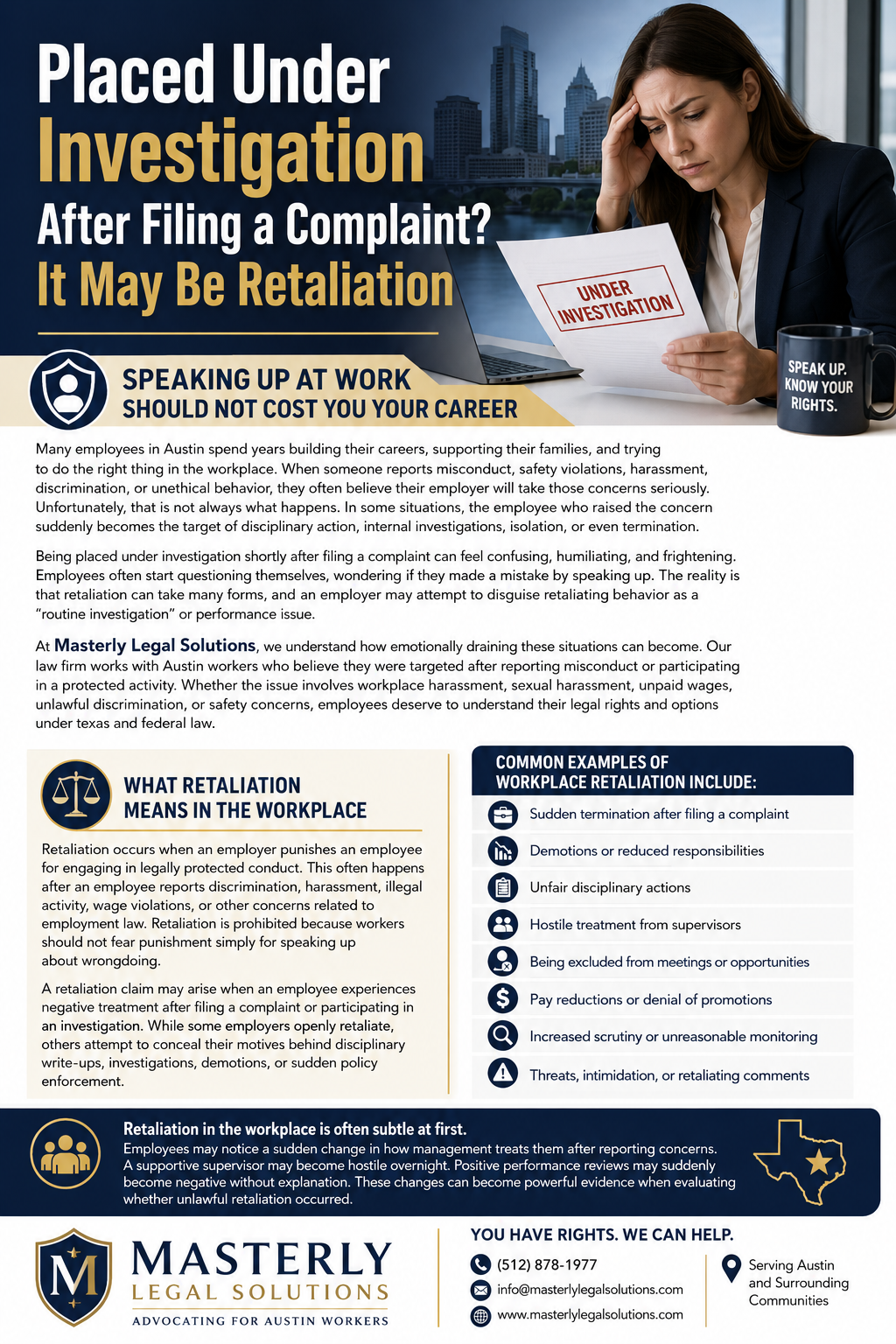
Placed Under Investigation After Filing a Complaint? It May Be Retaliation
Speaking Up at Work Should Not Cost You Your Career
Many employees in Austin spend years building their careers, supporting their families, and trying to do the right thing in the workplace. When someone reports misconduct, safety violations, harassment, discrimination, or unethical behavior, they often believe their employer will take those concerns seriously. Unfortunately, that is not always what happens. In some situations, the employee who raised the concern suddenly becomes the target of disciplinary action, internal investigations, isolation, or even termination.
Being placed under investigation shortly after filing a complaint can feel confusing, humiliating, and frightening. Employees often start questioning themselves, wondering if they made a mistake by speaking up. The reality is that retaliation can take many forms, and an employer may attempt to disguise retaliating behavior as a “routine investigation” or performance issue.
At Masterly Legal Solutions, we understand how emotionally draining these situations can become. Our law firm works with Austin workers who believe they were targeted after reporting misconduct or participating in a protected activity. Whether the issue involves workplace harassment, sexual harassment, unpaid wages, unlawful discrimination, or safety concerns, employees deserve to understand their legal rights and options under texas and federal law.
What Retaliation Means in the Workplace
Retaliation occurs when an employer punishes an employee for engaging in legally protected conduct. This often happens after an employee reports discrimination, harassment, illegal activity, wage violations, or other concerns related to employment law. Retaliation is prohibited because workers should not fear punishment simply for speaking up about wrongdoing.
A retaliation claim may arise when an employee experiences negative treatment after filing a complaint or participating in an investigation. While some employers openly retaliate, others attempt to conceal their motives behind disciplinary write-ups, investigations, demotions, or sudden policy enforcement.
Common examples of workplace retaliation include:
- Sudden termination after filing a complaint
- Demotions or reduced responsibilities
- Unfair disciplinary actions
- Hostile treatment from supervisors
- Being excluded from meetings or opportunities
- Pay reductions or denial of promotions
- Increased scrutiny or unreasonable monitoring
- Threats, intimidation, or retaliating comments
Retaliation in the workplace is often subtle at first. Employees may notice a sudden change in how management treats them after reporting concerns. A supportive supervisor may become hostile overnight. Positive performance reviews may suddenly become negative without explanation. These changes can become powerful evidence when evaluating whether unlawful retaliation occurred.
Why Employers Sometimes Investigate the Employee Who Filed the Complaint
After an employee reports misconduct, some employers attempt to shift attention away from the original issue by placing the complaining employee under investigation. This tactic can discourage other employees from reporting future violations and create fear throughout the workplace.
An employer may claim the investigation relates to attendance, performance, professionalism, or policy violations. However, timing matters. If the investigation begins shortly after filing a complaint, it may indicate retaliation rather than legitimate discipline.
In some cases, employers hope employees will resign voluntarily due to pressure or emotional distress. This strategy allows the employer to avoid openly firing the worker while still removing them from the workplace. Unfortunately, many employees blame themselves and leave before seeking advice from an attorney.
A skilled retaliation attorney can help determine whether the employer’s actions may violate texas labor code protections, federal law, or other laws designed to protect employees from retaliating conduct.
Protected Activity Under Employment Law
Not every disagreement at work qualifies for legal protection, but many employee actions do. A protected activity generally involves reporting misconduct, participating in an investigation, or asserting rights provided by employment law.
Protected activities may include:
- Reporting discrimination
- Reporting sexual harassment
- Filing a complaint with human resources
- Participating in an internal investigation
- Reporting unpaid wages
- Requesting reasonable accommodation
- Opposing unlawful discrimination
- Reporting workplace safety violations
- Participating in EEOC proceedings
- Assisting coworkers with legal complaints
Employees do not need to prove the employer actually violated the law to receive protection. In many employment law cases, the key issue is whether the employee reasonably believed misconduct occurred when they raised concerns.
The Connection Between Complaints and Sudden Investigations
One of the strongest indicators of retaliation is timing. When employees experience adverse action shortly after filing complaints, it raises important legal questions. Employers often attempt to justify their actions by claiming the employee had preexisting performance issues, but the timeline may tell a different story.
For example, an employee may receive excellent reviews for years before filing a complaint about workplace harassment. Days later, management suddenly accuses the employee of misconduct and launches an investigation. These patterns may suggest employer retaliation instead of legitimate workplace discipline.
Austin employment lawyers frequently examine:
- The timing of disciplinary actions
- Previous performance evaluations
- Internal communications
- Witness statements
- Changes in supervisor behavior
- Company policy enforcement
- Whether other employees were treated differently
Circumstantial evidence can play a major role in proving retaliation because employers rarely admit improper motives directly.
Retaliation After Reporting Harassment
Employees who report harassment often fear becoming targets themselves. Unfortunately, those fears are sometimes justified. Sexual harassment complaints may lead to isolation, demotions, retaliating remarks, or even termination.
Some employers attempt to protect high-level managers or valuable employees by discrediting the person who reported the misconduct. Instead of addressing the harassment through measures like regular sexual harassment training to prevent and correct misconduct, they investigate the reporting employee and attempt to paint them as problematic.
Workers should never be punished for reporting harassment concerns in good faith. Federal law and texas employment protections exist to help protect employees who speak up about misconduct in the workplace.
A hostile work environment may worsen after filing a complaint. Coworkers may begin excluding the employee, supervisors may increase scrutiny, and management may create unnecessary pressure. These forms of retaliation can become just as damaging as the original harassment itself.
Investigations Can Become Tools for Retaliating
Not every workplace investigation is improper. Employers sometimes need to investigate legitimate misconduct or policy violations. However, some companies misuse investigations as tools for retaliating against employees who raised concerns.
Retaliating investigations may involve:
- Selective enforcement of company policies
- False accusations
- Ignoring favorable evidence
- Interviewing biased witnesses
- Excessive monitoring
- Public humiliation
- Threatening disciplinary action
When investigations are conducted unfairly, employees may experience anxiety, financial uncertainty, and damage to their professional reputation. Workers often feel trapped because they fear additional retaliation if they defend themselves.
An experienced attorney can review the facts surrounding the investigation and identify signs of unlawful retaliation.
Understanding Adverse Action in Retaliation Cases
An adverse action is any negative employment decision that could discourage a reasonable employee from reporting misconduct or exercising legal rights. Many workers mistakenly believe only termination qualifies as retaliation, but retaliation can involve many forms of punishment.
Examples of adverse action may include:
- Demotion
- Suspension
- Pay cuts
- Reduced hours
- Transfer to undesirable shifts
- Denial of promotions
- Negative performance reviews
- Increased disciplinary actions
- Exclusion from training opportunities
Even actions that seem minor individually may support a retaliation claim when viewed together. Courts often examine the full pattern of conduct rather than focusing on one isolated event.
Retaliation and Workplace Discrimination Often Overlap
Retaliation cases frequently involve workplace discrimination as well. Employees may report discrimination based on race, national origin, gender, religion, disabilities, age discrimination, or pregnancy before experiencing retaliating conduct from management.
For example, an employee may report unlawful discrimination to human resources and then suddenly face disciplinary investigations, negative evaluations, or termination. These situations can involve multiple violations of employment law at the same time.
The equal employment opportunity commission investigates complaints involving discrimination and retaliation, while the department of labor may handle certain retaliation and labor complaints that must be filed promptly to protect legal rights. Filing with the EEOC may become an important step in preserving legal claims and protecting future rights.
Austin employment lawyers often handle cases involving both retaliation and discrimination because the issues are closely connected.
The Impact of Retaliation on Mental Health and Financial Stability
Employees dealing with retaliation often experience severe emotional distress. The stress of being investigated after filing complaints can affect nearly every part of life, including finances, family relationships, and physical health.
Workers may lose sleep, develop anxiety, or fear returning to the workplace each day. Some employees become worried about how future employers may view disciplinary records or investigations initiated by their employer.
Financial pressure can also become overwhelming. Lost wages, reduced hours, and termination may place families under significant strain. Employees sometimes hesitate to seek legal help because they fear the cost of hiring an attorney, but early legal guidance can help protect both careers and financial stability.
At Masterly Legal Solutions, we understand that retaliation cases are about more than workplace conflicts. They involve real people facing uncertainty about their future.
Retaliation Related to Reasonable Accommodation Requests
Employees with disabilities have protections under the disabilities act and other laws requiring employers to provide reasonable accommodation in many circumstances. Unfortunately, some workers face retaliation after requesting accommodations for medical conditions or disabilities.
Retaliation may occur when an employer:
- Refuses accommodation requests unfairly
- Begins disciplinary action after requests are made
- Isolates employees from coworkers
- Forces workers into less desirable roles
- Questions legitimate medical conditions
- Creates pressure to resign
Employees should not fear punishment for requesting accommodations they are legally entitled to receive. A workplace should support qualified workers instead of retaliating against them for exercising their rights.
Reporting Illegal Activity Should Never Lead to Punishment
Employees who report illegal activity often believe they are protecting coworkers, customers, students, or the public. Unfortunately, some employers respond by targeting the whistleblower instead of addressing the misconduct.
Examples of reported illegal activity may include:
- Fraud
- Wage violations
- Safety violations
- Ethical misconduct
- Regulatory violations
- Abuse of authority
- Financial misconduct
Government agencies and federal law provide certain protections for workers who report misconduct in good faith. Employees who experience retaliation after speaking up may have the right to pursue legal action.
School Employees and Retaliation Concerns in Austin
Employees working within school districts in austin may face unique retaliation issues. Teachers, administrators, counselors, coaches, and support staff often report concerns involving student safety, discrimination, policy violations, or misconduct within educational institutions.
In some situations, school employees who raise concerns suddenly find themselves under investigation by supervisors or the texas board overseeing educational matters, including TEA investigations that put a teacher’s license at risk. These investigations may involve allegations unrelated to the original complaint and can threaten professional licenses and future career opportunities.
Austin workers employed in educational settings deserve strong legal representation when facing retaliating conduct. An attorney familiar with employment law and school-related investigations, such as those involving Texas educators working to survive TEA investigations and protect their licenses, can help employees protect their careers and reputations.
How Employers Attempt to Justify Retaliation
Employers rarely admit they are retaliating against employees. Instead, they often create alternative explanations for disciplinary action or termination.
Common excuses employers use include:
- “Poor performance”
- “Violation of policy”
- “Restructuring”
- “Attendance concerns”
- “Professionalism issues”
- “Budget cuts”
- “Communication problems”
The challenge is that some employers carefully document alleged problems after an employee files a complaint. This is why it is critical for workers to gather evidence as early as possible.
A retaliation attorney can review emails, timelines, witness statements, and performance records to identify inconsistencies in the employer’s explanation.
Why Documentation Matters in Retaliation Cases
Employees should maintain records whenever possible after experiencing retaliation. Evidence may become extremely important later if legal action becomes necessary.
Helpful documentation may include:
- Emails
- Text messages
- Performance evaluations
- Witness names
- Complaint records
- Investigation notices
- Written disciplinary actions
- Notes about meetings
- Changes in job duties
Even small details can become important. For example, documenting the exact timing of retaliating behavior after filing complaints may help demonstrate a connection between the protected activity and adverse action.
Employees should avoid taking confidential company information improperly, but maintaining lawful documentation can strengthen a future claim.
Signs an Investigation May Be Retaliatory
Some employees sense something feels wrong about an investigation but struggle to explain why. Certain warning signs may indicate the investigation is connected to retaliation.
Potential warning signs include:
- The investigation started immediately after filing a complaint
- Supervisors suddenly changed behavior
- Policies are enforced inconsistently
- Witnesses are ignored selectively
- The employer refuses to discuss the original complaint
- Management pressures the employee to resign
- Other workers are not disciplined for similar conduct
Retaliation can evolve gradually. Employers may begin with subtle pressure before escalating toward termination or forced resignation.
The Difference Between Legitimate Discipline and Retaliation
Employers still have the right to discipline employees for genuine misconduct. However, discipline becomes unlawful when it is motivated by retaliation for protected activity.
The question is often whether the employer would have taken the same action if the employee had never filed a complaint. This requires careful analysis of evidence, timing, policies, and workplace behavior.
Employment lawyers investigate whether, and a dedicated retaliation lawyer focused on workplace retaliation and employment law can help evaluate if an employer’s actions crossed the line into unlawful conduct:
- The discipline was consistent with company policy
- Similar conduct was treated differently before
- Management followed standard procedures
- The employee had prior disciplinary history
- Supervisors expressed hostility after complaints
Retaliation claims are highly fact-specific, which is why experienced legal representation matters.
Retaliation Following Wage Complaints
Workers who report unpaid wages or overtime violations may also experience retaliation. Some employers punish employees who question pay practices because they fear broader investigations or liability.
Retaliation after wage complaints may involve reduced hours, disciplinary action, exclusion from opportunities, or termination. Employees have the right to ask questions about wages without fear of punishment.
Employment law protects workers who report compensation concerns in good faith. Retaliating against employees for raising wage issues can expose employers to additional liability.
The Role of the EEOC in Retaliation Cases
The EEOC plays a major role in investigating workplace discrimination and retaliation complaints. Employees may need to file administrative complaints before pursuing certain legal claims in court.
The equal employment opportunity commission reviews allegations involving:
- Workplace discrimination
- Sexual harassment
- Retaliation
- Hostile work environment claims
- Disability-related issues
- National origin discrimination
- Age discrimination
Deadlines matter in these cases. Waiting too long to speak with an attorney could affect important legal rights.
Austin employment lawyers can help determine whether EEOC filing requirements apply to a specific situation, and a retaliation lawyer experienced in workplace law and employment attorney help can guide employees through these steps.
How Retaliation Affects Careers Long-Term
Retaliation does not always end with one investigation or termination. Some employees struggle to find future employment because disciplinary records or negative references follow them.
Workers may also lose professional licenses, promotional opportunities, retirement benefits, or industry relationships. The long-term consequences can be devastating, especially for employees in specialized professions.
This is one reason why employees should not assume the situation will “blow over” without taking steps to protect themselves. Early legal guidance can help preserve careers and future opportunities.
Hostile Work Environment After Filing Complaints
A hostile work environment can develop when employers or coworkers begin targeting an employee after reporting concerns. Retaliation sometimes involves constant criticism, exclusion, humiliating comments, or unfair scrutiny.
These behaviors can make employees dread coming to work each day. Over time, the stress may become unbearable.
A hostile work environment may include:
- Public embarrassment
- Threatening comments
- Isolation from coworkers
- Constant monitoring
- Excessive workloads
- Retaliating remarks from management
Employees should not be forced to tolerate abusive treatment simply because they exercised protected rights.
Why Timing Is Often Critical in Retaliation Cases
One of the most important factors in many retaliation claims is how quickly the employer acted after the employee engaged in protected activity. Close timing between filing complaints and disciplinary action may support an inference of retaliation.
For example, if an employee reports harassment on Monday and receives disciplinary action on Friday, the timeline itself may raise serious concerns.
Courts and attorneys frequently evaluate:
- When the complaint was filed
- When management learned about the complaint
- When investigations started
- When adverse action occurred
Strong timelines can become persuasive evidence in employment law cases.
What Employees Should Avoid During Workplace Investigations
Employees facing investigations often feel emotional and defensive. While those feelings are understandable, certain actions may complicate a case.
Workers should avoid:
- Destroying records
- Making threats
- Posting about the situation online
- Violating company confidentiality rules
- Resigning impulsively without legal advice
- Signing agreements without review
Instead, employees should remain professional while gathering information and seeking legal guidance from an attorney experienced in retaliation matters.
Can Employees Seek Compensation for Retaliation?
In some cases, employees may seek compensation for financial and emotional harm caused by retaliation. Potential damages vary depending on the facts of the case and applicable law.
Possible compensation may involve:
- Lost wages
- Emotional distress damages
- Front pay
- Back pay
- Attorney fees
- Reinstatement in certain situations
A retaliation attorney can evaluate whether compensation may be available based on the circumstances.
Retaliation Against Employees Who Support Coworkers
Employees may also face retaliation for supporting coworkers involved in complaints or investigations. An employer cannot always punish workers for participating as witnesses or assisting with protected complaints.
For example, employees who testify during internal investigations or cooperate with government agencies may receive protection under employment law.
Retaliation protections are important because workers should not fear punishment for helping uncover misconduct or supporting coworkers facing discrimination or harassment.
Why Legal Representation Matters Early
Many employees wait too long before speaking with employment lawyers. By the time they seek help, important evidence may be lost, deadlines may pass, and the employer may already have built a damaging narrative.
Early legal representation can help employees:
- Understand their rights
- Preserve evidence
- Respond strategically to investigations
- Avoid harmful mistakes
- Evaluate settlement options
- Prepare for legal action if necessary
At Masterly Legal Solutions, we are committed to helping employees navigate difficult workplace situations with professionalism and clarity.
How Retaliation Can Escalate Into Termination
Some employers gradually escalate retaliating behavior over time. What begins as increased scrutiny may eventually lead to termination.
This escalation may involve:
- Repeated write-ups
- Sudden performance plans
- Exclusion from meetings
- Increased criticism
- Investigations
- Demotions
Employers sometimes hope the employee will resign before formal termination occurs. Workers should carefully evaluate their options before making major employment decisions during an investigation.
Understanding the Emotional Toll of Retaliation
Employees experiencing retaliation often feel isolated and powerless. Many entered their professions because they genuinely cared about their work and wanted to contribute positively to their workplace.
Being punished after doing the right thing can create deep frustration and disappointment. Workers may feel betrayed by leadership they once trusted.
At Masterly Legal Solutions, we recognize that retaliation cases involve more than policies and procedures. They involve people trying to protect their livelihoods, reputations, and futures.
Building a Stronger Workplace Culture
Employers should encourage transparency, accountability, and respect in the workplace. When employees fear retaliation for reporting concerns, problems often remain hidden and workplace culture deteriorates.
Healthy workplaces respond to complaints by, among other steps, adopting clear policies developed through employee handbook services that ensure compliant workplace rules:
- Conducting fair investigations
- Protecting employees from retaliation
- Encouraging reporting
- Addressing misconduct promptly
- Treating employees with respect
Organizations that retaliate against workers often create long-term morale and trust problems throughout the company.
Legal Protections Available to Austin Workers
Austin employment matters may involve protections under federal law, texas statutes, and local regulations. Depending on the circumstances, employees may have rights involving discrimination, harassment, whistleblower protections, wage laws, or disability accommodations.
Because retaliation cases can involve many forms of legal protections, workers should seek guidance from an attorney familiar with employment law in texas, and businesses may rely on general counsel services to navigate ongoing employment and compliance issues.
A skilled attorney can help determine:
- Whether protected activity occurred
- Whether adverse action took place
- What evidence supports the claim
- Which deadlines apply
- What next steps may be available
Every case is different, which makes personalized legal analysis important.
When an Employer Tries to Silence Complaints
Some employers discourage complaints by making examples of employees who speak up. Investigations, discipline, and retaliating conduct can create fear among workers and discourage future reporting.
However, the law exists to protect employees who report misconduct in good faith. Employers should not intimidate workers into silence through unlawful retaliation.
Employees who suspect retaliating behavior should take concerns seriously and seek professional legal guidance, while employers may benefit from HR consulting and training services designed to prevent retaliation disputes, before the situation worsens.
Taking the First Step Toward Protecting Yourself
Many workers hesitate to contact an attorney because they fear conflict or uncertainty. However, simply learning about your rights does not mean you are required to file a lawsuit immediately.
Speaking with employment lawyers can help you understand the situation more clearly and determine what options may exist. In many cases, early intervention may help protect both careers and reputations before matters escalate further.
If you believe your employer placed you under investigation after filing a complaint, your concerns deserve careful evaluation. You should not assume the employer’s actions are automatically justified simply because management claims the investigation is “routine.
How Retaliation Lawyers Help Protect Employees From Unfair Treatment
When workers experience punishment after reporting misconduct, retaliation lawyers can play an important role in protecting their rights and careers. Many employees feel intimidated when an employer suddenly launches investigations, issues disciplinary actions, or threatens termination after a complaint is made. A skilled attorney can review timelines, evaluate evidence, and determine whether the employer’s actions may violate employment law protections. At Masterly Legal Solutions, we represent employees facing retaliation, harassment, discrimination, and wrongful workplace treatment throughout Austin and across texas. Employees should not feel pressured into silence simply because an employer attempts to create fear or uncertainty after concerns are reported.
Filing a Discrimination Claim After Workplace Retaliation
A discrimination claim may arise when an employee experiences unfair treatment based on protected characteristics such as race, gender, disabilities, religion, age, or national origin. In some situations, workers not only experience discrimination itself but also retaliation after reporting the misconduct internally or through government agencies. Employers sometimes attempt to disguise retaliating behavior as performance concerns or policy enforcement, even when the real motivation involves punishment for speaking up. Employees who believe they have been treated unfairly should understand that both discrimination and retaliation may violate federal law and texas employment protections. Taking action early may help workers preserve important evidence and protect their future opportunities.
How Employment Attorneys Represent Employees During Retaliation Investigations
Employment attorneys often represent employees during internal investigations involving complaints, workplace disputes, and retaliating conduct. When an employer suddenly places a worker under investigation after filing complaints, the employee may feel uncertain about how to respond or what rights they still have. Legal representation can help workers understand investigation procedures, prepare documentation, and avoid mistakes that could negatively affect their case. At Masterly Legal Solutions, we represent employees facing hostile work environments, workplace harassment, retaliation, and termination concerns. Having experienced legal guidance may help employees feel more confident when dealing with difficult workplace situations.
What Happens When an Employee Complains About Workplace Misconduct
When an employee complains about harassment, discrimination, unpaid wages, or illegal activity, the employer should respond professionally and investigate the concerns fairly. Unfortunately, some employers react defensively and begin targeting the employee instead of addressing the original issue. Retaliation can involve many forms of mistreatment, including increased scrutiny, disciplinary write-ups, demotions, or exclusion from workplace opportunities. Employees should never fear punishment simply because they reported misconduct or participated in a protected activity. Speaking with an attorney early in the process may help workers better understand their legal rights and potential next steps.
Supreme Court Decisions Have Strengthened Employee Retaliation Protections
Over the years, the supreme court has issued important rulings that strengthened protections for employees facing retaliation in the workplace. These decisions recognize that workers must feel safe reporting discrimination, harassment, wage violations, and other misconduct without fear of punishment from an employer. Courts often examine whether retaliating conduct would discourage a reasonable employee from reporting concerns or participating in investigations. Supreme court rulings have also clarified that retaliation may occur even when the employer’s actions do not involve immediate termination. Understanding how these legal standards apply can be important for employees considering legal action after experiencing workplace retaliation.
Why Such Actions May Violate Employment Law Protections
Such actions by an employer may violate both federal law and texas employment protections when they are motivated by retaliation or discrimination. Employers cannot legally punish workers for reporting misconduct, participating in investigations, requesting reasonable accommodation, or asserting protected workplace rights. Even subtle retaliating behavior can create serious legal concerns when it affects an employee’s career, reputation, or financial stability. Employees experiencing these situations often feel isolated or pressured into resigning before fully understanding their options. At Masterly Legal Solutions, we are committed to helping workers evaluate whether unlawful retaliation may have occurred and what steps may help protect their future.
Speak With Masterly Legal Solutions About Retaliation Concerns
If you are an employee in austin or surrounding areas and believe you are facing retaliation after filing a complaint, Masterly Legal Solutions is here to help. Our law firm is committed to protecting workers facing workplace retaliation, discrimination, harassment, and unfair treatment throughout texas.
We understand how overwhelming these situations can become, especially when your career, reputation, and financial future are at stake. Whether you work in private industry, education, healthcare, or other professional environments, our team can help evaluate your concerns and discuss potential next steps.
Our austin employment team works closely with employees who believe they were targeted for reporting misconduct, requesting reasonable accommodation, participating in investigations, or asserting protected rights under employment law. We are committed to helping workers pursue justice while protecting their professional future.
Contact Masterly Legal Solutions at (972) 236-5051 for a free consultation. We can answer questions about retaliation, workplace investigations, discrimination concerns, termination issues, and other employment-related matters affecting austin workers and employees across texas.
Disclaimer: This article is provided for informational and educational purposes only and should not be considered legal advice or legal guidance. Reading this article does not create an attorney-client relationship with Masterly Legal Solutions. Every employment situation is different, and laws may change over time. If you are facing retaliation, workplace harassment, discrimination, or other employment concerns, you should contact a qualified attorney to discuss your specific circumstances.

Teacher Rights When Assaulted by a Special Needs Student: Safety, Reporting and Investigation Issues







Looking for Legal & Business Solutions? Contact Us Now
Fill in the form or call us to set up a meeting