

Forced Resignation Lawsuit: What Teachers Need to Know Before Signing Anything
When a Teacher Feels Pressured to Resign
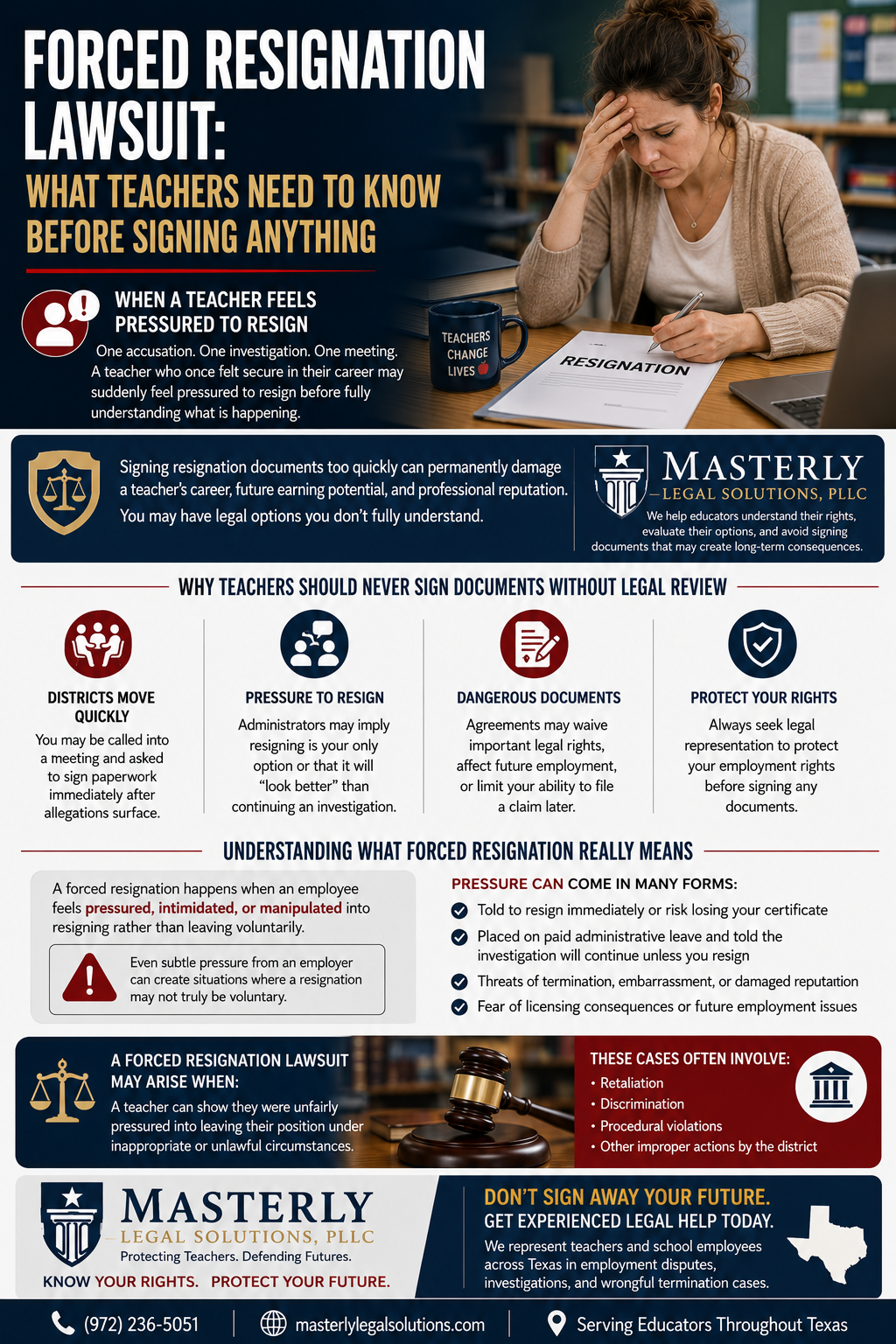
Most teachers enter education because they care deeply about students, their community, and the future they are helping shape every day. They spend years building classroom experience, developing relationships, and earning the trust of parents and administrators. Then suddenly, one accusation, one investigation, or one uncomfortable meeting with administration changes everything. A teacher who once felt secure in their career may suddenly feel pressured to resign before fully understanding what is happening.
Many educators facing allegations believe resigning will make the situation disappear. Others feel cornered after being placed on administrative leave or told they should “consider resigning” to avoid further problems. Unfortunately, signing resignation documents too quickly can permanently damage a teacher’s career, future earning potential, and professional reputation. In many situations, educators later realize they may have had legal options they never fully understood.
At Masterly Legal Solutions, our attorneys provide legal protection for teachers and understand how emotionally overwhelming these situations can become. Teachers often feel isolated, confused, and afraid of losing everything they worked hard to build. Our firm helps educators understand their rights, evaluate their legal options, and avoid signing documents that may create long-term consequences. A rushed resignation may appear simple in the moment, but it can become the foundation of a future forced resignation lawsuit or wrongful termination claim if the circumstances were unfair or unlawful.
Why Teachers Should Never Sign Documents Without Legal Review
School districts often move quickly once allegations surface. An educator may suddenly be called into a meeting with a principal, district administrator, or human resources representative and asked to sign paperwork immediately. Many teachers feel shocked and emotionally overwhelmed during these conversations.
Some administrators present resignation paperwork as though it is the only reasonable option available. Others imply that resigning quietly may “look better” than continuing through an investigation. Teachers who are frightened about losing their license or career sometimes sign documents without reading every detail carefully.
This can be extremely dangerous. Certain agreements may waive important legal rights, affect future employment opportunities, or impact a teacher’s ability to file a future wrongful termination claim. Educators should always seek legal representation to protect their employment rights before signing any document connected to allegations, investigations, or employment separation.
Understanding What Forced Resignation Really Means
A forced resignation happens when an employee feels pressured, intimidated, or manipulated into resigning rather than leaving voluntarily. In many school-related cases, the pressure may come from fear, threats of termination, public embarrassment, or concerns about future licensing consequences.
Some teachers are told they should resign immediately or risk losing their certificate. Others are informed they will remain on paid administrative leave while investigations continue unless they resign first. Even subtle pressure from an employer can create situations where a resignation may not truly be voluntary.
A forced resignation lawsuit may arise when a teacher can show they were unfairly pressured into leaving their position under inappropriate or unlawful circumstances. These cases often involve questions regarding retaliation, discrimination, procedural violations, or other improper actions by the district.
The Emotional Pressure Teachers Face During Investigations
Many educators describe investigations as one of the most stressful experiences of their lives. Teachers often worry about their family, finances, professional reputation, and ability to continue working in education. The emotional pressure can become especially intense after being placed on administrative leave.
A teacher who is suddenly removed from the classroom may feel embarrassed, isolated, and uncertain about the future. Coworkers may stop communicating, rumors may spread, and parents may begin asking questions. In many situations, educators feel pressured to resign simply to escape the stress and uncertainty surrounding the investigation.
Unfortunately, emotional decision-making can create long-term consequences. Teachers should never allow fear or panic to force them into signing documents they do not fully understand.
Administrative Leave Does Not Always Mean Guilt
One of the biggest misconceptions educators face is believing placement on administrative leave automatically means the district has already determined they are guilty. In reality, districts often place employees on leave while conducting internal investigations.
Some teachers are placed on paid leave while allegations are reviewed. Others may be placed on investigative leave during evidence collection or witness interviews. These actions are often described as temporary administrative measures rather than final disciplinary findings.
An employer may also grant administrative leave while reviewing allegations connected to student safety, workplace concerns, or policy issues. However, teachers should understand that administrative action does not necessarily mean wrongdoing occurred.
The Difference Between Paid and Unpaid Leave
Many school districts use different forms of leave during investigations. Some educators are placed on paid administrative leave, while others experience unpaid suspension or restrictions involving their employee's current position.
A teacher placed on paid leave may still face significant emotional and professional pressure despite continuing to receive compensation. The uncertainty surrounding the investigation can affect mental health, family stability, and future career opportunities.
Districts may also use terms such as investigative leave, safety leave, or temporary reassignment during investigations. Understanding the purpose and consequences of each status is important when evaluating legal options.
How Internal Reviews Can Escalate Quickly
Some school districts begin with informal concerns or internal reviews before escalating the matter into a formal disciplinary process. A simple complaint may quickly evolve into interviews, documentation requests, or district-wide investigations.
Teachers are often unaware of how much evidence administrators gather before they are formally notified. Emails, text messages, classroom records, and witness statements may already exist before the educator has the opportunity to respond.
This is one reason educators should seek experienced education law attorney guidance early in the process. Small procedural mistakes during early reporting stages can later become major issues during litigation or administrative proceedings.
Common Pressure Tactics Used During School Investigations
Teachers facing allegations are sometimes pressured to resign through subtle or direct tactics used by administrators or district personnel. These situations may leave an educator feeling trapped and uncertain about what to do next.
Common pressure tactics may include:
- Threats involving termination
- Sudden removal from campus
- Placement on administrative leave
- Negative publicity concerns
- Statements implying resignation will “look better”
- Warnings regarding certification consequences
- Pressure from human resources
- Threats involving future employment
An employee's resignation should never be based solely on fear, intimidation, or incomplete information.
Wrongful Termination and Forced Resignation
Some educators believe a resignation automatically prevents future legal action. However, that is not always true. In certain situations, a teacher may still pursue a wrongful termination claim even after resigning if the resignation was effectively forced.
A wrongful termination situation may occur when a district pressures an educator to resign for unlawful reasons or as retaliation for protected activities. Teachers may also have claims involving discrimination, whistleblower protections, or violations of public policy.
Determining whether a teacher has a valid claim depends heavily on the facts surrounding the resignation and investigation process.
Violation of Public Policy in Education Cases
Many employment disputes involving teachers center around a violation of public policy. This legal concept applies when an employer’s actions violate important legal protections or public interests.
For example, a district may not lawfully pressure a teacher to resign for reporting student safety concerns, discrimination, financial misconduct, or other forms of illegal activity. Educators who participate in protected reporting activities may have legal protections under state law or federal law.
In some situations, a violation of public policy may form the basis of a strong wrongful discharge or wrongful termination claim.
Reporting Illegal Activity Should Not Cost a Teacher Their Career
Teachers sometimes become targets after speaking up about misconduct inside a school district. An educator who reports testing irregularities, discrimination, harassment, or safety concerns may suddenly experience retaliation from administrators.
This type of retaliation may involve disciplinary action, hostile treatment, negative evaluations, or pressure to resign. In some cases, the district may attempt to justify the actions by launching investigations involving unrelated allegations.
An educator engaged in protected reporting activity should never feel forced out of their position for exposing possible illegal activity or misconduct.
How Retaliation Can Lead to a Wrongful Discharge Claim
Retaliation cases often arise after a teacher participates in protected activities involving workplace complaints or legal concerns. A district may react negatively after an educator reports misconduct, discrimination, or safety violations.
A wrongful discharge or wrongful termination case may exist if a teacher experiences adverse actions because of legally protected conduct. Retaliation can appear in many forms, including increased scrutiny, disciplinary action, removal from leadership roles, or pressure to resign.
At Masterly Legal Solutions, our education lawyers help educators determine whether retaliation may have played a role in the investigation or resignation process.
Employment Discrimination in School Investigations
Some investigations involve allegations connected to employment discrimination based on race, gender, disability, religion, or age. Teachers may feel targeted unfairly compared to other employees facing similar allegations.
Discrimination claims sometimes arise when districts apply policies inconsistently or discipline certain educators more harshly than others. An educator who feels singled out because of protected characteristics may have legal rights worth exploring.
A wrongful termination claim involving discrimination may require evidence showing the district acted unfairly or treated similarly situated employees differently.
The Role of Human Resources During Investigations
Teachers often assume human resources personnel are neutral participants during investigations. However, HR departments generally work to protect the district’s legal and financial interests.
While some HR professionals attempt to handle matters fairly, educators should remember that HR representatives do not represent the teacher personally. Statements made during meetings may later become evidence during disciplinary proceedings or litigation.
An employee should approach every investigation meeting carefully and seek an education law attorney for teachers and administrators whenever possible before providing statements or signing documents.
Investigative Leave and Teacher Rights
Many districts place educators on investigative leave while gathering evidence or interviewing witnesses. These actions may last days, weeks, or even months depending on the complexity of the allegations.
An educator on leave often feels powerless and uncertain about what is happening behind the scenes. District officials may limit communication, restrict access to school property, or prevent contact with coworkers.
Teachers should use this time carefully by organizing records, preserving evidence, and consulting experienced education law attorneys about possible legal options.
Why Teachers Should Preserve Evidence Immediately
One of the biggest mistakes educators make is failing to preserve evidence early in the investigation process. Emails, evaluations, text messages, meeting notes, and witness information may become critical later.
Some teachers panic and delete information out of fear or embarrassment. Unfortunately, destroying evidence can create additional problems and damage credibility during litigation.
Teachers should preserve all potentially relevant communications and avoid altering documents once allegations surface.
How School Policies Affect Teacher Investigations
Every district operates under specific agency policies, district rules, and disciplinary procedures. Some policies may be formally adopted, while others function more like ad hoc practices created by administrators.
Districts are generally expected to issue internal policies consistent with applicable laws and educational regulations. However, some districts fail to follow their own procedures during investigations or disciplinary proceedings.
An educator should carefully review district policies to determine whether administrators complied with required procedures.
Administrative Leave and Public Policy Concerns
Placement on administrative leave may raise significant legal questions when the district acts unfairly or inconsistently. In some situations, a teacher may believe the leave decision itself reflects retaliation or discrimination.
A violation of public policy may occur if an educator is punished for participating in legally protected activities such as whistleblowing or workplace reporting. Teachers should not face retaliation simply because they attempted to protect students or expose misconduct.
These cases often require detailed legal analysis regarding district motivations and procedural fairness.
Understanding At Will Employment in Texas
Many educators hear the phrase at will employment and assume school districts can terminate employees for any reason whatsoever. While Texas employment laws provide employers with significant discretion, important exceptions still exist.
An employer generally cannot terminate or pressure an employee to resign for unlawful reasons. Actions connected to discrimination, retaliation, whistleblower protections, or violation of public policy may create legal claims despite at-will employment principles.
Teachers should never assume they have no rights simply because they work in Texas; if an employer is pressuring them to resign, they should understand whether an employer can force you to quit your job under applicable employment laws.
Federal Regulations and School Employment
Some teacher investigations involve issues connected to federal employment protections or regulations. Depending on the allegations, districts may need to comply with various federal statutes and administrative requirements.
In certain cases, legal disputes may involve references to the united states code, opm regulations, or guidance issued by administrative agencies. While some of these standards apply more directly to federal employment systems, they may still influence broader employment law principles.
Teachers should understand that school investigations sometimes involve overlapping state and federal legal concerns.
Agency Officials and Administrative Authority
School investigations often involve multiple layers of district administration and outside personnel. Teachers may interact with principals, HR staff, district investigators, or agency officials throughout the process.
Some actions may only be taken when specifically authorized by district leadership or an agency head. In other situations, disciplinary recommendations may come from committees or administrative review panels.
Understanding who has authority to make decisions is important when evaluating the fairness of an investigation.
Authorized Agency Officials and Reporting Requirements
Certain educational investigations involve cooperation with outside agencies or state authorities. District personnel may communicate with authorized agency officials or other authorized agency officials when allegations involve licensing concerns, student safety, or criminal matters.
These situations often involve detailed reporting obligations and administrative procedures. Teachers should understand that statements made to district investigators may later be shared with outside entities.
An educator should never assume a conversation is “off the record” during a formal investigation.
Wrongful Termination and Violation of Public Policy
A teacher may have a valid wrongful termination case when an employer’s actions conflict with established legal protections or broader public interests. Courts often examine whether the district engaged in conduct amounting to a violation of public policy.
Examples may include punishing a teacher for reporting unsafe conditions, refusing unlawful instructions, or participating in legally protected activities. A district may also violate public policy by retaliating against educators who report financial misconduct or student safety concerns.
These cases are often highly fact-specific and require experienced legal analysis.
Workplace Safety Concerns and Teacher Protections
Teachers who raise concerns involving workplace safety should not fear losing their career because they spoke up. Educators often feel obligated to report unsafe conditions involving students, staff, or school operations.
Unfortunately, some teachers later experience retaliation after raising legitimate concerns. Investigations may suddenly begin, administrative pressure may increase, or disciplinary actions may follow protected complaints.
A violation of public policy may occur if a district retaliates against an educator for attempting to protect student or employee safety.
Understanding Paid Leave and Excused Absence Policies
Districts may use different forms of leave during investigations depending on the allegations involved. An educator may receive notice leave, paid leave, or another type of temporary reassignment during the process.
Certain absences may qualify as an excused absence under district policies or applicable regulations. Teachers should carefully review leave paperwork to understand how the district is classifying the absence and whether benefits or compensation may be affected.
An educator should also review whether the district properly followed its own internal policies regarding leave decisions.
Emotional Distress and Career Damage
The emotional impact of forced resignation situations can be severe. Teachers often experience anxiety, humiliation, depression, and fear about the future after being placed on administrative leave or pressured to resign.
Some educators struggle financially after losing their income or benefits. Others experience long-term emotional trauma connected to damaged professional reputations and public accusations.
In certain cases, educators may seek damages related to emotional distress as part of broader employment litigation.
Punitive Damages in Wrongful Termination Cases
Some employment disputes involve requests for punitive damages when the employer’s conduct was especially harmful or reckless. These damages are intended to punish particularly wrongful behavior and discourage similar conduct in the future.
Whether punitive damages may apply depends heavily on the facts of the case and the evidence available. Courts often evaluate whether the district acted intentionally, maliciously, or with reckless disregard for the employee’s rights.
Not every case qualifies for punitive damages, but the possibility may influence litigation strategy and settlement negotiations.
Adverse Actions and Protected Activity
A teacher engaged in protected activity should not face punishment simply for exercising legal rights. Protected activities may include discrimination complaints, whistleblower reporting, or participation in investigations.
When districts respond with negative employment actions, those actions may qualify as adverse actions under employment law principles. Examples may include forced resignation pressure, suspension, demotion, or termination.
Teachers who believe they were punished for protected conduct should seek experienced legal guidance quickly.
Internal Policies and Procedural Fairness
School districts are expected to follow established agency policies, employment procedures, and legal standards during investigations. However, procedural fairness is not always guaranteed.
Some districts rely on inconsistent or ad hoc disciplinary approaches rather than applying policies evenly. Others may ignore timelines, fail to provide adequate notice, or pressure educators into signing documents quickly.
An educator should carefully evaluate whether the district followed proper procedures before accepting disciplinary recommendations or resignation demands.
The Importance of Legal Representation During Investigations
Teachers facing investigations often feel intimidated by administrators, district attorneys, and HR personnel. Many educators attempt to handle the matter alone because they fear hiring an attorney will make them appear guilty.
In reality, experienced legal representation may significantly improve a teacher’s ability to protect their rights, preserve evidence, and avoid costly mistakes. A knowledgeable attorney can help evaluate whether the district violated employment laws or pressured the educator unfairly.
At Masterly Legal Solutions, our expert education lawyers work directly with teachers to help them understand every available option before making career-changing decisions.
Former Employer Issues After Resignation
Many educators worry about what happens after leaving a district. A former employer may continue reporting information to licensing agencies, future districts, or state authorities after the resignation occurs.
Teachers should understand that resigning does not always end the investigation process. In some situations, licensing reviews continue even after employment separation.
An educator should carefully review all agreements before resigning to understand how the district may communicate with future employers or state agencies.
Why Timing Matters During School Investigations
Teachers often feel pressure to make immediate decisions during investigations. Administrators may imply the educator must resign immediately or risk worse consequences later.
However, rushed decisions often create long-term problems. An educator should never feel forced to sign documents without fully understanding the consequences.
Taking time to consult experienced attorneys may improve the teacher’s ability to make informed decisions and protect their future career opportunities.
Public Policy Violations and Teacher Rights
A district’s actions may create legal exposure when they conflict with established public policy protections. Teachers who report misconduct, discrimination, or safety concerns should not face retaliation simply because they acted responsibly.
A violation of public policy may support claims involving wrongful discharge, retaliation, or other employment-related disputes. Courts often evaluate whether the district’s conduct undermined important legal protections or broader public interests.
Understanding these protections is essential when evaluating possible legal claims.
How Other Employees May Influence Investigations
Coworker statements often play a major role during school investigations. A single co worker complaint or witness statement may significantly influence how administrators view the allegations.
Unfortunately, some educators discover that workplace politics, personality conflicts, or misunderstandings contributed to the investigation itself. Teachers should never assume every witness statement is accurate or unbiased.
Preserving evidence and obtaining legal guidance early may help identify inconsistencies or credibility issues during the investigation process.
Agency Mission and Administrative Judgment
District administrators often justify disciplinary actions by referencing the school’s educational mission or student safety responsibilities. An agency determines disciplinary responses based on what leadership believes supports the district’s overall goals.
In some situations, an agency's mission may influence how allegations are investigated or resolved. However, districts must still comply with employment laws, procedural requirements, and public policy protections.
An educator should not lose their career simply because administrators prioritized public image over fairness.
How Agency Judgments Affect Employment Decisions
School investigations often involve subjective decision-making by administrators and district personnel. These agency judgments may influence whether a teacher remains employed, stays on leave, or faces disciplinary recommendations.
In some situations, an agency determines outcomes based on incomplete evidence, inconsistent procedures, or assumptions rather than verified facts. Teachers should understand that administrative decisions are not always final or legally correct.
Legal review may reveal procedural problems or rights violations that significantly affect the educator’s options moving forward.
Teachers Should Not Navigate This Alone
Many educators spend years supporting students, families, and coworkers only to feel abandoned during investigations. Teachers facing allegations often feel emotionally exhausted, financially stressed, and uncertain about the future.
At Masterly Legal Solutions, we understand how deeply these situations affect educators and their families. Our attorneys are committed to helping teachers understand their rights, protect their professional reputation, and avoid mistakes that could permanently damage their career.
Every situation is different, and every teacher deserves careful legal guidance before making life-changing employment decisions.
Administrative Leave Policies and Employment Standards Teachers Should Understand
School districts often rely on detailed leave procedures and employment rules when responding to allegations against educators. In some situations, districts place teachers on leave for brief or short periods while administrators gather information or conduct interviews, and Texas educators should understand the steps to take when placed on administrative leave. Other districts may use temporary leave assignments on a time limited basis during internal investigations. While these actions may appear routine, teachers should understand that even brief periods of removal from the classroom can affect professional reputation, future employment opportunities, and emotional well-being.
Many districts attempt to justify disciplinary decisions by claiming the allegations involve serious policy concerns or possible illegal reasons for termination, which may also trigger Texas Education Agency investigation and license defense issues. However, a teacher should never assume the district’s version of events is automatically correct. In some cases, the allegations may involve misunderstandings, false accusations, or exaggerated claims regarding alleged misconduct. A careful legal review may help educators determine whether the district acted unfairly or violated employment protections during the investigation process.
School districts also maintain internal employment standards connected to personnel management, employee conduct, and workplace investigations. Some administrative procedures are influenced by broader employment practices used in government agencies or public-sector systems. These practices may reference guidance connected to an executive order, presidential memorandum, presidential directive, or various forms of opm guidance depending on the employment structure involved. Certain leave rules may also involve provisions regarding medical care, family emergencies, blood donations, or participation in officially sponsored professional activities throughout the calendar year.
In some situations, districts may attempt to defend their actions by arguing a reasonable person would have resigned under the same circumstances. However, whether a resignation was truly voluntary often depends on the pressure, threats, or intimidation used by administrators during the process. If a jury believes the district intentionally pressured a teacher to resign unfairly, the educator may have grounds to pursue legal claims involving wrongful termination or retaliation. Teachers should remember that an employer fired an educator does not automatically mean the district acted lawfully or fairly under employment regulations.
Certain employment disputes may also involve broader workplace compliance concerns unrelated to the teacher personally. For example, investigations involving hiring policies, allegations of employing undocumented workers, or disputes connected to undocumented workers may create additional scrutiny within the district. While these issues may seem unrelated to classroom performance, administrators sometimes use broader investigations to justify disciplinary actions against educators. In larger districts or metropolitan areas such as san francisco, employment disputes have demonstrated how quickly administrative investigations can expand into major legal conflicts involving multiple parties and agencies.
Teachers should also pay close attention to communications from a principal or supervisor during investigations because even informal conversations may later become evidence. In many cases, educators struggle to prove their resignation was forced because they lacked documentation showing the pressure or threats involved. Preserving emails, meeting notes, witness information, and district communications can become critical if litigation eventually occurs. Additionally, some employment disputes involve leave rules or protections created under other provision standards that may not be immediately obvious to the educator during the early stages of the case.
Speak With Masterly Legal Solutions Before Signing Anything
If you are being pressured to resign, placed on administrative leave, or facing allegations involving your employment, do not make decisions out of fear or panic. A resignation signed too quickly may affect your career, financial future, and teaching opportunities for years to come.
Masterly Legal Solutions helps educators understand their rights, evaluate possible legal claims, and respond strategically during investigations and disciplinary proceedings. Whether you are facing a possible wrongful termination, retaliation concerns, or pressure connected to a forced resignation lawsuit, our team is ready to help.
Our attorneys genuinely care about helping teachers protect their careers and future opportunities. Before signing any agreement, resignation paperwork, or settlement documents, take the time to speak with experienced legal counsel. Contact Masterly Legal Solutions today at (972) 236-5051 for a free consultation and let us help you understand your options moving forward.
Disclaimer: This article is for informational and educational purposes only and does not constitute legal advice. Reading this article does not create an attorney-client relationship with Masterly Legal Solutions, PLLC. Every case is different, and individuals should consult qualified attorneys regarding their specific circumstances.

Teacher Rights When Assaulted by a Special Needs Student: Safety, Reporting and Investigation Issues







Looking for Legal & Business Solutions? Contact Us Now
Fill in the form or call us to set up a meeting