

How an Attorney Uses Work Retaliation Laws to Defend Teachers Under Investigation
When a teacher is placed under investigation, the experience can feel overwhelming and isolating. Many educators dedicate their lives to serving students, only to find themselves facing allegations, scrutiny, and uncertainty about their careers. In some cases, the investigation may be connected to a deeper issue—retaliation in the workplace after the teacher engaged in a protected activity. Understanding how an attorney uses work retaliation laws to defend teachers under investigation is critical for anyone who believes they are being treated unfairly.
At Masterly Legal Solutions, we represent educators who are facing disciplinary action, administrative leave, or even termination. We know that retaliation at work can be subtle or direct, and it can have serious consequences for both the employee and their professional reputation. Our role is to examine whether the employer’s actions violate federal and state laws and to use those protections to defend the teacher’s rights.
Understanding Retaliation in the Workplace
When an employer takes negative action against an employee because the employee engaged in protected behavior, this is known as retaliation. This could include filing a complaint about discrimination, reporting harassment, cooperating in an investigation, or raising concerns about safety violations. The law recognizes that employees must be free to report wrongdoing without fear of punishment.
In the education setting, retaliation may happen after a teacher reports misconduct to authorized agency officials or other authorized agency officials. It can also occur after filing a retaliation complaint with the equal employment opportunity commission. Even subtle changes to the employee's current position may qualify as adverse action under the law.
A reasonable person standard is often used to evaluate whether the action would discourage someone from reporting wrongdoing. If the employer’s response would deter a reasonable person from engaging in protected activity, it may support a retaliation claim. This analysis is central to the legal process when defending teachers.
Common Triggers for Retaliation Claims in Schools
Educators often speak up about serious concerns in the workplace. When they do, they are protected by federal law and state laws. However, retaliation still happens.
Common triggers for a retaliation claim include:
- Reporting discrimination based on national origin, age discrimination, or sex under Title VII of the Civil Rights Act
- Filing a complaint regarding harassment in the workplace
- Reporting violations of minimum wage laws or other employment act requirements
- Requesting accommodations under the disabilities act
- Cooperating in an internal investigation involving co workers
In each example, the employee is engaged in protected activity. If retaliation occurs afterward, an attorney can examine whether the employer’s actions qualify as adverse action under the law.
What Counts as Adverse Action Against a Teacher
Adverse action can take many forms. It does not have to be outright termination. In fact, many retaliation cases involve less obvious changes.
Examples of adverse action may include:
- Placing a teacher on administrative leave without justification
- Initiating investigative leave after a complaint is filed
- Changing duties in a way that harms the employee’s career
- Issuing unwarranted disciplinary action
- Creating a hostile workplace environment
Administrative leave is often used during an investigation. While administrative leave can be appropriate in certain circumstances, it can also be misused as a tool of retaliation. The context matters. If the agency determines that leave is necessary for the agency's mission, it must be supported by legitimate agency judgments and consistent agency policies.
The Role of Administrative Leave in Retaliation Cases
Administrative leave is a complex issue in public employment. In some situations, an employer may grant administrative leave for brief periods while investigating a possible violation. However, repeated or extended administrative leave without proper justification can be evidence of retaliation.
For federal employees and some educators in federally funded programs, administrative leave is governed by OPM regulations and opm guidance. These rules often require that administrative leave be used on a time limited basis. The agency head may need to justify the leave in writing, particularly if it exceeds brief or short periods.
There are different categories of leave, including investigative leave, notice leave, and safety leave. Investigative leave may be used while reviewing allegations. Notice leave may be used when proposing disciplinary action. Safety leave can be used when there is a credible concern about harm in the workplace.
An attorney will evaluate whether administrative leave was specifically authorized under applicable executive order or presidential directive. If the agency determines to grant administrative leave outside these rules, that decision may be challenged as improper or retaliatory.
Federal Protections That Safeguard Teachers
Teachers employed by public institutions may be protected by various federal statutes. Title VII of the Civil Rights Act prohibits discrimination and retaliation based on protected categories such as race, national origin, and sex. The United States Code also contains provisions protecting whistleblowers and federal employees.
The equal employment opportunity commission enforces many of these protections. Filing a complaint with the equal employment opportunity commission is a protected activity. If retaliation occurs after such a complaint, it may form the basis of a strong retaliation claim.
Other federal agencies, including those connected to health administration or education oversight, must follow agency policies that align with federal law. Agency officials cannot ignore legal protections simply because an investigation is ongoing. Even during investigative leave, the employer must respect due process.
State Laws That Strengthen Retaliation Protections
In addition to federal protections, many state laws provide additional safeguards for teachers. State laws may prohibit wrongful termination and retaliation related to whistleblowing or discrimination. Some state laws also offer protections related to immigration status, ensuring that employees are not targeted for raising concerns.
An attorney will analyze both federal and state laws to build a defense. The combination of these legal frameworks can strengthen a retaliation claim. When both the employee and employer are subject to overlapping laws, strategic coordination is essential.
The Investigation Process and Legal Strategy
When a teacher is placed under investigation, the legal process often begins quickly. The employer may collect statements, review documents, and consult agency officials. During this time, the teacher may be placed on paid administrative leave or investigative leave.
Our role as employment lawyers is to monitor each step of the investigation. We assess whether the employer’s actions align with agency policies and whether the agency's mission truly requires removal from the workplace. If the agency determines that administrative leave is needed, we examine whether that decision was supported by consistent agency judgments.
We also review the teacher’s personnel file for evidence of positive performance and prior evaluations. A sudden shift in treatment following a protected activity can be powerful evidence of retaliation.
Filing and Defending a Retaliation Claim
A retaliation claim typically requires proof of three elements:
- The employee engaged in protected activity
- The employer took adverse action
- There is a connection between the two
For example, if a teacher files a complaint about harassment and is placed on administrative leave shortly afterward, timing may support an inference of retaliation. The attorney will gather emails, internal policies, and any relevant fact sheet issued by the employer.
If the matter involves federal agencies, additional procedures may apply under opm regulations. We ensure that any executive order or presidential memorandum governing leave practices has been followed.
How Attorneys Challenge Improper Administrative Leave
Administrative leave must serve a legitimate purpose. It cannot be used as punishment before findings are made. If administrative leave is imposed for longer than brief periods without clear explanation, it may violate law.
We often request documentation explaining why the agency head approved administrative leave. If the agency determines that removal was necessary for the agency's mission, we analyze whether that reasoning is supported by evidence. Unsupported agency judgments can be challenged.
In some cases, administrative leave may exceed limits set by opm guidance. When that happens, the employer may be required to reinstate the teacher to their employee's current position or provide alternative remedies.
Addressing Harassment and Discrimination Allegations
Sometimes a teacher under investigation is also the person who reported harassment or discrimination. In these situations, retaliation can be intertwined with the original complaint.
For example, a teacher who reports age discrimination under the employment act or discrimination under the disabilities act may suddenly face scrutiny. If co workers who engaged in similar conduct are not investigated, this disparity may suggest retaliation.
An attorney evaluates whether a reasonable person would see the employer’s conduct as retaliatory. We also examine whether the employer applied internal policies consistent with federal and state laws.
Executive Orders and Agency Guidance on Leave
In the federal context, executive order directives and presidential memorandum guidance can shape how leave is granted. These directives may limit administrative leave to short periods and require documentation.
OPM regulations and opm guidance may include a fact sheet outlining when agencies may grant administrative leave. Some types of leave, such as excused absence for blood donations or officially sponsored events, are distinct from investigative leave.
When defending a teacher, we analyze whether the leave was properly categorized. Ad hoc decisions that do not follow agency policies may violate law and support a retaliation claim.
The Impact of Retaliation on a Teacher’s Career
Retaliation can have lasting consequences. Even paid leave can harm a teacher’s reputation, disrupt their career, and create stress. If the employer moves toward wrongful termination, the stakes are even higher.
Administrative leave that stretches beyond a calendar year may affect professional advancement. It may also signal to other employees that speaking up leads to punishment. The law is designed to prevent this chilling effect.
By challenging retaliation early, an attorney can protect both the employee’s rights and their long term career. The goal is not only to respond to the investigation but to restore fairness in the workplace.
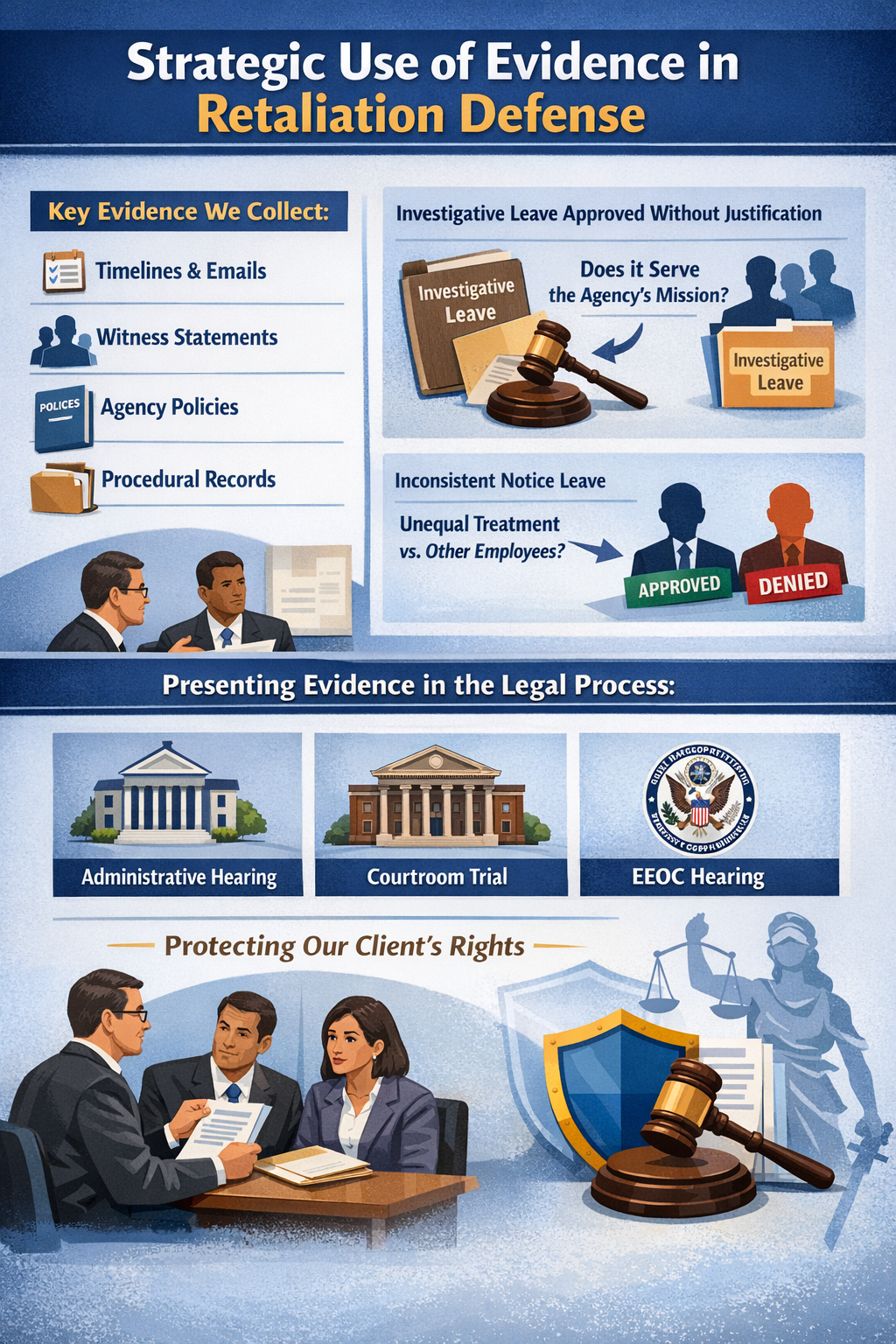
Strategic Use of Evidence in Retaliation Defense
Building a strong retaliation claim requires careful documentation. We collect timelines, emails, witness statements, and any relevant agency policies. We also evaluate whether the employer followed proper personnel management procedures.
For example, if an agency head approves investigative leave without explaining how it serves the agency's mission, that gap may be significant. If notice leave is issued inconsistently compared to other employees, that inconsistency can support the claim.
The legal process may involve presenting evidence to administrative bodies, courts, or the equal employment opportunity commission. Throughout the investigation, we ensure that our client’s rights are protected.
Protecting Teachers During Ongoing Investigations
While a retaliation claim is being evaluated, the teacher may still be on administrative leave or safety leave. We work to limit the duration of investigative leave and push for resolution within a reasonable time.
If the agency determines that leave should continue, we demand justification under applicable law. Administrative leave must not become indefinite. A time limited basis is often required under federal guidance.
We also advise teachers on how to communicate with agency officials and other authorized agency officials. Protecting the integrity of the defense is essential.
Contact Masterly Legal Solutions for Guidance
If you are a teacher facing investigation and believe retaliation may be involved, you do not have to navigate this alone. The stress of administrative leave, workplace scrutiny, and uncertainty about your future can feel overwhelming. Speaking with experienced employment lawyers can help you understand your options and protect your rights.
At Masterly Legal Solutions, we carefully examine whether adverse action, disciplinary action, or investigative leave was justified under federal and state laws. We evaluate your retaliation claim, review your personnel file, and challenge improper agency judgments. Our goal is to safeguard your career and ensure that your employer follows the law.
Call us at (972) 236-5051 for a free consultation. We will listen to your concerns, answer your questions, and explain how work retaliation laws may apply to your situation. Taking action early can make a meaningful difference in the outcome of your case.
This article is for informational purposes only and does not constitute legal advice. Reading this content does not create an attorney client relationship. For advice about your specific situation, please contact a qualified attorney directly.



Teacher Rights When Assaulted by a Special Needs Student: Safety, Reporting and Investigation Issues



Looking for Legal & Business Solutions? Contact Us Now
Fill in the form or call us to set up a meeting