

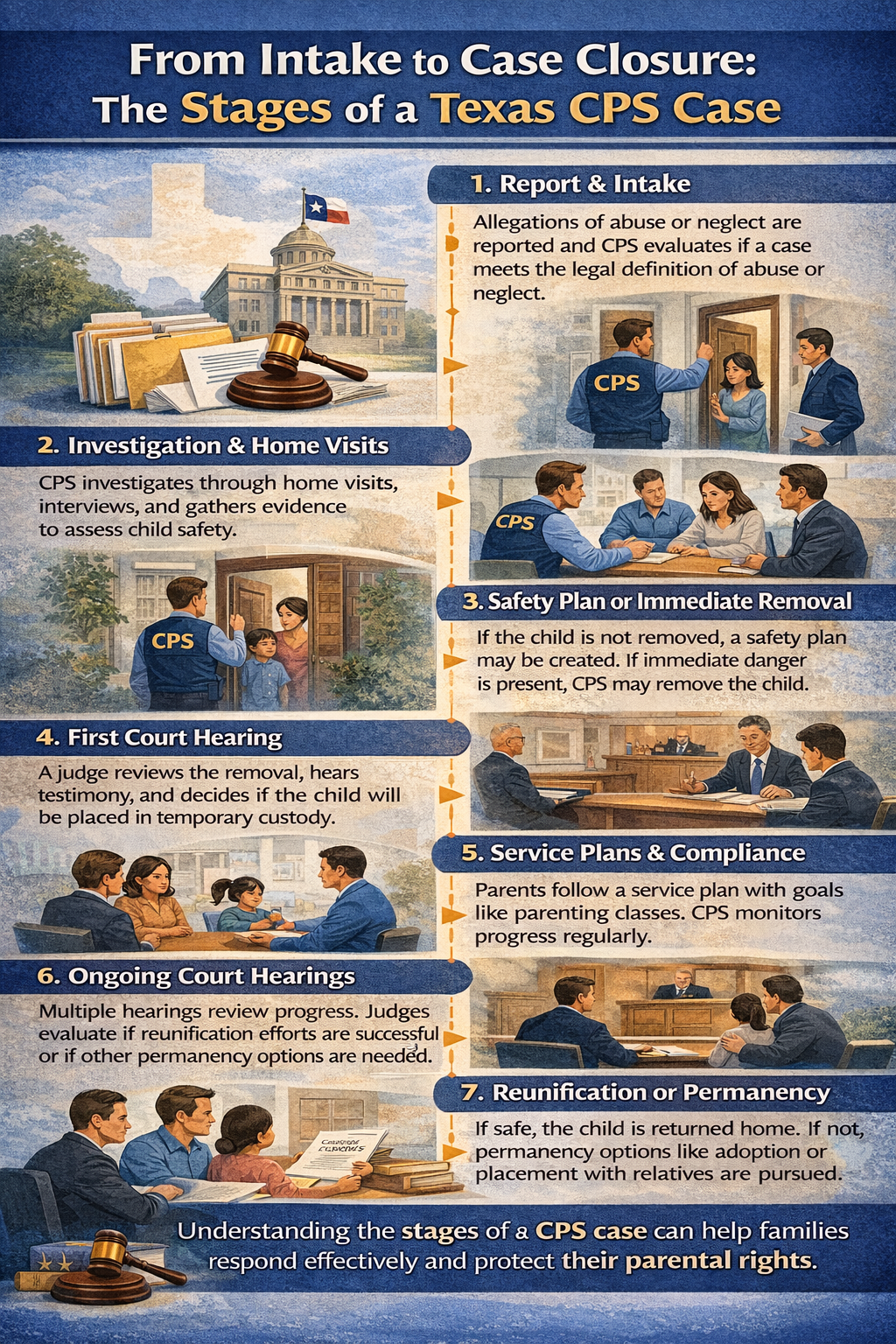
From Intake to Case Closure: The Stages of a Texas CPS Case
When a family first hears from Child Protective Services, the experience can be frightening and confusing. Parents often wonder what happens next, how long the process will last, and whether their child will remain in the home. Understanding the full path of a CPS case—from intake to case closure—can reduce fear and help families make informed decisions.
At Masterly Legal Solutions, we represent parents and caregivers across Texas who are navigating a CPS case. Our goal is to explain each step of the CPS investigation process in clear terms and to protect parental rights at every stage. While every case is different, most follow a structured path under the Texas Family Code and related regulations. Knowing that structure can make a significant difference in the outcome.
The Intake Stage: When a Report Is Made
A Texas CPS case begins when someone reports suspected child abuse or neglect. Reports may come from teachers, doctors, neighbors, or even anonymous callers. The Texas Department of Family and Protective Services receives these allegations and begins evaluating them immediately.
During intake, CPS workers assess whether the report meets the legal definition of child abuse or neglect under Texas law. If the allegations involve serious harm, sexual abuse, domestic violence, or sexual exploitation, the case may be prioritized for immediate review. The agency evaluates whether there is an immediate risk to the child’s safety.
Not every report leads to a full CPS investigation. However, if suspected abuse appears credible, the agency assigns a CPS investigator to begin the formal investigation stage.
Understanding the Legal Definition of Abuse or Neglect
Under the Texas Family Code, child abuse or neglect includes physical injury, emotional harm, sexual abuse, and failure to provide adequate supervision or care. The legal definition is broader than many parents expect. Even allegations of neglect happened due to circumstances such as inadequate housing or supervision can trigger review.
The law focuses on whether a child is exposed to immediate danger or ongoing risk factors that could lead to future abuse. The agency must determine if the allegations meet statutory criteria before moving forward. Understanding this definition is critical in defending a CPS case.
The CPS Investigation Stage
Once intake is approved, the CPS investigation begins. The cps investigation timeline depends on the urgency of the allegations. In cases involving immediate risk, CPS workers may act within hours.
During the investigation stage, a cps investigator interviews the alleged victim, the child’s parents, and sometimes other family members. The agency may also review medical records, school records, and criminal history reports. This is a crucial part of the investigation process because early statements can influence investigation results.
The cps investigation process is structured, but it can move quickly. Families should seek legal representation as soon as possible.
Home Visits and Interviews
CPS workers typically visit the child’s home to evaluate living conditions and safety concerns. They may assess whether the environment poses a risk of serious harm. The investigator may also speak privately with the child and other family members.
These interviews are part of child protective investigations designed to determine whether abuse or neglect occurred. Parents often feel pressured during this stage, especially when allegations involve domestic violence or sexual abuse. Having legal counsel can help ensure that rights are respected.
Risk Assessment and Safety Decisions
After gathering information, CPS conducts a risk assessment. This process evaluates risk factors such as prior reports, criminal history, and the presence of an alleged perpetrator in the home. The agency must determine whether the child can remain safely in the child’s home.
If child safety issues are identified but removal is not necessary, CPS may implement a safety plan. A safety plan outlines steps parents must follow to ensure the child safe while the investigation continues.
Safety plans may include supervision requirements, temporary relocation of an alleged perpetrator, or participation in support services.
When Immediate Removal Occurs
In cases of immediate danger, CPS may remove a child without prior court approval. This action is usually taken when there is a belief that the child faces serious harm. The agency must then seek a court order promptly.
Temporary custody may be granted if a judge determines removal was necessary. This is often the first step into juvenile dependency court proceedings. The child may be placed in foster care or with relatives through voluntary placement arrangements.
Removal is one of the most serious actions in a CPS case. It directly affects parental rights and requires immediate legal representation.
The First Court Hearing
If removal occurs, a court hearing is scheduled quickly. In juvenile dependency court, the judge reviews whether CPS had sufficient grounds for removal. The court evaluates evidence presented by CPS workers and considers arguments from the child’s parents.
Parents may be appointed a court appointed attorney if they cannot afford one. Legal protections under the Texas Family Code ensure parents have representation during court proceedings.
This initial hearing can shape the direction of the CPS case and influence future custody decisions.
Family Based Safety Services
When removal is not required, CPS may offer family based safety services. These services aim to support families and address risk factors without separating children from their parents. Examples include parenting classes, counseling, and substance abuse treatment.
Family based safety services are part of child and family services designed to strengthen households. A safety plan may remain in effect during participation in these programs. Compliance with recommended services can influence investigation outcomes.
Participating fully and responsibly can demonstrate commitment to protecting the child’s care and well being.
Ongoing Court Proceedings in Juvenile Dependency Court
If the case moves forward, multiple court proceedings may follow. Juvenile dependency court reviews progress at regular intervals. Judges examine whether CPS determines that continued involvement is necessary.
Court proceedings may address temporary custody, reunification efforts, or long term foster care placement. The court reviews whether the child’s safety remains at risk.
Parental rights are a central focus in these hearings. Effective legal representation ensures that parents can present evidence and challenge allegations.
Criminal Investigations and Parallel Proceedings
In some cases, a CPS investigation overlaps with a criminal investigation. A police officer may conduct interviews if allegations involve sexual abuse, physical harm, or serious neglect.
A criminal case can proceed alongside the CPS case. Statements made during the CPS investigation may affect criminal charges. Parents must understand the risks of speaking without legal counsel.
Coordination between criminal defense and family law attorneys is often necessary in these complex situations.
The Role of CPS Workers and Caseworkers
CPS workers and the assigned cps caseworker manage the daily aspects of the case. They coordinate services, monitor compliance with safety plans, and prepare reports for court.
CPS workers also evaluate whether voluntary services are effective. Their recommendations carry weight in juvenile dependency court. Maintaining respectful communication can be important, but families should also protect their rights by seeking guidance from a Texas-based law firm offering a broad range of legal and business services.
Each cps case is unique, and the assigned worker’s evaluation may influence the final outcome.
Investigation Results and Possible Outcomes
At the end of the cps investigation, the agency issues investigation results. The findings may be ruled out, unable to determine, or reason to believe abuse or neglect occurred.
Investigation outcomes affect whether the case continues. If the allegations are ruled out, the case may move toward administrative closure. If abuse or neglect is confirmed, court supervision may continue.
Understanding investigation results is critical in planning the next legal steps, which sometimes includes parallel Dallas estate planning services focused on personalized wills and trusts to protect your family’s long-term interests.
Service Plans and Compliance
If the court maintains jurisdiction, parents may be required to follow a service plan. A service plan outlines actions necessary to address safety concerns and reduce future abuse risks.
The court reviews progress during scheduled court hearing dates. Compliance can influence whether a child returns home or remains in foster care.
Failure to comply may lead to further restrictions on parental rights, and many parents also use this time to consider Texas estate planning services, including wills, trusts, and powers of attorney to safeguard their children’s future.
Reunification and Voluntary Placement
When progress is made, CPS may support reunification. Voluntary placement arrangements may also allow children to stay temporarily with relatives while parents complete services.
Child welfare services focus on ensuring long term stability and safety. The agency must demonstrate that returning the child to the child’s home does not present immediate risk, while parents may explore tools like a power of attorney for your children’s healthcare and financial decisions to provide added security.
The court considers whether family services have effectively reduced risk factors.
Case Closure and Administrative Review
A CPS case ends when the court determines that protective services are no longer necessary. Administrative closure may occur after services are completed and the child’s safety is assured.
In some situations, an administrative review is requested to reassess findings. This review examines whether the investigation process complied with regulations.
Case closure restores a measure of stability for families. However, records may remain part of agency files, so some parents then turn to estate planning for families with minor children in Austin, Texas to formalize guardianship and financial protections.
Comparing the California CPS Investigation Process
While this article focuses on Texas, some families compare their situation to the California CPS investigation process. Although both states follow structured procedures, laws and timelines differ.
Understanding Texas specific regulations is essential when facing a CPS case. Relying on out of state information can lead to confusion. Consulting experienced attorneys familiar with Texas family law ensures accurate guidance, and many families also benefit from discussing essential legal documents for families before age 40 as part of broader planning.
Support Resources for Families
Families navigating a CPS case may benefit from community resources and support families programs. A family helpline or legal aid organization can provide additional assistance, and some families also seek trust-focused estate planning services to secure assets for children.
Organizations such as the Texas Legal Services Center may offer referrals or educational materials. However, each case requires individualized attention from experienced legal counsel, and colleges or universities involved in a matter may also need higher education law services and FERPA compliance guidance.
No two CPS cases are identical, and outcomes depend on the specific facts and legal strategy.
Protecting Your Rights Throughout the CPS Process
From intake through administrative closure, each stage of a CPS case carries legal consequences. Child protective services and family and protective services agencies operate under strict rules, but parents also have rights.
Understanding the cps process and seeking legal representation early can significantly impact your case. Whether the issue involves alleged perpetrator allegations, foster care placement, or court order disputes, informed action matters.
At Masterly Legal Solutions, we are committed to protecting families during every phase of a CPS case, with multiple law office locations and contact options across Texas to make reaching us easier.
Contact Masterly Legal Solutions for Help With Your CPS Case
If you are facing a CPS investigation, do not wait until the next court hearing to seek help. The earlier you understand the cps investigation timeline and your legal protections, the better prepared you will be. At Masterly Legal Solutions, we guide parents through every stage of a CPS case with clarity and strength.
We handle cases involving child abuse or neglect allegations, temporary custody disputes, juvenile dependency court proceedings, and related family law matters. Our firm is dedicated to protecting parental rights and helping families move toward stability, and we also advocate for educators and school staff through education law services for teachers and administrators.
Call (972) 236-5051 for a free consultation. We are ready to listen to your concerns, explain your options, and stand beside you throughout the CPS case process.
This article is for informational purposes only and does not constitute legal advice. Reading this content does not create an attorney client relationship. For guidance regarding your specific circumstances, please contact a qualified attorney directly.




Teacher Rights When Assaulted by a Special Needs Student: Safety, Reporting and Investigation Issues



Looking for Legal & Business Solutions? Contact Us Now
Fill in the form or call us to set up a meeting