
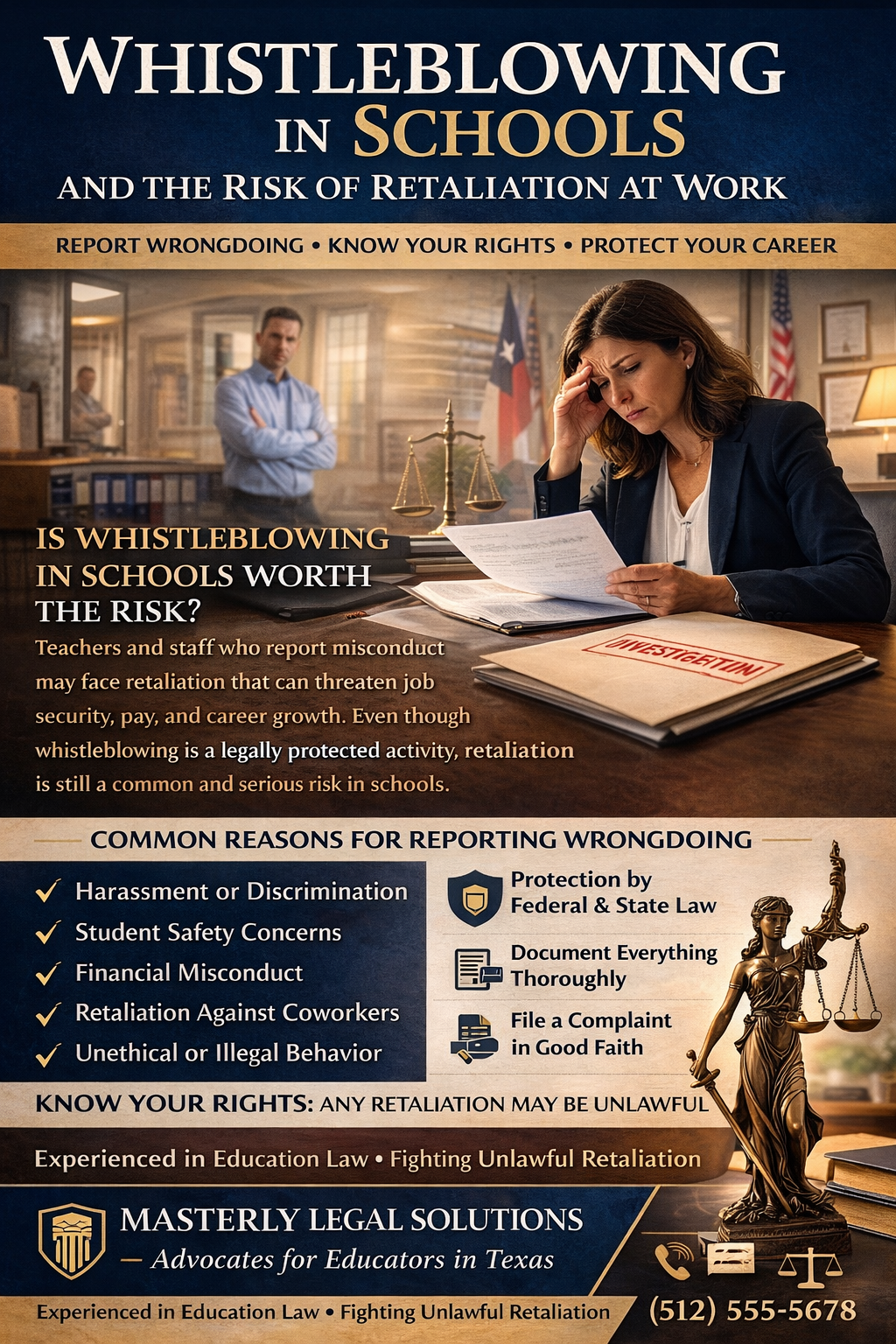
Whistleblowing in Schools and the Risk of Retaliation at Work
Speaking up is rarely easy, especially in a school setting where relationships matter and reputations carry weight. Teachers, administrators, and support staff often feel a strong duty to protect students, coworkers, and the integrity of their campus. Yet when an employee reports wrongdoing, the fear of retaliation can be overwhelming. At Masterly Legal Solutions, we help workers understand how the law can protect them when they step forward.
In many dallas fort worth school districts, concerns may involve harassment, discrimination, misuse of funds, or even threats of physical harm. Whistleblowing can be a protected activity under federal and state laws, but that protection is not always honored in practice. When retaliation occurs, it can affect your job, your pay, and your future career opportunities. Knowing your rights is the first step toward protecting yourself.
The Meaning of Whistleblowing in Schools
Whistleblowing generally refers to reporting misconduct, policy violations, or unlawful behavior within the workplace. In schools, this may include reporting discrimination based on disability, national origin, or other protected characteristics. It can also involve raising concerns about financial irregularities, safety issues, or improper conduct by a supervisor or higher level manager.
An employee who chooses to file a complaint is often engaging in protected activity. Federal regulations and state laws prohibit retaliation against workers who report wrongdoing in good faith. However, even though these regulations exist, some employer decisions still cross the line.
Why School Employees Speak Up
Teachers and staff members engage in whistleblowing for many reasons. Some want to protect students from harm. Others are concerned about unfair treatment, harassment, or discrimination that affects coworkers, which may ultimately require guidance from an experienced retaliation lawyer for workplace disputes.
For example, an employee may report a possible violation of Title VII if they believe someone has been discriminated against. Another example might involve reporting wage violations, such as unpaid overtime pay or failure to pay wages for all work hours. These actions are not acts of disloyalty; they are efforts to protect the workplace and uphold the law.
Retaliation Occurs More Often Than Many Realize
Even though federal and state laws clearly prohibit retaliation, retaliation occurs in subtle and obvious ways. An employer may place a worker on administrative leave or paid administrative leave shortly after a complaint is made. While administrative leave can sometimes be neutral, it may also function as an adverse action depending on the circumstances.\
Retaliation can take many forms. It may include reduced pay, removal from leadership roles, negative performance evaluations, or reassignment to less desirable duties. In serious cases, an employee may face termination or feel pressured to resign.
Administrative Leave and Its Impact on Your Career
Administrative leave is common during a workplace investigation. In schools, employees may be placed on administrative leave while allegations are reviewed. This leave may be paid time, but it can still carry long-term consequences.
Being placed on paid administrative leave can damage a professional reputation. Colleagues may speculate about the reason for the leave. Even when the investigation finds no violation, the stigma may linger and affect future discrimination risks or advancement opportunities.
An employer must use administrative leave carefully. If the leave is imposed as punishment for protected activity, it could be considered retaliation.
Federal Protections for Whistleblowers
Federal law provides significant protections for workers who report wrongdoing. Title VII, for example, protects employees from discrimination and retaliation when they oppose unlawful practices. Federal agencies such as the Equal Employment Opportunity Commission enforce these laws.
The EEOC investigates complaints involving discrimination, harassment, and retaliation. Filing with the EEOC is often the first step before pursuing a lawsuit in federal court. The agency reviews evidence, interviews witnesses, and determines whether there is reasonable cause to believe a violation occurred, and clear policies in an employee handbook drafted and reviewed by legal counsel can be important evidence in these matters.
Federal agencies also oversee issues involving wages, overtime pay, and job protected leave under the Family and Medical Leave Act. When eligible employees take FMLA leave, an employer cannot lawfully retaliate against them.
Understanding FMLA Leave and Retaliation
FMLA leave allows eligible employees to take job protected leave for serious health conditions or to care for a family member. If an employee takes fmla leave and then faces adverse action, it may signal retaliation.
For example, a teacher who returns from fmla leave may suddenly receive negative evaluations or be placed on administrative leave. Another example might involve reduced pay or a change in work hours. These changes can create a possible violation of federal regulations.
Retaliation related to fmla leave is prohibited. Workers who experience such treatment may file a complaint with the appropriate agency or pursue legal action.
Discrimination and Retaliation Often Overlap
Discrimination and retaliation frequently intersect. A worker may report harassment or discrimination based on disability, national origin, or genetic information. After filing a complaint, that employee may be treated differently by a supervisor.
Title VII and other federal protections make it unlawful for an employer to discriminate or retaliate. State laws may provide additional safeguards. When a worker is discriminated against and then punished for reporting it, multiple violations may be present.
Recognize that discrimination can appear in many forms. It may involve hiring decisions, promotion denials, unequal pay, or exclusion from benefits.
Examples of Retaliation in School Settings
To better understand how retaliation can appear, consider a few example scenarios. An employee reports harassment to human resources and later receives a sudden demotion. A teacher raises concerns about safety and is placed on administrative leave without clear explanation.
Another example involves a staff member who reports wage violations and later sees a reduction in pay or benefits. A worker who contacts police about a safety threat may then face discipline or exclusion from meetings. These examples show how retaliation can follow protected activity.
Each example highlights the importance of documenting events and seeking legal guidance. The law is designed to protect workers who engage in good faith reporting.
The Role of Human Resources and Internal Investigations
Human resources departments play a central role in handling complaints. When an employee files a complaint, human resources typically begins an investigation. The investigation may include interviews, document review, and placement on administrative leave.
While these processes are intended to address issues fairly, they do not always result in fair treatment. An employer must follow regulations and avoid retaliating, and some rely on HR consulting services and workplace investigations support to help them comply with employment laws. Workers should understand that statements made during an investigation may later be reviewed by federal agencies.
Having legal assistance during this stage can help protect your interests. An attorney can help you determine how to respond and what information to provide.
Paid Administrative Leave Versus Unpaid Leave
There is a significant difference between paid administrative leave and unpaid leave. Paid administrative leave allows an employee to continue receiving pay during an investigation. Unpaid leave, however, can create immediate financial stress.
If an employer uses unpaid administrative leave after a protected activity, it may constitute an adverse action. The loss of wages or benefits can support a claim of retaliation. Even paid administrative leave may be unlawful if used as punishment rather than as a neutral step.
Each case depends on specific circumstances. It is important to determine whether the leave aligns with established policies and consistent treatment of other workers.
Filing a Complaint with the EEOC
When retaliation or discrimination occurs, workers often must file a complaint with the EEOC before filing a lawsuit. The EEOC is a federal agency responsible for enforcing Title VII and related laws. Filing deadlines are strict, and missing them can limit your options.
To file a complaint, you typically provide details about the discrimination, retaliation, or harassment you experienced. The EEOC may request additional information and conduct interviews. In some cases, the agency may issue a right-to-sue letter allowing you to proceed in court.
Filing with the EEOC does not guarantee success. However, it is often a necessary step in protecting your rights.
The Importance of Documentation
Documentation can make or break a retaliation claim. Keep copies of emails, performance reviews, and written communications. Take notes about conversations with your supervisor or human resources.
If you are placed on administrative leave, request written confirmation explaining the reasons. If your pay changes or benefits are reduced, keep records of those changes. Detailed documentation can help demonstrate a possible violation.
Courts and federal agencies rely on evidence. Without documentation, it becomes more difficult to prove that retaliation occurred.
Wage and Hour Violations in Schools
Whistleblowing sometimes involves wage issues. Workers may report unpaid wages, failure to provide overtime pay, or improper calculation of work hours. Labor regulations require employers to pay employees correctly and on time.
If an employee files a complaint about wages and is later disciplined, it may constitute retaliation. Financial harm caused by reduced pay can be part of a claim. State laws and federal labor protections both address these concerns.
Workers who speak up about wage violations help protect themselves and their colleagues. The law is designed to protect that courage.
Protecting Yourself Before and After a Complaint
Before you file a complaint, consider gathering relevant information. Review your employment policies and note any prior evaluations. After filing, monitor how your employer responds.
If you notice changes in pay, work assignments, or treatment by your supervisor, document them. Recognize that retaliation may not happen immediately. It can develop gradually over time.
An attorney can help you determine whether the employer’s actions amount to an adverse action. Early legal advice can prevent costly mistakes.
Lawsuits and the Path to Justice
When internal processes and agency reviews do not resolve the issue, a lawsuit may be necessary. Filing a lawsuit is a serious step that requires careful evaluation. It may involve claims of discrimination, harassment, or retaliation that call for experienced education lawyers supporting teachers and schools.
A lawsuit can seek financial damages, reinstatement, or other remedies. Courts review whether the employer violated federal or state regulations. The goal is to restore fairness and protect workers from unlawful consequences.
Pursuing justice can be challenging, but it can also create meaningful change. Schools must respect the rights of those who speak up.
How Masterly Legal Solutions Can Help
At Masterly Legal Solutions, we focus on protecting employees in complex employment disputes. We understand the unique challenges faced by workers in schools. Our team provides guidance on administrative leave, retaliation, discrimination, and wage concerns as part of our broader education law services for teachers and administrators.
We help clients determine whether a possible violation occurred and whether filing with the EEOC or another agency is appropriate. We also represent workers in lawsuits when necessary, and our firm has developed focused legal support services for educators and school employees. Our goal is to protect your job, your pay, and your professional future.
We believe that workers who engage in protected activity deserve strong legal support. You do not have to face your employer alone.
Protecting Your Future from Further Harm
Whistleblowing can create fear about future discrimination or stalled career growth. An employee who is placed on administrative leave may worry about being treated differently long after the investigation ends. Addressing retaliation early can help prevent further harm.
Federal and state laws exist to protect workers from such consequences. By taking action, you send a message that unlawful conduct will not be tolerated. Protecting your rights also protects others in your workplace.
Speaking up should not cost you your career. With proper legal assistance, including support from an education law attorney experienced in TEA investigations, you can pursue justice and move forward with confidence.
Reach Out for Guidance and Support
If you work in one of the dallas fort worth school districts and believe you are facing retaliation, discrimination, or harassment after whistleblowing, it may be time to seek guidance. Administrative leave, changes in pay, or sudden discipline after filing a complaint should not be ignored.
At Masterly Legal Solutions, we are ready to listen. We can review your circumstances, explain your options, and help you determine the best path forward. Our team is committed to protecting workers and holding employers accountable when regulations are violated, drawing on our broader education law and business consulting experience.
Contact Masterly Legal Solutions for a Free Consultation
If you have questions about administrative leave, retaliation, discrimination, or filing with the EEOC, contact us today. We provide confidential consultations to workers throughout the Dallas Fort Worth area. Call (972) 236-5051 for a free consultation and speak directly with a member of our legal team.
We understand how stressful it can be to challenge an employer, especially in a school environment. Let us provide the support and assistance you need to protect your job, your pay, and your future. Reaching out today could make a meaningful difference in your case.
Disclaimer: This article is for informational purposes only and does not constitute legal advice. Reading this article does not create an attorney-client relationship. For advice about your specific situation, please contact a qualified attorney.


Teacher Rights When Assaulted by a Special Needs Student: Safety, Reporting and Investigation Issues


Looking for Legal & Business Solutions? Contact Us Now
Fill in the form or call us to set up a meeting