
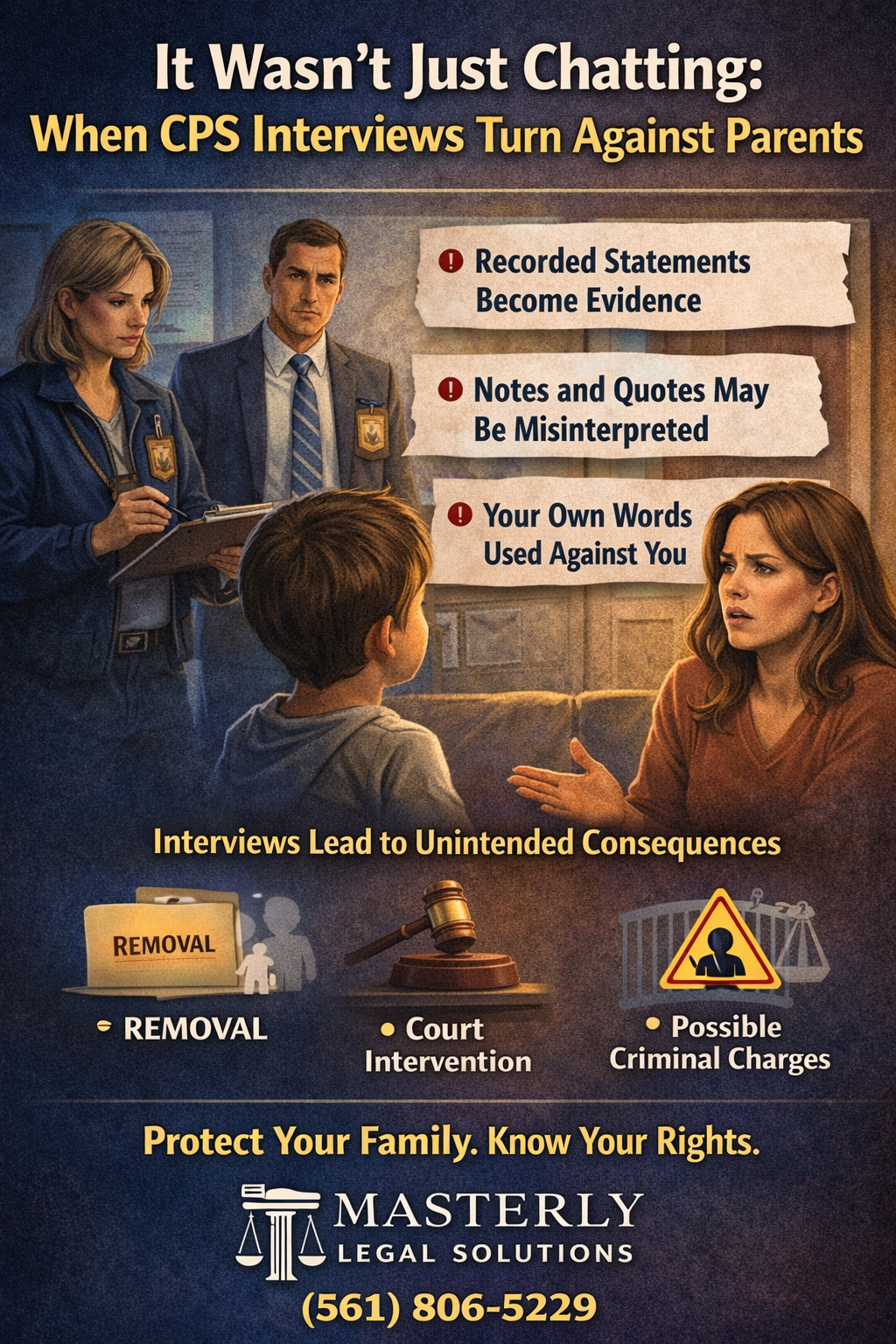
How CPS Uses Interviews and Statements Against Parents Later
A conversation that feels casual at first can quietly become the foundation of a cps case. Many parents believe that being honest and cooperative will make child protective services leave quickly, but that assumption often leads to unintended consequences. Interviews and statements are not informal chats; they are evidence-gathering tools used throughout the investigation. At Masterly Legal Solutions, we regularly help families who never expected their own words to be used against them.
When children and parents speak to cps workers, every response is documented, interpreted, and compared to future statements. Even small inconsistencies can later shape allegations, influence court decisions, or justify removal. Understanding how this process works is essential to protecting your family.
Why CPS Interviews Are Never Neutral
Although interviews may feel supportive, child protective services cps operates as an investigative agency. The goal is not to defend parents but to assess risk and determine whether intervention is required. Questions are structured to test credibility and uncover potential neglect or abuse. Once statements are recorded, they rarely disappear.
Even when no child abuse has occurred, wording can be misunderstood. A moment of stress or confusion can be framed as intent or harm. These early interactions often guide how the case develops.
How CPS Decides Who to Interview
Most cps cases involve interviews with parents, children, teachers, doctors, and sometimes a family member. Reports may originate from a school, medical provider, or concerned individual. Teachers and mandated reporters are legally required to alert protective services if concerns arise. That single report can trigger a chain reaction.
Once interviews begin, the scope often widens. Relatives and caregivers may also be questioned. Each interview builds a narrative that may not reflect the full picture.
Statements Can Change Over Time
What a parent says on day one may sound different weeks later. Stress, fear, and lack of sleep affect memory. Cps believes inconsistencies suggest dishonesty rather than human emotion. This assumption can escalate cases unnecessarily.
Later hearings may focus more on what was said than what actually occurred. That is why preparation matters before speaking.
Interviews With Children Carry Unique Risks
When children are interviewed, the stakes increase dramatically. Young children are especially vulnerable to suggestion. The way a question is phrased can shape the answer. Statements may later be cited as proof of abused conditions or sexual abuse, even when context is missing.
Once a statement is recorded, it may follow the case permanently. Parents rarely get the chance to correct or clarify it later.
CPS Uses Statements to Justify Removal
One of the most serious outcomes of interviews is removal. Cps may argue that a parent’s own words show an inability to protect a child’s safety. Even well-intended explanations can be reframed as admissions.
Removal decisions often happen quickly. By the time a court order is issued, interviews may already support the agency’s position.
How Interviews Shape Juvenile Dependency Cases
Juvenile dependency cases rely heavily on documented statements. Judges review interview summaries, not live conversations. Tone, emotion, and context are often lost. What remains is a written version filtered through the investigator’s interpretation.
Dependency proceedings move fast. Early interviews often become the backbone of the entire case.
CPS Investigators Are Trained to Document Everything
Every investigator is trained to observe inconsistencies and behavior. Notes include body language, pauses, and emotional responses. These observations are later included as part of the evidence. Parents are rarely told what is being recorded.
This documentation is not shared immediately. Many families only see it once a petition is filed.
Allegations Can Expand After Interviews
Initial allegations may be limited, but interviews often broaden them. A statement meant to clarify one issue can introduce new concerns. Neglect, exploitation, or supervision issues may be added later. The scope of the investigation grows.
What began as a single concern can turn into multiple claims. This expansion surprises many parents.
When Statements Lead to Criminal Exposure
Some cps cases overlap with law enforcement. Statements made to child protective services may be shared with police. This can expose parents to criminal charges. Even when no arrest occurs, the risk increases.
What feels like a civil matter can quickly become criminal. Legal strategy must account for both.
Why Parents Should Never Assume Confidentiality
Many parents believe interviews are confidential. In reality, information is shared across department lines. Protective services, prosecutors, and the court may all access statements. There are limited privacy protections once an investigation begins.
Understanding who sees your words is critical before speaking.
The Role of CPS Beliefs and Bias
Investigators are human. Once cps believes a concern exists, confirmation bias can influence interpretation. Neutral statements may be viewed suspiciously. This bias affects how evidence is framed.
Parents must understand this reality. Intent does not always protect against misinterpretation.
How Statements Are Used in Court
During hearings, attorneys and judges rely on written summaries. Parents may be confronted with prior statements they barely remember making. The judge may view inconsistencies as credibility issues. This affects custody decisions.
Statements often matter more than physical proof. Preparation changes outcomes.
CPS Defense Begins Before You Speak
Effective cps defense starts early. A cps defense attorney helps parents understand what to say, what not to say, and when silence is appropriate. Representation protects parental rights. Strategy matters from the first call.
Waiting until after interviews limits options. Early guidance is imperative.
How Legal Representation Changes the Process
With legal representation, interviews are no longer one-sided. Attorneys can attend or advise beforehand. They help respond carefully and avoid self-incrimination. This protection often prevents escalation.
Parents who hire counsel early often face fewer surprises. Advocacy shifts power back to families.
The Importance of Intent and Context
Statements without context are dangerous. A comment about discipline may be framed as harm. An admission of stress may be labeled neglectful. Attorneys help explain intent properly.
Context restores fairness. Without it, narratives become distorted.
Filing Petitions Based on Interview Notes
Many petition filings rely heavily on interviews. These documents request court oversight or dependency findings. Once filed, reversing direction becomes harder. Early statements often determine whether filing occurs.
This is why preparation before interviews matters so much.
CPS Interviews in Different Jurisdictions
Procedures vary by location. California, orange county, riverside, and cps charlotte nc each follow different administrative practices. However, the reliance on interviews is consistent nationwide. Statements remain central everywhere.
Understanding local procedures helps tailor defense strategies.
The Risk of Repeated Interviews
Parents and children may be interviewed multiple times. Repetition increases inconsistency risk. Each retelling slightly changes wording. These changes are often treated as contradictions.
Limiting unnecessary interviews protects families.
How Attorneys Assist During Interviews
A qualified attorney helps clients stay focused and calm. They explain the process, attend interviews when allowed, and review statements afterward. Their presence discourages inappropriate questioning. Support reduces stress.
Clients feel less isolated with representation.
Protecting Children While Defending Parents
Defense does not mean ignoring safety. Effective advocacy balances child protection with family preservation. Reunification remains a priority in many cases. Strong defense supports healthier outcomes.
Protecting children includes protecting family stability.
CPS Workers Are Not Your Advocates
While many cps workers care deeply about children, they are not advocates for parents. Their duty is to the agency’s mandate. Understanding this boundary helps parents make informed choices.
Good intentions do not replace legal protection.
When Lawsuits Arise From CPS Actions
In some situations, improper interviews lead to civil lawsuit claims. Mishandled investigations can violate rights. Documentation matters. Legal review determines whether action is appropriate.
Accountability protects future families.
Maintaining Control in a CPS Case
Parents who stay informed maintain leverage. Understanding interview risks helps maintain control. A clear plan reduces fear. Knowledge changes dynamics.
Families deserve fair treatment.
Why Hiring a Lawyer Is Imperative
The decision to hire counsel is often the turning point. A knowledgeable lawyer helps defend, protect, and guide families. Dedicated representation matters. This is not a situation to navigate alone.
Early action preserves options.
How We Help Families Navigate CPS Interviews
At Masterly Legal Solutions, we assist clients through every stage of cps involvement. We review interview strategies, prepare families, and represent parents in hearings. Our approach is strategic and compassionate. We are dedicated to protecting families.
Every case deserves careful attention.
Taking the First Step Toward Protection
If cps has contacted you or your children, it is imperative to act quickly. Interviews shape cases long before court. A free consult can help you understand your position and next steps. Support begins with a conversation.
You do not have to face this alone.
When Child Protection Services Evaluates Risk and Authority
When child protection services becomes involved, their role is to assess child welfare and determine whether a child may be in danger. Acting on behalf of the state, the agency has the authority to intervene when concerns are investigated and potential risks are identified. During this process, officials review the circumstances present in the home and evaluate whether intervention aligns with the child’s interests. While the stated objective is protection, families benefit from legal guidance to ensure that conclusions are based on facts rather than assumptions.
Talk With Masterly Legal Solutions Today
If you are dealing with child protective services, interviews, or escalating cps cases, Masterly Legal Solutions is here to assist. We focus on cps defense, juvenile dependency, and protecting parental rights while prioritizing child safety. Call (972) 236-5051 to contact us for a free consultation and learn how strategic legal support can protect your family’s future.
This article is not intended to be legal advice or guidance; rather, it is meant to be informative. Since each case is different, you should speak with an experienced lawyer about your particular circumstances.
Teacher Rights When Assaulted by a Special Needs Student: Safety, Reporting and Investigation Issues


Looking for Legal & Business Solutions? Contact Us Now
Fill in the form or call us to set up a meeting