

How CPS Uses Statements Made During Initial Interviews
When parents first hear from CPS, the moment can feel sudden and disorienting. Many people assume that being open and cooperative will immediately resolve concerns, but initial interviews often carry more weight than families realize. At Masterly Legal Solutions, we regularly help clients understand how early statements can shape the direction of an entire case. What is said during the first CPS interaction may be documented, analyzed, and reused long after that conversation ends.
This article explains how CPS uses statements made during initial interviews, why those words matter, and how legal guidance can help protect your family during a stressful and uncertain process.
Why Initial CPS Interviews Matter So Much
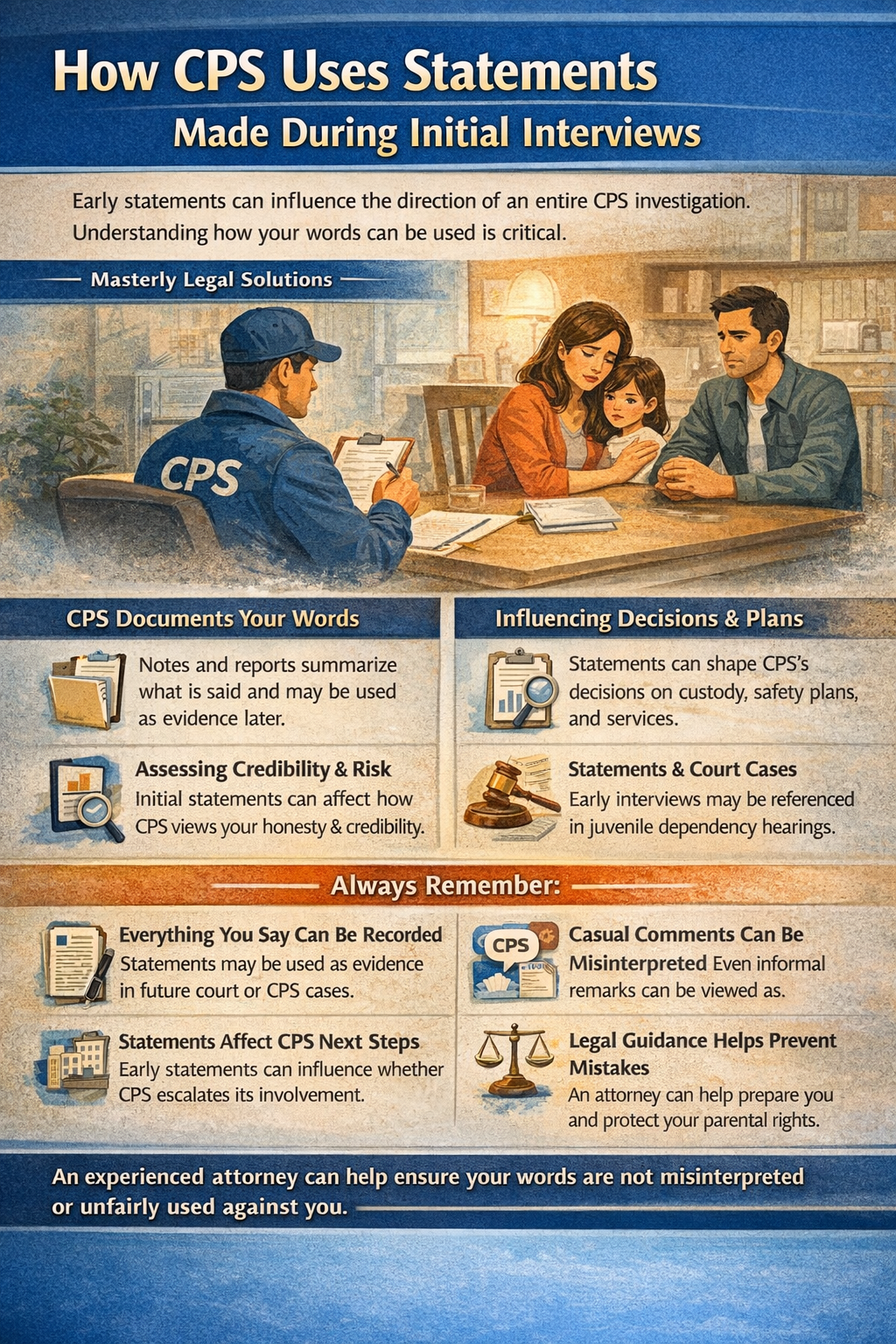
Initial interviews are a foundational part of the CPS investigation process. During these early conversations, CPS workers begin forming opinions about credibility, risk, and family dynamics. Statements made in these moments may later be treated as factual admissions, even when they were spoken casually or under stress.
Parents are often unaware that these interviews are not informal chats. They are investigative tools used by child protective services to assess whether abuse or neglect may have occurred and whether further action is needed.
The Purpose Behind CPS Questioning
Child protective services operates as a government agency tasked with responding to reports involving potential harm to a child. Their goal is centered on child safety and ensuring child well being, but they rely heavily on interviews to gather information. Questions are designed to clarify allegations, assess risk, and determine whether protective services should intervene.
CPS is also evaluating consistency. When stories change or details are unclear, CPS may interpret that as a sign of concern rather than confusion or fear.
How Statements Are Documented by CPS
Everything said during an interview may be documented in CPS reports. These notes are not transcripts, but summaries written from the perspective of the cps caseworker. Once recorded, those statements become part of the official CPS file.
These records can later be shared with supervisors, social services, attorneys, and even a judge if court intervention occurs. Parents rarely have the opportunity to correct how their words were recorded.
The Role of CPS Caseworkers in Interpretation
A cps caseworker has significant discretion when documenting interviews. Their interpretation of tone, body language, and phrasing can influence how statements are perceived. Even neutral comments can be framed in a way that supports existing allegations.
This discretion is one reason why early legal representation is so important. A cps defense attorney helps parents understand how statements may be interpreted before they are made.
Statements as Evidence in CPS Cases
Statements gathered during interviews are often treated as evidence in CPS cases. They may be compared against other information, such as school records, medical reports, or statements from third parties. Inconsistencies can be viewed as indicators of abuse or neglect.
Even when there is little physical evidence, statements alone may be used to justify ongoing investigation or services. This is particularly true in cases involving child abuse or neglect allegations.
How CPS Uses Statements to Assess Credibility
Credibility plays a major role in CPS investigations. CPS workers evaluate whether parents appear honest, cooperative, and consistent. Statements that seem defensive or uncertain may raise red flags, even when parents are simply nervous.
CPS may compare statements from parents, children, and other adults in the home. Differences between accounts are often emphasized in reports and can influence decisions about protective services.
Statements and Allegations of Abuse or Neglect
When allegations involve abuse or neglect, statements become especially significant. CPS looks for admissions, explanations, or perceived justifications related to the alleged conduct. A single poorly worded response can be interpreted as confirmation of abuse or neglect.
This is common in cases involving physical discipline, supervision, or medical attention decisions. Parents may unintentionally describe behavior in a way that supports allegations of child maltreatment.
Child Abuse and Neglect Cases and Early Interviews
Child abuse and neglect cases often hinge on early impressions. CPS uses initial interviews to decide whether allegations warrant escalation. Statements may influence whether CPS believes a child has been abused, neglected, or exposed to unsafe conditions.
Once CPS forms an early narrative, it can be difficult to change. That narrative may follow the family through the entire investigation and beyond.
The Impact on Juvenile Dependency Proceedings
In some cases, initial statements later appear in juvenile dependency proceedings. Judges may review CPS reports that include early interview summaries. Statements made before parents understood the seriousness of the situation can resurface months later.
This connection makes early legal guidance critical. What feels like a simple conversation today may become a key issue in court tomorrow.
Statements and Risk of Court Intervention
CPS uses statements to assess whether court intervention is necessary. If interviews suggest ongoing safety concerns, CPS may seek a court order affecting custody or visitation. Even statements intended to reassure CPS can sometimes have the opposite effect.
Once court involvement begins, those early statements are difficult to undo. Preparation before interviews can reduce unnecessary risk.
How CPS Determines Next Steps
CPS determines next steps by evaluating statements alongside other information. This includes reports from schools, doctors, neighbors, and family members. Statements that appear inconsistent with other evidence may trigger additional scrutiny.
CPS may also use statements to justify services, safety plans, or supervised visitation. Each decision builds on the information gathered early in the process.
The Use of Statements in Safety Plans
Safety plans are often based heavily on what parents say during interviews. If a parent acknowledges stress, conflict, or past mistakes, CPS may interpret that as a need for restrictions. Even honest reflections can lead to unexpected consequences.
Once in place, safety plans can affect family life and parental rights. Legal guidance helps parents understand how statements may lead to these outcomes.
Statements and Supervised Visitation Decisions
CPS may rely on interview statements to recommend supervised visitation. Comments about discipline, arguments, or supervision can be used to justify restrictions. These decisions are often made quickly.
Supervised visitation can significantly disrupt family routines and relationships. Early preparation helps reduce the likelihood of unnecessary limitations.
Statements and Foster Care Considerations
In more serious cases, statements may be used to justify temporary foster care placement. CPS may interpret certain remarks as evidence that a child is at risk. Even statements made out of concern for a child can be misread.
Preventing removal often starts with careful communication. Understanding how CPS uses statements helps protect families from extreme outcomes.
Criminal Charges and CPS Interviews
Statements made during CPS interviews can sometimes be shared with law enforcement. This is especially true in cases involving allegations of sexual abuse or severe physical harm. Parents may not realize that CPS investigations can overlap with criminal charges.
A defense attorney helps parents avoid self-incrimination while still complying with CPS requirements. Protecting legal rights across systems is essential.
How Statements Affect Custody and Divorce Cases
CPS interview statements often surface in custody disputes and divorce proceedings. Family court proceedings may rely on CPS records when determining the best interest of the child. Statements made early can influence custody decisions later.
Parents involved in divorce should be especially cautious during CPS interviews. Prior statements can resurface at unexpected times.
Statements and the Best Interest Standard
CPS frames decisions around the best interest of the child. Statements that suggest instability, conflict, or poor judgment may be used to argue that intervention is necessary. Even isolated remarks can be taken out of context.
An experienced attorney helps ensure that statements reflect the full picture of a family’s strengths and stability.
Investigating Reports and Interview Strategy
When investigating reports, CPS uses interviews to confirm or challenge allegations. The structure of questioning is intentional. Parents may feel pressured to answer quickly without fully understanding the implications.
Preparation helps parents respond accurately without speculation. Thoughtful communication is a key part of cps defense.
The Importance of Consistency
Consistency across statements is critical. CPS compares interviews conducted on different days and with different individuals. Minor discrepancies can be viewed as significant.
Stress and fear often cause memory lapses, but CPS may interpret those lapses negatively. Legal guidance helps parents stay focused and consistent.
How Attorneys Review Statements After Interviews
If parents have already spoken to CPS, an attorney reviews those statements carefully. Understanding how CPS documented the interview allows attorneys to plan next steps. Correcting misunderstandings early can limit damage.
This review is a core part of effective legal representation.
The Role of a CPS Defense Attorney
A cps defense attorney prepares clients before interviews and advocates for them afterward. Attorneys help parents understand what CPS is really asking and why. This support reduces fear and prevents impulsive responses.
Strong cps defense starts before statements are made.
Protecting Parental Rights During Interviews
Parental rights can be affected long before court proceedings begin. Statements made during interviews may justify restrictions or services. Early legal involvement helps protect those rights.
Protecting parents ultimately protects children and family stability.
Understanding Regional Practices and Agencies
CPS practices can vary by county and region. Differences may exist between Orange County, Southern California, and other jurisdictions. Understanding how local authority operates improves defense strategies.
Regional experience allows attorneys to anticipate how statements may be used.
The Role of the Texas Department in CPS Cases
In Texas, CPS operates under the Texas Department responsible for child welfare oversight. Policies and procedures influence how statements are evaluated. Administrative standards guide decision-making.
Understanding these standards helps attorneys challenge unsupported conclusions.
How Evidence Is Built Over Time
Statements are only one part of the evidence CPS builds. Over time, CPS combines interviews with documents, observations, and third-party reports. Early statements often anchor later evidence.
This is why early interviews are so influential in the overall process.
Filing Reports and Case Records
CPS files reports that include interview summaries, findings, and recommendations. These filings become part of the permanent record in many child protective services cases. They may be reviewed in future proceedings.
Parents rarely see these records until much later, making early accuracy critical.
Working With an Experienced Attorney Matters
An experienced attorney brings perspective, strategy, and calm to a chaotic situation. With a proven track record, legal professionals help families avoid unnecessary escalation. Clients benefit from clear guidance during difficult moments.
Strong advocacy can change how statements are interpreted.
How Masterly Legal Solutions Supports Families
At Masterly Legal Solutions, our law firm focuses on protecting families during CPS investigations. Our attorneys understand how statements are used and how quickly situations can escalate. We work closely with clients to safeguard their rights and family life.
Our law office is committed to thoughtful, strategic legal services tailored to each family’s situation.
Taking Control of the Process Early
CPS involvement can feel overwhelming, but preparation restores a sense of control. Understanding how CPS uses statements allows parents to approach interviews with clarity. Early guidance reduces long-term consequences.
Families deserve support during these challenging times.
The Role of Child Protection Services in CPS Matters
Child protection services exists to respond to reports involving the safety and well being of a child, but its involvement can feel intimidating for families. This agency has broad authority to investigate concerns, interview parents, and assess living conditions. While the stated goal is to protect children, the process can be stressful and confusing for parents who are unfamiliar with how decisions are made. Understanding the role of child protection services helps families respond more effectively and avoid unnecessary escalation.
Understanding Child Protective Services CPS Investigations
Child protective services CPS investigations are structured processes, not informal conversations. Once a report is made, CPS follows internal procedures to gather information, document findings, and determine next steps. These investigations often rely heavily on interviews and observations rather than physical proof alone. Knowing that child protective services CPS operates under formal rules can help parents take the process seriously from the start.
How Child Neglect Is Evaluated by CPS
Child neglect allegations are among the most common issues reviewed by CPS. Neglect does not always involve intentional harm and may relate to supervision, living conditions, or access to basic needs. CPS evaluates whether a child’s needs are consistently met, not whether parents are perfect. Even temporary challenges can raise concerns if they are misunderstood during an investigation.
Ensuring Child Safety During Investigations
Ensuring child safety is the primary focus of every CPS investigation. CPS evaluates immediate risks and long-term stability when deciding whether intervention is necessary. While safety is important, CPS may sometimes take a cautious approach that feels excessive to parents. Legal guidance helps ensure that child safety concerns are addressed without unfair or unnecessary disruption to family life.
The Importance of Sufficient Evidence
CPS decisions should be based on sufficient evidence, but that standard is not always clear to parents. Unlike criminal cases, CPS investigations may rely on patterns, statements, and observations rather than definitive proof. This means allegations can move forward even when evidence feels limited. Understanding how CPS evaluates evidence is critical to protecting parental rights.
Why Compelling Arguments Matter Early
Once CPS forms an initial impression, it can be difficult to change the direction of a case. Compelling arguments presented early can clarify misunderstandings and challenge unsupported assumptions. Legal advocacy focuses on presenting facts, context, and documentation in a way CPS must consider. Strong early arguments can prevent long-term consequences.
What to Expect During an Initial Consultation
An initial consultation provides parents with clarity during an overwhelming time. This meeting allows an attorney to review allegations, explain the CPS process, and outline potential risks. Parents also learn what to expect in upcoming interviews or visits. Having clear expectations helps families feel more prepared and less reactive.
Facing Allegations and Emotional Stress
Facing allegations of abuse or neglect can be emotionally exhausting for parents. Fear, anger, and confusion are common reactions, especially when claims feel unfair or exaggerated. These emotions can make communication with CPS more difficult. Support and guidance help parents respond calmly and thoughtfully rather than out of fear.
How an Attorney Helps Defend Families
To defend a family in a CPS matter means more than arguing facts. It involves protecting rights, correcting misinformation, and guiding parents through each step of the process. Defense strategies focus on preventing escalation while addressing CPS concerns appropriately. Early defense efforts often lead to better outcomes.
The Role of Counseling and Support Services
Counseling is sometimes recommended during CPS investigations to address stress, parenting challenges, or family conflict. While counseling can be helpful, participation should be carefully considered. CPS may interpret involvement in counseling in different ways. Legal guidance helps families understand how support services may affect their case.
Using Legal Expertise to Navigate CPS
Legal expertise is essential when dealing with CPS because the process is governed by complex laws and agency rules. Parents without experience in CPS matters may not realize how small details can have large consequences. An attorney’s expertise helps families avoid common mistakes. Informed guidance brings confidence during uncertainty.
What Parents Should Expect Moving Forward
Parents should expect CPS investigations to take time and involve multiple steps. Interviews, follow-ups, and requests for information are common. The process can feel invasive, but preparation makes it more manageable. Knowing what to expect helps families stay focused on protecting their child and their future.
Contact Masterly Legal Solutions for Help
If you are facing CPS involvement or have concerns about how statements may be used against you, speaking with the right legal team matters. Our attorneys work alongside dcfs lawyers when cases cross jurisdictions and provide focused CPS defense.
We invite you to contact Masterly Legal Solutions at (972) 236-5051 for a free consultation. Let us help you protect your family, your rights, and your future.
Disclaimer: This article is for informational purposes only and does not constitute legal advice. Reading this content does not create an attorney-client relationship. For advice specific to your situation, consult a qualified attorney.

Teacher Rights When Assaulted by a Special Needs Student: Safety, Reporting and Investigation Issues

Looking for Legal & Business Solutions? Contact Us Now
Fill in the form or call us to set up a meeting





