

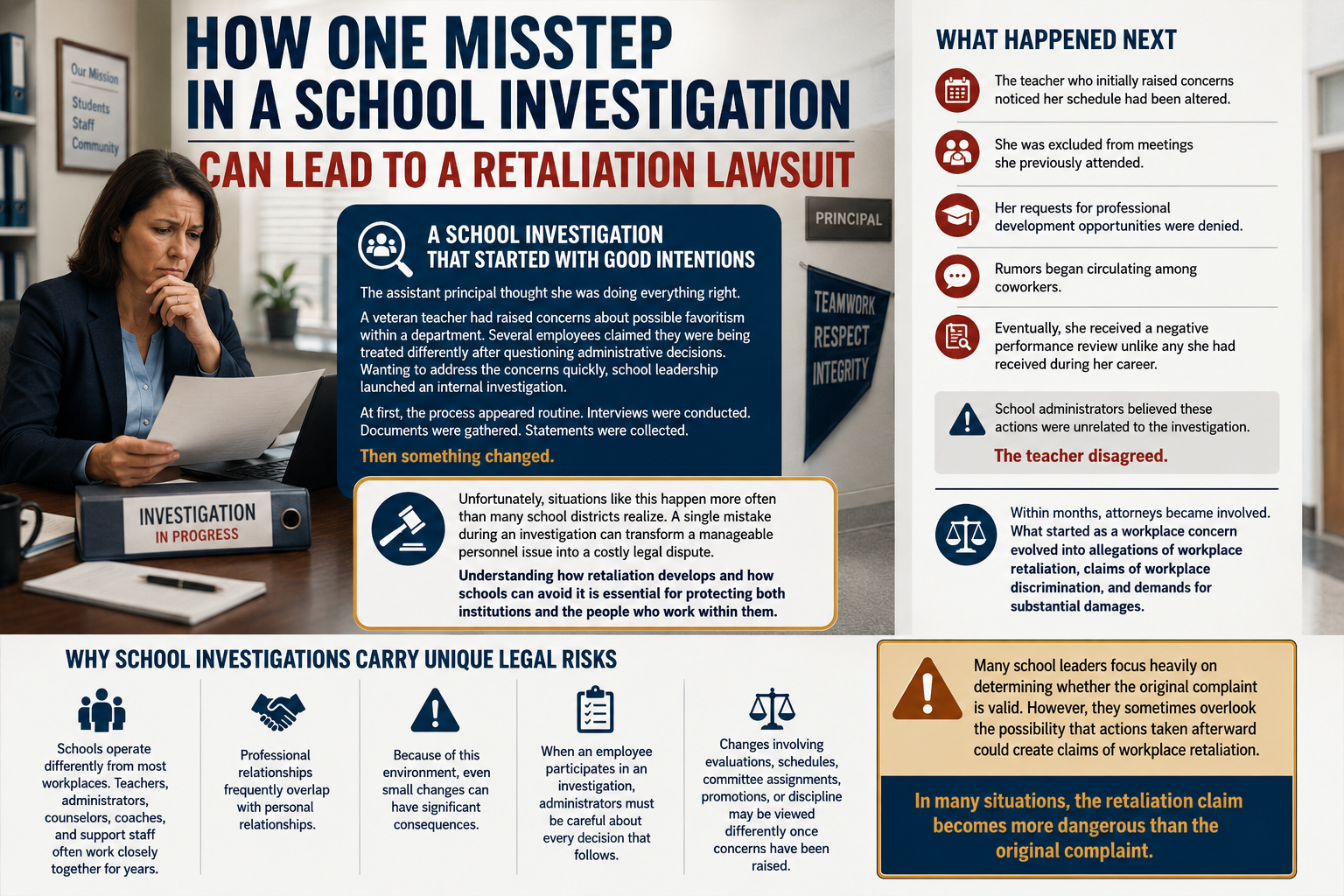
How One Misstep in a School Investigation Can Lead to a Retaliation Lawsuit
A School Investigation That Started with Good Intentions
The assistant principal thought she was doing everything right.
A veteran teacher had raised concerns about possible favoritism within a department. Several employees claimed they were being treated differently after questioning administrative decisions. Wanting to address the concerns quickly, school leadership launched an internal investigation.
At first, the process appeared routine. Interviews were conducted. Documents were gathered. Statements were collected.
Then something changed.
The teacher who initially raised concerns noticed her schedule had been altered. She was excluded from meetings she previously attended. Her requests for professional development opportunities were denied. Rumors began circulating among coworkers. Eventually, she received a negative performance review unlike any she had received during her career.
School administrators believed these actions were unrelated to the investigation.
The teacher disagreed.
Within months, attorneys became involved. What started as a workplace concern evolved into allegations of workplace retaliation, claims of workplace discrimination, and demands for substantial damages.
Unfortunately, situations like this happen more often than many school districts realize. A single mistake during an investigation can transform a manageable personnel issue into a costly legal dispute. Understanding how retaliation develops and how schools can avoid it is essential for protecting both institutions and the people who work within them.
Why School Investigations Carry Unique Legal Risks
Schools operate differently from most workplaces. Teachers, administrators, counselors, coaches, and support staff often work closely together for years. Professional relationships frequently overlap with personal relationships.
Because of this environment, even small changes can have significant consequences.
When an employee participates in an investigation, administrators must be careful about every decision that follows. Changes involving evaluations, schedules, committee assignments, promotions, or discipline may be viewed differently once concerns have been raised.
Many school leaders focus heavily on determining whether the original complaint is valid. However, they sometimes overlook the possibility that actions taken afterward could create claims of workplace retaliation.
In many situations, the retaliation claim becomes more dangerous than the original complaint.
Understanding the Legal Definition of Retaliation
The legal definition of retaliation generally involves an employer taking action against an employee because that employee engaged in a legally protected activity.
A protected activity can include:
- Reporting discrimination
- Reporting harassment
- Filing a complaint with administration
- Participating in an investigation
- Assisting another employee during an investigation
- Cooperating with government agencies
- Opposing unlawful workplace conduct
Many administrators mistakenly believe retaliation only occurs when someone is terminated.
That is not accurate.
Retaliation can involve a wide range of actions that negatively affect an employee's work environment or career opportunities.
Courts often examine whether a reasonable person would be discouraged from reporting concerns if they knew the employer would respond in the same manner.
What Counts as a Protected Activity in Schools?
A teacher who reports sexual harassment may be engaging in a protected activity.
A counselor who reports workplace discrimination may also be protected.
A coach who assists investigators reviewing allegations of sex discrimination could receive similar protections.
Even an employee who simply participates in interviews during an investigation may be protected under various laws.
This is one reason schools must proceed carefully once concerns are raised. The employee does not have to ultimately win the underlying claim to be protected from retaliation.
The fact that the employee participated in the process may be enough.
How Retaliation Begins Without Anyone Realizing It
In many cases, retaliation begins unintentionally.
A principal may become frustrated after a complaint is filed. An administrator may feel personally attacked. Department leaders may view the complaining employee as disruptive.
Although these reactions are human, they can create significant legal problems.
Once emotions enter the process, decisions may start changing.
An employee may suddenly receive additional scrutiny. Minor mistakes that were previously overlooked become disciplinary issues. Leadership may exclude the employee from opportunities available to others.
Even if administrators believe they are acting fairly, the appearance of retaliatory conduct can create serious exposure.
The Most Common Misstep During School Investigations
One of the most common mistakes occurs when administrators fail to separate the investigation from future personnel decisions.
Consider a teacher who files a formal complaint involving alleged discrimination.
The school completes its investigation and determines there is insufficient evidence to support the allegations.
Leadership assumes the matter is closed.
A few months later, the teacher receives a poor evaluation.
The school may believe the evaluation is justified. However, if documentation is weak or timing appears suspicious, the employee may argue the evaluation was connected to the earlier complaint.
The result can be allegations of workplace retaliation, even if the original complaint was not substantiated.
Why Timing Matters So Much
Timing frequently becomes one of the most important factors in retaliation cases.
When negative actions occur shortly after an employee reports concerns, courts and investigators often look more closely at the situation.
For example, a teacher reports sexual harassment.
Two weeks later, the teacher loses leadership responsibilities.
One month later, the teacher receives discipline.
Three months later, the teacher is transferred.
Even if each decision appears defensible individually, the sequence can create the appearance of retaliation.
This is why experienced employment lawyers often focus heavily on timelines.
The Role of Human Resources During Investigations
Strong involvement from human resources can help reduce risk.
The human resources department should not simply collect paperwork and close files. Instead, it should monitor what happens after the investigation concludes, and some districts rely on outside HR consulting services and training to strengthen these processes.
Effective human resources professionals often review:
- Performance evaluations
- Disciplinary recommendations
- Transfer decisions
- Schedule modifications
- Assignment changes
- Promotion opportunities
These reviews help identify actions that could be interpreted as retaliation.
Schools that fail to involve human resources throughout the process often face greater legal exposure.
Workplace Retaliation Can Take Many Forms
Many people assume retaliation requires termination.
In reality, workplace retaliation can involve numerous actions.
Examples include:
- Demotions
- Reduced responsibilities
- Unfavorable schedules
- Exclusion from committees
- Negative evaluations
- Loss of leadership opportunities
- Unnecessary investigations
- Increased scrutiny
- Public criticism
Some employees experience false rumors after filing complaints.
Others receive undesirable job assignments.
In each situation, the question becomes whether the action occurred because the employee engaged in protected conduct.
When Discipline Becomes a Legal Problem
Schools have the right to discipline employees when appropriate.
However, discipline becomes problematic when it appears connected to protected activities.
A teacher who violated district policy may deserve corrective action.
But if that same teacher recently filed a retaliation complaint, the school must carefully document its reasoning.
Without strong documentation, employees may argue the discipline was motivated by retaliation rather than legitimate concerns.
This is why every disciplinary action should be supported by objective evidence.
The Connection Between Discrimination and Retaliation Claims
Many retaliation lawsuits begin with allegations of discrimination.
An employee may report:
- Gender discrimination
- Age discrimination
- Sex discrimination
- Discrimination based on sexual orientation
- Discrimination based on national origin
- Discrimination based on disability
The investigation may focus initially on whether unlawful conduct occurred.
However, once the complaint is filed, a second legal issue emerges.
The employer must ensure that no actions occur that could be viewed as punishment for speaking up.
This is where many organizations make costly mistakes.
Federal Laws That Protect School Employees
Several laws protect school employees from retaliation.
Among the most important is Title VII of the Civil Rights Act.
Title VII prohibits many forms of workplace discrimination involving race, religion, sex, and national origin.
The Civil Rights Act also contains provisions designed to prohibit retaliation against employees who oppose unlawful practices or participate in investigations.
Other protections may arise under the Americans with Disabilities Act, often referred to as the disabilities act, along with various state statutes.
These laws create significant obligations for school districts.
When Workplace Discrimination Investigations Expand
A complaint involving workplace discrimination may initially seem narrow.
However, investigations often expand as additional information emerges, which is why some schools turn to independent internal investigation services to ensure neutrality and compliance.
One employee may report concerns involving sex discrimination.
Another employee may report being treated differently because of similar circumstances.
Soon investigators may discover broader patterns involving policies, supervision, or training.
The larger the investigation becomes, the greater the risk that employees will later claim workplace retaliation occurred.
How Employees Interpret Administrative Decisions
Administrators often focus on intent.
Employees often focus on impact.
This difference can create legal disputes.
A principal may believe a transfer serves operational needs.
The employee may view the transfer as punishment.
An administrator may believe a performance review reflects legitimate concerns.
The employee may view it as retaliation.
Because perception matters, schools must carefully communicate the reasons behind employment decisions.
Why Documentation Becomes Critical
Proper documentation frequently determines whether a school can successfully defend a retaliation claim.
Documentation should explain:
- What decision was made
- Why the decision was made
- Who participated in the decision
- When the decision was discussed
- What evidence supported the decision
When records are incomplete, employees may argue that explanations were created after litigation began.
Strong documentation helps demonstrate legitimate business reasons for actions affecting employees.
The Hidden Cost of Workplace Retaliation Allegations
Many school leaders focus on litigation expenses.
Those costs can be significant.
However, the impact often extends far beyond legal fees.
Allegations of workplace retaliation can damage:
- Public trust
- Staff retention
- Recruitment efforts
- Community confidence
- Internal culture
Perhaps most importantly, retaliation allegations can severely affect employee morale.
When employees believe complaints will result in punishment, they become less likely to report concerns in the future.
That creates additional risk for the institution.
The Equal Employment Opportunity Commission and School Investigations
Many retaliation claims eventually reach the Equal Employment Opportunity Commission.
The employment opportunity commission EEOC investigates allegations involving workplace rights protected under federal law. Employees who believe they experienced workplace discrimination or retaliation often file charges before pursuing litigation.
When the Equal Employment Opportunity Commission becomes involved, investigators frequently review not only the original complaint but also everything that occurred afterward.
This is why schools should never assume a complaint disappears simply because an internal investigation has ended.
Federal Law and State Laws Work Together
Many administrators focus exclusively on federal law.
While federal requirements are important, schools must also comply with state laws, local laws, and other regulations that may provide additional protections.
In many situations, federal and state laws overlap.
An action that violates a state statute may also create liability under federal regulations. Likewise, some state and local laws provide broader protections than federal law alone.
Understanding the interaction between these legal frameworks is essential when handling employee complaints.
Protected Employees Include More Than Teachers
School districts often think primarily about classroom educators.
However, legal protections extend to many categories of workers.
Protected individuals may include:
- Administrators
- Counselors
- Coaches
- Support staff
- Maintenance personnel
- Transportation employees
- Substitute personnel
- Contract workers in certain situations
These individual employees may all have rights under applicable laws, and many benefit from guidance provided by an education law attorney for teachers.
A retaliation claim is not limited to certified educators.
When Reporting Harassment Creates Legal Exposure
Many retaliation cases begin with reporting harassment.
An employee may report sexual harassment, bullying, hostile conduct, or other inappropriate behavior.
The school may investigate and address the concern appropriately.
However, problems often arise afterward.
If the employee later experiences unfavorable treatment, reduced opportunities, or increased scrutiny, allegations of workplace retaliation may follow.
This is true even when the original harassment complaint cannot be substantiated.
Retaliation and Wrongful Termination Claims
One of the most serious outcomes occurs when an employee loses employment.
An employee who believes he or she was unfairly fired after making a complaint may pursue claims involving retaliation and wrongful termination.
Courts frequently examine whether the termination followed a protected activity.
Questions often include:
- Was a complaint recently filed?
- Did the employee participate in an investigation?
- Was discipline consistent with prior practices?
- Were other employees treated similarly?
If the evidence suggests retaliation played a role, the employer may face significant liability.
The Importance of Consistent Employment Practices
Consistency is one of the strongest defenses available to an employer.
When schools apply policies unevenly, allegations of retaliation become easier to support.
Strong employment practices help demonstrate fairness and objectivity.
For example, if multiple employees commit the same violation, disciplinary outcomes should generally be similar.
When one employee receives harsher treatment shortly after filing a complaint, investigators may question the motive behind the decision.
How Workplace Retaliation Affects Employee Trust
Employees want to believe they can raise concerns without fear.
When workplace retaliation occurs, trust erodes quickly.
Staff members may become reluctant to report misconduct, policy violations, or safety concerns.
Some employees may remain silent even when they witness serious problems.
This environment increases organizational risk and makes future issues more difficult to identify and address.
Understanding Discrimination Based on Protected Characteristics
Many investigations involve allegations of discrimination based on protected characteristics.
Examples include discrimination based on race, sex, disability, religion, age, or sexual orientation.
Others involve discrimination based on national origin, family status, or other protected classifications recognized under applicable law.
When these complaints arise, schools must conduct fair investigations while ensuring employees do not experience retaliation afterward.
Failure to do so can significantly increase legal exposure.
The Role of Title VII in School Employment Cases
Title VII remains one of the most significant employment laws affecting educational institutions.
Under Title VII, employers may not engage in unlawful workplace discrimination based on protected categories.
The law also protects employees who oppose discriminatory practices or participate in investigations.
Because of these protections, schools should approach every complaint with the understanding that retaliation concerns may arise alongside discrimination allegations.
Careful planning can help prevent unnecessary disputes.
Federal Employees and School-Related Claims
While public school employees are not always categorized as federal employees, some educational professionals working within federally connected programs may receive protections under federal systems.
Certain investigations may also involve interactions with federal agencies, including the Department of Labor for some retaliation and labor complaints.
Understanding these relationships is important because retaliation concerns can trigger scrutiny from multiple levels of government, making experienced education lawyer support for teachers and schools especially valuable.
School leaders should not assume that internal procedures alone resolve every legal issue.
Human Resources Should Continue Monitoring After the Investigation
Many organizations make the mistake of ending oversight once a report is completed.
Effective human resources departments continue monitoring workplace conditions afterward.
This includes reviewing complaints, personnel actions, evaluations, and disciplinary recommendations.
Ongoing oversight allows human resources professionals to identify patterns that could suggest workplace retaliation.
Early intervention often prevents disputes from escalating into litigation.
What Happens When an Employer Denies Retaliation?
In many cases, the employer denies any retaliatory motive.
That alone does not end the matter.
Investigators often compare statements against documents, emails, personnel records, witness interviews, and timelines.
If evidence suggests the stated reason differs from actual events, liability may still arise.
This is why transparency and documentation remain critical throughout the process.
Adverse Actions Can Be Subtle
Many administrators assume retaliation requires a dramatic event.
In reality, an adverse action can be relatively subtle.
An employee may be excluded from leadership opportunities.
Professional development requests may suddenly be denied.
Preferred assignments may disappear.
These actions may appear minor individually, but collectively they can support claims of workplace retaliation.
When Workplace Discrimination Leads to Multiple Claims
A single complaint involving workplace discrimination may eventually evolve into several legal claims.
Employees sometimes pursue allegations involving:
- Retaliation
- Discrimination claims
- Harassment
- Hostile work environment
- Wrongful termination
- Failure to accommodate disabilities
This expansion often increases litigation costs and potential damages.
As a result, addressing issues correctly from the beginning becomes extremely important.
Disability-Related Complaints Require Additional Care
Employees covered under the Americans with Disabilities Act, sometimes referenced as the disabilities act, may receive additional protections.
Schools may have obligations to provide reasonable accommodations unless doing so would create an undue hardship.
Requests involving reasonable accommodations should be handled carefully.
Retaliation allegations can arise if an employee believes adverse treatment occurred after requesting assistance.
The risk increases when communication is inconsistent or poorly documented.
Family Responsibilities and Protected Leave
Some employment disputes involve caregiving obligations.
An employee may request leave to assist a family member or manage significant family responsibilities.
In certain situations, protections may arise under the medical leave act and related statutes.
Employees who take job protected leave should not face retaliation for exercising legal rights.
Failure to respect these protections can expose employers to additional liability.
Wage Issues and Other Protected Activities
Not every retaliation claim involves discrimination.
Employees may engage in protected activities involving:
- Overtime pay
- Safety concerns
- Reporting fraud
- Ethical violations
- Contract compliance
Some complaints involve occupational safety issues.
Others arise under whistleblower laws.
Regardless of the underlying topic, retaliation concerns can emerge whenever employees exercise legally protected rights.
Workplace Retaliation Can Harm More Than Careers
The consequences of retaliation extend beyond employment records.
Employees sometimes experience stress, anxiety, reputational harm, and disruption to their personal life.
In severe cases, allegations may involve threats, intimidation, or concerns regarding physical harm.
Even when claims do not reach that level, the emotional impact can be substantial.
Schools should never underestimate the human side of these disputes.
Investigators Must Avoid Direct Discrimination
A fair investigation requires neutrality.
Any appearance of direct discrimination can undermine credibility and increase liability.
Investigators should evaluate evidence objectively and avoid assumptions regarding protected characteristics.
Employees must feel confident that concerns will be reviewed fairly.
Trust in the process helps reduce conflict and encourages cooperation.
Why Some Employees Feel Treated Differently
Perception often plays a major role in retaliation cases.
Employees compare their experiences to coworkers facing similar situations.
If one person appears treated differently, questions naturally arise.
Investigators and administrators should be prepared to explain decisions with objective evidence.
Consistency remains one of the strongest defenses available to an employer.
Employment Decisions Must Be Defensible
Every significant employment decision should withstand scrutiny.
Whether the issue involves evaluations, transfers, promotions, or discipline, schools should be able to articulate legitimate reasons for their actions.
Documentation should support those reasons.
When records are incomplete or inconsistent, plaintiffs' attorneys often argue retaliation motivated the decision.
Careful preparation can reduce this risk substantially.
What Damages Can Employers Face?
Retaliation lawsuits can become expensive, and for some educators they may arise alongside professional license or misconduct investigations that require focused
educator misconduct defense.
Depending on the circumstances, employees may seek:
- Back pay
- Front pay
- Emotional distress damages
- Attorney's fees
- Reinstatement
- Punitive damages
The financial impact can be significant, particularly when litigation continues for years.
Avoiding retaliation is far less costly than defending a lawsuit.
How Labor and Employment Lawyers Help Schools
Experienced labor and employment lawyers help educational institutions navigate complex investigations.
They can:
- Review investigative procedures
- Evaluate risk exposure
- Assess policy compliance
- Train administrators
- Defend claims when litigation arises
Legal guidance is especially valuable when allegations involve employment discrimination cases, retaliation, or high-profile personnel disputes.
Early involvement often prevents larger problems later.
Building a Culture That Prevents Retaliation
The strongest defense against retaliation begins long before a complaint is filed.
Schools should create environments where employees feel comfortable raising concerns, sometimes with support from outside counsel that offers broader legal services and customized training for educators and administrators.
This includes:
- Clear reporting procedures
- Effective training
- Consistent policy enforcement
- Leadership accountability
- Strong employee handbook provisions
When employees trust the process, disputes are often resolved more effectively.
Protecting Schools and Employees Through Proper Investigations
A well-executed investigation protects everyone involved.
It helps the employer identify concerns, address misconduct, and comply with legal obligations.
It also helps employees feel respected and heard.
When investigations are conducted fairly and followed by thoughtful decision-making, the likelihood of workplace retaliation, workplace discrimination, and related claims decreases significantly.
One misstep may be enough to create years of litigation.
A careful approach can help prevent that outcome.
How Employment Laws Protect Employees During School Investigations
Various federal and state laws exist to ensure fairness in the workplace when complaints arise. The employment act provisions found in numerous employment statutes help establish procedures that schools and other employers must follow when addressing employee concerns. These laws protect employees who report misconduct, cooperate with investigations, or raise concerns about discrimination and retaliation. Schools that understand these obligations are better positioned to avoid legal disputes and create a more transparent workplace environment. When administrators ignore these protections, they may inadvertently expose the district to liability and increase the risk of future claims.
Preventing Future Discrimination and Retaliation Claims
One of the primary goals of any workplace investigation should be preventing future discrimination and similar complaints from occurring. School leaders should carefully evaluate whether policies, training programs, and supervisory practices contributed to the concerns being reported. Proactive corrective measures can help ensure that all eligible employees have equal access to opportunities, resources, and support. By addressing problems early and consistently, employers demonstrate a commitment to fairness while reducing the likelihood of additional allegations. A culture of accountability can often prevent minor workplace concerns from becoming significant legal disputes.
Fair Treatment of Employees Regardless of Background
Every employee deserves to be evaluated based on performance and conduct rather than personal characteristics. Employment decisions should never be influenced by factors such as race, religion, national origin, or immigration status. When employees believe they are experiencing unfair treatment, trust in leadership can quickly erode. Administrators should ensure that policies are applied consistently and that disciplinary decisions are supported by objective evidence. These efforts help create a workplace where employees feel respected and confident that their rights will be protected.
Why Employees Seek Legal Representation in Retaliation Cases
When workplace disputes escalate, employees often turn to attorneys who represent employees in retaliation and discrimination matters. These legal professionals evaluate evidence, review investigative records, and determine whether an employee's rights may have been violated. In many cases, the concern is not only whether someone lost his or her job, but whether the actions leading up to that outcome were motivated by retaliation. Courts frequently examine whether the employer's conduct was justified or whether unlawful motives influenced workplace decisions. Strong documentation and consistent practices remain essential for employers defending against these claims.
Understanding Employee-Based Complaints in Educational Settings
Many school investigations begin with an employee based complaint involving workplace conduct, discrimination, harassment, or policy violations. These concerns should be taken seriously regardless of the employee's position within the organization. Administrators who respond promptly and fairly are often better equipped to resolve disputes before they escalate into litigation. Thorough investigations, clear communication, and ongoing oversight can help reduce misunderstandings and reinforce confidence in the process. Ultimately, a fair response benefits both employees and the institution as a whole.
Employment Discrimination Cases Often Lead to Retaliation Allegations
Many employment discrimination cases begin with a complaint about unequal treatment in the workplace. An employee may report concerns involving race, gender, religion, disability, or other protected characteristics. While employers often focus on investigating the original allegations, they must also ensure that no retaliatory actions occur afterward. Even when discrimination claims are ultimately unsubstantiated, employees remain protected from retaliation for participating in the process. Schools that fail to recognize this distinction can face significant legal and financial consequences.
Sexual Orientation Complaints Require Careful Investigation
Modern employment laws provide protections against discrimination based on sexual orientation in many workplace settings. Employees who report concerns involving harassment, exclusion, or unequal treatment related to sexual orientation should feel confident that their complaints will be taken seriously. Administrators must conduct investigations objectively and avoid actions that could be perceived as retaliation. A fair and consistent response helps protect both the employee and the institution. It also demonstrates the school's commitment to maintaining a respectful and inclusive work environment.
Understanding Employee Rights Under the Medical Leave Act
Schools and educational institutions must understand their obligations under the medical leave act and related employment laws. Employees who qualify for protected leave often have the right to take time away from work without fear of retaliation. Problems can arise when supervisors view leave requests as inconvenient or disruptive to operations. Any negative employment action following a leave request may attract legal scrutiny. Proper training and careful documentation help ensure compliance while reducing the risk of retaliation claims.
When Retaliation Escalates Beyond Professional Consequences
Most retaliation cases involve employment-related actions such as discipline, transfers, or negative evaluations. However, in rare situations, workplace conflicts can escalate to threats, intimidation, or concerns involving physical harm. Allegations of this nature are particularly serious and should be addressed immediately. Employers have a responsibility to maintain a safe environment for employees and investigate safety-related concerns thoroughly. Failure to respond appropriately can create additional liability and further damage employee trust.
The Importance of Providing Reasonable Accommodations
Employees with disabilities may have legal rights to request workplace modifications that allow them to perform essential job duties. Schools may be required to provide reasonable accommodations unless doing so would create a significant hardship for the organization. Requests for accommodations should be reviewed carefully and addressed through an interactive process. Retaliation concerns may arise if an employee experiences negative treatment after requesting assistance. Open communication and consistent procedures can help employers comply with legal requirements while supporting employee success.
Punitive Damages Can Significantly Increase Employer Liability
Retaliation lawsuits can expose employers to substantial financial risk. In some cases, courts may award punitive damages when evidence suggests particularly reckless or intentional misconduct. These damages are designed not only to compensate the employee but also to discourage similar behavior in the future. While not available in every case, punitive damages can dramatically increase the overall cost of litigation. This is one reason schools should take retaliation complaints seriously and seek legal guidance before small problems become major disputes.
Speak with Masterly Legal Solutions About Retaliation at Work
When allegations of retaliation at work, workplace discrimination, or employee complaints arise, schools and educational institutions often face difficult decisions with significant legal consequences. A poorly handled investigation can expose an employer to claims involving retaliation, discrimination, and other employment-related disputes.
At Masterly Legal Solutions, our experienced employment lawyers understand the challenges schools, administrators, and employees face when navigating sensitive workplace investigations. Whether you are concerned about retaliation, disciplinary issues, discrimination claims, policy compliance, or employee rights, our team can help evaluate your situation and explain the options available.
If you have questions about a school investigation, believe you have experienced workplace mistreatment, or need guidance regarding retaliation concerns, contact Masterly Legal Solutions for a free consultation. We take the time to understand the facts, answer your questions, and help you make informed decisions before a problem becomes a lawsuit.
Call (972) 236-5051 today for a free consultation and learn how proactive legal guidance can help protect your rights, your career, and your organization.
Disclaimer: This article is provided for educational and informational purposes only. It is not legal advice and should not be relied upon as legal guidance for any specific situation. Reading this article does not create an attorney-client relationship. Laws may vary depending on jurisdiction, and legal outcomes depend on the specific facts of each case. If you have questions regarding retaliation, discrimination, employment matters, or any workplace-related issue, contact a qualified attorney to obtain advice tailored to your circumstances.


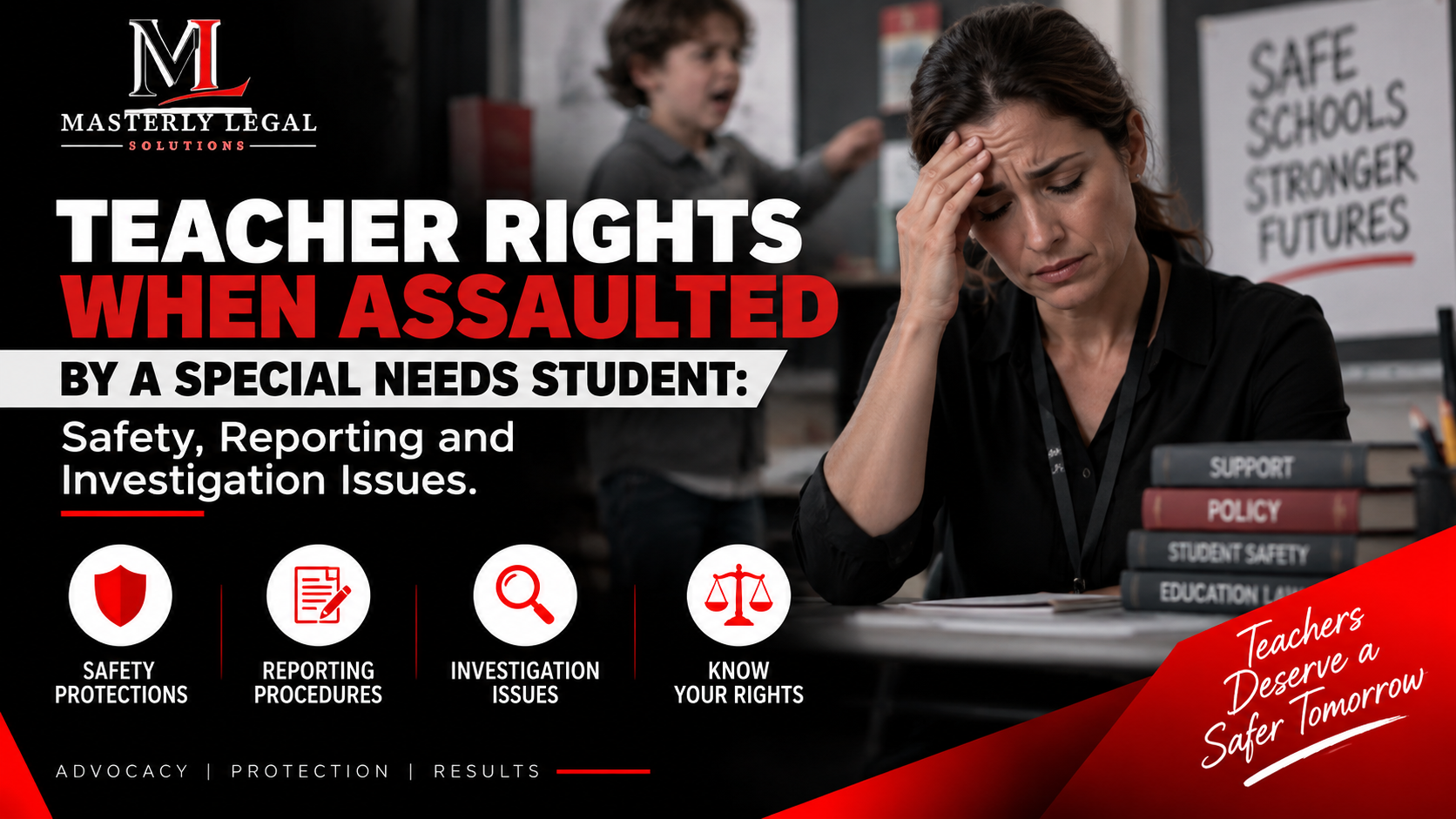
Teacher Rights When Assaulted by a Special Needs Student: Safety, Reporting and Investigation Issues



Looking for Legal & Business Solutions? Contact Us Now
Fill in the form or call us to set up a meeting





