

Poorly Written Employee Handbooks Can Create More Liability Than Protection
Why Many Business Owners Overlook the Risks Hidden in Their Employee Handbook
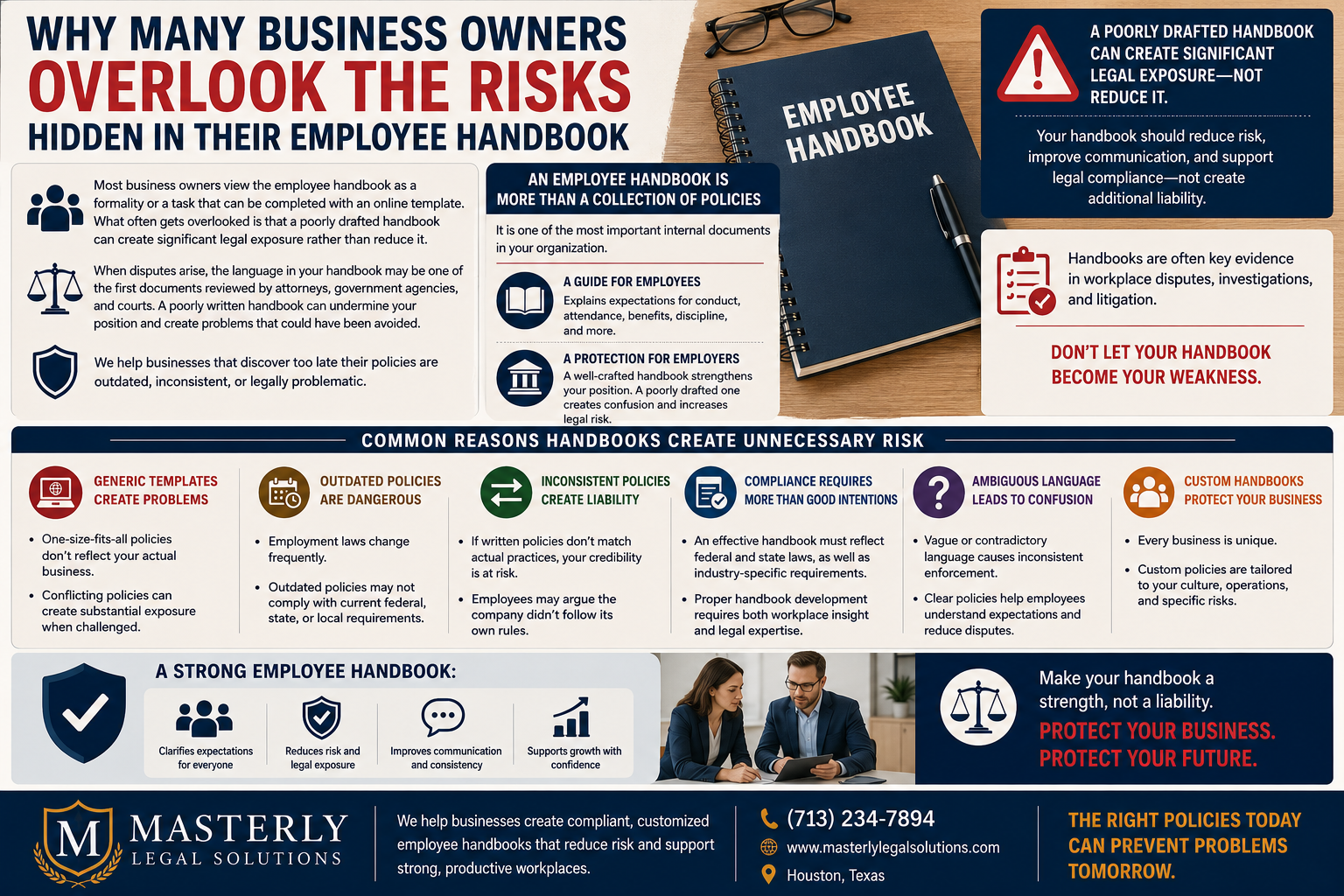
Most business owners understand that an employee handbook is an important part of managing a workforce. Unfortunately, many companies view it as little more than a formality or an administrative task that can be completed using a template found online. What often gets overlooked is the fact that a poorly drafted employee handbook can create significant legal exposure rather than reduce it.
Many organizations spend considerable time developing products, serving customers, and growing revenue, yet give very little attention to the policies that govern their employees. When disputes arise, however, the language contained in an employee handbook may become one of the first documents reviewed by attorneys, government agencies, and courts. A poorly written handbook can undermine an employer's position and create problems that could have been avoided.
At Masterly Legal Solutions, we regularly work with businesses that discover too late that their policies are outdated, inconsistent, or legally problematic. The goal of an employee handbook should be to reduce risk, improve communication, and support legal compliance—not create additional liability.
An Employee Handbook Is More Than a Collection of Policies
Many employers mistakenly assume that an employee handbook is simply a place to store company rules. In reality, an employee handbook often serves as one of the most important internal documents within an organization.
The handbook serves as a guide for employees while also helping employers establish expectations regarding workplace conduct, attendance, benefits, discipline, and numerous other topics. Because the document influences day-to-day operations, mistakes can have widespread consequences.
A well-constructed employee handbook can strengthen a company's position during workplace disputes. A poorly drafted handbook, however, may create confusion and increase legal risk.
Why Generic Templates Create Problems
Online templates and automated handbook builder programs have become increasingly popular. While these tools may seem cost effective initially, they often fail to account for the unique needs of a business.
Many handbook builder products rely on generalized policies that may not reflect a company's actual business practices. In some cases, the policies included in these documents directly conflict with how the business operates on a daily basis.
The result is a handbook that looks professional on paper but creates substantial exposure when employees challenge company actions.
The Hidden Dangers of Outdated Policies
One of the most common issues we encounter involves outdated policies. Employment laws change regularly, and businesses that fail to keep their employee handbook up to date may unknowingly expose themselves to liability.
Federal regulations, state laws, and local requirements evolve over time. Policies that were appropriate several years ago may no longer satisfy current legal standards.
Employers should regularly review their current handbook to ensure compliance with applicable laws and regulations. Failure to do so may create unnecessary risk when disputes arise.
Federal and State Laws Continue to Evolve
Employment laws rarely remain static. New court decisions, agency interpretations, and legislative changes can significantly affect workplace obligations.
Federal and state laws govern numerous employment issues, including discrimination, wage requirements, leave policies, workplace accommodations, and employee rights. Companies operating without updated policies may find themselves struggling to address new legal obligations.
Maintaining an up to date employee handbook helps employers adapt to these evolving requirements while supporting legal compliance.
How Inconsistent Policies Create Liability
A common problem occurs when written policies differ from actual workplace practices. Employers may distribute an employee handbook that outlines one procedure while managers follow an entirely different process.
This inconsistency can become problematic during employment disputes. Employees may argue that the employer failed to follow its own policies, creating credibility issues and potential liability.
A compliant employee handbook should accurately reflect how the company operates rather than how management wishes it operated.
Why Legal Compliance Requires More Than Good Intentions
Many employers genuinely want to comply with employment laws. However, good intentions alone do not ensure legal compliance.
An employee handbook should be drafted with a thorough understanding of federal law, state laws, and industry-specific requirements. Policies that appear reasonable may still create legal problems if they conflict with applicable regulations.
Proper handbook development requires both practical workplace knowledge and legal expertise.
The Cost of Ambiguous Language
Ambiguous language is another frequent source of problems. Policies that are vague, contradictory, or difficult to understand often lead to confusion among employees and managers.
Clear and concise explanations help employees understand expectations while reducing misunderstandings. When policies lack clarity, different supervisors may interpret them differently, leading to inconsistent enforcement.
These inconsistencies often become significant issues during investigations and litigation.
Why Every Business Needs a Custom Employee Handbook
No two businesses operate exactly the same way. A retail company, healthcare provider, construction firm, and professional services organization face different risks and operational challenges.
A custom employee handbook allows policies to be tailored to the organization's specific workplace culture, business model, and operational needs. Generic templates rarely account for these differences.
Developing a custom employee handbook helps ensure that policies align with actual business operations while supporting compliance objectives.
Understanding the Value of a Custom Handbook
A custom handbook provides far more than personalization. It allows employers to address issues unique to their industry, workforce structure, and organizational goals.
Businesses operating in multiple states may require policies that account for varying state regulations. Companies with remote workers may need different procedures than businesses operating from a single location.
A properly drafted custom handbook creates consistency while reducing confusion across the organization, and employers can benefit from an essential guide to employee handbooks with policy and manual examples when considering how best to structure their own documents.
Employee Handbook Creation Is a Strategic Process
Effective employee handbook creation should never be treated as a simple administrative task. The handbook creation process requires thoughtful planning, legal review, and alignment with company operations.
Policies should support business objectives while complying with federal and state regulations. The drafting process should also account for future growth and organizational changes.
A strategic approach to handbook development often helps employers avoid costly problems later.
The Relationship Between Company Policies and Workplace Culture
Company policies do more than establish rules. They also influence workplace culture and employee expectations.
An employee handbook that promotes transparency, consistency, and fairness can strengthen employee confidence in management. Conversely, unclear or contradictory policies can damage morale and create unnecessary conflict.
Employers should view the employee handbook as a communication tool rather than merely a legal document.
Why HR Best Practices Matter
HR best practices play a critical role in creating an effective employee handbook. Policies should reflect practical workplace realities while supporting compliance goals.
Experienced HR professionals understand how policies affect employee relations, performance management, and workplace communication. Their input can help create a more functional handbook.
When combined with legal review, HR best practices and HR consulting services and training often produce stronger and more effective policies.
The Risks of Relying Exclusively on an Employee Handbook Builder
Many employers are attracted to employee handbook builder software because of its convenience and affordability. While these tools may provide a starting point, they often lack the customization necessary for complex employment environments.
An employee handbook builder may not account for industry-specific requirements, state specific filters, or unique organizational needs. Businesses operating in multiple jurisdictions face particularly significant challenges when relying solely on automated solutions.
The result may be a handbook that appears comprehensive while overlooking critical compliance issues.
Why Federal and State Compliance Requires Ongoing Attention
Federal and state compliance is not a one-time project. Employment laws continue to evolve, and employers must regularly update policies to remain compliant.
Changes involving leave laws, wage regulations, anti-discrimination protections, and workplace accommodations may require revisions to existing policies. Businesses that fail to stay compliant may face avoidable legal exposure.
An up to date handbook is one of the most effective tools for maintaining compliance across the organization.
Common Mistakes Found During Employee Handbook Review
An employee handbook review often reveals issues that employers never realized existed. Some of the most common problems include outdated language, inconsistent policies, and references to obsolete laws.
Other issues may involve missing policies, inadequate disclaimers, or provisions that inadvertently create contractual obligations. These problems frequently remain hidden until a dispute occurs.
Regular employee handbook review helps identify potential concerns before they become larger problems.
Why an Existing Handbook May Need Immediate Attention
Many companies already have an employee handbook in place. Unfortunately, simply having a handbook does not mean the document provides adequate protection.
An existing handbook may contain language drafted years ago that no longer reflects current business operations or legal requirements. As organizations evolve, policies often become disconnected from actual workplace practices.
Reviewing and updating the handbook periodically helps ensure continued relevance and legal accuracy.
Legal Compliance Is a Moving Target
Compliance challenges rarely disappear. New regulations, court decisions, and agency guidance frequently affect employer obligations.
Federal regulations and state regulations continue to change, making it difficult for employers to keep policies current without professional assistance. Businesses that fail to monitor these developments may face significant compliance risk.
Maintaining an up to date handbook helps organizations adapt to changing legal requirements more effectively.
Why Employers Need Legal Expertise During Handbook Development
Drafting an employee handbook involves more than selecting policy language. Employers must also understand how those policies interact with employment laws and workplace realities.
Legal expertise helps identify provisions that may create liability or conflict with current regulations. It also helps ensure compliance with federal and state laws governing employment relationships.
A properly drafted handbook supports both legal compliance and effective business operations.
How Poor Policies Can Increase Workplace Disputes
One of the primary purposes of an employee handbook is to reduce workplace disputes. Ironically, poorly drafted policies often create the very conflicts they were intended to prevent.
Confusing procedures, inconsistent expectations, and vague disciplinary standards frequently lead to disagreements between employees and management. These disputes may escalate into formal complaints or legal claims.
A well-designed handbook promotes consistency and helps reduce unnecessary conflict within the workplace.
Employee Handbook Services Are an Investment in Risk Management
Many employers view employee handbook services as an optional expense rather than an important business investment. Unfortunately, that perspective often changes after a workplace dispute, government investigation, or employment claim arises.
A properly drafted employee handbook can help establish expectations, improve consistency, and reduce legal exposure, which is why many organizations turn to professional employee handbook services for drafting and review support. The cost of proactive handbook development is often far less than the expense associated with defending a lawsuit, responding to agency complaints, or correcting compliance issues after they occur.
Businesses that invest in employee handbook services are often better positioned to manage employee relations while reducing unnecessary liability.
Why Employee Handbook Services Should Be Customized
Every company operates differently. An employee handbook designed for one organization may be completely inappropriate for another. This is why employee handbook services should focus on customization rather than generic templates.
A custom employee handbook allows employers to address issues specific to their workforce, industry, and operational structure. Policies should reflect actual business practices rather than assumptions about how companies generally operate.
The more closely policies align with organizational realities, the more effective the handbook becomes.
A Custom Employee Handbook Reflects Your Business Model
A custom employee handbook should be designed around the company's specific business model. Employment practices that work for a manufacturing company may be unsuitable for a healthcare provider, professional services firm, or retail organization.
The handbook should address the company's operational needs while remaining compliant with applicable employment laws. This requires more than copying language from another organization's policies.
A thoughtfully drafted custom employee handbook provides clarity while supporting organizational objectives.
Why Custom Employee Policies Matter
The needs of every workforce are different. Businesses often have unique scheduling practices, reporting procedures, attendance expectations, and workplace policies.
Custom employee policies help ensure that employees understand what is expected of them while reducing the likelihood of misunderstandings. Customized policies also allow employers to address industry-specific risks that generic templates frequently overlook.
This level of personalization is one reason why a custom handbook often provides significantly greater value than standardized alternatives.
The Importance of Federal and State Compliance
Compliance obligations vary significantly across jurisdictions, and many organizations rely on outside general counsel services to help them navigate these evolving requirements. Employers must often navigate a combination of federal law, state laws, and local regulations.
Federal and state compliance requires careful review of policies governing discrimination, leave, wages, accommodations, workplace safety, and numerous other employment issues. Businesses that fail to account for these requirements may inadvertently expose themselves to liability.
An employee handbook should support compliance efforts rather than undermine them.
Businesses Operating in Multiple States Face Additional Challenges
Organizations operating in multiple states frequently encounter unique compliance concerns. Employment laws that apply in one jurisdiction may differ substantially from those applicable elsewhere.
A handbook that satisfies legal requirements in Texas may not fully address obligations in another state. This becomes particularly important when companies employ remote workers or maintain offices in multiple locations.
Employers operating in multiple states should carefully evaluate whether their handbook adequately addresses differing legal obligations.
Multiple Jurisdictions Require Careful Planning
Companies operating across multiple jurisdictions often struggle to maintain consistency while addressing varying legal requirements. Policies must be drafted carefully to avoid conflicts between different regulatory frameworks.
State specific filters and jurisdiction-specific provisions may be necessary to ensure compliance across the organization. Without proper planning, employers may inadvertently create policies that violate local requirements.
A strategic approach to handbook development helps reduce these challenges.
Why State Compliance Cannot Be Ignored
State compliance obligations often receive less attention than federal requirements. However, state laws frequently provide employee protections beyond those required under federal law.
Employers who focus exclusively on federal requirements may overlook important state-specific obligations. These omissions can create significant legal exposure if disputes arise.
A compliant handbook should account for both state and federal requirements whenever applicable.
Staying Compliant Requires Ongoing Updates
Many businesses make the mistake of drafting an employee handbook once and then ignoring it for years. Unfortunately, compliance obligations continue to evolve.
To stay compliant, employers should periodically review policies to determine whether updates are necessary. Changes in employment laws, court decisions, and agency guidance may require revisions to existing provisions.
An up to date handbook is one of the most effective tools for managing compliance risk.
Why Handbook Development Should Include Legal Review
Handbook development should involve more than internal management discussions. Policies should be reviewed by legal professionals familiar with employment laws and regulatory requirements.
Legal professionals can identify provisions that create unnecessary exposure while recommending language that better supports compliance goals. Their involvement often helps prevent problems that may not be obvious to management.
Legal review is particularly valuable when organizations are experiencing growth or operational changes.
The Role of Employment Attorneys in Handbook Drafting
Employment attorneys understand how employee handbook provisions are evaluated during investigations, litigation, and regulatory reviews. Their perspective can be invaluable when developing workplace policies.
Employment attorneys often identify concerns that employers and HR personnel may overlook, especially when they also provide broader legal services for corporations, nonprofits, and individuals that touch on higher education, labor, and internal investigations. They can also help ensure compliance with evolving federal and state regulations.
Including legal review as part of the handbook creation process often strengthens the final document significantly.
Why Legal Experts Recommend Regular Reviews
Legal experts consistently recommend periodic reviews of employee handbooks. Even a well-drafted handbook can become outdated as laws and workplace practices evolve.
Regular reviews help ensure that policies remain relevant, legally compliant, and aligned with organizational objectives. They also provide opportunities to address emerging workplace issues.
An up to date handbook is often one of the strongest risk-management tools available to employers.
Employee Handbook Review Services Help Identify Problems Early
An employee handbook review service can uncover issues before they result in claims or disputes. These reviews often reveal inconsistencies, outdated provisions, and missing policies.
Businesses frequently discover that policies drafted years ago no longer reflect current employment laws or workplace realities. Identifying these issues early allows employers to make corrections proactively.
Preventive review is almost always less expensive than reactive legal defense.
The Benefits of an Employee Handbook Review Service
An employee handbook review service provides an objective assessment of existing policies and procedures. This process helps employers identify gaps, inconsistencies, and compliance concerns.
The review may also evaluate whether policies accurately reflect current business operations and workforce needs. Recommendations can then be incorporated into future handbook development efforts.
This type of review often provides substantial value for organizations seeking to reduce legal exposure.
Why Legal Accuracy Matters
Legal accuracy is essential when drafting workplace policies. Even minor wording issues can create confusion or expose an employer to unintended liability.
Policies should be reviewed for consistency with relevant laws, regulations, and organizational practices. Ambiguous language should be clarified to reduce misunderstandings.
A handbook that lacks legal accuracy may create more problems than it solves.
HR Professionals and Legal Professionals Must Work Together
Successful handbook development often requires collaboration between HR professionals and legal professionals. Each group brings valuable perspectives to the process.
HR professionals understand employee relations, workplace culture, and operational concerns. Legal professionals focus on compliance, risk management, and legal requirements, and an experienced employment lawyer for businesses can be particularly valuable when workplace disputes or complex regulations are involved.
Combining these perspectives often produces stronger and more effective workplace policies.
Experienced HR Professionals Improve Policy Effectiveness
Experienced HR professionals can help ensure that policies are practical and enforceable. They understand how employees interact with workplace rules and how managers implement those policies.
Their insights often improve policy clarity and usability. A handbook that employees can understand is more effective than one filled with complex legal terminology.
Practical guidance and legal compliance should work together rather than compete.
Why HR Management Relies on Strong Policies
Effective HR management depends heavily on well-drafted policies. Managers need clear guidance when addressing attendance issues, disciplinary matters, leave requests, and employee complaints.
Without consistent policies, supervisors may handle similar situations differently. These inconsistencies can create frustration among employees and increase legal exposure.
A strong employee handbook provides a foundation for consistent decision-making.
HR Operations Benefit From Clear Expectations
Clear policies support effective HR operations by establishing expectations for both employees and management. When expectations are communicated effectively, misunderstandings become less common.
Employees benefit from knowing what is expected of them. Employers benefit from having documented standards that support decision-making and accountability.
A well-structured employee handbook helps create this consistency.
Why HR Solutions Must Align With Legal Requirements
Many organizations implement HR solutions designed to improve efficiency and employee engagement. However, these initiatives must also align with legal requirements.
Policies that conflict with employment laws can undermine otherwise effective HR strategies. This is why legal review should remain an important component of policy development.
The most successful organizations balance operational goals with compliance obligations.
Handbook Services Support Long-Term Business Growth
As organizations grow, their policies often become more complex. Handbook services can help businesses adapt policies to changing workforce needs while maintaining compliance.
A handbook drafted for a small organization may no longer be appropriate as the company expands. New departments, locations, and employment arrangements often require policy revisions.
Proactive updates help ensure that the handbook remains relevant as the business evolves.
Why Company Culture Should Be Reflected in Your Employee Handbook
An employee handbook should do more than outline rules and procedures. It should also communicate the values and expectations that shape a company's daily operations. A handbook that reflects the organization's company culture helps employees understand not only what is expected of them, but also why those expectations exist.
When policies align with company culture, employees are more likely to follow procedures and embrace organizational goals. Conversely, a handbook that feels disconnected from actual workplace practices can undermine credibility. An effective employee handbook helps create consistency between written policies and real-world expectations.
A Strong Employee Handbook Supports Company Culture
Many employers focus exclusively on compliance issues when drafting policies. While legal compliance is essential, an employee handbook should also reinforce company culture and organizational values. Employees often look to the handbook for guidance when navigating workplace situations.
A well-crafted handbook can strengthen communication, encourage accountability, and support a positive work environment. By aligning policies with organizational values, employers create a document that serves both operational and legal purposes.
Workplace Policies Must Be Practical and Enforceable
Workplace policies should be realistic, understandable, and capable of being enforced consistently. Policies that look impressive on paper but are routinely ignored often create legal challenges.
Employers should periodically evaluate whether workplace policies reflect actual workplace practices. Policies that are no longer followed should be revised or removed. Consistency between written expectations and daily operations is critical to reducing liability.
Why Workplace Disputes Often Begin With Policy Problems
Many workplace disputes can be traced back to unclear, outdated, or inconsistently applied policies, and in serious cases organizations may need outside counsel for internal investigations to address alleged misconduct or compliance failures tied to those policies. Employees who receive different treatment under the same policy often perceive the process as unfair.
A properly drafted employee handbook helps reduce workplace disputes by providing clear guidance for employees and supervisors alike. When policies are consistently enforced, organizations are often better positioned to defend employment decisions if disputes arise.
Compliance Support Helps Businesses Avoid Costly Mistakes
Compliance support should be viewed as an ongoing process rather than a one-time event. Employment laws, regulations, and workplace expectations continue to evolve, creating new challenges for employers.
Businesses that seek compliance support proactively are often able to identify risks before they become significant legal problems. Regular handbook reviews and policy updates can help employers avoid costly mistakes and maintain legal compliance.
Why Relevant Laws Must Be Considered During Handbook Development
An employee handbook should be drafted with a clear understanding of all relevant laws affecting the workforce. Employment laws vary based on industry, location, workforce size, and numerous other factors.
Employers that fail to account for relevant laws may unintentionally create policies that conflict with legal requirements. Reviewing policies regularly helps ensure that the handbook remains aligned with applicable regulations and compliance obligations.
Federal and State Regulations Continue to Change
Federal and state regulations are constantly evolving. Employers who fail to monitor these changes may find themselves relying on policies that no longer satisfy legal requirements.
An employee handbook should be reviewed whenever significant legal changes occur. Staying informed about regulatory developments allows organizations to make necessary revisions before compliance issues arise.
An up to date handbook is often one of the most effective ways to address changing legal obligations.
Why Federal and State Laws Must Be Addressed Together
Employers frequently focus on federal requirements while overlooking important state-specific obligations. However, federal and state laws often work together to regulate workplace practices.
A handbook that addresses only federal law may leave significant compliance gaps. Policies should be evaluated to ensure they satisfy both federal and state requirements whenever applicable.
Comprehensive compliance efforts help reduce risk and strengthen organizational protections.
Understanding State and Federal Regulations
State and federal regulations affect virtually every aspect of the employment relationship. These rules may govern wage practices, workplace accommodations, leave policies, discrimination issues, and numerous other topics.
Employers should ensure that handbook provisions accurately reflect current regulatory requirements. Failure to do so can expose organizations to unnecessary liability and enforcement actions.
Maintaining compliance requires continuous attention rather than occasional updates.
Why Federal and State Compliance Is Essential
Federal and state compliance should remain a top priority for employers seeking to reduce legal exposure. Organizations that fail to maintain compliance may face government investigations, employee complaints, or litigation.
A compliant handbook helps demonstrate an employer's commitment to following applicable laws and regulations. It also provides employees with clear information regarding workplace expectations and rights.
Regular updates are essential for maintaining compliance over time.
The Importance of State Compliance for Growing Businesses
As businesses expand, state compliance becomes increasingly complex. Organizations operating across multiple locations may face different requirements depending on where employees work.
State compliance efforts should address jurisdiction-specific obligations while maintaining consistency across the organization. Employers should review policies regularly to ensure that legal requirements are being satisfied.
Growth often creates new compliance responsibilities that require ongoing attention.
Why a Compliant Handbook Is a Valuable Business Asset
A compliant handbook does more than reduce legal risk. It provides structure, promotes consistency, and helps support effective workforce management.
Employees benefit from having clear guidance regarding workplace expectations. Employers benefit from having documented policies that support decision-making and compliance objectives.
A properly maintained handbook often becomes one of the most valuable operational tools within an organization.
How a Legally Compliant Handbook Protects Employers
A legally compliant handbook can help employers defend workplace decisions and demonstrate good-faith efforts to comply with employment laws. While no document can eliminate all legal risk, a well-drafted handbook often strengthens an employer's position during disputes.
Policies should be reviewed regularly to ensure they remain accurate and enforceable. Legal compliance is most effective when it becomes part of an organization's broader risk-management strategy.
Why Businesses Need Up to Date Policies
Outdated policies frequently create confusion, inconsistency, and compliance concerns. Employers should ensure that all handbook provisions remain up to date with current business operations and legal requirements.
An up to date handbook helps employees understand expectations while reducing uncertainty regarding workplace procedures. It also helps employers adapt to changing regulations more effectively.
Regular updates demonstrate a commitment to compliance and organizational improvement.
Keeping Your Handbook Current Protects the Organization
Many organizations create a handbook and then fail to revisit it for years. Unfortunately, this approach can create significant legal and operational challenges.
Keeping the handbook current helps ensure that policies reflect evolving employment laws, workplace practices, and organizational goals. Employers should periodically review whether the handbook remains aligned with current operations.
A handbook current with modern legal requirements is far more effective than one based on outdated assumptions.
Why Legal Experts Recommend Ongoing Support
Legal experts often emphasize the importance of ongoing support rather than one-time handbook creation. Compliance obligations change regularly, and businesses need a reliable process for evaluating policy updates.
Ongoing support helps employers address new legal developments before they become significant problems. This proactive approach often reduces long-term compliance costs and legal exposure.
How HR Experts Help Improve Employee Handbooks
HR experts play an important role in developing practical workplace policies. Their experience allows them to identify potential operational issues that may not be obvious during the drafting process.
When HR experts collaborate with legal professionals, organizations often achieve better results, especially when they integrate ongoing initiatives like regular sexual harassment training to improve workplace culture. The combination of practical HR knowledge and legal insight creates stronger, more effective policies.
Why Handbook Services Can Be Cost Effective
Some employers hesitate to invest in handbook services because they focus solely on upfront costs. However, professionally drafted policies are often far more cost effective than defending employment claims, regulatory investigations, or internal disputes.
A strong employee handbook helps reduce risk while improving organizational consistency. The long-term value frequently outweighs the initial investment.
Evaluating Printing Costs and Distribution Options
Businesses should also consider how employee handbooks are distributed and maintained. Printing costs can add up quickly, particularly for organizations with large workforces or frequent policy updates.
Some employers choose digital distribution while others continue to provide printed copies. Regardless of the method used, employees should have easy access to current policies.
Professional Printing Services and Handbook Distribution
For organizations that prefer printed handbooks, professional printing services may provide a polished and consistent presentation. Professionally produced materials often improve readability and reinforce the importance of the document.
Whether distributed electronically or in print, the employee handbook should remain accessible and easy to update when changes occur.
HR Resources and Long-Term Success
Effective employee handbooks are often part of a broader collection of HR resources designed to support organizational success, which can include required programs such as sexual harassment training and related legal requirements for employers. Policies, training materials, management guides, and compliance tools should work together to create consistency.
When employers invest in strong HR resources, they are often better prepared to address workplace challenges and maintain compliance.
Why Employee Handbook Services Matter More Than Ever
Today's employers face increasing regulatory complexity and heightened expectations regarding workplace management. Employee handbook services help organizations navigate these challenges while reducing compliance risk.
A properly drafted handbook supports business operations, strengthens communication, and promotes legal compliance. Most importantly, it helps protect both the employer and employees by creating clear expectations and consistent workplace standards.
Why Pre Populated Staff Policies Can Create Hidden Liability
Many employers rely on software platforms and templates that include pre populated staff policies as a shortcut to creating an employee handbook. While these tools may save time initially, they often contain generic language that fails to reflect the company's actual operations, workforce, or legal obligations. Policies that are copied without careful review can create confusion, inconsistent enforcement, and increased liability. Businesses should ensure that every policy included in their handbook is relevant, accurate, and tailored to their specific needs.
The Value of a Customized Handbook for Modern Employers
A customized handbook provides significantly more protection than a generic template because it is designed around the organization's workforce, industry, and operational practices. Every company faces unique challenges, and a customized handbook allows employers to address those issues directly while maintaining legal compliance. Employees are also more likely to understand and follow policies that reflect the realities of their workplace. Investing in a customized handbook can help reduce disputes, improve consistency, and support long-term business success.
Why Federal Policies Must Be Reviewed Carefully
Many employee handbooks include references to federal policies governing workplace conduct, leave rights, anti-discrimination requirements, and employee protections. However, simply including federal policies is not enough if the language is outdated or inconsistent with current legal standards. Employers should regularly review handbook provisions to ensure they accurately reflect applicable federal requirements. A periodic review can help businesses identify gaps and avoid compliance concerns before they become larger legal issues.
Keeping Up With the Latest Federal Developments
Employment laws continue to evolve, making it essential for employers to monitor the latest federal changes affecting workplace policies. New agency guidance, court decisions, and regulatory updates can significantly impact how employee handbooks should be drafted and enforced. Businesses that fail to incorporate the latest federal developments into their policies may unknowingly expose themselves to liability. Maintaining an up-to-date handbook helps employers adapt to changing legal requirements while supporting ongoing compliance efforts.
When City Specific Policies Are Necessary
Employers operating in larger metropolitan areas may need to address city specific policies that go beyond state and federal requirements. Certain cities have enacted workplace regulations involving paid leave, scheduling practices, anti-discrimination protections, and other employment-related issues. A handbook that ignores city specific policies may leave important compliance gaps for employers with employees working in those jurisdictions. Reviewing local requirements as part of the handbook development process helps ensure that workplace policies remain comprehensive and legally sound.
Why Employment Laws Should Shape Every Employee Handbook
An employee handbook should be drafted with a clear understanding of applicable employment laws that govern the workplace. Many employers mistakenly assume that a handbook only needs to contain company rules, but employment laws influence everything from hiring practices and workplace conduct to leave policies and disciplinary procedures. Failing to account for these legal requirements can expose a business to unnecessary liability and workplace disputes. A properly drafted handbook helps employers align their policies with current legal standards while providing employees with clear expectations.
Handbook Policies Should Reflect How the Company Operates
One of the most common mistakes businesses make is adopting policies that do not match how the company operates on a daily basis. A handbook may contain procedures copied from another organization or generated through a template, even though those policies are never actually followed. When written policies conflict with real-world practices, employers may face credibility issues during investigations, audits, or employment disputes. An effective employee handbook should accurately reflect how the company operates while supporting consistency throughout the organization.
Regular Reviews Help Ensure Compliance
Creating an employee handbook is only the beginning of the process. Businesses should periodically review and update their policies to ensure compliance with changing laws, regulations, and workplace practices. Employment requirements evolve over time, and policies that were appropriate several years ago may no longer satisfy current legal standards. Regular handbook reviews help employers identify outdated provisions, address compliance concerns, and reduce legal risk. Taking proactive steps to ensure compliance can help protect both the organization and its employees.
Contact Masterly Legal Solutions for Employee Handbook Services
A poorly drafted employee handbook can create significant liability, expose your business to unnecessary risk, and undermine otherwise sound management practices. Whether you need a custom employee handbook, an employee handbook review, handbook development assistance, or ongoing compliance support, Masterly Legal Solutions can help.
Our team works with businesses of all sizes to develop legally compliant policies tailored to their unique workforce, business model, and operational needs. We combine legal expertise, practical guidance, and HR best practices to help organizations create effective employee handbook solutions that support both compliance and business success.
If your company needs employee handbook services, handbook review services, or assistance updating an existing handbook, contact Masterly Legal Solutions at (972) 236-5051 for a free consultation. We can discuss your current policies, identify potential risks, and help ensure compliance with applicable employment laws while supporting your long-term business goals.
Disclaimer: This article is provided for educational and informational purposes only. It does not constitute legal advice and should not be relied upon as a substitute for obtaining legal counsel regarding your specific situation. Reading this article does not create an attorney-client relationship with Masterly Legal Solutions. Employment laws, federal and state regulations, and workplace compliance requirements vary depending on the circumstances. Businesses should consult qualified legal counsel regarding employee handbook development, legal compliance, and employment-related matters.



Teacher Rights When Assaulted by a Special Needs Student: Safety, Reporting and Investigation Issues



Looking for Legal & Business Solutions? Contact Us Now
Fill in the form or call us to set up a meeting





