

The Hidden Risks of Resigning During a TEA Investigation in School Districts Dallas
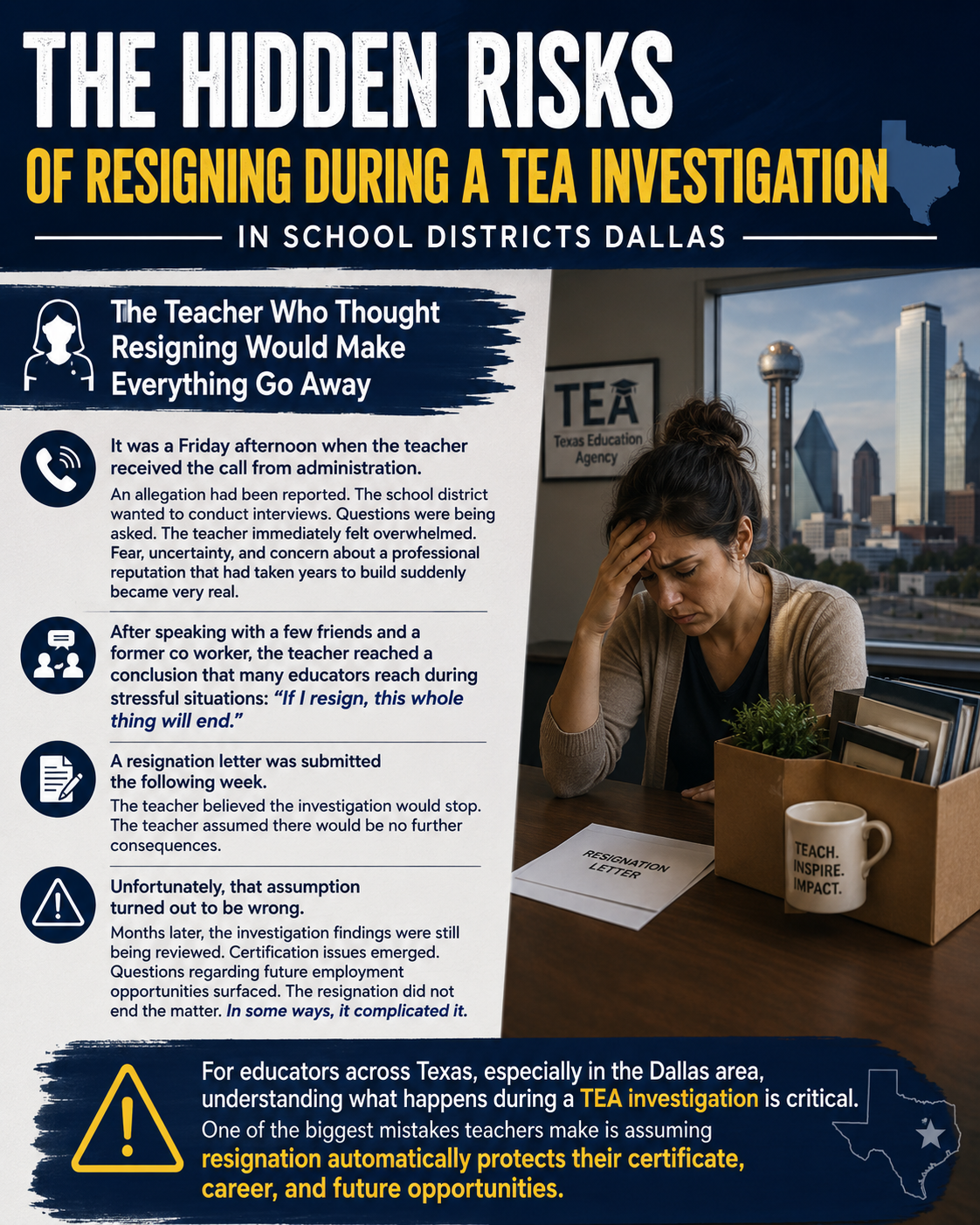
The Teacher Who Thought Resigning Would Make Everything Go Away
It was a Friday afternoon when the teacher received the call from administration. An allegation had been reported. The school district wanted to conduct interviews. Questions were being asked. The teacher immediately felt overwhelmed. Fear, uncertainty, and concern about a professional reputation that had taken years to build suddenly became very real.
After speaking with a few friends and a former co worker, the teacher reached a conclusion that many educators reach during stressful situations: "If I resign, this whole thing will end."
A resignation letter was submitted the following week. The teacher believed the investigation would stop. The teacher assumed there would be no further consequences. Unfortunately, that assumption turned out to be wrong.
Months later, the investigation findings were still being reviewed. Certification issues emerged. Questions regarding future employment opportunities surfaced. The resignation did not end the matter. In some ways, it complicated it.
For educators across Texas, especially in the Dallas area, understanding what happens during a TEA investigation is critical. One of the biggest mistakes teachers make is assuming resignation automatically protects their certificate, career, and future opportunities.
Why Teachers Often Consider Resignation During Investigations
When allegations arise, emotions often take control. Many educators experience embarrassment, anxiety, and uncertainty. Some fear damage to their reputation. Others worry about how colleagues, students, and parents may view the situation.
These concerns are understandable. Teachers frequently believe resignation allows them to regain control of a difficult situation. They may think leaving the district prevents additional scrutiny or closes the investigation entirely.
Unfortunately, TEA investigations do not always operate that way. The decision to resign should never be based solely on assumptions or rumors circulating among staff members.
Understanding the Role of TEA Investigations
The Texas Education Agency investigates certain allegations involving educator misconduct, and teacher certification help during TEA investigations can be crucial when your license is at stake. These investigations may involve complaints from administrators, parents, students, or other individuals connected to the school environment.
The purpose is not simply to determine whether a teacher remains employed by a district. The agency's focus often extends to whether an educator should continue holding a Texas teaching certificate.
That distinction is extremely important. A school district investigation and a TEA investigation may overlap, but they are not always the same process.
Resignation Does Not Automatically End an Investigation
One of the most common misconceptions among educators is that resignation causes an investigation to disappear. In reality, many investigations continue after an employee leaves employment.
School districts may still complete reports. Witnesses may still be interviewed. Evidence may still be collected. Findings may still be forwarded to the Texas Education Agency.
The fact that an employee resigned does not necessarily prevent further review. In some situations, a resignation may occur before the investigation reaches its most important stage.
Why Certification Matters More Than Employment
Most teachers can eventually find another position. Certification issues are different. A teaching certificate represents years of education, training, testing, and professional experience. Once certification becomes the focus of an investigation, the stakes increase significantly.
An educator may leave one district but still face questions regarding future employment opportunities throughout Texas. Protecting certification status often becomes more important than preserving a single job, and experienced guidance on how to survive a TEA investigation and protect your license can make a significant difference. Unfortunately, many educators do not realize this until it is too late.
What Happens After a District Reports an Educator?
Texas school districts have reporting obligations under certain circumstances. When allegations involve serious misconduct, districts may be required to submit information to state authorities.
Once a report is made, the process can continue regardless of whether the teacher remains employed. This surprises many educators.
Some resign believing the matter will never reach TEA. Later, they learn that reports were submitted after their departure.
Understanding reporting requirements is a critical part of any effective legal strategy.
Fear Often Leads to Quick Decisions
Educators facing investigations frequently experience what can best be described as survival mode. They want the stress to stop. They want difficult conversations to end. They want certainty in an uncertain situation.
Those feelings are normal. However, major career decisions made under pressure can create long-term consequences.
Before resigning, teachers should fully understand how resignation may affect certification reviews, the immediate steps to take after a TEA investigation notice, future employment opportunities, and potential disciplinary findings.
The Difference Between Employment and Certification Proceedings
Many educators assume their relationship with the school district is the only issue that matters.
That is not always true.
An employer can terminate employment. An employer can accept a resignation. An employer can place a teacher on leave.
TEA, however, evaluates certification issues separately.
Even if employment ends, certification proceedings may continue. This distinction is one of the most misunderstood aspects of educator investigations.
Why School District Findings Can Follow You
Educators often focus on immediate employment concerns. What they sometimes overlook is how investigative findings can affect future opportunities.
Future districts may review employment history. Questions regarding prior investigations may arise during application processes. A resignation does not necessarily erase concerns that appear in records or reports.
For this reason, educators should consider both short-term and long-term consequences before making major decisions.
Paid Administrative Leave Is Not Always the End of the Story
Many teachers are placed on leave while investigations are conducted. Being removed from the classroom can feel alarming. It can also create pressure to resign quickly.
However, leave status does not automatically indicate guilt. In many situations, districts use leave simply to preserve the integrity of the investigation.
Educators should avoid assuming that placement on leave means resignation is the only available option.
The Emotional Toll of an Investigation
Investigations can create significant stress. Teachers often worry about finances, professional reputation, family concerns, and future employment.
The uncertainty can be overwhelming. Some educators experience anxiety and even symptoms associated with emotional distress while waiting for answers.
Because of this pressure, many individuals make decisions before fully understanding their legal options.
When Workplace Issues Become More Complicated
Not every investigation involves allegations of misconduct. Sometimes complaints arise alongside concerns involving workplace discrimination, sexual harassment, or other employment-related disputes.
In these situations, multiple legal issues may overlap. A teacher may be defending certification concerns while simultaneously evaluating potential employment rights. These circumstances require careful analysis rather than quick decisions.
Protected Activity and Educator Rights
Teachers have rights under various employment laws. Certain actions may qualify as a protected activity, including reporting discrimination, participating in investigations, or opposing unlawful conduct.
A good faith belief that misconduct occurred may provide legal protections even if allegations are ultimately not substantiated. Understanding whether a protected activity exists can be extremely important when evaluating employment-related concerns.
This becomes particularly relevant when adverse employment decisions follow a complaint.
When Retaliation Concerns Arise During Investigations
Some educators fear that raising concerns will create additional problems. Unfortunately, allegations of retaliation occasionally arise in educational settings.
An employee who reports concerns involving discrimination, policy violations, or inappropriate conduct may later believe an employer retaliated against them.
Whether such claims exist depends on the facts.
However, teachers should understand that workplace retaliation and certification investigations are separate legal issues that sometimes intersect.
Understanding Workplace Retaliation in School Districts
Workplace retaliation occurs when an employer takes negative action because an employee engaged in a legally protected activity.
Examples may include:
- Filing complaints
- Participating in investigations
- Reporting unlawful conduct
- Opposing discriminatory practices
Not every disciplinary decision qualifies as retaliation. However, when actions closely follow a protected complaint, questions often arise regarding motive and timing. This is one reason educators should carefully document important events.
The Importance of Gathering Evidence Early
One mistake many educators make is waiting too long to preserve information. Documents disappear. Emails become harder to locate. Memories fade. It is often important to gather evidence while information remains available.
Relevant evidence may include communications, evaluations, policies, witness information, and investigative records. Strong documentation can become valuable whether the matter involves certification concerns, employment disputes, or both.
Why Human Resources May Not Be Enough
Many teachers assume the human resources department exists solely to protect employees. In reality, human resources professionals often balance numerous responsibilities.
Their role frequently includes helping the district comply with laws, policies, and procedures. While human resources can provide information about workplace processes, educators should understand that independent legal advice serves a different purpose.
Knowing this distinction can help teachers make informed decisions during investigations.
The Hidden Risk of Waiting Too Long
Some educators assume they can address problems later. Unfortunately, legal matters often involve very short deadlines.
Certain rights can be lost if action is delayed. An employee waits too long at significant risk.
Whether the issue involves certification concerns, employment disputes, or potential claims against an employer, prompt evaluation is often beneficial.
Why Teachers Should Seek Advice Before Resigning
Resignation may sometimes be the right decision. Other times, it may create complications that educators never anticipated.
The key is understanding the consequences before acting. Consulting an employment lawyer or a dedicated education law attorney for teachers familiar with educator matters can provide valuable insight into risks, options, and potential outcomes.
What seems like a simple resignation today could have lasting effects on certification and future employment opportunities tomorrow.
What TEA Looks for During an Investigation
The Texas Education Agency does not simply review whether a teacher resigned. Instead, investigators often focus on the underlying allegations and whether evidence supports disciplinary action against certification.
This means that a resignation letter does not necessarily change the questions being asked.
Investigators may review witness statements, district reports, employment records, emails, and other documentation. The agency's goal is often to determine whether professional standards were violated.
For educators, this means the investigation may continue long after they have left the district.
How Certification Sanctions Can Affect Your Future
Many teachers focus on the immediate loss of a position. However, certification sanctions can create much larger problems.
A teacher who resigns may still face restrictions on certification renewal, disciplinary findings, or other consequences that affect future opportunities. These issues can impact applications with school districts throughout Texas.
Protecting a certificate often requires more planning than simply leaving a current position. An informed approach can help educators avoid unnecessary damage to their careers.
Why Some Teachers Resign Too Quickly
Fear is often the driving force behind a sudden resignation. Educators may worry about termination, public accusations, or damage to their professional reputation. Some believe resigning demonstrates cooperation or helps avoid negative findings.
Unfortunately, resignation does not always accomplish those goals. Without understanding the investigation process, a teacher may unknowingly give up opportunities to respond to allegations or provide important context.
When Workplace Retaliation Becomes Part of the Investigation
Not every TEA matter involves only certification concerns.
Sometimes allegations arise after an educator engages in a protected activity, such as reporting misconduct or raising concerns about policy violations. In these situations, claims involving workplace retaliation may emerge alongside the investigation.
An educator may believe an employer retaliated after concerns were reported. When that occurs, the teacher may need to evaluate both certification issues and potential employment claims.
Understanding Retaliation Claims in Educational Settings
Many retaliation claims arise because employees believe they were punished for speaking up.
An educator who reports misconduct, participates in an investigation, or opposes unlawful practices may later face disciplinary measures, reassignment, or other negative treatment.
Not every employment decision constitutes retaliation.
However, if a teacher engaged in a protected activity and later experienced negative consequences, legal analysis may be necessary to determine whether a viable retaliation claim exists.
These situations often require careful review of timelines and documentation.
What Counts as a Protected Activity?
The concept of protected activity is extremely important in employment matters.
Examples may include:
- Reporting unlawful conduct
- Participating in workplace investigations
- Filing complaints involving discrimination
- Opposing illegal workplace practices
- Cooperating with government investigations
A teacher does not necessarily need to prove misconduct occurred. A good faith belief that unlawful conduct existed may provide protection under certain circumstances. This distinction is often misunderstood by both employees and employers.
Workplace Retaliation and School District Investigations
Allegations of workplace retaliation frequently involve claims that an employee suffered consequences after engaging in protected conduct.
For example, a teacher may report concerns and later face increased scrutiny, disciplinary measures, or unfavorable treatment.
Whether these actions constitute unlawful retaliation depends on the facts.
Still, educators should understand that retaliation concerns can exist independently from the allegations that triggered the investigation.
This is one reason legal guidance can be valuable.
The Difference Between Discipline and Retaliation
School districts have authority to address legitimate performance concerns. An employer may impose disciplinary action when supported by evidence and district policy.
However, problems arise when adverse treatment appears connected to protected conduct rather than legitimate concerns.
Courts and agencies often evaluate whether the employer had valid reasons for its decisions or whether retaliation influenced the outcome.
The distinction is critical in employment disputes.
Employment Law Protections for Teachers
Teachers benefit from numerous protections under employment law. Federal statutes, state law, and district policies all influence how investigations should be conducted.
Many educators are surprised to learn that rights may exist even while an investigation is pending. Understanding those rights can help teachers avoid decisions that unintentionally weaken their position.
This is particularly true when allegations involve workplace discrimination, retaliation, or procedural concerns.
Workplace Discrimination and Certification Investigations
Some investigations overlap with allegations of workplace discrimination.
Teachers may report unequal treatment, harassment, or conduct involving protected characteristics. When these concerns arise, additional legal protections may apply.
In some cases, an educator's complaints become intertwined with certification proceedings.
This creates a more complicated situation requiring careful evaluation of both employment rights and professional licensing concerns.
Ignoring either issue can be costly.
Federal Law May Protect Educators
Several forms of federal law provide protections for employees. The Civil Rights Act, anti-retaliation provisions, and other statutes prohibit certain forms of misconduct in the workplace.
Many of these protections apply when employees engage in a protected activity. The existence of a TEA investigation does not automatically eliminate these rights.
Teachers should understand that employment protections and certification reviews can occur simultaneously.
Most Anti Discrimination Laws Include Retaliation Protections
One fact many educators do not realize is that most anti discrimination laws prohibit retaliation.
This means an employer cannot lawfully punish an employee for reporting concerns involving unlawful conduct.
Whether the complaint involves harassment, discrimination, or other issues, retaliation protections may apply. As a result, allegations of unlawful retaliation often accompany underlying discrimination complaints.
Understanding this relationship is important when evaluating legal options.
The Equal Employment Opportunity Commission and Teacher Complaints
The Equal Employment Opportunity Commission investigates certain workplace complaints involving discrimination and retaliation, and educators navigating overlapping TEA and workplace issues often benefit from understanding why teachers need an experienced education attorney.
Although TEA focuses on educator certification, employment-related issues may be reviewed by other agencies. An educator facing multiple concerns may find that separate legal processes occur simultaneously.
This is one reason teachers should avoid assuming a resignation resolves every issue. Different agencies may evaluate different aspects of the situation.
Dallas Employment Concerns Extend Beyond One District
Many educators worry primarily about their current employer. However, Dallas employment concerns often extend beyond a single district.
Future employers may ask questions about prior investigations, disciplinary matters, or employment history. A resignation that appears simple today may affect future opportunities later.
This is especially important for educators hoping to continue teaching elsewhere in Texas.
Hostile Work Environment Allegations
Some educators report working in a hostile work environment before an investigation begins. They may describe bullying, intimidation, retaliation, or ongoing conflict with administrators or colleagues.
While every situation is different, these allegations sometimes become relevant during employment disputes. A hostile work environment may influence decisions involving complaints, investigations, and workplace relationships.
Understanding the broader context often helps clarify what occurred.
Why Documentation Matters More Than Memory
When months pass, details become harder to recall. Investigators, attorneys, and agencies often rely heavily on documentation rather than personal recollection.
Emails, evaluations, policies, witness statements, and records frequently become the most persuasive evidence. Teachers who preserve important information often place themselves in a stronger position than those who rely solely on memory.
Good records can make a significant difference.
When Employment Lawyers Become Important
An experienced employment lawyer can help educators understand risks before important decisions are made. Legal counsel may review investigative procedures, evaluate allegations, and explain potential consequences.
This does not mean every teacher needs to fight every allegation. Instead, informed decision-making allows educators to protect their interests while understanding the full picture.
Early advice is often far more effective than attempting to repair damage later.
Why One Conversation Can Change the Outcome
Many educators wait until after resigning to seek legal guidance. Unfortunately, by then certain opportunities may already be lost.
Speaking with an employment lawyer before submitting a resignation can provide clarity regarding options, deadlines, and risks.
Sometimes a single conversation changes the entire strategy.
Understanding what is at stake before acting can make a tremendous difference in the outcome of an investigation.
Retaliation Claims Can Continue After Resignation
One of the biggest misconceptions among educators is that leaving employment eliminates all potential legal issues. In reality, retaliation claims may continue even after a teacher resigns. If an employee believes an employer retaliated because of a protected activity, the claim may survive regardless of employment status.
The critical issue is often what happened before the resignation occurred. A teacher who experienced unlawful retaliation before leaving may still have legal rights that deserve careful evaluation.
Wrongful Termination Concerns and Forced Resignations
Not every resignation is truly voluntary. Some educators feel overwhelming pressure to resign because they believe termination is inevitable. Others are told resignation may be their best option without fully understanding the consequences.
In certain situations, claims involving wrongful termination may arise if circumstances suggest the employee had little realistic choice.
Every case is different, but teachers should never assume that a resignation automatically prevents review of employment-related concerns.
The facts surrounding the resignation often matter significantly.
When Retaliation and Discrimination Overlap
Many employment disputes involve more than one issue. A teacher may believe retaliation occurred after reporting discrimination. Another educator may allege employment discrimination based on age, disability, race, religion, or sexual orientation.
These situations frequently involve both retaliation and discrimination concerns. When multiple legal issues overlap, careful analysis becomes even more important.
Ignoring one aspect of the situation may weaken the overall response.
Understanding Discrimination Claims in School Districts
Educators sometimes face circumstances involving discrimination claims connected to hiring, promotion opportunities, evaluations, or discipline.
Allegations may involve age discrimination, disability-related concerns, or other forms of unlawful treatment.
When an employee reports concerns about unlawful conduct, anti-retaliation protections may apply. This is particularly true when complaints are made in good faith and involve conduct prohibited by law.
Teachers should understand that retaliation protections often exist alongside discrimination protections.
Federal and State Law Protections
Numerous employment protections exist under federal and state law. The Civil Rights Act, the Americans with Disabilities Act often referenced as the disabilities act, and other statutes establish important rights for employees.
These protections may apply when an educator experiences retaliation, discrimination, or other unlawful treatment. The existence of a TEA investigation does not automatically eliminate those protections.
Understanding how these laws interact is an important part of protecting a professional career.
FMLA Leave and Medical Leave Issues
Some investigations occur while an educator is dealing with health-related concerns. Teachers may be taking FMLA leave, medical leave, or leave connected to personal or family medical situations.
Federal protections may apply under the Medical Leave Act in qualifying circumstances. An employer generally should not take adverse action simply because an employee exercised protected leave rights.
Questions involving leave, investigations, and employment status should be reviewed carefully.
Maternity Leave and Workplace Rights
Teachers returning from maternity leave occasionally face concerns involving assignments, evaluations, or workplace treatment. While every situation is unique, employment laws may provide protections against unlawful conduct. An employee who raises concerns regarding workplace treatment may also engage in a protected activity.
If negative consequences follow, questions regarding retaliation may arise. Understanding available workplace rights can help educators make informed decisions.
Reasonable Accommodation Requests and Investigations
Some educators require a reasonable accommodation because of a medical condition or disability. Employers have obligations under applicable laws to consider qualifying requests appropriately. When accommodation requests become intertwined with investigations, confusion can occur.
Teachers should understand their rights and responsibilities during these situations. Careful documentation often becomes extremely important.
The Texas Workforce Commission and Employment Complaints
In some situations, educators may explore options through the Texas Workforce Commission or other agencies responsible for employment-related matters. These agencies may review allegations involving retaliation, discrimination, wage concerns, or other employment issues.
The process differs from a TEA certification review.
Because multiple agencies may become involved, teachers should avoid assuming that one proceeding controls every aspect of their case.
Different agencies often focus on different legal questions.
Employer Retaliation Is Not Always Obvious
Many people assume employer retaliation involves termination. In reality, retaliation can take many forms.
Examples may include unfavorable assignments, exclusion from opportunities, heightened scrutiny, or other forms of negative treatment. A teacher may experience an adverse action that appears minor when viewed alone but becomes more concerning when considered within the broader timeline.
Context matters in retaliation cases.
Workplace Retaliation Can Affect Future Opportunities
The impact of workplace retaliation often extends beyond a current position.
Educators may lose advancement opportunities, references, leadership roles, or future employment prospects.
In some cases, allegations can affect earning potential and result in lost wages. These consequences are one reason retaliation matters so much. A teacher's professional reputation can take years to rebuild.
How Employers Defend Retaliation Cases
Most employers deny retaliation allegations. An employer typically argues that decisions were based on performance concerns, policy violations, or other legitimate factors. Whether those explanations are persuasive depends on the evidence.
Documentation, timelines, witness testimony, and employment records often become critical. This is why preserving information early can be so important.
The Importance of Workplace Policies
Strong workplace policies and clear company policies help reduce misunderstandings during investigations.
Teachers should review relevant policies carefully when concerns arise.
Policies often explain reporting procedures, investigative processes, and employee rights. Understanding these rules may help educators avoid mistakes that could affect future options. Knowledge is often one of the most valuable tools available during an investigation.
Why Other Employees May Be Important Witnesses
Investigations rarely involve only one person. Other employees may possess information that supports or contradicts allegations.
Witness statements frequently play a significant role in both district investigations and certification reviews.
Educators should avoid discussing investigations improperly, but they should recognize that witness testimony often influences outcomes.
A single witness can sometimes change the direction of a case.
When Workplace Retaliation Creates a Hostile Environment
Repeated acts of workplace retaliation can sometimes contribute to a difficult work atmosphere.
An educator may feel isolated, excluded, or targeted after engaging in a protected activity.
Over time, these circumstances may contribute to what some individuals describe as a hostile work environment.
Not every unpleasant workplace qualifies legally.
However, ongoing retaliatory conduct deserves careful evaluation.
Adverse Employment Actions and Legal Claims
Retaliation cases often focus on whether an adverse employment action occurred. Examples may include termination, demotion, reassignment, reduced responsibilities, or other negative consequences.
When an employee experiences an adverse action shortly after engaging in protected conduct, questions naturally arise. These facts may help support a potential legal claim depending on the circumstances. Each situation requires individual analysis.
What Damages May Be Available?
When a successful retaliation case is established, various forms of compensation may be available.
Potential damages can include:
- Lost income
- Future earnings losses
- Emotional distress damages
- Attorney's fees
- Certain forms of equitable relief
In exceptional circumstances, courts may award punitive damages when conduct is particularly serious.
The availability of damages depends heavily on the facts of each case.
Why Timing Matters in Retaliation Cases
Timing frequently becomes one of the most important factors in a retaliation case. If negative treatment follows closely after an employee engages in a protected activity, investigators and attorneys often examine the sequence carefully.
Timing alone does not prove retaliation.
However, it can become important evidence when combined with other facts. This is one reason maintaining records is so valuable.
How a Dallas Employment Lawyer Can Help
Educators facing investigations often benefit from understanding their options before making major decisions, and working with an experienced education lawyer who supports teachers and schools can be an important part of that process.
An experienced employment lawyer can review allegations, explain procedural requirements, and identify potential risks.
Whether the issue involves TEA certification concerns, retaliation allegations, discrimination matters, or employment disputes, informed advice can be extremely valuable.
The earlier guidance is obtained, the more options may be available. Waiting too long can sometimes limit opportunities.
Why Dallas Workers Should Act Quickly
Dallas workers often assume there will be plenty of time to evaluate their options. Unfortunately, employment matters frequently involve deadlines and procedural requirements. The Dallas employment landscape can be complicated when certification issues, retaliation allegations, and workplace disputes intersect, making it important to understand how an education lawyer for teachers in Texas can help coordinate a response.
Teachers should avoid making assumptions based on advice from coworkers or online discussions. Professional guidance tailored to the specific facts is often the safest approach.
Choosing the Right Legal Strategy
No two investigations are identical. A strong legal strategy depends on the facts, the allegations, the available evidence, and the educator's goals.
For some teachers, protecting certification is the primary concern.
For others, employment-related claims may be equally important. Understanding all available options before acting is often the key to protecting a long-term career.
Why Contacting a Law Firm Early Can Make a Difference
One of the most common mistakes educators make is waiting until after major decisions have been made.
By then, opportunities may have been lost and important evidence may be harder to obtain.
An experienced law firm, such as one focused on supporting educators through TEA license defense and school investigations, can evaluate the situation, explain available options, and help identify potential risks before irreversible decisions occur. Masterly Legal Solutions’ educator-focused legal support is designed with these challenges in mind.
Seeking advice does not mean conflict is inevitable.It means making informed decisions during a stressful time.
Why Speaking with a Retaliation Lawyer Dallas Educators Trust Matters
When a teacher becomes the subject of a TEA investigation, uncertainty can make every decision feel overwhelming. Speaking with a retaliation lawyer Dallas educators trust can help clarify whether resignation, cooperation, or another approach is in the teacher's best interest. An experienced retaliation lawyer understands how employment concerns, certification issues, and allegations of retaliation can overlap. Early legal guidance may help educators avoid mistakes that could affect both their employment and professional license. Understanding the risks before taking action is often the best way to protect a long-term career.
How a Workplace Retaliation Attorney Evaluates Your Situation
A skilled workplace retaliation attorney will review the facts surrounding the investigation, workplace complaints, and any negative treatment experienced by the employee. In some situations, a teacher may believe the district engaged in unlawful discrimination or retaliatory behavior after concerns were reported. The attorney's role is to determine whether evidence supports a potential claim and whether further legal action may be appropriate. Every situation is unique, which is why a thorough review of records and timelines is essential. The earlier an educator seeks advice, the more options may be available.
When Employer's Discrimination Becomes Part of the Investigation
Sometimes an investigation begins because an employee reports concerns involving an employer's discrimination practices. Allegations may involve unequal treatment, biased decision-making, or conduct prohibited under the Employment Act and other workplace laws. If an employer participating in the investigation process fails to remain impartial, additional concerns may arise. Teachers should understand that employment-related complaints and certification matters can occasionally intersect. Careful documentation can be valuable when multiple issues are being examined simultaneously.
Understanding Workplace Rights Beyond Minimum Wage Issues
Many employment laws protect workers in areas beyond minimum wage requirements, and consulting with an attorney experienced in education law and teacher license defense can help clarify which protections apply in a given situation. Teachers and other school employees have rights related to retaliation, discrimination, workplace safety, and fair treatment. These protections exist regardless of whether the underlying concern involves wages, certification issues, or workplace conduct. Understanding these rights can help employees make informed decisions during stressful situations. Knowledge of the law often provides clarity when uncertainty is at its highest.
Should You Sign a Severance Agreement During an Investigation?
Some educators are offered a severance agreement when leaving employment. While these agreements may appear straightforward, they can contain important legal provisions affecting future rights. Teachers should carefully review any agreement before signing, particularly if allegations of retaliation, discrimination, or certification concerns exist. In some cases, accepting an agreement without understanding its terms may create unintended consequences. Legal review can help ensure that educators understand what they are agreeing to before making a final decision.
Legitimate Fears Teachers Experience During TEA Investigations
Educators facing investigations often have legitimate fears about their future. They may worry about their teaching certificate, professional reputation, income, and ability to secure future employment. These concerns are understandable, especially when information is limited and rumors begin circulating within a district. Unfortunately, fear sometimes causes teachers to make rushed decisions. Taking time to understand the facts can help reduce uncertainty and improve decision-making.
Why Employee's Participation Can Affect the Outcome
The employee's participation in an investigation often plays a significant role in how allegations are evaluated. Cooperating with investigators, providing accurate information, and responding appropriately to inquiries can help ensure that relevant facts are considered. Refusing to participate or making decisions without understanding the process may create additional complications. Every investigation is different, but informed participation is often preferable to assumptions. Educators should understand their rights and obligations before deciding how to proceed.
Reporting Illegal Acts in Educational Settings
Teachers occasionally find themselves in situations involving suspected illegal acts or serious policy violations. Reporting such concerns may qualify as a protected activity under certain circumstances. When educators raise concerns in good faith, they should not automatically assume they must resign to avoid conflict. Understanding available legal protections can help employees make informed choices. In some situations, prompt consultation with counsel may be appropriate.
Medical Care Institutions and Educational Employment Issues
Although schools differ from medical care institutions, both environments often involve professional licensing requirements and regulatory oversight. Allegations affecting a professional credential can create consequences beyond immediate employment concerns. Just as healthcare professionals must protect their licenses, educators should take steps to safeguard their teaching certificates. Decisions made during an investigation can have long-lasting effects on a professional career. Understanding those risks is essential before resigning.
Recognizing Retaliatory Acts in the Workplace
Not all retaliation is obvious. Some retaliatory acts involve subtle changes in treatment, assignments, or opportunities rather than outright termination. A teacher may notice increased scrutiny, exclusion from meetings, or negative evaluations following a complaint. While these actions do not automatically establish retaliation, they may warrant closer examination. Documentation often becomes important when determining whether unlawful conduct occurred.
Job Performance Concerns and Investigation Outcomes
School districts frequently cite job performance concerns during investigations. In some cases, those concerns are legitimate and supported by documentation. In others, performance issues may become intertwined with complaints, workplace disputes, or allegations of retaliation. Understanding the basis for performance-related allegations is important before making major employment decisions. Teachers should carefully review records and seek clarification when necessary.
Full Time Employees and Workplace Complaints
Most full time employees in educational settings spend years building their careers and professional reputations. When an investigation begins, the stakes can feel incredibly high. Teachers may worry about future opportunities, financial stability, and professional standing. These concerns often influence decisions about resignation and cooperation. Understanding available options before acting can help protect long-term interests.
Complaint Based Investigations Require Careful Review
Many TEA matters begin as a complaint based investigation. The existence of a complaint does not automatically mean misconduct occurred. Investigators are tasked with gathering information, reviewing evidence, and determining whether allegations have merit. Teachers should avoid assuming that a complaint guarantees a negative outcome. Responding thoughtfully and strategically is often more effective than making decisions based solely on fear.
Working Conditions Can Influence Employment Disputes
In some cases, concerns about working conditions contribute to broader employment disputes. Teachers may report safety issues, policy violations, retaliation, or other workplace concerns before an investigation begins. These circumstances can provide important context when evaluating later employment actions. Understanding the full workplace environment often helps explain how conflicts developed. A comprehensive review of the facts is essential before drawing conclusions.
Speak With Masterly Legal Solutions Before You Resign
If you are a teacher facing a TEA investigation, do not assume resignation automatically ends the matter. Investigations may continue, reports may still be submitted, and certification consequences can follow an educator long after employment ends.
At Masterly Legal Solutions, our experienced attorneys understand the challenges educators face when allegations, investigations, retaliation, discrimination, and certification concerns overlap. We help teachers evaluate their options, understand potential risks, and make informed decisions before taking actions that could affect their future careers.
Whether you are concerned about TEA proceedings, workplace retaliation, a potential retaliation claim, employment-related disputes, or protecting your professional license, our team is ready to help.
Contact Masterly Legal Solutions today at (972) 236-5051 for a free initial consultation. The sooner you understand your rights and options, the better positioned you may be to protect your career, certification, and future opportunities. Sometimes reaching out Dallas sooner rather than later can make all the difference.
Disclaimer: This article is provided for educational and informational purposes only. It is not legal advice and should not be interpreted as legal guidance for any specific situation. You do not establish an attorney-client relationship with Masterly Legal Solutions by reading this material. Laws change frequently, and outcomes depend on the unique facts of each case. If you have questions regarding TEA investigations, educator certification matters, retaliation, discrimination, or employment-related concerns, consult a qualified attorney regarding your specific circumstances.



Teacher Rights When Assaulted by a Special Needs Student: Safety, Reporting and Investigation Issues



Looking for Legal & Business Solutions? Contact Us Now
Fill in the form or call us to set up a meeting





