

Responding to a Texas Medical Board Prescribing Complaint
A Texas Medical Board Prescribing Complaint Can Threaten More Than Your License
Receiving a Texas Medical Board prescribing complaint can be one of the most stressful moments in a physician's career. Allegations involving prescribing practices or medical documentation often require an immediate response, and the outcome may affect your medical license, professional reputation, hospital privileges, and ability to continue practicing medicine.
Many physicians are surprised to learn that a complaint may arise from prescribing decisions that were made in good faith during patient care. Questions involving documentation, prescribing protocols, or compliance with professional standards can quickly become part of a formal regulatory investigation.
Masterly Legal Solutions represents Texas physicians responding to a Texas Medical Board prescribing complaint. The Texas Medical Board is the authority that oversees physician licensing and discipline in these matters. We provide strategic legal guidance throughout the administrative process to help physicians protect their licenses, evaluate the allegations, and respond effectively before regulatory issues become more serious.
Why Your First Response Matters
When the Texas Medical Board begins reviewing a complaint, every response becomes important.
Information submitted early in the investigation, including the information provided in a response, may influence how the matter develops and becomes part of the Board’s official regulatory file. Physicians should not respond emotionally, because statements made without fully understanding the allegations or applicable legal standards can be misinterpreted and create additional challenges during the investigation.
Obtaining legal guidance early allows physicians to review the allegations carefully, organize supporting documentation, and develop a thoughtful strategy before responding to the Board.
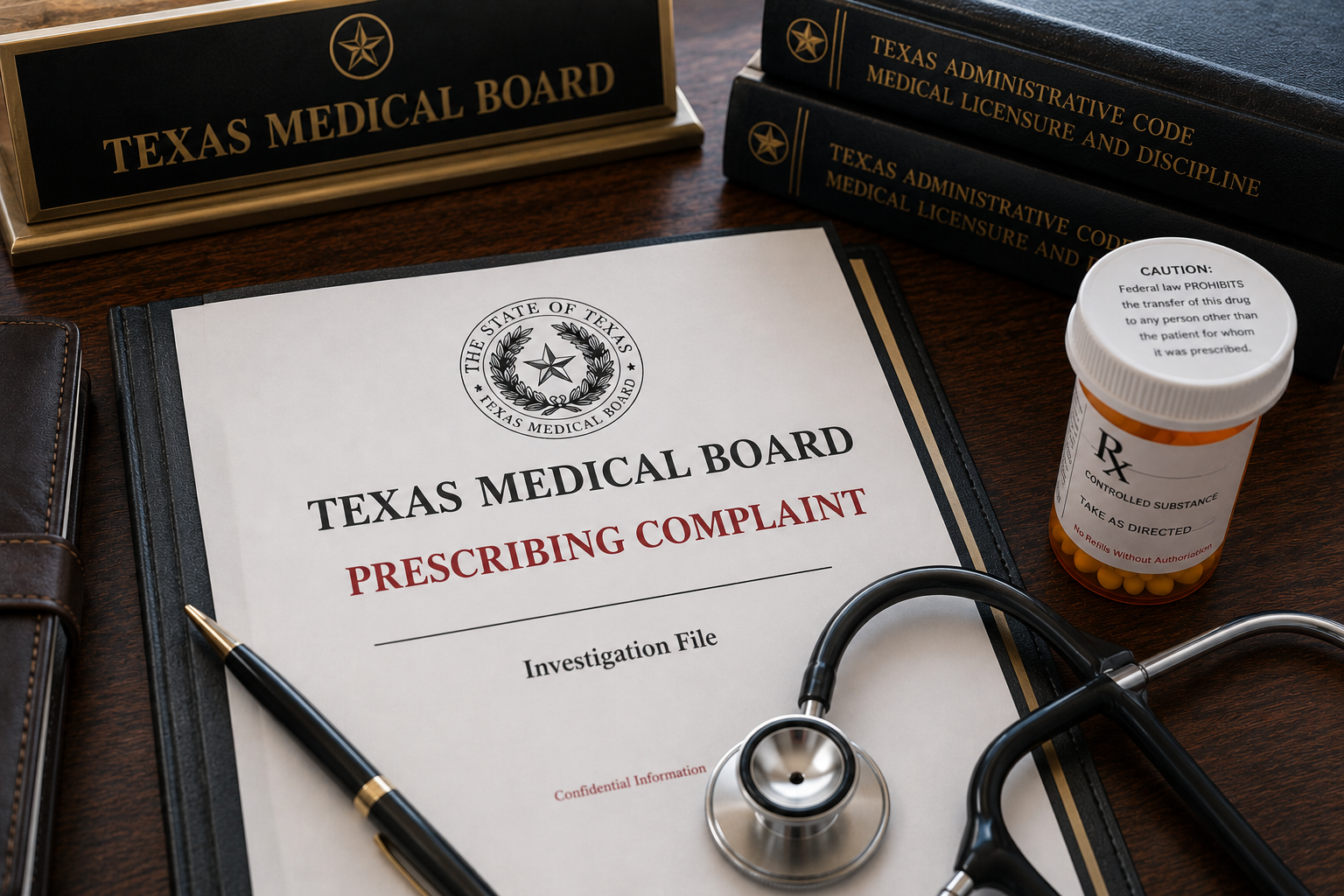
Understanding a Texas Medical Board Prescribing Complaint
A Texas Medical Board prescribing complaint generally involves allegations related to prescribing decisions, documentation, patient management, or compliance with professional regulations governing medical practice.
The complaint itself does not determine the outcome of the case. Instead, it begins an administrative process that often starts with formal notice from the Board, which then reviews available information before making decisions regarding possible disciplinary action.
Any complaint letter or written request from the TMB should be treated seriously and answered by the stated deadline, because missed deadlines may be treated as noncooperation.
Each investigation depends on its own facts, documentation, and medical circumstances, just as teachers facing employment or licensing allegations benefit from an education law attorney’s guidance tailored to the specifics of their situation.
What May Lead to a TMB Prescribing Investigation
A TMB prescribing investigation may involve concerns such as:
- Prescribing practices, including unusual prescribing patterns that may lead to a complaint being filed
- Medical documentation, as insufficient medical records are a common complaint trigger
- Treatment decisions
- Patient monitoring
- Prescription management
- Recordkeeping
- Professional judgment
- Compliance with Board regulations
The Board investigates complaints and may investigate these matters when prescribing patterns or documentation raise concerns.
Every investigation is unique. The issues raised, the supporting evidence, and the physician's response all contribute to how the matter proceeds.
Physician Prescribing Complaint Matters Require Careful Review
A physician prescribing complaint often requires a careful evaluation of more than a single prescription.
Investigators may examine:
- Medical documentation
- Clinical decision-making
- Patient history
- Treatment plans
- Follow-up care
- Communication with patients
- Office procedures, including applicable rules for prescribing and documentation
- Compliance practices
Poorly organized records can suggest broader violations or a failure to meet professional standards.
A complete understanding of the physician's clinical reasoning is often essential when responding to allegations, similar to how institutions rely on higher education legal counsel to evaluate complex compliance and investigation issues.
Controlled Substances Require Careful Regulatory Review
Prescribing controlled substances and other prescription drugs frequently receives increased regulatory attention due to patient safety concerns and public health considerations.
When these medications become part of an investigation, physicians may be asked to explain:
- Clinical decision-making
- Medical necessity
- Treatment objectives
- Monitoring procedures
- Documentation practices
- Follow-up evaluations
Legal representation helps physicians organize relevant information while ensuring responses accurately reflect the medical circumstances surrounding patient care, which is often reviewed under board rules and the Texas Medical Practice Act.
Medical Records Often Become Critical Evidence
Complete and accurate patient records are critical evidence in many cases during Board investigations.
Documentation may help demonstrate:
- Clinical evaluations
- Medical history
- Treatment planning
- Informed decision-making
- Patient monitoring
- Follow-up care
- Medication management
Carefully reviewing medical records, including material from multiple providers involved in the patient’s care, before submitting responses allows physicians to identify important information that supports their clinical decisions.
Standard of Care Questions Require Careful Analysis
Many prescribing investigations ultimately focus on whether the physician's treatment decisions met the applicable standard of care.
Evaluating those allegations often requires careful review of:
- Medical documentation
- Clinical reasoning
- Patient circumstances
- Applicable professional expectations
- Regulatory requirements
Every case depends on its own facts, making individualized legal guidance especially important, particularly when physicians practice within organizations that may also require outside counsel for internal investigations into compliance or workplace issues.
Protecting Your Professional Reputation
A prescribing investigation may affect more than regulatory proceedings, much like school inquiries that lead educators to seek help from an education lawyer for teachers and schools to protect their professional standing.
Physicians may also experience concerns involving:
- Hospital credentialing
- Employment opportunities
- Insurance participation
- Professional references
- Referral relationships
- Practice operations
- Public confidence
Addressing allegations promptly and thoughtfully helps physicians protect both their licenses and the professional reputations they have built over many years.
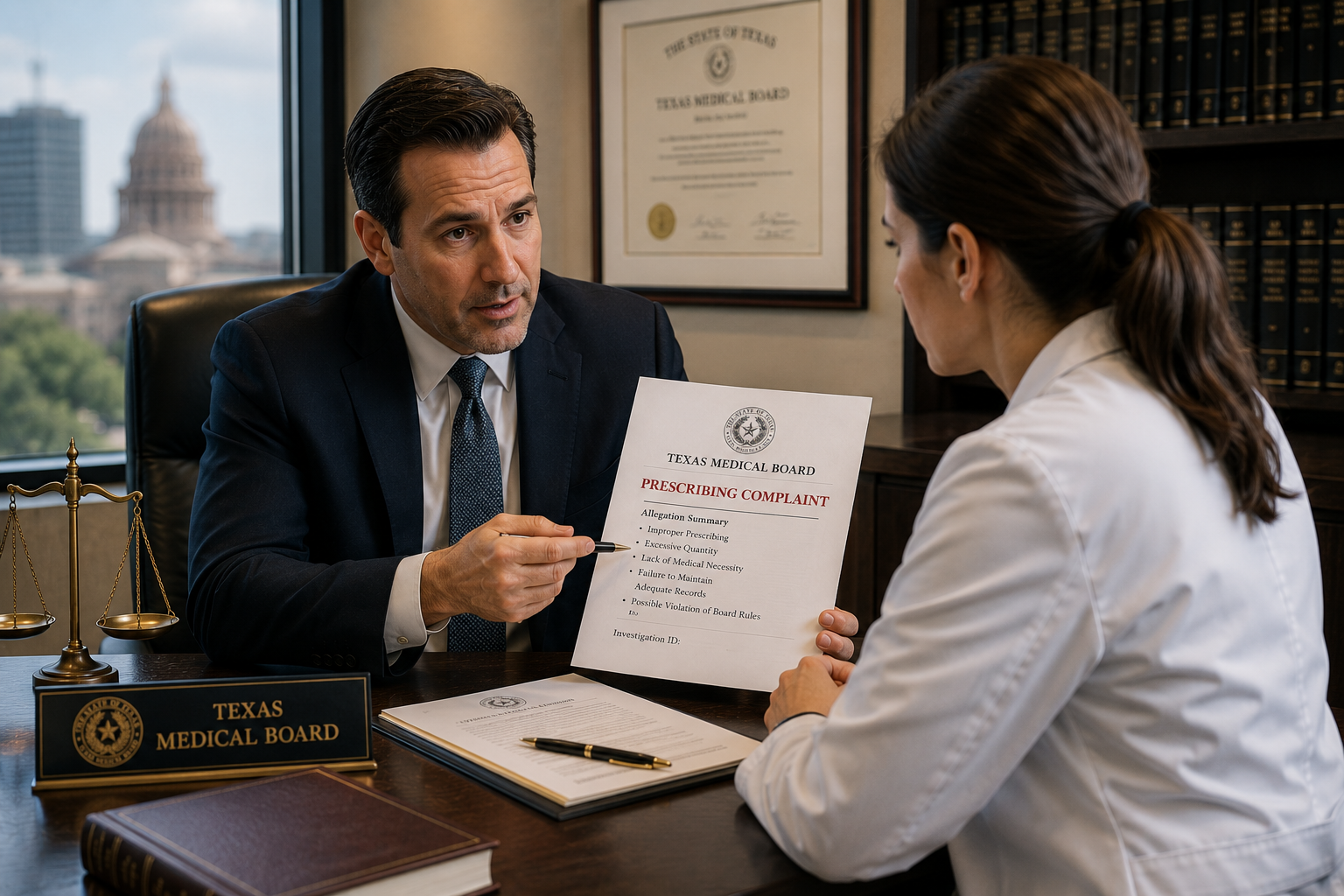
Why Physicians Choose Masterly Legal Solutions
Regulatory investigations require legal counsel that understands the seriousness of professional licensing matters.
Masterly Legal Solutions represents physicians throughout Texas facing licensing investigations with responsive communication, careful preparation, and individualized legal strategy, supported by a broad range of legal and business services designed to address complex professional issues. The Board’s role is regulatory, including disciplinary actions when warranted, and it cannot award monetary damages to a complainant.
Our firm assists physicians by:
- Reviewing Board correspondence
- Evaluating investigative materials
- Analyzing allegations
- Reviewing medical documentation
- Preparing responses
- Developing defense strategies
- Protecting professional interests throughout the process
We understand that every licensing matter carries significant professional consequences, and we work diligently to help physicians make informed decisions at every stage of the investigation, encouraging clients to use our Texas office locations and contact options to schedule consultations that fit their needs.
Understanding the Long-Term Impact of a Prescribing Investigation
A prescribing investigation may have consequences that extend beyond the Texas Medical Board's review. Depending on the outcome, certain disciplinary actions may be reported to the National Practitioner Data Bank, potentially affecting future credentialing, employment opportunities, and hospital privileges. In some situations, the Board may propose a remedial plan or an agreed order to resolve the matter. These resolutions can include the appointment of a chart monitor, practice improvements, or other compliance measures. Physicians should carefully review every report, important date, and written explanation provided by the Board before making decisions. While separate lawsuits or civil matters may involve different legal issues, the information developed during a licensing investigation can still have important implications, making experienced legal guidance essential throughout the process, especially from counsel familiar with education, estate planning, and business consulting services that may intersect with a physician’s broader professional and personal obligations.
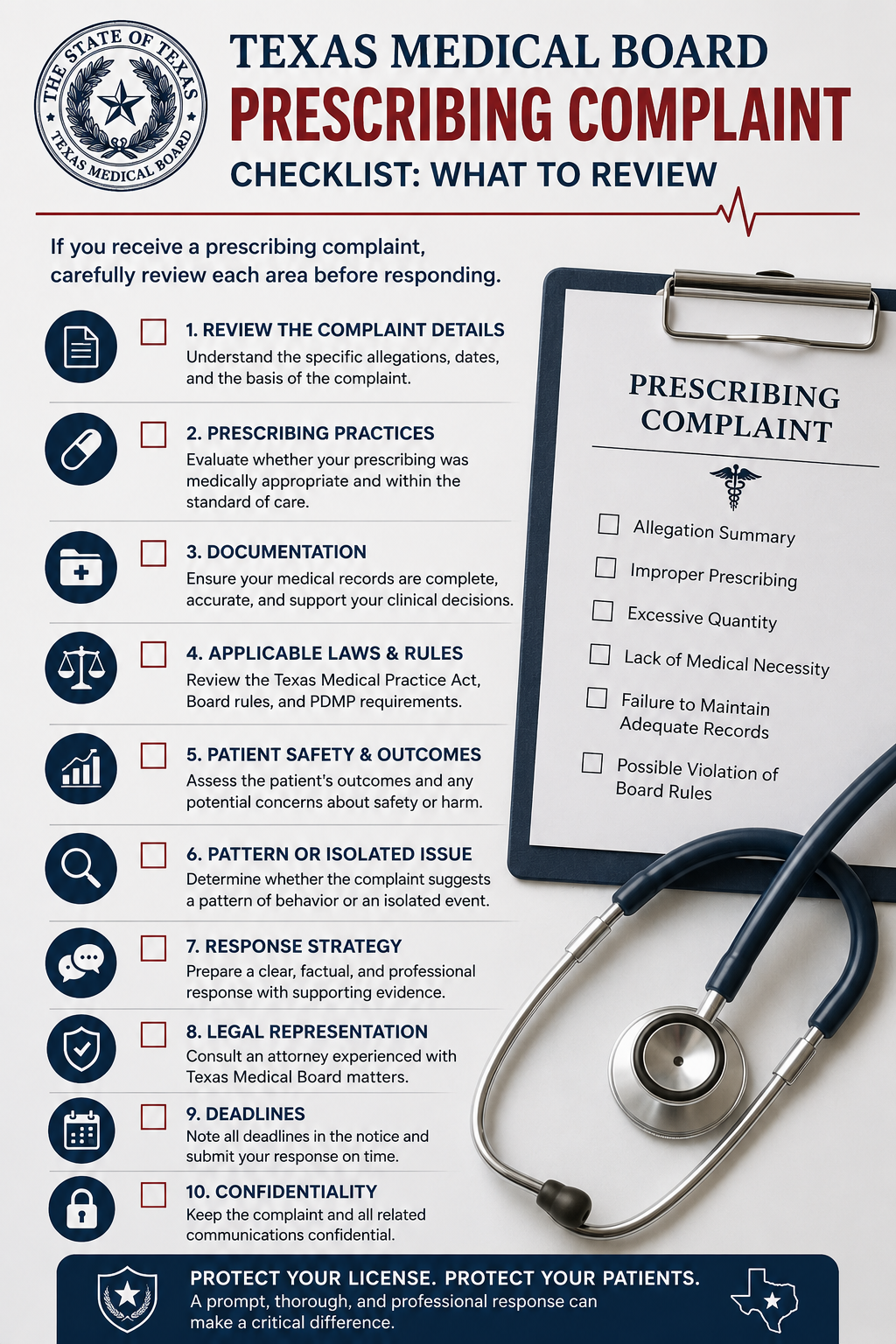
Frequently Asked Questions
What is a Texas Medical Board prescribing complaint?
A Texas Medical Board prescribing complaint is an allegation that questions a physician's prescribing practices, documentation, or compliance with applicable medical regulations. The complaint begins an administrative review and does not automatically establish wrongdoing. These complaints may be initiated online, by phone, or by mail, but to proceed they must be submitted in writing on the appropriate complaint form, so you need to fill out each form completely. The TMB cannot accept anonymous complaints, although the identity of the complainant is kept confidential by law in Texas.
What is a TMB prescribing investigation?
A TMB prescribing investigation is the process through which the Texas Medical Board reviews allegations involving prescribing decisions, medical records, or related professional conduct to determine whether the matter falls within its jurisdiction before deciding whether further action is appropriate, similar to how education law support for Texas educators focuses on protecting teaching licenses during investigations.
What is a physician prescribing complaint?
A physician prescribing complaint involves concerns about prescribing practices, documentation, treatment decisions, or patient management that become the subject of a Board investigation. Some issues should instead go to the appropriate board: pharmacy-practice matters go to the Texas State Board of Pharmacy, insurance-related disputes may require assistance from your insurance company or the Texas Department of Insurance, and a personal service or rudeness concern may fall outside the board's jurisdiction, so do not try to resolve it through the TMB.
Why are patient records important during an investigation?
Complete patient records help explain the physician's clinical reasoning, treatment decisions, follow-up care, and documentation supporting medical judgment, just as clear documentation is essential when educators work with an education law attorney for teachers and administrators during agency or school investigations.
Why does the standard of care matter?
The standard of care is often central to evaluating whether a physician's prescribing decisions were appropriate under the circumstances presented during patient treatment. Failures involving supervision, delegation, or prescribing can expose physicians, a physician assistant, and other professionals to board action under applicable law, while different boards regulate doctors and nursing, much like the way Texas educators can face Texas Education Agency license investigations when allegations arise in school settings.
Speak with Counsel Before Submitting a Response
If you have received a Texas Medical Board prescribing complaint, a tmb complaint, or an investigation letter, it is often the first sign the Board is reviewing prescribing concerns. Do not respond before fully understanding the allegations and the potential impact on your professional future, and do not contact the complainant directly or try to resolve the matter informally before counsel reviews it. Careful legal guidance can help you evaluate the complaint, organize supporting documentation, and prepare the right response to the information provided, unusual prescribing allegations, and any deadline in the Board’s notice, since missed deadlines are treated as noncooperation and can increase the risk of suspension or revocation.
Masterly Legal Solutions represents physicians throughout Texas facing TMB prescribing investigation matters, physician prescribing complaint proceedings, and other professional licensing issues involving controlled substances, patient records, and the applicable standard of care.
Masterly Legal Solutions
Website: https://www.masterlylegal.com/
Phone: (972) 236-5051





Teacher Rights When Assaulted by a Special Needs Student: Safety, Reporting and Investigation Issues



Looking for Legal & Business Solutions? Contact Us Now
Fill in the form or call us to set up a meeting





