

Independent Executor in Texas: What the Role Involves
Independent Executor in Texas: Quick Answer
An independent executor in Texas settles a deceased person's estate with minimal court supervision. Once a probate court enters an order of appointment and the executor files the required inventory or affidavit, most estate decisions proceed without further court involvement. This stands in contrast to dependent administration, where selling a house, paying debts, or distributing assets each requires a separate court order.
Independent administration is the dominant form of estate administration in Texas because it closes estates faster and costs less. Filing fees for independent administration range from $275 to $400 in Texas, and the reduced number of hearings and filings cuts attorney time. Privacy is another factor: fewer documents enter the public court record compared with dependent administration.
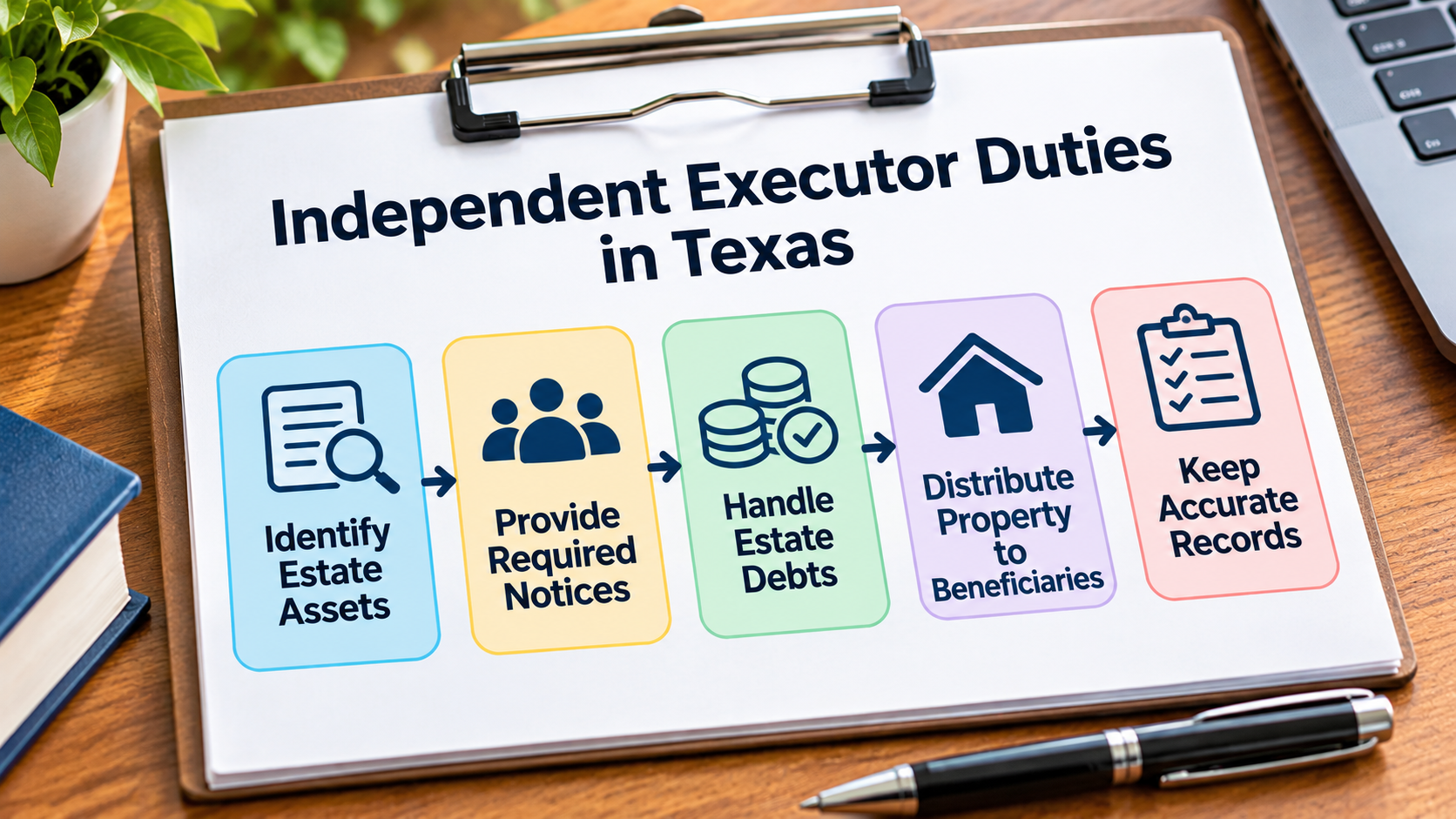
The big-picture steps look like this: probate the original will, receive letters testamentary, notify creditors and beneficiaries, file an inventory, pay debts and taxes, distribute remaining assets to the beneficiaries named in the will, and close the estate. The sections below cover how to qualify, the step by step process, the timeline, costs, and what to do if you have already been named as executor in a Texas will.
Why Texans Prefer Independent Executors
Texas law provides three paths to establish independent administration, and the Texas Estates Code is structured to favor that outcome when the testator's will or the estate's distributees permit it. Families that want to settle an estate without repeated trips to the probate court choose the independent route for practical reasons.
An independent executor manages routine estate decisions without asking for court permission each time. Collecting bank accounts, selling estate property, paying insurance policies and outstanding bills, managing investments, and distributing assets all happen under the executor's own authority once Letters Testamentary are issued. Executors do not need court approval for routine actions in independent administration.
Benefits over dependent administration:
- Faster resolution. Executors can manage estates more quickly under independent administration because there is no waiting for a judge to approve each transaction. Most independent estates close in 6 to 12 months.
- Lower costs. Independent administration reduces overall costs compared to dependent administration. Fewer filings, fewer hearings, and less attorney time all reduce the total bill paid from estate funds.
- Fewer court hearings. Many independent executor cases involve only a single hearing; dependent cases can require half a dozen or more.
- Greater privacy. Independent administration provides greater privacy for estate details because the executor files fewer financial records with the court.
- Flexibility. The executor manages estate assets, responds to creditors, and distributes property on a schedule driven by estate needs rather than the court calendar.
Dependent administration can slow the probate process by weeks or months at each decision point. For estates where the family agrees on the executor and the will is clear, independent administration removes that friction.
What Is an Independent Executor Under Texas Law?
Under the Texas Estates Code, Chapter 402, an independent executor is a personal representative who, after appointment and filing of the required inventory or affidavit, can perform most administrative actions without court orders. The Texas Estate Code provides guidelines on executor's powers and duties throughout Chapters 351 through 405.
Independent executors are usually named in a valid Texas will and are formally appointed by the county probate court that admits the will. Being named in a will does not automatically grant authority to act as executor; the person must file a probate application, attend a hearing, take an oath, and receive letters testamentary before they hold any legal power over estate assets.
The position is fiduciary. Independent executors in Texas must act as fiduciaries and can be held liable for misconduct. That means following the deceased's wishes as stated in the will, acting in the interest of beneficiaries, keeping accurate records of all transactions, and never using estate property for personal benefit. "Independent" describes the relationship to the court, not freedom from accountability.
How Someone Becomes an Independent Executor in Texas
The Texas Estates Code offers multiple paths toward independent executor status. The creation method affects bond requirements, the scope of the executor's authority, and whether beneficiaries must consent before the court grants the appointment.
1. Independent Executor Named in a Texas Will
The most common path is a will that expressly authorizes independent administration. The will typically includes language directing that no other action be had in probate court beyond admitting the will and filing an inventory. If the testator included that language and named an executor, the court will generally honor both provisions after the will is admitted to probate.
Executors must file the will with the probate court as part of the application. Courts then verify the will's validity, confirm the executor's qualifications, and enter an order of appointment. Executors do not need to post a bond in independent administration when the will waives that requirement, which most well-drafted wills do.
If the named executor has died, declined, or is disqualified (for example, due to a felony conviction), the will often names an alternate. That alternate can serve under the same independent status the testator originally authorized.
2. All Distributees Agree to Independent Administration
When a will is silent about independent status, the distributees can fill the gap. All persons entitled to inherit must sign a written agreement asking the court to grant independent administration and designating someone to serve as executor. If even one distributee refuses, this path closes and the estate moves toward dependent administration.
The court reviews whether independent administration serves the estate's interest before approving the request. Bond requirements in this scenario depend on whether the distributees waive the bond and whether the judge concurs. Courts tend to require a bond when estate assets are large or when the proposed executor is not a family member.
3. Court-Appointed Independent Administrator When No Executor Can Serve
For intestate estates (no will) or estates where no named executor is available, heirs can petition for appointment of an independent administrator. This requires an heirship proceeding first to establish who the legal heirs are under Texas law. Once heirs are determined, they may agree to independent administration and designate a person to serve.
Courts apply more scrutiny here. If beneficiaries disagree, if minors or incapacitated adults have an interest in the estate, or if the estate involves complex litigation or large debts, judges often default to dependent administration so that court supervision protects vulnerable parties.
Powers of an Independent Executor in Texas
Independent executors hold broad statutory authority under the Texas Estates Code. That authority exists to let one person manage and settle an estate without returning to court for each decision. The powers are limited by the will's specific instructions, by statute, and by the executor's fiduciary duties.
Core Powers Independent Executors Commonly Use
Once the order appointing the independent executor is entered and the inventory or affidavit is filed, the executor can:
- Collect estate assets. Gather funds from bank accounts, brokerage accounts, and other financial institutions using certified letters testamentary as proof of authority.
- Sell or lease estate property. List and sell real property or personal property without obtaining separate court approval. Section 402.052 grants independent executors the same power of sale as supervised administrators, minus the requirement for court permission.
- Manage investments. Rebalance portfolios, liquidate certain assets, or hold investments depending on estate needs and the will's instructions.
- Pay valid debts and expenses. The executor must pay valid debts in a specific order as required by Texas law, covering funeral costs, administration expenses, secured claims, and unsecured claims in the statutory sequence.
- Distribute property. Once debts and taxes are satisfied, the executor distributes remaining assets to beneficiaries as instructed in the will.
- Hire professionals. Attorneys, CPAs, appraisers, and real estate brokers can be retained at the estate's expense when their services are reasonably necessary.
Independent administration allows limited court involvement after appointment; the executor handles day-to-day management, transactions, and distributions without filing motions or waiting for judicial approval.
Legal Limits on Independent Executor Authority
Certain situations still require court involvement. Serious disputes among beneficiaries may need a judge to interpret ambiguous will provisions or approve a family settlement agreement. Proposed distributions affecting minors or incapacitated adults often require court oversight to protect those parties' interest. Removal proceedings, by definition, involve the court.
An independent executor cannot act contrary to the will's explicit instructions about who receives which assets. If the will says the house goes to a specific beneficiary, the executor cannot sell it and distribute cash instead unless the will authorizes that substitution.
Self-dealing is grounds for removal and personal liability. An executor must maintain separate estate funds and avoid mixing with personal funds. Hiding information from beneficiaries, using estate property for personal benefit, or failing to account for transactions can all result in a petition to remove the executor and a claim for damages.
Step-by-Step: Independent Executor Process in Texas
Most independent executor probates in Texas follow the same core milestones. County-level rules add procedural details, but the statutory framework under the Texas Estates Code sets the sequence.
Step 1: File the Application for Probate and Independent Executor Appointment
The named executor or an attorney files an Application to Probate Will and for Issuance of Letters Testamentary in the county where the deceased resided at death. The application must specifically request independent administration if the will authorizes it, or if the heirs are seeking it by agreement.
The filing packet includes the original will, a certified death certificate, a list of heirs and beneficiaries named in the will, and an estimate of estate value. Filing fees vary by county but typically fall within the $275 to $400 range.
Step 2: Posting (Citation) and Waiting Period
After filing, the probate clerk posts a citation at the courthouse for at least 10 days. This notice informs interested parties that a probate case has been opened and gives them time to file objections to the will, the proposed executor, or the requested independent status. No hearing can occur until the posting period expires.
Step 3: Initial Probate Hearing and Order Appointing Independent Executor
The court schedules a hearing, often two to four weeks after filing. The proposed executor testifies about the will's authenticity, the decedent's domicile, the identity of heirs, and the executor's own qualifications. If the court admits the will to probate and finds the executor qualified, it signs an order appointing the independent executor.
Contested cases require additional evidence. If a beneficiary challenges the will's validity or objects to the proposed executor, the hearing may extend over multiple sessions.
Step 4: Oath, Possible Bond, and Receiving Letters Testamentary
An independent executor must sign an official oath of office within 20 days of appointment. The oath is a sworn promise to faithfully perform all duties required by Texas law. Bond may or may not be required; most wills that authorize independent administration also waive the bond. Independent executors do not need to post a bond in Texas when the will contains a waiver and the court agrees.
After the oath is filed (and bond posted, if applicable), the court clerk issues letters testamentary. These formal documents serve as proof of the executor's authority when dealing with banks, title companies, government agencies, and other third parties.
Step 5: Required Notices to Creditors and Beneficiaries
Independent executors must publish notices to creditors within one month of appointment. The notice runs in a newspaper in the county where the probate case is pending, alerting potential creditors to file claims against the estate.
The executor must notify beneficiaries within 60 days of will admission. Written notice goes to each beneficiary named in the will and to known secured creditors. An executor must file a sworn certificate confirming beneficiaries were notified of the probate. Executors must notify all beneficiaries about probate proceedings; failure to do so can expose the executor to liability and delay distribution.
Step 6: Inventory or Affidavit in Lieu of Inventory
An independent executor must file an inventory of the estate within 90 days of qualifying. The Inventory, Appraisement, and List of Claims describes all estate assets and debts as of the date of death. Executors must inventory and appraise the estate's assets, including real property, personal property, bank accounts, investments, insurance policies, and any business interests.
If the will permits, the executor may instead file a sworn Affidavit in Lieu of Inventory. This option keeps detailed financial information out of the public court record, adding a layer of privacy. Missing the 90-day deadline can trigger court orders to compel filing, fines, or a removal proceeding.
Step 7: Managing Estate Assets and Paying Valid Debts
During administration, the executor manages the estate: securing real property, maintaining insurance, operating any business the decedent owned, and deciding when to sell or hold certain assets. Executors are responsible for paying debts and taxes owed by the estate, including filing final income tax returns and any estate tax returns required by state or federal law.
The executor evaluates creditor claims, pays legitimate debts from estate funds, and rejects or contests improper or late-filed claims. Every transaction must be documented. Accurate records protect the executor if beneficiaries later request an accounting; under Section 404.001, any interested person may demand a formal accounting once 15 months pass after Letters Testamentary are issued.
Step 8: Distributing Property to Beneficiaries
Once debts, taxes, and administration expenses are satisfied, the executor distributes remaining assets as the will directs. Executors distribute remaining assets to beneficiaries as instructed in the will. Distributions may involve executing deeds for real property, retitling vehicles, liquidating and transferring investment accounts, or dividing personal property.
Executors should obtain signed receipts or release forms from each beneficiary acknowledging what they received. These records protect the executor from future claims that a distribution was incomplete or incorrect.
Step 9: Winding Up and Effectively Closing the Estate
Independent administrations in Texas usually do not require a formal closing order from the court. The estate is functionally closed when all property is distributed, all bills are paid, and no further estate business remains. Executors must provide a final accounting to the court before closing the estate if any interested person requests one, or if the court orders it.
After two years from issuance of letters testamentary, any interested person may petition the court to order a final accounting and distribution, terminate the executor's powers, and release any bond sureties under Chapter 405 of the Texas Estates Code.
Timeline: How Long Independent Executor Estates Take in Texas
Straightforward independent administrations in Texas typically close in 6 to 12 months. Estates with simple assets, cooperative beneficiaries, and no tax complications tend to finish toward the shorter end. Here is an approximate breakdown:
- Filing through initial hearing: 2 to 6 weeks, depending on the county's calendar and whether any party objects.
- Creditor notice and inventory: The executor publishes notice within one month of appointment and files the inventory within 90 days of qualification. These run concurrently.
- Creditor claim resolution and debt payment: 3 to 6 months. Contested claims or large debts (mortgages, business liabilities) extend this phase.
- Distribution and closing: Once debts and taxes are resolved, distribution can happen within weeks. Total elapsed time from filing to final distribution often falls between 6 and 9 months.
Factors that push timelines past 12 months: real property that is difficult to sell, beneficiaries who disagree over asset division, IRS audits or estate tax returns, pending lawsuits involving the estate, and complex litigation over will validity. Texas law imposes strict deadlines for the inventory and creditor notices but does not set a maximum duration for the entire probate process.
Costs and Compensation in Independent Executor Administrations
Independent administration is less expensive than dependent administration, but Texas probate still involves predictable cost categories that the executor pays from estate funds.
Typical Court and Publication Costs
Texas probate courts charge filing fees for the initial application, with amounts varying by county. Filing fees for independent administration range from $275 to $400 in Texas. The separate cost for newspaper publication of creditor notices depends on the publication's rates and the county; most legal notices run between $100 and $300.
Attorney and Professional Fees
Many independent executors hire a probate attorney, particularly for the initial filing, inventory preparation, and creditor notice compliance. Billing structures vary: hourly rates, flat fees for routine probates, or hybrid arrangements. Fees increase when the estate involves contests, tax planning, or hard-to-value assets.
Appraisers may be needed for real estate, business interests, or collectibles. Accountants prepare final income tax returns and, for larger estates, federal estate tax returns. Real estate brokers handle the sale of estate property. All of these costs are reimbursable from estate funds when reasonably incurred.
Executor Compensation Under Texas Law
An independent executor may be entitled to compensation as specified in Texas law. Under Texas Estates Code Chapter 352, the standard commission is five percent of all amounts the executor actually receives and pays out in cash during administration, provided the court finds the estate was managed properly. Certain items are excluded from the commission base: cash already in bank accounts at the time of death, life insurance proceeds, and cash paid directly to heirs in their capacity as beneficiaries.
The will can modify this default. Some wills increase compensation; others reduce or waive it entirely. Family members serving as executor often waive the fee to preserve estate assets for beneficiaries. Executor commissions are taxable income to the executor, unlike most inheritances.
Independent vs. Dependent Executor in Texas: Key Differences
The choice between independent and dependent administration affects how long the probate process takes, how much it costs, and how much of the estate's financial information becomes public. Here are the key differences:
- Court supervision. Independent administration allows executors to act without court approval after the initial appointment. Dependent administration requires court approval for many estate actions, including property sales, debt payments above certain thresholds, and distributions.
- Number of hearings. An independent executor often attends only the initial probate hearing. A dependent executor may need to appear multiple times for permissions and accountings.
- Cost. Each court filing and hearing in dependent administration adds attorney time and court fees. Independent administration eliminates most of those costs.
- Privacy. Dependent administration requires detailed financial disclosures in public court filings. Independent administration keeps more estate information out of the public record.
- Flexibility. An independent executor can respond to market conditions (selling a house when the offer is strong, for example) without waiting weeks for court permission.
Both types of executor owe the same fiduciary duties: loyalty, care, honest accounting, and adherence to the will. Both can be removed for mismanagement. The difference is structural, not ethical.
Independent administration is often preferred for high-net-worth estates where speed and privacy matter. Courts and families lean toward dependent administration when the estate involves disputes, allegations of undue influence, or parties who cannot protect their own interests.
When Independent Execution Is a Good Fit; and When It Isn't
Independent administration is not automatically the right choice for every Texas estate. The decision depends on the estate's composition, the family dynamics, and the complexity of outstanding obligations.
Signs Independent Executor Status Is Appropriate
Independent status works well when the estate has a clear, valid will; cooperative adult beneficiaries who agree on the executor; straightforward assets such as a house, bank accounts, retirement funds, and insurance policies; and a capable person willing to manage the administration. Speed, minimal court appearances, and privacy are the practical payoffs.
Estates where the executor manages property distribution according to unambiguous will instructions, with no outstanding lawsuits or contested creditor claims, are textbook candidates for independence.
Red Flags Suggesting Dependent Administration May Be Safer
Dependent administration may be preferable when: family conflict makes it likely that beneficiaries disagree over allocations; allegations of undue influence or elder abuse surround the will; minors or incapacitated adults hold an interest in the estate; the estate carries large debts or ongoing business operations with complex liabilities; or the will's instructions are ambiguous or contradictory.
In these situations, structured court supervision protects both the executor and the beneficiaries. A dependent executor who follows court orders has a built-in defense against later accusations of mismanagement. An independent executor facing the same accusations has no such shield.
Common Mistakes Texas Independent Executors Make
Independent executors have more freedom than their dependent counterparts, which also means more room for errors that carry personal consequences.
- Missing the 90-day inventory deadline. Courts can compel filing, impose fines, or initiate removal proceedings. Calendar the deadline from the date of qualification.
- Distributing assets before debts and taxes are settled. If the estate later lacks funds to pay creditors, the executor becomes personally responsible for the shortfall.
- Commingling estate funds with personal funds. An executor must maintain separate estate funds and avoid mixing with personal funds. Even temporary commingling creates legal exposure and undermines the executor's credibility.
- Poor recordkeeping. Every check, transfer, sale, and payment should be documented with receipts and bank statements. Without records, the executor cannot defend an accounting if beneficiaries or the court demand one.
- Failing to communicate with beneficiaries. Texas law requires formal notices, but good practice goes further. Beneficiaries who feel uninformed are more likely to file complaints or removal petitions.
- Ignoring tax obligations. The executor is responsible for filing the decedent's final income tax returns and any required estate tax returns. Missed filings generate penalties that come out of estate funds or the executor's pocket.
- Skipping creditor notices. Failing to publish notice to potential creditors or notify known creditors in writing can leave the estate (and executor) exposed to late claims that could have been barred.
Professional help and a written checklist reduce the risk of each of these errors.
How an Independent Executor in Texas Handles Probate and Beneficiary Disputes
An independent executor in Texas manages important responsibilities during the probate process, including paying debts, protecting estate property, and distributing assets according to the deceased person's will and applicable law. Unlike dependent administration, independent administration generally allows the executor to handle routine estate matters with limited court supervision. However, the probate court still has authority over certain legal issues, and additional court involvement may be necessary when disputes arise. If beneficiaries disagree about property distribution, creditor payments, or the executor's decisions, the disagreement may complicate probate in Texas. Masterly Legal Solutions helps executors and families understand their legal responsibilities, evaluate estate disputes, and determine when legal representation may be appropriate.
When Beneficiaries Agree to Independent Administration in Texas
In some Texas probate cases, independent administration may be established when the appropriate estate beneficiaries agree to the arrangement. Under Texas Estates Code Chapter 401, certain qualified distributees may consent to independent administration even if the will does not expressly authorize it or the deceased person left no will. However, the agreement must satisfy applicable legal requirements, and the probate court must approve the appointment where required. When beneficiaries disagree or questions arise about who must consent, Masterly Legal Solutions can help families understand their options and the legal requirements for independent estate administration.
Frequently Asked Questions
1. What Is the Difference Between an Independent and a Dependent Executor?
An independent executor generally manages estate administration with limited ongoing court supervision.
A dependent executor operates under closer court supervision and must obtain approval for many transactions.
Both types of executors have legal responsibilities, including managing estate property and addressing valid debts.
The appropriate form of administration depends on the will, statutory requirements, and court determinations.
2. Does an Independent Executor Still Need Court Approval for Anything?
Yes. Independent administration does not eliminate all court involvement.
The court generally handles the initial appointment, and certain matters may still require court action.
Examples include statutory accounting proceedings, removal disputes, and other matters for which Texas law expressly permits or requires court involvement.
The executor's authority also depends on the will, applicable statutes, and any relevant court orders.
3. Is an Executor Personally Responsible for an Estate's Debts?
An executor is not automatically personally responsible for a deceased person's debts merely because they accepted the appointment.
Valid estate debts are generally handled using available estate assets according to applicable law.
However, an executor may face personal liability in certain circumstances involving misconduct, improper distributions, or breaches of legal duties.
Texas Estates Code § 403.0585 provides protection for certain claim payments when the statutory conditions are satisfied.
An attorney can evaluate potential liability based on the executor's actions and the estate's circumstances.
Request a Confidential Consultation with Masterly Legal Solutions
Managing an estate can involve important financial decisions, legal deadlines, and responsibilities to beneficiaries and creditors.
Independent administration may provide flexibility, but understanding the executor's authority and obligations remains essential.
Masterly Legal Solutions
Phone:
(972) 236-5051
Website:
https://www.masterlylegal.com/
This article provides general legal information and is not legal advice for an individual estate. Legal requirements and available options depend on the facts of each matter.
Author: Andrew Rhoden, Masterly Legal Solutions








Looking for Legal & Business Solutions? Contact Us Now
Fill in the form or call us to set up a meeting