

Special Education Due Process in Texas: What Parents Should Know
When a Texas school district disagrees with a parent about a child's special education services, evaluation, or placement, the dispute can affect the student's learning and progress. Parents may feel frustrated when repeated concerns remain unresolved or promised support is not provided.
A special education due process hearing in Texas is a formal legal proceeding under the Individuals with Disabilities Education Act (IDEA). It allows parents and school districts to present evidence about disagreements involving a child's special education rights. An impartial hearing officer reviews the issues and makes a decision based on the applicable law and evidence.
Understanding the available options can help families make informed decisions before a disagreement becomes a formal legal matter.
Masterly Legal Solutions provides education-law guidance to Texas families facing special education disputes. The firm helps parents understand their rights, review school decisions, and evaluate appropriate legal options.
1. Special Education Due Process: The Short Answer
Special education due process is a legal procedure for resolving certain disagreements between parents and public schools about special education. Under IDEA, parents may request a hearing concerning a child's identification, evaluation, educational placement, or right to a Free Appropriate Public Education (FAPE). An impartial hearing officer considers the evidence before issuing a decision.
The process is governed by 34 CFR § 300.507 and related IDEA regulations.
When a Special Education Disagreement Becomes a Legal Concern
Not every disagreement with a school requires a formal hearing. Parents and school districts often resolve concerns through communication, meetings, or other dispute resolution services.
However, legal questions may arise when a district:
- Disputes a child's eligibility for special education services.
- Refuses an evaluation or reevaluation requested by a parent.
- Fails to provide services required by an Individualized Education Program (IEP).
- Proposes a placement that parents believe does not meet the child's educational needs.
- Disagrees with parents about whether the student is receiving FAPE.
For example, a parent may discover that a child has not received documented speech therapy services for several weeks. The district may acknowledge some missed sessions but disagree about whether additional services are necessary.
The disagreement may involve whether the school complied with IDEA and what action, if any, is required.
For a broader discussion of education-law disputes, see From IEP Disputes to License Suspension: A Special Education Law Attorney Can Intervene Immediately.
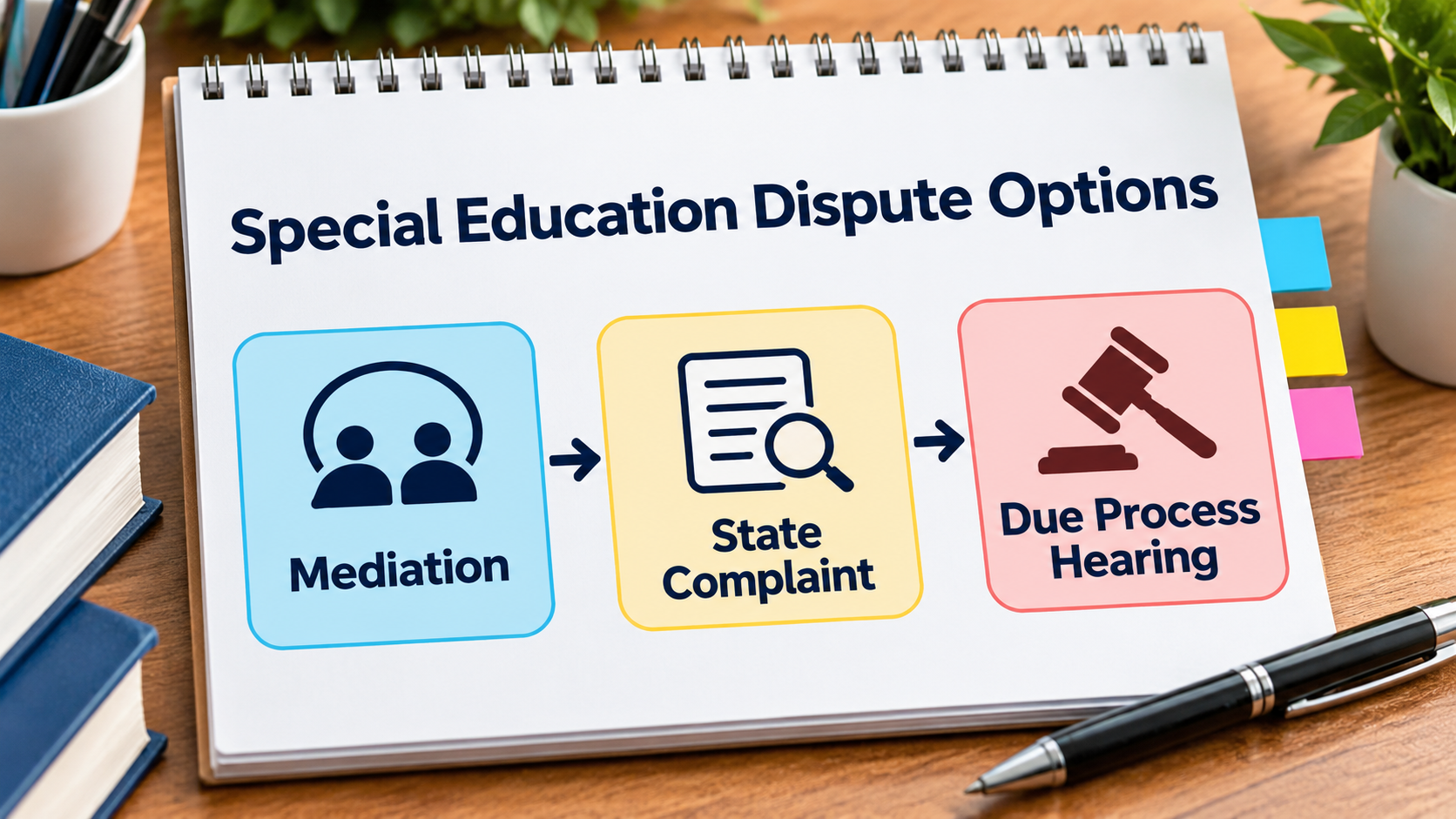
2. Options Before a Hearing: Resolution, Mediation, and State Complaints
Texas parents have several ways to address special education concerns. A due process hearing is one option, but it is not the only process available.
The Texas Education Agency (TEA) provides information about mediation, state complaints, IEP facilitation, and due process hearings.
Understanding how these procedures differ is an important part of parent rights in special education.
Informal Resolution and School-Level Discussions
Some disagreements can be addressed through direct communication with school administrators, a case manager, or special education staff, and parents and districts should first work collaboratively in the child’s best interests to resolve disagreements before moving into a formal hearing.
Parents may raise concerns about missed services, evaluations, educational records, or the implementation of existing educational plans that affect the child's education.
Understanding how these dispute-resolution options differ is part of the special education process and helps families exercise parental rights. An informal discussion does not automatically become a formal legal proceeding. It also does not necessarily suspend the deadlines that apply to filing complaints.
Families may want legal guidance when a disagreement remains unresolved or the district's position raises questions about federal or state requirements.
Special Education Mediation
Mediation allows parents and school districts to discuss a dispute through direct communication aimed at helping the parties resolve disagreements about the child's education, with help from a qualified, impartial mediator.
Under 34 CFR § 300.506, mediation must be voluntary. Both parties must agree to participate. Before seeking mediation, families may try informal steps such as contacting the child's teacher, case manager, administrator, or special education staff, and this process can help protect rights through IDEA's procedural safeguards.
Mediation may be available before or after a due process complaint is filed.
The mediator does not make a ruling like a hearing officer. Instead, the mediator helps the parties explore possible resolutions.
If the parties reach an agreement, IDEA provides for a legally binding written mediation agreement.
Texas offers mediation services through TEA. Participation does not automatically mean that either party agrees with the other's position.
Filing a State Special Education Complaint
A state complaint is a written allegation that a public education agency violated a federal or state special education requirement, and mediation is one of the IDEA procedural safeguards available to help protect parent and student rights while resolving disputes.
TEA reviews qualifying complaints and determines whether a violation occurred.
A state complaint may address issues such as a district's alleged failure to provide required services or follow special education procedures.
According to TEA's Special Education Complaints Process, the alleged violation generally must have occurred within one calendar year before TEA receives the complaint, and the agency's office also provides additional information and other resources for families.
Under IDEA, state complaint decisions are generally required within 60 calendar days, subject to permitted extensions.
If a state complaint and a due process hearing involve the same issues, TEA generally sets aside those issues in the state complaint investigation until the hearing concludes.
These procedures serve different purposes. An attorney can help families evaluate which process addresses the specific disagreement.
3. How a Due Process Hearing Works and the Deadlines Parents Should Know
A special education due process hearing is more formal than a school meeting or mediation session.
TEA describes the process as similar to a court trial because the parties may present evidence, question witnesses, and make legal arguments.
The procedures are established under IDEA and applicable Texas regulations.
Filing a Due Process Complaint
A parent or public education agency may initiate the process by filing a written due process complaint.
The complaint generally identifies:
- The child and the school involved.
- The nature of the disagreement.
- Relevant facts supporting the concern.
- A proposed resolution, to the extent known and available.
Texas rules also require the filing party to provide a copy to the other party.
The complaint must meet applicable legal requirements before the matter can proceed to a hearing.
Source: 19 Texas Administrative Code § 89.1165.
The Resolution Period
When a parent files a due process complaint, IDEA generally requires the school district to hold a resolution meeting within 15 calendar days after receiving notice.
This meeting gives the parties an opportunity to discuss the complaint and possible resolution.
The district generally has a 30-calendar-day resolution period, subject to exceptions and adjustments under federal law.
The parties may agree in writing to waive the resolution meeting or use mediation instead.
Evaluation disputes may also arise after earlier consent and assessment decisions, including when a parent makes a written request for an Independent Educational Evaluation and the district disagrees with how the evaluation was developed or handled.
If the dispute is not resolved during the applicable period, the case may proceed toward a hearing.
These requirements are explained in 34 CFR § 300.510.
The Due Process Hearing
During a hearing, an impartial hearing officer considers evidence and arguments presented by the parties.
Depending on the dispute, the hearing may involve educational evaluations, service records, witness testimony, and relevant school documents. Once a due process complaint is filed, the student generally has the right to stay put in the current educational placement during the dispute unless an exception applies.
Under 34 CFR § 300.512, parties have procedural rights that include presenting evidence, questioning witnesses, and receiving the hearing decision.
The hearing officer determines whether the evidence establishes a violation of applicable special education requirements, including the provision of related services.
A decision may address the student's educational rights, the parties' knowledge of procedural safeguards, and any relief authorized by law.
The outcome depends on the facts, the issues raised, and the applicable legal standards, as well as the effect on educational outcomes.
Important Filing and Hearing Deadlines
Texas parents should understand several timelines:
- Two years: Due process complaints generally must be filed within two years of when the parent knew or should have known about the alleged action, subject to legal exceptions.
- 15 calendar days: The district generally must convene a resolution meeting within 15 days after receiving a parent's complaint, unless an exception applies.
- 30 calendar days: The usual resolution period allows time to address the disagreement before the hearing proceeds.
- 45 calendar days: A final hearing decision is generally due within 45 days after the resolution period ends, subject to permitted adjustments or extensions.
These timelines come from 34 CFR §§ 300.507, 300.510, and 300.515 and TEA's dispute resolution guidance.
[CONFIRM] The filing date, possible exceptions, and any shorter deadlines for expedited disciplinary hearings must be reviewed against the specific facts of each case before publication or client-specific advice.
4. Records to Keep Before and During a Dispute
Special education disagreements often depend on what the school was required to provide, what actually happened, and how the district responded to concerns.
Accurate records help establish the history of a disagreement.
Individualized Education Program (IEP) Plans and Evaluations
Documents that may be relevant include current and previous IEPs, eligibility decisions, evaluation reports, and written notices from the district.
These records may show the services, supports, and educational goals identified for the student.
For example, if a parent believes that required reading intervention was not provided, the child's IEP and service documentation may help explain the disagreement.
Communications with the School District
Emails, letters, meeting notices, and written responses may provide important context. An IEP is a written plan developed by the IEP team to address the student’s unique needs.
A record of communication can show when concerns were raised, how the district responded, and whether proposed changes were discussed at an iep meeting. Parents should also keep copies of educational records and any written notice provided by the district.
Under IDEA, transition planning must begin by age 16 and may address postsecondary goals such as employment and, when appropriate, independent living, and special education services may continue through age 21 depending on eligibility and graduation status.
Dates may also matter when determining which legal deadlines apply.
Progress and Service Records
Student progress reports, attendance records, assessment results, service logs, and written notice may help explain whether educational support was delivered.
Parents may also have relevant communications from service providers or outside evaluations, and records requested before an IEP meeting can be important for reviewing the district’s position in advance and shaping advocacy strategies.
An attorney can review available materials to identify which documents relate to the legal issues and whether families may need additional training to organize or understand them.
Records Involving Student Discipline
Special education disputes sometimes involve suspension, removal from school, or disagreements about disciplinary placement.
Additional IDEA protections may apply when a disciplinary decision involves a qualifying change of placement.
Families facing these concerns can read Student Discipline Cases: What Families Should Understand About Due Process.
For disputes involving disability-related behavior, see Manifestation Determination Review: What Parents Should Know Before the Meeting.
These matters may have different procedures and timelines from ordinary special education due process complaints.
5. When Families Talk with an Education Attorney
A disagreement with a school district can place significant pressure on a family, especially when a child's educational services or placement are uncertain.
Parents may understand their child's needs but still have questions about the legal standards schools must follow.
Legal guidance may be valuable when a disagreement becomes formal, deadlines are approaching, or the district's decisions raise concerns about compliance with IDEA.
Understanding the Available Legal Options
An education attorney can examine the facts, review relevant records, and explain how federal and Texas special education laws apply.
The review may involve whether the disagreement concerns evaluation, placement, services, or access to FAPE.
An attorney can also explain the differences between mediation, a state complaint, and a due process hearing.
Reviewing the District's Position
A school district may rely on evaluations, educational records, or its interpretation of special education requirements.
Legal review can help parents understand the district's stated reasons and whether the dispute raises an issue that can be addressed through a formal process.
This does not mean every disagreement should result in litigation.
The appropriate response depends on the child's circumstances and the legal questions involved.
How Masterly Legal Solutions Can Help
Masterly Legal Solutions provides legal guidance for education-related disputes involving Texas students and families.
Depending on the matter and scope of representation, the firm's services may include reviewing school records, examining who was responsible for key decisions and how the student's program was developed, explaining procedural rights, evaluating complaint options, and assisting with appropriate legal proceedings; families may also visit a state or federal department, an advocacy organization, or resources tied to special education programs for additional information.
The goal is to help families understand their position and make informed decisions grounded in the law.
No attorney can predict a particular hearing decision or promise that a school district will agree to a requested change.
How Special Education Laws and Procedural Safeguards Protect Children with Disabilities
Under the Individuals with Disabilities Education Act (IDEA), schools must follow specific procedures when evaluating and providing services to children with disabilities. A child's disability may affect learning, communication, behavior, or other developmental needs. While early intervention services support eligible infants and toddlers, school-age students may qualify for special education services designed to meet their individual needs.
IDEA includes several mechanisms to protect families, including requirements for parental consent, mediation, state complaints, and due process hearings. Schools generally must obtain informed parental consent before conducting an initial special education evaluation or providing special education services for the first time. When students reach the age of majority, certain educational rights may transfer from parents to students, depending on applicable state law and required notices. Texas families facing disagreements about these protections can consult Masterly Legal Solutions to better understand their legal options.
Protecting Parental Rights Through Special Education Dispute Resolution
Under the Individuals with Disabilities Education Act (IDEA), eligible students may receive special education and related services, such as speech therapy, occupational therapy, or transportation when required to support their education. When parents believe a school district has failed to provide appropriate services, understanding their parental rights is important. IDEA provides several dispute resolution options, including mediation, state complaints, and due process hearings, to address disagreements about a child's educational needs. Families seeking additional information about these legal protections can consult Masterly Legal Solutions for guidance on their rights, available options, and applicable procedures under Texas and federal law.
Frequently Asked Questions About Special Education Due Process
1. What Is the Difference Between a State Complaint and a Due Process Complaint?
A state complaint asks TEA to investigate an alleged violation of federal or state special education requirements. A due process complaint begins a formal legal process involving an impartial hearing officer.
State complaints generally concern violations within the previous year. Due process complaints generally have a two-year filing period, subject to exceptions.
The appropriate process depends on the type of disagreement and the relief being sought.
2. Is There a Deadline to File a Special Education Due Process Complaint?
Yes. Under IDEA, the general filing period is two years from when the parent knew or should have known about the alleged action.
Exceptions may apply when a district made specific misrepresentations that it had resolved the problem or withheld information it was legally required to provide.
Different timelines may apply to certain expedited disciplinary matters.
Parents with questions about a specific deadline may benefit from having an attorney review the relevant dates and circums
3. Can a Parent Bring an Attorney to a Due Process Hearing?
Yes. Under IDEA, parents have the right to be accompanied and advised by legal counsel during a due process hearing.
An attorney may assist with reviewing legal issues, preparing evidence, explaining hearing procedures, and representing the parent's interests.
Parents may also represent themselves. Whether legal representation is appropriate depends on the complexity of the dispute and the family's circumstances.
The right to legal counsel is established under 34 CFR § 300.512.
Request a Confidential Special Education Consultation
When a special education disagreement remains unresolved, understanding the applicable law and available options can help parents evaluate what comes next.
Masterly Legal Solutions provides education-law guidance to Texas families dealing with disputed educational services, school decisions, and special education due process concerns.
Masterly Legal Solutions
Phone:
(972) 236-5051
Website:
https://www.masterlylegal.com/
This article provides general legal information and is not legal advice for an individual case. Consultation and representation are subject to the firm's review and applicable engagement requirements.
Author: Andrew Rhoden, Masterly Legal Solutions






Looking for Legal & Business Solutions? Contact Us Now
Fill in the form or call us to set up a meeting