Medical Peer Review Lawyer: What Physicians Should Protect Before Committee Review
A hospital peer review notice can put years of education, training, and professional reputation at risk. Even before a formal decision is made, a physician may face questions about clinical judgment, patient care, documentation, or professional conduct. The way you respond during the early stages of the process can affect your hospital privileges, future credentialing, and even your medical license.
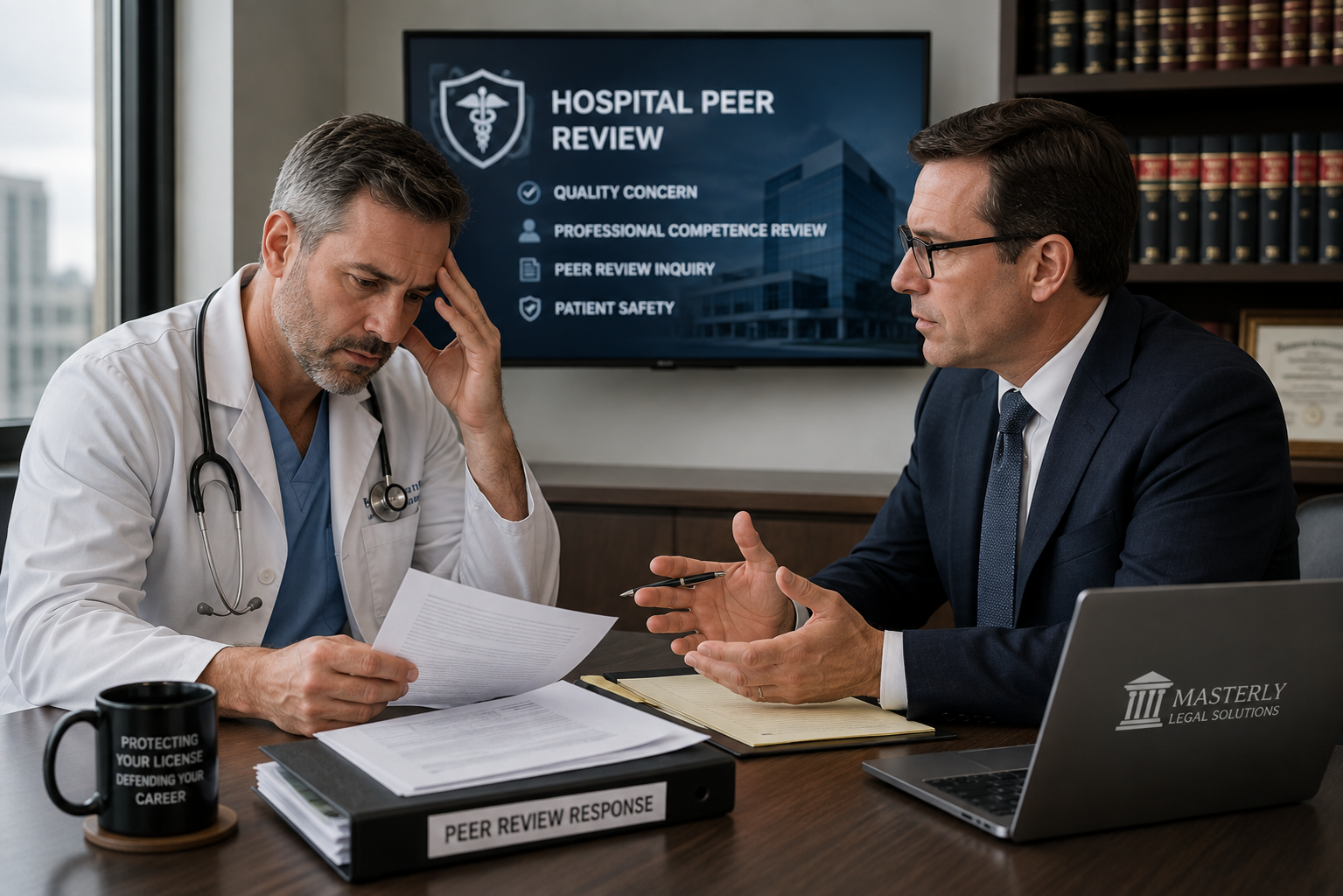
Working with an experienced medical peer review lawyer gives you legal guidance before important decisions are made. At Masterly Legal Solutions, we represent physicians facing hospital peer review, adverse committee recommendations, credentialing concerns, and medical license risks. Our goal is to protect your career while helping you present a clear, well-supported response.
If you have received notice of a peer review investigation or committee meeting, now is the time to prepare carefully.
Why Hospital Peer Review Deserves Immediate Attention
Many physicians believe peer review is simply an internal quality review. While quality improvement is one purpose, hospital peer review can quickly become much more serious.
Questions raised during a review may influence hospital privileges, employment, future credentialing applications, and reporting obligations. A committee's recommendation can follow a physician long after the original concern has been addressed.
A physician peer review attorney helps evaluate the allegations, review supporting documents, identify procedural concerns, and prepare an effective response before important decisions are made.
What Is Hospital Peer Review?
Hospital peer review is a structured review process used by healthcare organizations and the organized medical staff to evaluate concerns involving patient care, clinical competence, professional conduct, compliance with hospital standards, and a physician's performance. The medical peer review process is intended to promote quality health care, protect patients, and support effective peer review by qualified physicians, peer reviewers, medical professionals, healthcare providers, and other healthcare providers when questions arise about care or conduct.
Reviews may involve:
- Questions about patient outcomes
- Clinical decision making
- Documentation concerns
- Professional communication
- Alleged policy violations
- Quality improvement reviews
- Requests for additional education or monitoring
- Physician credentialing evaluations
- Clinical privileges
Questions raised during a review may influence hospital privileges, employment, future credentialing applications, and reporting obligations. Due process concerns matter because the outcome can affect a physician's career long after the review begins.
Not every review leads to discipline. However, early legal guidance can better protect the physician's position within the peer review process because even preliminary findings may affect future opportunities.
Common Reasons Physicians Receive Peer Review Notices
Hospitals conduct hospital peer review as a medical peer review process used by organized medical staff and other healthcare providers to protect patients and support quality health care. Effective review also depends on qualified physicians and other medical professionals serving as peer reviewers. These peer review investigations typically examine a physician's performance and clinical competence, including issues tied to clinical privileges. Some involve isolated patient events while others involve broader practice concerns.
Examples include:
Hospitals conduct peer review in part because The Joint Commission requires it for accreditation.
Near the end of the process, it also matters that the Health Care Quality Improvement Act governs procedural standards and gives limited immunity to peer reviewers involved in good faith peer review.
Patient Care Concerns
Unexpected patient outcomes, complications, or complaints may trigger additional review. A poor patient outcome can lead to peer review investigations ranging from preliminary review to more serious scrutiny, depending on the facts.
Documentation Issues
Incomplete, inaccurate, or delayed medical records sometimes become part of a committee evaluation.
Professional Conduct
Disruptive behavior allegations, communication complaints, or workplace conflicts may also be reviewed.
Credentialing Questions
Concerns raised during physician credentialing or reappointment may require committee review before a physician's clinical privileges are renewed, especially when allegations claim a doctor was a disruptive physician based on communication problems or workplace conflict that could affect a physician's privileges. In some cases, unfair peer review allegations arise when conduct complaints are politically motivated, retaliatory, or based on invented charges rooted in personal dislike.
Quality Improvement Reviews
Hospitals regularly evaluate physician performance to identify opportunities for improvement or additional education, and concerns raised during physician credentialing or reappointment may require review before a physician's privileges or physician's clinical privileges are renewed. In some cases, that starts with informal peer review proceedings, seeks informal resolution, or includes a performance improvement plan.
Each situation requires its own legal strategy because the facts, hospital bylaws, and committee procedures are different.
Why Early Legal Representation Matters
Many physicians wait until after a committee recommendation before contacting an attorney. By then, important opportunities may already have been lost.
A medical peer review lawyer helps physicians prepare before interviews, committee meetings, written responses, and credentialing decisions occur. Many quality improvement reviews begin as an informal peer review action aimed at resolving concerns without escalation, and the hospital may recommend additional education or a performance improvement plan before moving further.
Early representation with experienced legal counsel can help physicians:
- Understand hospital hearing procedures
- Review medical records carefully
- Organize supporting evidence for a peer review hearing
- Prepare written responses
- Identify procedural concerns tied to a fair hearing
- Protect professional reputation if adverse actions are proposed
- Reduce unnecessary misunderstandings
- Prepare to present evidence and address future licensing questions
Preparation often makes a significant difference in how a committee evaluates the available information.
Understanding the Medical Staff Committee Process
Every hospital has its own medical staff bylaws and review procedures, and experienced legal counsel matters before concerns escalate into formal peer review proceedings or adverse actions at a particular hospital.
A medical staff committee within the organized medical staff, the hospital's medical staff, or other peer review bodies may review:
- Medical records
- Patient outcomes
- Expert opinions
- Clinical guidelines
- Internal policies
- Physician explanations from the subject physician
- Witness statements
- Hearing procedures and preparation for a fair hearing, including preserving the ability to present evidence if one becomes necessary
In some matters, the hospital and medical staff may refer concerns to an ad hoc committee for a more focused review.
The committee may request additional documentation or schedule meetings before making recommendations.
Understanding both the medical issues and the procedural rules is essential throughout the process. Hospitals may have to report adverse actions or peer review actions lasting more than 30 days to the NPDB. Adverse peer review findings can also trigger a state Medical Board investigation.
Hospital Policies Matter
Hospital bylaws often contain important rules governing investigations, notice requirements, hearings, committee authority, and physician rights, and each hospital has its own hospital and medical staff rules for these proceedings.
Carefully reviewing these documents helps ensure physicians understand the process they are facing. Concerns involving the subject physician may be reviewed by peer review bodies within the hospital's medical staff. Some matters are handled by the organized medical staff or an ad hoc committee, depending on the hospital's structure.
Counsel must compare the hospital's actions to its procedures, including whether it followed its own bylaws; attorneys who advise healthcare organizations may also draft and update peer review policies and bylaws.
Written Responses Can Become Part of the Record
Anything submitted during peer review may become part of the review file, and hospital bylaws often contain important rules the hospital must follow during investigations, notice, hearings, committee authority, and physician-rights determinations.
An experienced physician peer review attorney and legal team helps physicians prepare responses that accurately explain the facts while avoiding unnecessary statements that could create future complications in later peer review findings.
How Adverse Peer Review Can Affect Your Career
Even when a physician continues practicing, anything submitted at this stage may shape later findings, and an adverse peer review recommendation may have lasting consequences.
Potential concerns include:
- Restrictions on clinical privileges that affect a physician's ability to practice medicine
- Delayed credentialing and review by other credentialing entities
- Additional monitoring and possible adverse actions
- Employment challenges tied to the National Practitioner Data Bank
- Insurance participation issues
- Professional reputation concerns, including allegations of physician misconduct
- Increased scrutiny during future applications and by a Medical Board
- Possible medical license risk depending on the circumstances
Protecting the record during peer review helps the legal team prepare accurate responses that explain the facts without creating avoidable future problems.
Protecting Your Professional Reputation
Physicians spend years building professional credibility, and adverse actions can affect a physician's ability to practice medicine, especially where clinical privileges are involved.
A committee review may affect relationships with hospitals, referral sources, employers, and credentialing organizations. From the physician's perspective, the process needs a fair, accurate record, particularly when concerns about sham peer review arise.
Legal representation focuses on presenting complete, organized information that accurately reflects the physician's qualifications, clinical judgment, and commitment to patient care. It also helps address reporting issues, including the National Practitioner Data Bank and reports shared with other credentialing entities, which may intersect with employment law compliance and internal workplace investigations.
Every response should support both the immediate review and the physician's long-term career, while accounting for possible Medical Board scrutiny when allegations involve physician misconduct.
How Masterly Legal Solutions Helps Physicians
Masterly Legal Solutions represents physicians facing complex hospital and licensing matters throughout Texas, as part of a broader Texas-based law firm providing comprehensive legal services.
Our experienced legal team evaluates the matter from the physician's perspective, especially where the facts suggest sham peer review rather than a fair quality review, drawing on legal services tailored for corporations, nonprofits, and individuals. Inappropriate peer reviews can also undermine legitimate whistleblower reports and distort the record.
When serving as your medical peer review lawyer, or as your physician peer review lawyer in credentialing and disciplinary disputes, we draw on our role as a Texas-based law firm offering a broad range of legal and business services and we help with:
Reviewing the Allegations
We examine committee notices, supporting documents, hospital policies, and available records.
Evaluating Medical Records
Careful review often identifies important facts that deserve additional explanation.
Preparing Written Responses
Well-organized responses help physicians communicate clearly with review committees.
Preparing for Committee Meetings
We help physicians understand the issues likely to be discussed before appearing before hospital committees.
Addressing Credentialing Concerns
When peer review overlaps with physician credentialing, we work to protect future practice opportunities, including issues that may later affect reporting to other credentialing entities. Preparation may include appearances before hospital committees or a later peer review hearing, depending on how the matter develops.
Protecting Long-Term Career Goals
Every recommendation today may affect future hospital applications, employment opportunities, and licensing matters.
Our representation focuses on protecting both the current matter and your professional future.
Why Physicians Choose Masterly Legal Solutions
Healthcare professionals deserve legal counsel that understands both the legal process and the realities of modern medical practice, and many also benefit from a law firm that supports clients in estate planning, HR consulting, and sports law matters.
Clients choose Masterly Legal Solutions because we provide personalized attention backed by big-firm experience across multiple practice areas and:
- Careful case evaluation
- Clear communication
- Professional representation
- Strategic preparation
- Attention to credentialing concerns
- Experience representing licensed professionals
- Focus on protecting professional reputations
Every physician deserves representation tailored to the specific facts of the case, just as businesses often need ongoing general counsel services to manage legal risk while focusing on operations.
Frequently Asked Questions
Do I need a medical peer review lawyer if the hospital says the review is routine?
Yes. Even routine reviews can affect future credentialing, privileges, or employment decisions depending on the outcome.
When should I contact a physician peer review attorney?
As soon as you receive notice of a hospital review, committee meeting, investigation, or request for information.
Can hospital peer review affect my medical license?
It can, depending on the circumstances and any reporting obligations. Early legal guidance helps evaluate potential medical license risk.
What does a medical staff committee review?
A medical staff committee may review patient records, clinical decisions, documentation, professional conduct, credentialing information, and hospital policy compliance involving the subject physician. Early legal guidance can help evaluate potential medical license risk, including whether the matter could draw attention from the Texas Medical Board.
Does every adverse peer review result in discipline?
No. Many reviews end without significant disciplinary action. Proper preparation helps physicians present complete and accurate information, especially in physician disputes. Depending on the matter, the committee may review records, decisions, conduct, and credentialing information relating to the subject physician. If an adverse recommendation is made, a fair hearing may be available before the matter goes to the hospital's governing board.
Can peer review affect future physician credentialing?
Yes. Questions raised during peer review may become relevant during future hospital credentialing or reappointment applications.
Request a Confidential Physician-Defense Consultation
A hospital peer review can affect your privileges, professional reputation, and future career opportunities. You do not have to face the process alone. Masterly Legal Solutions helps physicians respond to peer review inquiries, credentialing concerns, and committee proceedings with thoughtful legal guidance tailored to their situation.
If you have received notice of a hospital peer review or have concerns about your professional standing, contact Masterly Legal Solutions today. Call (972) 236-5051 or submit our online contact form to request your confidential physician-defense consultation.








Looking for Legal & Business Solutions? Contact Us Now
Fill in the form or call us to set up a meeting