
OCR Complaint: How Families File a Civil Rights Complaint Against a School
If you believe you or someone you know has been discriminated against at a school, college, hospital, or health program that receives federal funding, filing an OCR complaint may be the fastest way to trigger a federal investigation and push for real corrective action. An "OCR complaint" is a formal written grievance submitted to a U.S. Office for Civil Rights - most commonly the one within the U.S. Department of Education or the one housed in the U.S. Department of Health and Human Services (HHS).
The situations that lead people to file are concrete and urgent: a student denied a disability accommodation at school in October 2026, a patient whose protected health information was exposed in a 2025 data breach, or a person facing access barriers at a clinic because of their national origin or disability. These are not abstract legal exercises - they are tools designed to hold federally funded institutions accountable under federal civil rights laws.
This article covers exactly who can file an OCR complaint, when to file, where to file (Education OCR vs. HHS OCR), the practical steps and deadlines involved, what happens after you submit, common mistakes that lead to dismissals, and official resources for getting help. This guide is informational and not a substitute for legal advice in complex situations.
What Is an OCR Civil Rights Complaint?
An OCR complaint is a formal allegation that covered entities - such as a public school district, university, hospital, health insurer, or social services program - have violated specific federal civil rights or privacy laws. The two principal offices that handle these complaints serve separate areas of law:
- U.S. Department of Education Office for Civil Rights (ED-OCR): The U.S. Department of Education Office for Civil Rights, sometimes referenced as Rights OCR, handles discrimination in educational settings. It enforces Title VI (race, color, national origin), Title IX (sex discrimination, including sexual harassment), Section 504 of the Rehabilitation Act and Title II of the Americans with Disabilities Act (disability discrimination), the Age Discrimination Act, and protections against retaliation.
- U.S. Department of Health and Human Services OCR (HHS-OCR): The U.S. Department of Health and Human Services OCR handles healthcare-related discrimination. HHS OCR enforces HIPAA regulations for health privacy and security, and while HIPAA's five titles are often discussed broadly, Title II is the section most tied to privacy and security requirements, as well as civil rights protections in federally funded health and human services programs - covering discrimination based on race, color, national origin, sex, disability, age, and religion.
- Who can file: Any person or organization can file a discrimination complaint. You do not need to be the direct victim. Parents can file for minor children, advocates can file for patients, and organizations can file on behalf of groups - but when filing for another adult, you must obtain written consent to file for someone else.
- Scope of complaints: A complaint can address a single incident, multiple related events, or an ongoing policy or pattern of conduct. OCR protects patients, consumers, and students from discrimination across all programs and institutions receiving federal financial assistance.
- An OCR complaint alleges violations of federal civil rights laws by federally funded entities. Complaints typically involve discrimination based on race, color, national origin, sex, disability, or age. Retaliation claims for using a protected right are also investigated.
Why Filing an OCR Complaint Matters
Timing and selecting the correct office are pivotal - misfiling or missing deadlines are among the most common reasons complaints are dismissed. Understanding why the complaint process exists helps you decide whether filing makes sense for your situation.
Filing an OCR complaint matters for several concrete reasons:
- Stopping ongoing discrimination or privacy violations. Whether the problem is a school refusing to accommodate a student's disability, a hospital exposing patient records, or a clinic denying services based on national origin, an OCR complaint can interrupt the harm.
- Triggering a federal investigation. Filing an OCR complaint triggers a federal investigation into the allegations. OCR has the authority to request documents, conduct interviews, perform site visits, and examine institutional policies - far beyond what an individual can do alone.
- Forcing institutional change. If OCR finds a violation, it may require corrective measures from the institution involved. These can include revised policies, mandatory staff training, improved access for people with disabilities, monitoring plans, and reporting requirements. These changes affect not just the complainant but everyone served by the institution.
- Building a record. A filed complaint becomes part of the public record and can support later legal actions, broader enforcement efforts, or policy change campaigns.
OCR does not usually award monetary damages for complaints but seeks institutional policy changes. It cannot function as a personal attorney or provide financial compensation the way a court might. But the systemic remedies OCR can negotiate - monitoring, training, revised procedures - often produce results that benefit entire communities.
Who Handles Which Kind of OCR or Disability Discrimination Complaint?
"OCR" can mean different offices depending on the law and context, and matching your complaint to the correct office is critical. Different complaints are handled by different OCR offices under separate legal authorities, so filing with the wrong department is a common reason for delays or outright dismissal.
Education Department OCR handles:
- Discrimination by schools, school districts, colleges, universities, and state education agencies that receive federal funds
- Complaints based on race, color, or national origin (Title VI)
- Sex discrimination, including sexual harassment (Title IX)
- Disability discrimination, including failure to provide accommodations (Section 504 of the Rehabilitation Act and Title II of the Americans with Disabilities Act)
- Age discrimination (Age Discrimination Act)
- Retaliation against anyone who reports discrimination or participates in an OCR case
HHS Office for Civil Rights handles:
- HIPAA privacy and security violations by health plans, hospitals, clinics, insurers, and their business associates, with the rules applying to covered entities and their business associates to protect protected health information
- OCR can issue penalties for HIPAA violations, and OCR's Breach Notification Portal lists breaches affecting over 500 individuals
- Disability, race, national origin, sex, age, or religion discrimination in health and human services programs receiving federal funds
- Conscience protections for healthcare providers
Some issues overlap. For example, disability discrimination in a hospital's educational program or a medical school at a university might fall under both offices' jurisdiction. When in doubt, check official guidance or portals like CivilRights.gov to confirm which office should handle your complaint. OCR was reorganized into three divisions in February 2023, which may affect how certain complaints are routed internally.
When You Should File an OCR Complaint
OCR complaints are time-sensitive. Missing the filing deadline is one of the most common and preventable reasons complaints are dismissed outright.
- Education OCR: File complaints within 180 days of the incident - specifically, 180 calendar days from the last discriminatory act. For example, if the last denied accommodation occurred in May 2026, the deadline would be in November 2026.
- HHS OCR (HIPAA and civil rights in health care): Similarly, file within 180 days of when you knew, or should have known, about the violation.
- Extensions for good cause: Both offices can extend deadlines for good cause - for example, hospitalization or other extraordinary circumstances - but this is discretionary, not guaranteed. If you must explain delays if filing after 180 days, do so clearly and with supporting documentation.
- Build a timeline now. Before filing, create a chronological log of all relevant incidents, internal complaints, communications with staff or administrators, and responses. Include exact dates, names, locations, and copies of relevant documents. This timeline strengthens your case and helps OCR evaluate timeliness.
Checking Deadlines and Internal Grievance Processes
Internal school or healthcare grievance procedures are generally optional before filing with OCR, but they can affect your timing:
- Education settings: If you use a school's internal Title IX or disability grievance procedure, OCR typically expects you to file your OCR complaint within about 60 days after that internal process concludes. You are not required to exhaust internal procedures before contacting OCR, but if you do use them, track the start and end dates carefully.
- Healthcare settings: Internal privacy or patient-relations complaints at a hospital or clinic run in parallel with an OCR complaint and do not replace it. Filing an internal complaint does not extend or pause the 180-day OCR deadline.
- Document everything. Record the start date, end date, and outcome of any internal grievance process. OCR will ask for these details during intake. Keep copies of all written complaints, responses, and decisions from the institution.
How to File an OCR Complaint: Step‑by‑Step
This section walks through the practical steps for filing a complaint with either Education OCR or HHS OCR. Both offices accept online forms, mailed or faxed forms, and written letters containing all required elements - but the online option is usually fastest. Complaints to OCR are free to file and generally don't require legal representation. Accuracy, clarity, and completeness on the first submission help avoid delays.
Step 1: Confirm That OCR Has Jurisdiction
Before investing time in a detailed complaint, verify that your situation falls within OCR's authority:
- Identify the institution. Confirm that the school, college, hospital, health plan, or program receives federal financial assistance or is a HIPAA-covered entity. Public school districts, state universities, Medicare-participating hospitals, and major health insurers almost always qualify.
- Match the harm to the law. OCR investigates discrimination based on race, color, and national origin (Title VI), sex discrimination including harassment (Title IX), disability discrimination (Section 504 and the Americans with Disabilities Act), and age discrimination. For health privacy, the institution must be a covered entity or business associate under HIPAA. OCR generally investigates civil rights violations and does not handle general complaints about service quality.
- Check official resources. Visit the ED OCR or HHS OCR gov websites, or use CivilRights.gov, to confirm that your issue is within OCR's jurisdiction before drafting your complaint.
Step 2: Gather Evidence and Key Facts
Strong complaints are built on specific, organized facts. Before starting the form, collect:
- Names and contact information for the complainant, the person affected (if different), and the institution or provider - including full institutional name, department, and address
- A chronological list of incidents with specific dates, locations, and the names of people involved
- Relevant documents: emails, letters, disciplinary notices, medical records, privacy notices, screenshots of portals, internal grievance filings, and any written responses from the institution
- Notes on any internal complaints already made and how the institution responded, including dates and decisions
Keep the materials factual and organized. Emotional language in supporting documents can undermine credibility. Focus on what happened, when, where, who was involved, and what the institution did or failed to do.
Step 3: Choose the Filing Method and Complete the OCR Form
Each office offers multiple filing methods:
- Education OCR: Use the online form or send a signed complaint letter. The electronic Complaint Assessment System is the fastest option. A fillable PDF Discrimination Complaint Form is also available, or you can send a written letter containing all required data.
- HHS OCR: File through the online complaint portal, download and mail paper forms, or send a letter including all required HIPAA or civil rights information by mail, fax, or email.
Regardless of method, your complaint must include:
- The full name and address of the institution being complained against
- The protected category involved (e.g., disability, sex, race, national origin, age, health privacy)
- A clear, factual description of what happened, written as dated events rather than generalities - complaints can be based on race, sex, or disability, among other protected categories
- What you want to happen as a result (e.g., policy change, staff training, access provided, records corrected, investigation of a breach)
- Your signature (electronic or handwritten, depending on method)
Step 4: Address Consent, Confidentiality, and Representation
Additional consent forms may be needed in several situations:
- When filing on behalf of another adult - for example, a parent filing for a college student, or an advocate representing a patient - you must include the affected person's written consent
- For students 18 or older, OCR usually requires the student's own written consent, even when a parent is submitting the complaint
- OCR provides its own consent and release forms and sets deadlines for returning them; missing those deadlines can result in the complaint being closed
Confidentiality is maintained as much as possible, but your identity may need to be disclosed to the institution under investigation. In practice, the specific facts described in a complaint often make the complainant's identity apparent. If a complainant refuses to grant necessary consent, the complaint may be closed.
Step 5: Submit and Keep Records
After submitting, keep thorough records:
- A full copy of the complaint text - downloaded from the portal or saved from your letter
- Any confirmation page or email with a case number and submission date
- Proof of mailing, fax confirmation sheets, or email "sent" records for paper filings
Maintain a dedicated folder - digital or physical - for all OCR-related documents, including every piece of later correspondence from the office. You may need to respond quickly to follow-up requests, and having everything organized saves critical time.
What Happens After You File an OCR Complaint?
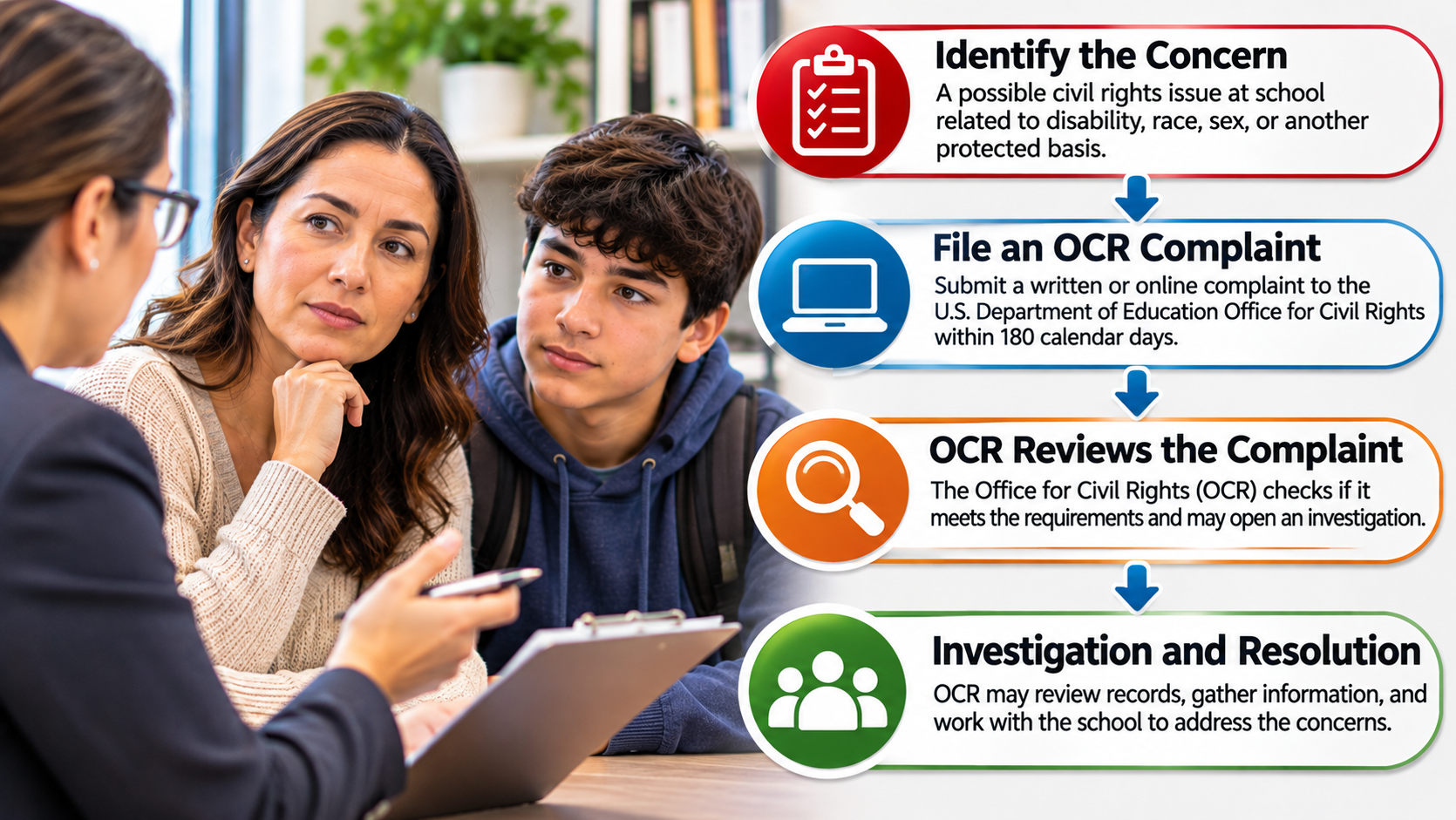
Filing is only the first step. OCR acts as an impartial investigator rather than an advocate for the complainant. Here is the typical sequence after submission:
- Initial review: OCR screens the complaint for timeliness, jurisdiction, legal sufficiency, and completeness. If additional information is needed, the complainant is given a set time window - often 14 to 20 calendar days - to respond.
- Decision to investigate or decline: OCR issues a written notice either opening an investigation or declining (with an explanation of reasons, such as lack of jurisdiction, untimely filing, or insufficient detail).
- Investigation: If accepted, OCR notifies the institution, requests documents, conducts interviews, and may perform site visits. OCR reviews institutional policies, training records, and data related to the allegations.
- Early resolution options: OCR may offer mediation before proceeding with a formal investigation. In FY 2024, ED-OCR achieved 41% more resolutions through mediation and 88% more via its Rapid Resolution Procedure compared to the prior year.
- Findings and corrective action: OCR issues a Letter of Findings describing which allegations are supported. If a violation is confirmed, OCR negotiates a resolution agreement with the institution - specifying corrective measures, training, monitoring, and reporting requirements. If the institution refuses to cooperate, OCR can initiate enforcement, including terminating federal funding or referring the matter to the Department of Justice.
- Closure: A closure letter summarizes findings and any required corrective actions. The complainant is notified whether a violation was or was not found.
Realistic timelines vary widely. Some cases resolved through mediation or rapid resolution may conclude in a few months. Systemic discrimination cases or those requiring site visits can take significantly longer - sometimes over a year. As of January 2023, OCR settled 43 access violation cases, illustrating both the volume and variety of outcomes.
Common Mistakes People Make With OCR Complaints (and How to Avoid Them)
Preventable errors slow cases or lead to outright dismissals. Here are the most frequent pitfalls and how to avoid them:
- Missing the 180-day deadline. File as soon as possible. If you are late, include a written explanation with supporting documentation.
- Filing with the wrong office. Education discrimination goes to ED-OCR; health privacy and healthcare discrimination go to HHS OCR. Check before you submit.
- Vague or broad accusations. Complaints that lack specific dates, names, and incidents are far more likely to be dismissed. Provide a clear, dated chronology.
- Leaving out key documents or ignoring follow-up requests. OCR sets short deadlines for additional information. Failing to respond in time can result in closure.
- Expecting money damages or personal legal counsel. OCR does not function as a court and cannot award financial compensation. Its role is to investigate and require institutional changes.
- Jurisdiction confusion. OCR handles civil rights and privacy in federally funded programs. It does not cover private employment discrimination, housing complaints (which go to HUD), or general service concerns unrelated to federal civil rights laws.
- Failing to provide consent when filing for someone else. Without proper written consent, especially for adult students or patients, the complaint may be closed.
Official OCR Resources and Where to Get Help
The most accurate, up-to-date instructions and forms are always found on official gov websites. Here are the primary resources:
- U.S. Department of Education Office for Civil Rights: The "How to File a Discrimination Complaint with OCR" page provides filing instructions, the online Complaint Assessment System, downloadable forms, and the Case Processing Manual outlining procedures and deadlines.
- HHS Office for Civil Rights: The HHS complaint portal handles both HIPAA and health-related civil rights complaints. The "What to Expect" and "Intake and Review" guides explain the complaint process step by step.
- CivilRights.gov: This central portal helps users find the correct federal agency based on the type of issue - whether it involves education, health, housing, or employment.
- Local legal aid and advocacy organizations: Disability rights centers, patient advocacy groups, and legal aid offices can provide individualized help drafting complaints at low or no cost.
This article is informational. Complex situations - especially those involving overlapping legal claims, state law deadlines, or potential lawsuits - may benefit from consultation with an attorney.
Frequently Asked Questions About OCR Complaints
Is There a Deadline to File an OCR Complaint?
Yes. An OCR complaint generally must be filed within 180 calendar days of the last alleged discriminatory act.
OCR may consider requests to waive the deadline under certain circumstances. However, approval of a waiver is not automatic.
Families concerned about filing deadlines may benefit from having an education attorney review the relevant dates and circumstances.
Does Filing an OCR Complaint Cost Anything?
No. The U.S. Department of Education does not charge a fee for submitting an OCR discrimination complaint.
Individuals are not required to hire an attorney to file. However, professional legal assistance may be valuable when a complaint involves complicated evidence, multiple allegations, or separate legal proceedings.
Attorney fees for private legal services are separate from the OCR complaint process.
Can a School Retaliate After an OCR Complaint Is Filed?
No. Federal civil rights laws enforced by OCR prohibit retaliation against individuals for reporting discrimination, exercising protected civil rights, or participating in civil rights proceedings.
U.S. Department of Education
Retaliation concerns may arise when a student experiences adverse treatment connected to a protected complaint or participation in an investigation.
However, not every unfavorable school decision constitutes unlawful retaliation. The circumstances and supporting evidence must be considered.
Masterly Legal Solutions can assess potential retaliation concerns and explain the legal options available to affected students and families.
Request a confidential consultation with Masterly Legal Solutions
Students deserve access to educational opportunities without unlawful discrimination. When a school fails to address civil rights concerns, denies appropriate disability accommodations, or engages in potentially discriminatory conduct, professional legal guidance can help clarify your rights and options.
Masterly Legal Solutions assists parents, students, and university community members in Texas, North Carolina, and the District of Columbia with OCR complaints, educational discrimination matters, and related civil rights concerns.
Our firm can review your circumstances, prepare relevant legal documents, and provide personalized representation based on your individual needs.
Phone: (972) 236-5051
Disclaimer: This article is for general informational purposes only and does not constitute legal advice or establish an attorney-client relationship, and legal rights and outcomes depend on individual circumstances and applicable laws.








Looking for Legal & Business Solutions? Contact Us Now
Fill in the form or call us to set up a meeting