

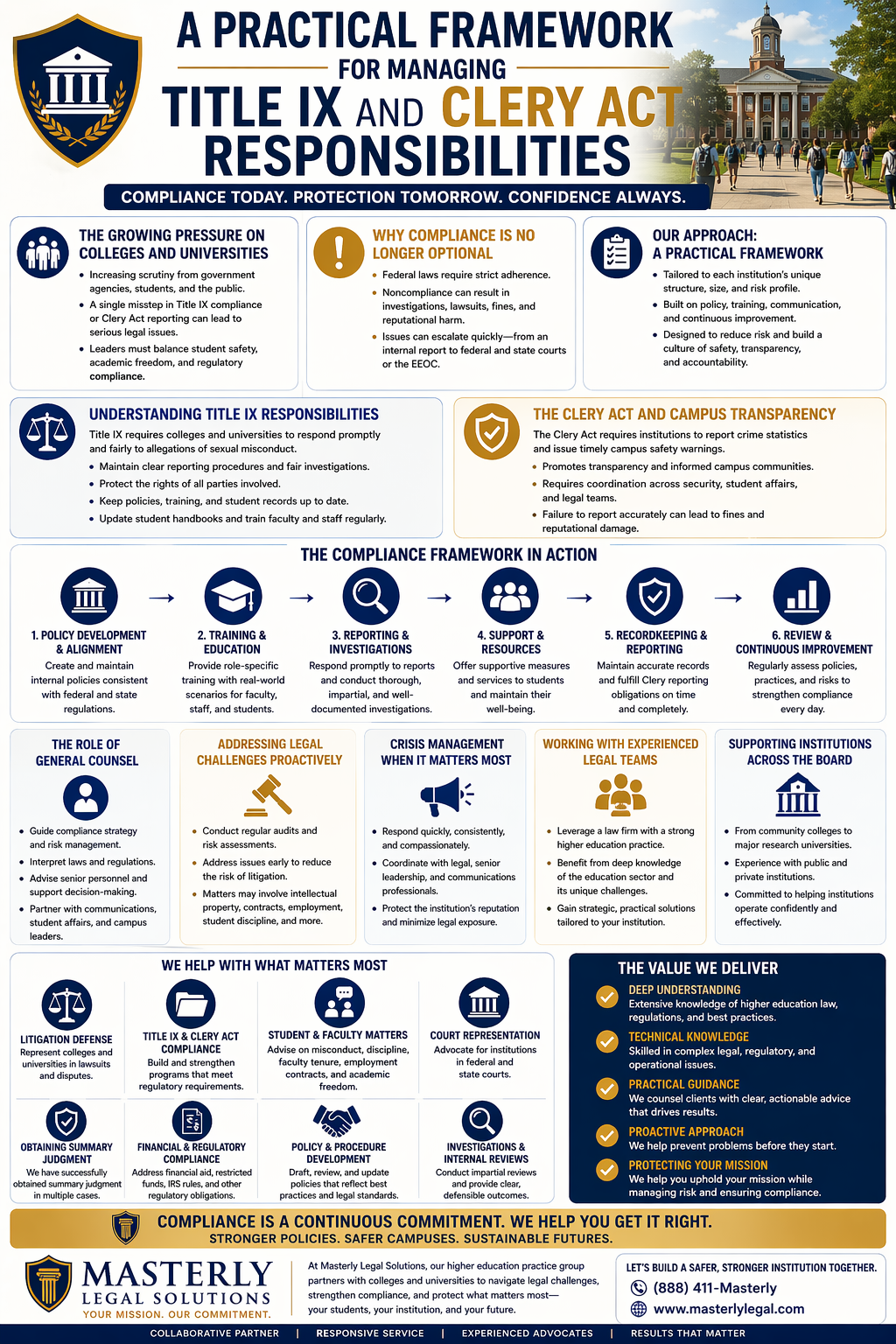
A Practical Framework for Managing Title IX and Clery Act Responsibilities
The Growing Pressure on Colleges and Universities
Across the higher education sector, expectations around compliance have never been higher. Colleges and universities are facing increasing scrutiny from government agencies, students, and the public. In today’s environment, even a single misstep involving Title IX compliance or Clery Act reporting can lead to serious legal issues.
For many educational institutions, the challenge is not just understanding the rules, but applying them consistently across campus. Leaders in higher education must balance student safety, academic freedom, and regulatory compliance. This is where a structured, practical framework becomes essential.
Why Compliance Is No Longer Optional
Higher education institutions are now operating under a microscope. Federal laws such as the Higher Education Act, the Disabilities Act, and Title IX require strict adherence. Failure to comply can result in investigations, lawsuits, and reputational harm that can impact enrollment and funding.
Many educational institutions underestimate how quickly compliance concerns can escalate. What begins as a report of sexual misconduct can quickly involve federal and state courts, internal reviews, and even the Equal Employment Opportunity Commission. The stakes are high, and preparation is critical.
Understanding Title IX Responsibilities
Title IX compliance requires colleges and universities to respond promptly and fairly to allegations of sexual misconduct. This includes ensuring proper reporting procedures, conducting investigations, and protecting the rights of all parties involved.
Educational institutions must also create policies that reflect current regulations and evolving expectations. This includes updating student handbooks, training faculty members, and maintaining accurate student records. Without these safeguards, institutions risk significant legal challenges.
The Clery Act and Campus Transparency
The Clery Act focuses on campus safety and transparency. It requires higher education institutions to report crime statistics and provide timely warnings to the campus community.
For many private colleges and community colleges, meeting these requirements involves coordination between student affairs, security teams, and general counsel. Failure to report accurately can result in fines and damage to the institution’s reputation.
The Role of General Counsel in Higher Education
General counsel plays a central role in guiding compliance efforts. These professionals help educational institutions interpret laws, develop policies, and respond to legal issues.
In many major universities and private research university settings, general counsel works closely with senior personnel and communications professionals. Their role extends beyond legal advice—they help shape strategy and protect the institution’s long-term interests.
Building a Framework That Works
A practical compliance framework must be tailored to the needs of each institution. While many educational institutions share similar challenges, their structures and risks can vary significantly.
An effective framework typically includes policy development, training programs, and clear communication channels. It also requires ongoing evaluation to ensure that practices remain aligned with current regulations.
Policy Development and Internal Alignment
Strong policies are the foundation of compliance. Educational institutions must issue internal policies consistent with federal and state regulations.
These policies should address areas such as sexual misconduct, student discipline, and faculty tenure. They should also align with broader legal frameworks, including the Internal Revenue Code and other applicable laws, while accounting for Texas educators facing TEA investigations and protecting their licenses.
Training Programs That Make a Difference
Training programs are essential for maintaining compliance. Faculty members, administrators, and staff must understand their responsibilities under Title IX and the Clery Act.
Effective training goes beyond basic instruction. It should include real-world scenarios, case studies, and guidance on handling complex situations. This helps create a campus culture that prioritizes safety and accountability.
Managing Investigations and Reports
Handling reports of sexual misconduct requires a careful and structured approach. Educational institutions must ensure that investigations are thorough, impartial, and timely, particularly when guiding respondents through the Title IX investigation process and their rights.
This process often involves collaboration between student affairs, legal teams, and external advisors. A clear framework helps ensure that all steps are documented and defensible.
Addressing Legal Challenges Proactively
Legal challenges in higher education are diverse and often complex. They may involve issues such as intellectual property, employment contracts, or student discipline, as well as broader higher education law compliance and NCAA and Title IX issues that overlap with US sports law and athletics legal perspectives.
By taking proactive steps, institutions can reduce the risk of litigation. This includes conducting regular audits, reviewing policies, and seeking legal guidance when necessary.
The Importance of Crisis Management
Crisis management is a critical component of compliance. When a serious issue arises, educational institutions must respond quickly and effectively.
This includes coordinating with general counsel, communications professionals, and senior personnel. A well-prepared response can help protect the institution’s reputation and minimize legal exposure.
Working With Experienced Legal Teams
Many colleges and universities rely on law firms with a strong higher education practice group. These teams bring a deep understanding of the education sector and its unique challenges.
At Masterly Legal Solutions, our firm’s higher education law services focus on helping institutions navigate complex legal issues. We work closely with education clients to provide tailored solutions that meet their needs.
Supporting Higher Education Clients Across the Board
Our higher education team supports a wide range of institutions, from community colleges to private universities, as well as K–12 educators who may need legal support for educators and TEA license defense. We understand that each institution faces different challenges and requires customized support.
We assist institutions with regulatory compliance, policy development, and crisis management, underscored by our belief that colleges need dedicated higher education attorneys. Our goal is to provide legal resources that help institutions operate confidently and effectively.
Representing Colleges and Universities in Legal Matters
Our firm represents colleges and universities in a variety of legal matters. This includes defending institutions in lawsuits, handling disputes, and advising on compliance issues as part of our broader legal services for corporations, nonprofits, and individuals, supported by our work as an education law attorney for teachers and administrators.
We have advised universities and numerous institutions on complex cases involving sexual misconduct, academic misconduct, and employment issues, including defending against suspended or delayed Title IX investigations and defending educators in TEA investigations that threaten their licenses. Our experience allows us to provide practical and effective solutions.
The Role of Evidence and Summary Judgment
In many cases, the outcome of a dispute depends on the strength of the evidence. Educational institutions must be prepared to present clear and compelling documentation.
Our team has successfully obtained summary judgment in multiple cases, helping institutions resolve disputes efficiently. This approach can reduce the time and cost associated with litigation.
Protecting Academic Freedom and Institutional Integrity
Academic freedom is a core value in higher education. Institutions must balance this principle with their responsibility to maintain a safe and compliant environment.
This requires careful consideration of policies, procedures, and decision-making processes. A strong legal framework helps ensure that these values are upheld.
Navigating Employment and Faculty Issues
Employment contracts, faculty tenure, and employee benefits are key areas of focus in higher education law. These issues often intersect with compliance requirements and institutional policies.
Educational institutions must ensure that their practices align with legal standards while supporting their faculty members. This requires ongoing collaboration between legal teams and administrators.
Addressing Student Life and Campus Culture
Student life and campus culture play a significant role in compliance efforts. Educational institutions must create an environment where students feel safe and supported.
This includes addressing issues such as sexual misconduct, student discipline, and community engagement. A proactive approach helps foster strong and lasting relationships within the campus community.
Managing Financial and Regulatory Obligations
Financial aid, restricted funds, and compliance with the Internal Revenue Code are critical areas for higher education institutions. These responsibilities require careful oversight and coordination.
Failure to meet these obligations can lead to investigations and penalties. A structured framework helps ensure that all requirements are met.
Collaborating With National Associations and Experts
Many institutions benefit from working with national associations and industry experts. These partnerships provide valuable insights and resources for managing compliance.
By staying informed about best practices, educational institutions can adapt to changing regulations and maintain compliance.
The Value of a Deep Understanding of Higher Education Law
A deep understanding of higher education law is essential for navigating today’s complex environment. This includes knowledge of federal regulations, state laws, and industry standards.
At Masterly Legal Solutions, our education team brings technical knowledge and expertise to every case. We are committed to helping institutions succeed.
Providing Legal Guidance That Makes a Difference
Providing legal guidance is about more than solving problems—it’s about preventing them. By working closely with institutions, we help identify risks and implement solutions.
Our approach is proactive and focused on long-term success. We counsel clients on best practices and support institutions in achieving their goals.
Supporting Institutions Through Every Challenge
From crisis management to policy development, our higher education practice supports institutions at every stage, drawing on our broader education lawyer services for teachers and schools and our focus on education law attorneys helping protect teacher rights. We understand the unique challenges facing the education sector and are prepared to help.
Our team works with university clients, private institutions, and public entities to address legal issues and protect their interests, supported by our firm’s broader education law and business consulting practice and our education law and attorneys for teachers in Texas.
How a Firm’s Higher Education Practice Supports Institutions
A firm’s higher education practice is designed to address the complex and evolving legal issues that colleges and universities face every day. From compliance with federal regulations to crisis management and policy development, this specialized practice area provides targeted support for educational institutions. At Masterly Legal Solutions, our firm’s higher education practice focuses on helping institutions reduce risk, respond to investigations, and maintain strong operational standards. By working closely with leadership, general counsel, and administrators, we help ensure that decisions are legally sound and aligned with the institution’s long-term goals.
When a Student Is Dismissed and Legal Risks Arise
When a student is dismissed, the situation must be handled with precision and care to avoid unnecessary legal exposure. Decisions involving discipline or removal from an institution can quickly lead to disputes, especially if the student believes the process was unfair. Educational institutions must follow clear procedures, maintain accurate documentation, and ensure compliance with applicable laws. Addressing these cases proactively helps protect the institution while also preserving fairness and integrity in the decision-making process.
Navigating Oversight From the National Labor Relations Board
Higher education institutions must also be aware of how the National Labor Relations Board can impact campus operations, especially in matters involving faculty, staff unions, and employment disputes. Colleges and universities are increasingly facing scrutiny over labor practices, which can lead to complex legal issues if not handled correctly. A proactive approach ensures that policies align with federal expectations and reduce the risk of disputes. Having experienced counsel helps institutions respond effectively while maintaining stability across their workforce.
Unique Legal Considerations for Academic Medical Centers
Academic medical centers operate at the intersection of education, healthcare, and research, creating unique compliance challenges. These institutions must manage patient care responsibilities while also adhering to higher education regulations. Issues can arise involving liability, research compliance, and even personal injury claims tied to clinical training environments. A structured legal framework helps these institutions balance their educational mission with regulatory demands.
Corporate Law Principles in Higher Education Governance
Although colleges and universities are not traditional corporations, many aspects of corporate law still apply to their operations. Governance structures, financial oversight, and contractual obligations all require careful legal attention. Educational leaders must understand how these principles affect decision-making and institutional risk. Applying corporate law strategies can help strengthen compliance and improve long-term stability.
Legal Support for Postsecondary Institutions and Their Communities
Postsecondary institutions serve not only students but also faculty, staff, and community members. This broad responsibility creates a wide range of legal considerations, from campus safety to public engagement, often intersecting with our education law and teacher license defense services and our guidance on why every teacher needs a lawyer for legal protection. Providing legal advice in these situations requires a comprehensive understanding of how decisions impact all stakeholders. Institutions that prioritize clear communication and compliance can better protect their communities and maintain trust.
Addressing Student Discipline and Dismissal Decisions
When a student is dismissed, the decision must be handled carefully to ensure fairness and compliance with applicable laws. Educational institutions must follow established procedures and document their actions to avoid potential disputes. These situations often involve sensitive issues that can lead to legal challenges if not managed properly. A consistent and transparent approach helps protect both the institution and the student.
Understanding Federal Laws Like the False Claims Act
Higher education institutions that receive federal funding must comply with laws such as the False Claims Act. Violations can occur if funds are misused or reporting requirements are not met. These issues can lead to significant penalties and damage to the institution’s reputation. A strong compliance framework helps prevent these risks and ensures accountability.
Protecting Student Information Under Family Educational Rights
The Family Educational Rights framework governs how student records are handled and protected. Educational institutions must ensure that sensitive information is kept secure and only shared when appropriate. Failure to comply can result in legal consequences and loss of trust. Proper policies and training help safeguard student data and maintain compliance.
Managing Technology Agreements in Modern Campuses
Technology agreements have become increasingly important in higher education as institutions rely on digital tools and platforms. These agreements often involve data security, intellectual property, and vendor relationships. Educational institutions must carefully review and manage these contracts to avoid potential legal issues. A proactive approach ensures that technology supports the institution’s goals without creating unnecessary risk.
Supporting Higher Education Institutions Through Complex Legal Challenges
Higher education institutions operate in a highly regulated environment where even small missteps can lead to significant legal issues. From compliance requirements to internal investigations, these institutions must constantly balance their academic mission with legal responsibilities. Colleges and universities are expected to protect students, support faculty, and maintain transparency, all while adhering to strict federal and state laws. Having experienced legal support, including Texas education lawyers providing expert legal help for schools and educators, helps institutions navigate these pressures with confidence and clarity.
The Role of a Higher Education Practice Group
A dedicated higher education practice group provides focused legal support tailored to the unique needs of colleges and universities. These teams understand the structure, governance, and risks associated with higher education institutions. By working closely with leadership, they help address compliance concerns, develop policies, and respond to emerging legal challenges. This specialized approach ensures that institutions receive guidance that is both practical and aligned with industry standards.
Legal Considerations Across Education Institutions
Education institutions, whether public or private, face a wide range of legal responsibilities. These include managing student affairs, addressing faculty concerns, and maintaining compliance with federal regulations. Each institution must ensure that its policies and procedures reflect current legal expectations and understand Texas educator certification and TEA-related legal guidance. A proactive approach to legal planning helps reduce risk and supports long-term stability.
Managing Employee Benefits and Workplace Compliance
Employee benefits are an important aspect of operations within higher education. Institutions must ensure that benefits programs comply with applicable laws and regulations while meeting the needs of faculty and staff. Issues related to compensation, healthcare, and retirement plans can create legal exposure if not handled properly. Careful planning and oversight help protect both employees and the institution.
How an Education Team Strengthens Institutional Strategy
An experienced education team brings together legal knowledge, strategic insight, and practical experience to support institutions effectively. This team works across departments, assisting with compliance, policy development, and risk management. By collaborating with administrators and general counsel, the education team helps ensure that decisions are informed and consistent. Their involvement can make a significant difference in how institutions respond to challenges.
Addressing Legal Pressures in the Education Sector
The education sector continues to evolve, bringing new legal challenges for institutions to manage. Changes in regulations, increased scrutiny, and shifting expectations require institutions to stay adaptable. Colleges and universities must be prepared to respond quickly to legal concerns while maintaining their core mission. Strong legal guidance helps institutions remain resilient in a changing landscape.
Understanding the Role of the Equal Employment Opportunity Commission
The Equal Employment Opportunity Commission plays a key role in enforcing workplace laws within higher education. Institutions must comply with regulations related to discrimination, harassment, and employment practices. Failure to meet these standards can lead to investigations and legal consequences. By maintaining clear policies and training programs, institutions can reduce the risk of issues arising and ensure a fair workplace environment.
When a Student Is Dismissed and the Legal Stakes Increase
When a student is dismissed, the decision carries significant legal and institutional consequences. Colleges and universities must ensure that the dismissal process follows established policies, protects the student’s rights, and aligns with applicable laws. If not handled properly, a student dismissed from a program may challenge the decision, leading to disputes, hearings, or even litigation.
Educational institutions must carefully document the reasons for dismissal, whether related to academic misconduct, behavioral concerns, or policy violations. Clear communication, fairness, and consistency are critical in these situations. Working with experienced legal counsel helps institutions reduce risk, defend their decisions, and maintain the integrity of their processes while protecting their reputation.
Contact Masterly Legal Solutions for Higher Education Law Support
If your institution is facing challenges related to Title IX, the Clery Act, or broader higher education law concerns, now is the time to act. At Masterly Legal Solutions, we help colleges and universities navigate compliance, manage risk, and protect their reputation.
Our higher education team is ready to assist your institution with tailored strategies and experienced legal support. Contact us at (972) 236-5051 for a free consultation so we can discuss your situation and help you move forward with confidence.
Disclaimer: This article is for educational purposes only and does not constitute legal advice. For guidance specific to your institution, please contact Masterly Legal Solutions directly.



Looking for Legal & Business Solutions? Contact Us Now
Fill in the form or call us to set up a meeting





