North Carolina Power of Attorney: Types, Signing Rules, and What to Know
Author: Andrew Rhoden, Masterly Legal Solutions
A North Carolina power of attorney is a legal document that authorizes a trusted person to make certain decisions on another person's behalf. Depending on the authority granted, it may cover financial matters, property transactions, specific responsibilities, or healthcare decisions. Common types include general, durable, limited, and healthcare powers of attorney.
When an aging parent begins experiencing health problems or difficulty managing financial responsibilities, families may discover that they lack the legal authority to help. Even close family members may encounter difficulties accessing financial accounts, managing property, or making important healthcare decisions.
A properly prepared power of attorney can address these concerns while respecting an individual's wishes and independence.
Masterly Legal Solutions helps North Carolina residents and their families evaluate power of attorney options, prepare legal documents, and address concerns involving financial authority, healthcare decisions, and future incapacity.
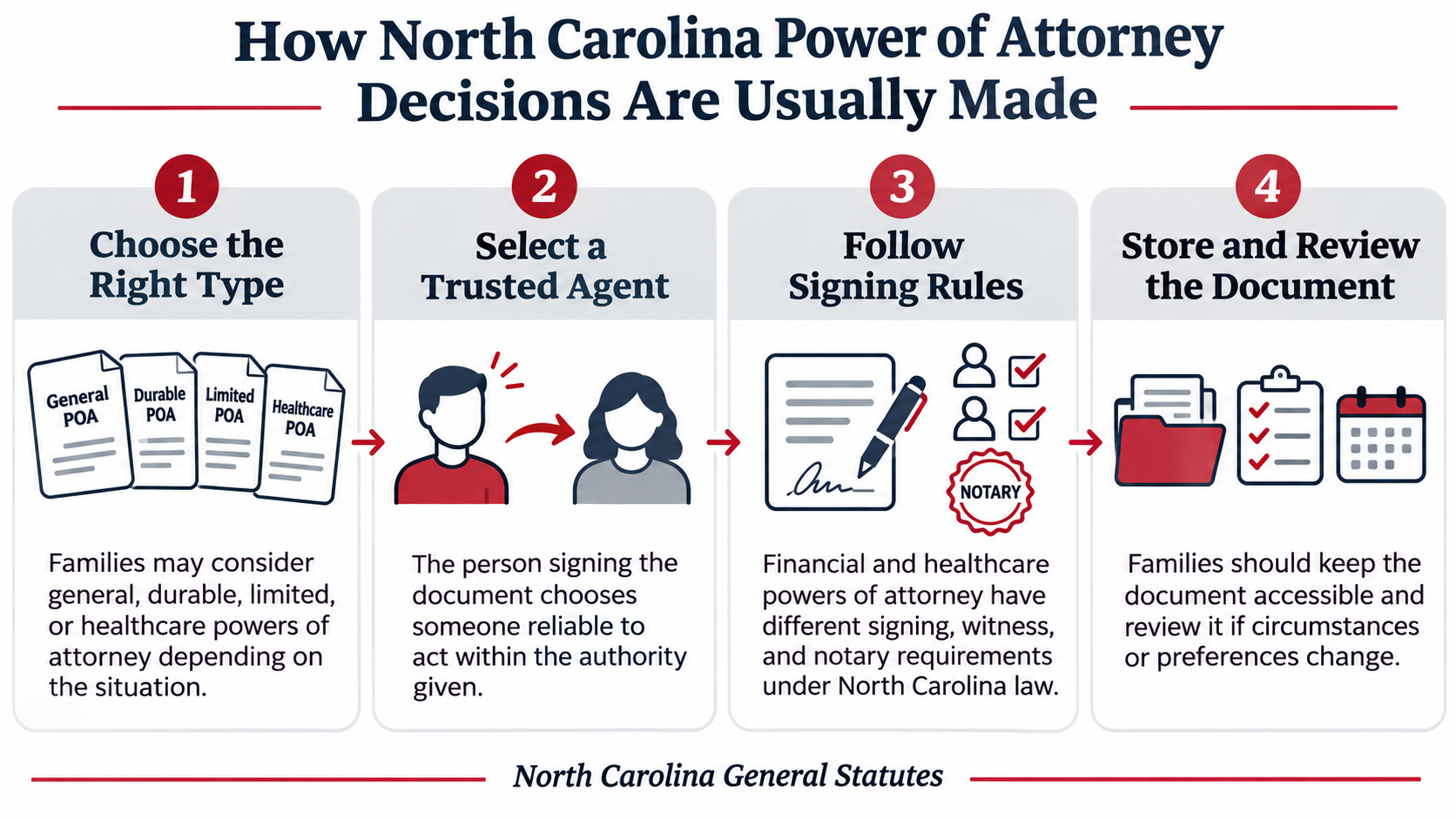
Types of Power of Attorney in North Carolina
Different powers of attorney serve different purposes. Choosing the appropriate document depends on the individual's circumstances, the responsibilities involved, and when the authority needs to become effective. North Carolina provides official forms for some POAs in its statutes.
Financial powers of attorney are governed by the North Carolina Uniform Power of Attorney Act, Chapter 32C of the North Carolina General Statutes. Healthcare powers of attorney are governed separately under Chapter 32A, Article 3, and these North Carolina power of attorney forms are commonly available in PDF and Word formats.
General Power of Attorney
A general power of attorney may authorize an agent to handle a broad range of financial and property matters. The North Carolina statutory short form for general financial authority is the form defined in N.C.G.S. §32C-3-301.
Depending on the document, this authority may include managing bank accounts, handling investments, paying bills, managing business interests, or conducting real estate transactions. When properly executed, that statutory form is commonly accepted by banks in North Carolina.
General authority does not necessarily mean unlimited authority. The agent remains subject to the document's provisions and applicable legal responsibilities.
North Carolina Durable Power of Attorney
A durable power of attorney allows an agent's authority to continue if the individual who granted it becomes incapacitated.
Under North Carolina General Statutes Section 32C-1-104, a power of attorney created under Chapter 32C is durable unless the document expressly states that incapacity terminates the authority.
This provision makes durability an important consideration for families preparing for age-related incapacity, serious illness, or other circumstances that may affect an individual's ability to manage personal finances.
For additional background, our article on durable power of attorney explains the general purpose of these documents. North Carolina residents should note that Texas signing requirements and statutory provisions may differ from North Carolina law.
Limited Power of Attorney
A limited power of attorney grants authority over particular responsibilities or transactions.
For example, an individual may authorize someone to manage a specific property transaction while they are traveling or unavailable.
The document may restrict the agent's authority to certain activities, time periods, or circumstances. This option may be appropriate when broad financial authority is unnecessary.
Healthcare Power of Attorney
A healthcare power of attorney allows an individual to designate someone to make authorized medical decisions when the individual cannot make or communicate those decisions.
Healthcare powers of attorney in North Carolina are governed by Chapter 32A, Article 3 of the North Carolina General Statutes.
A financial power of attorney does not automatically provide healthcare decision-making authority. Families may need separate documents to address both financial and medical responsibilities.
North Carolina Power of Attorney Signing, Witness, and Notary Requirements
A power of attorney may create significant legal responsibilities. A document that does not comply with applicable state requirements may lead to questions about its validity or the agent's authority.
North Carolina establishes different signing requirements for financial and healthcare powers of attorney.
Signing Requirements for a Financial Power of Attorney
Under North Carolina General Statutes Section 32C-1-105, the following requirements apply:
- The principal must sign the document or direct another individual to sign on their behalf in their conscious presence.
- The document must be acknowledged.
- A signature acknowledged before a notary public or another legally authorized individual is presumed genuine.
- Two additional witnesses are not generally required under this particular statute.
- www3.ncleg.gov
The principal is the person granting authority, while the agent is the person receiving that authority.
Signing Requirements for a Healthcare Power of Attorney
Under North Carolina General Statutes Section 32A-16, a healthcare power of attorney generally must be signed in the presence of two qualified witnesses and acknowledged before a notary public.
Witnesses must satisfy statutory eligibility requirements involving family relationships, inheritance interests, healthcare employment, and certain financial interests.
These differences are important when preparing documents for an elderly parent or family member who requires both financial and healthcare support.
Does a Power of Attorney Need to Be Registered?
Under North Carolina General Statutes Section 47-28, if a power of attorney is used to execute a deed, it must be acknowledged and registered with the register of deeds in the county where the property is located before an authorized agent completes certain real estate transfers on behalf of the principal.
An attorney can evaluate whether registration or additional documentation is necessary based on the intended use of the power of attorney.
Why an Online NC Power of Attorney Form May Not Be Enough
Although an NC power of attorney form may be readily available free online, and some sites let you find or prepare a power of attorney online and complete it in under 5 minutes, a standard document may not address every family's circumstances.
An improperly selected document may grant broader authority than intended, overlook important restrictions, or fail to address future incapacity.
Professional legal review can help identify these concerns before the document is used for significant financial or personal decisions.
Choosing an Agent and Setting Appropriate Limits
Choosing an agent is one of the most important decisions involved in preparing a power of attorney, and families often choose the person they trust most for the role.
The individual selected may become responsible for managing sensitive financial information, handling property, or making important healthcare decisions.
Families often consider the person's reliability, financial judgment, availability, communication skills, trustworthiness and integrity, and ability to respect the principal's wishes.
A North Carolina power of attorney can also name co-agents, but families should consider whether shared authority will work in practice.
Understanding an Agent's Legal Responsibilities
Under North Carolina General Statutes Section 32C-1-114, an agent exercising financial authority must respect the principal's known reasonable expectations, act honestly, and remain within the authority provided by the document.
Additional duties generally include maintaining transaction records, avoiding harmful conflicts of interest, and acting for the principal's benefit.
Granting power of attorney does not transfer ownership of the principal's assets to the agent.
Establishing Clear Financial Boundaries
A power of attorney can address the scope of an agent's authority over financial accounts, property, investments, business interests, and other responsibilities.
Under North Carolina General Statutes Section 32C-2-201, certain sensitive powers, including specified gifting and estate planning transactions, require express authorization.
Clear restrictions may help reduce uncertainty regarding the agent's responsibilities and the principal's intentions.
Families considering legal arrangements for younger family members may also find useful general information in our article on the importance of getting a power of attorney for your children.
When Families Talk With a North Carolina Power of Attorney Lawyer
Preparing for future incapacity can involve difficult conversations, particularly when an elderly parent lives alone or family members reside in different states.
An attorney can review existing documents, explain available legal options, and prepare a power of attorney that reflects the principal's circumstances and intentions.
Legal assistance may be particularly valuable when an aging parent is experiencing declining capacity, family members disagree about decision-making authority, or existing documents were prepared under another state's laws.
How Masterly Legal Solutions Helps North Carolina Families
Masterly Legal Solutions provides professional legal assistance with power of attorney documents and related estate planning concerns.
Depending on your circumstances, our legal services may include:
- Reviewing existing financial and healthcare powers of attorney.
- Preparing or reviewing the appropriate power of attorney form.
- Evaluating agent authority and appropriate restrictions.
- Addressing concerns involving signing and acknowledgment requirements.
- Reviewing existing incapacity planning arrangements.
- Advising families about amendments and helping revoke a power of attorney while the principal remains mentally competent and the revocation is properly signed.
- Addressing legal concerns involving suspected misuse of authority.
Our estate planning services help individuals and families consider their long-term financial, healthcare, and personal planning needs.
Rather than relying on a generic document, families can receive legal guidance tailored to their circumstances and applicable North Carolina law.
Frequently Asked Questions About North Carolina Power of Attorney
Does a North Carolina Power of Attorney Have to Be Notarized?
A financial power of attorney must be acknowledged before a notary public or another individual authorized by law to take acknowledgments.
Online notarization is accepted in North Carolina.
A healthcare power of attorney generally requires two qualified witnesses and acknowledgment before a notary public under separate statutory requirements. See our related North Carolina online notarization page for details on current requirements.
What Is the Difference Between a General and a Durable Power of Attorney?
A general power of attorney describes the breadth of an agent's authority. A durable power of attorney describes whether that authority continues after the principal becomes incapacitated.
A document can be both general and durable.
Under North Carolina law, financial powers of attorney created under Chapter 32C are durable unless the document expressly provides otherwise.
Can a Power of Attorney Be Changed or Revoked in North Carolina?
Yes, subject to applicable legal requirements and the principal's capacity. A principal can revoke a power of attorney at any time while mentally competent, provided the revocation is properly signed.
Under North Carolina General Statutes Section 32C-1-110, revocation requirements differ depending on whether a financial power of attorney has been registered.
Registered documents require a formal revocation recorded with the register of deeds in the appropriate county and proof of service on the agent.
Signing a new financial power of attorney does not automatically revoke an earlier document unless the new document provides for revocation, and notice issues may matter to parties relying on the earlier document.
Healthcare powers of attorney have separate revocation provisions under Section 32A-20.
Legal review can help families address conflicting documents and understand the applicable requirements.
Request a confidential consultation with Masterly Legal Solutions
A North Carolina power of attorney is an important part of preparing for unexpected illness, future incapacity, and significant financial or healthcare decisions. Choosing the appropriate document and defining an agent's authority deserve careful legal consideration.
Masterly Legal Solutions assists North Carolina residents and their families with power of attorney preparation, document reviews, incapacity planning, and related estate planning matters.
Our office can also be reached at (972) 236-5051.
This article is provided for general informational and educational purposes only and does not constitute legal advice. North Carolina laws and legal requirements may change or vary depending on individual circumstances. Reading this article does not establish an attorney-client relationship with Masterly Legal Solutions. Individuals should consult a qualified attorney for legal guidance specific to their situation. No particular legal outcome is promised.








Looking for Legal & Business Solutions? Contact Us Now
Fill in the form or call us to set up a meeting