School Investigations and Due Process: What Schools Must Get Right to Avoid Legal Exposure
When a School Investigation Becomes a Legal Problem
Most school investigations begin with good intentions. A complaint is filed, concerns are raised, or an incident occurs that requires administrators to gather facts and determine what happened. Schools have an obligation to respond appropriately, especially when the safety of students, teachers, or staff members may be involved. However, many investigations that start as internal matters quickly evolve into serious legal disputes because proper procedures were not followed.
What often surprises administrators is that legal exposure frequently stems from the process itself rather than the underlying allegations. A school may ultimately reach the correct conclusion, but if due process rights were ignored along the way, the institution may still face significant liability. This is particularly true when decisions affect employment, student discipline, educational opportunities, or professional reputations.
Across Texas and throughout the country, schools increasingly face challenges involving investigations, compliance requirements, and evolving legal standards. Understanding how due process works within education law can help educational institutions avoid mistakes that lead to costly litigation, damaged reputations, and strained relationships with students, employees, and parents.
Why Due Process Matters in Education Law
Due process is one of the foundational principles of education law. Although many people associate due process with criminal proceedings, the concept extends far beyond the courtroom. Schools, colleges, and universities regularly make decisions that can affect important rights and interests, making procedural fairness essential.
At its most basic level, due process requires schools to follow fair procedures before taking action that may negatively affect someone. Whether the issue involves student discipline, employee termination, suspension, academic misconduct, or allegations of discrimination, schools must ensure that proper steps are followed before reaching a decision.
Educational institutions that fail to provide a fair process often create unnecessary legal issues. Even when administrators believe they are acting in the best interests of the institution, procedural mistakes can undermine the integrity of an investigation and expose schools to significant legal challenges.
The Growing Legal Landscape Facing Schools
The legal environment surrounding education continues to become more complex. Public school districts, charter schools, private schools, private universities, and public and private universities must comply with a wide range of federal and state requirements. These obligations affect nearly every aspect of school operations, including investigations, discipline, employment decisions, and student rights.
Today’s educational institutions must navigate regulations involving Title IX, disability accommodations, employment matters, free speech rights, privacy concerns, and student conduct. Each area carries its own procedural requirements and potential consequences for noncompliance.
Because of these challenges, many administrators recognize the importance of working with an education lawyer who understands how these laws interact. A single procedural error can transform a manageable situation into a dispute requiring extensive legal intervention.
Understanding What Due Process Actually Requires
Many administrators understand that due process is important but remain uncertain about what it actually requires in practice. While specific obligations vary depending upon the circumstances, several principles generally apply.
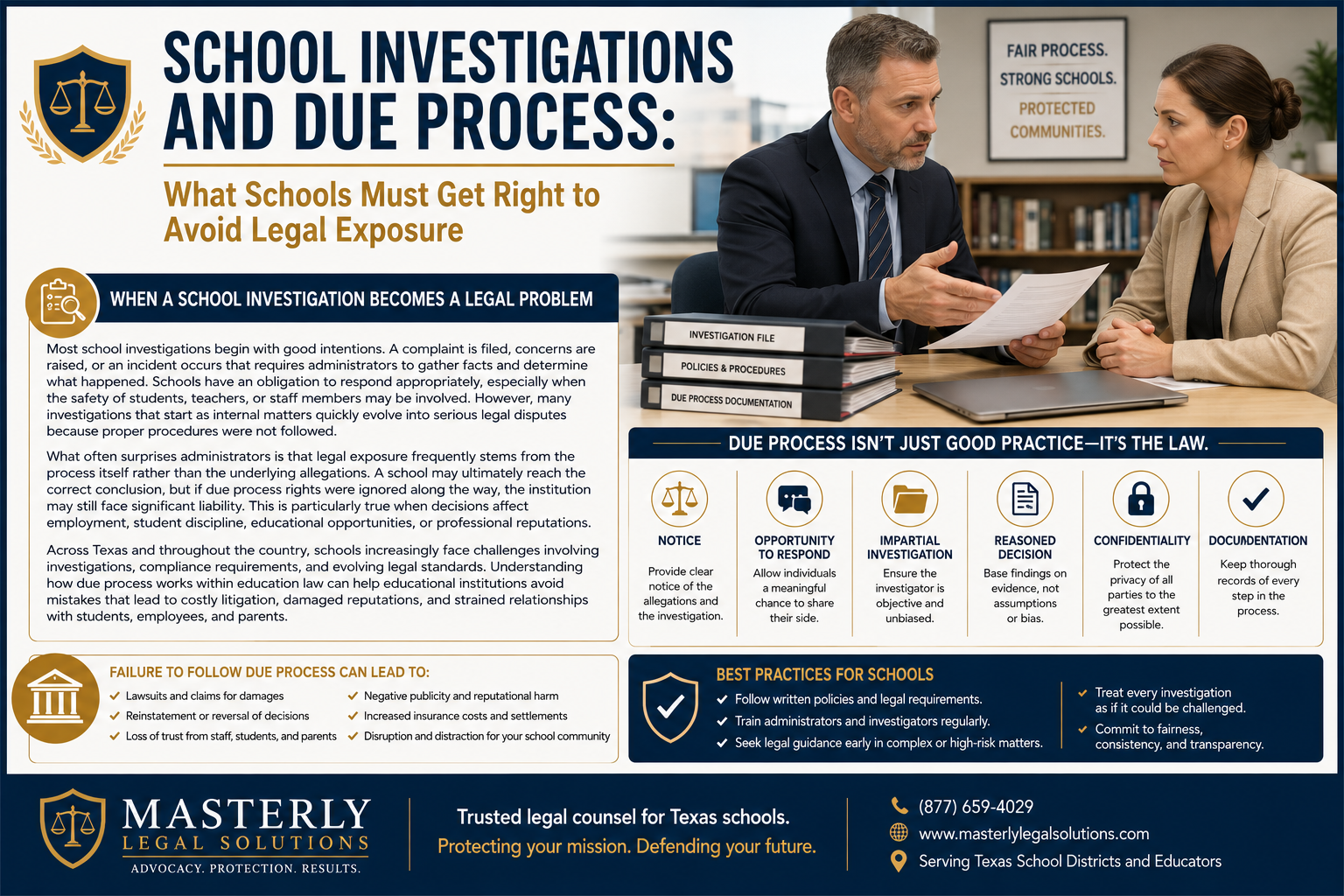
A fair process often includes:
- Adequate notice of allegations.
- An opportunity to respond.
- An impartial decision-maker.
- Consideration of relevant evidence.
- Consistent application of policies.
- Documentation supporting decisions.
These safeguards help ensure fairness while protecting both the institution and the individuals involved. Schools that consistently follow these principles are often in a stronger position when their decisions are later challenged.
Why Schools Face Liability Even When Their Intentions Are Good
One of the most common misconceptions in education law matters is that good intentions eliminate legal risk. Unfortunately, that is not always the case.
Administrators frequently act with the goal of protecting students and maintaining order. However, acting quickly without following proper procedures may create legal exposure regardless of intent. Courts, regulatory agencies, and administrative hearings often focus heavily on whether established procedures were followed.
A school may genuinely believe it reached the correct conclusion, but if the process was flawed, the institution may still face disputes, appeals, or litigation. Procedural fairness remains essential regardless of the outcome.
The Consequences of Inadequate Notice
One of the most common procedural failures involves inadequate notice. Individuals cannot effectively defend themselves if they do not understand the allegations they face.
For example, a teacher accused of misconduct should generally receive sufficient information regarding the nature of the allegations. Likewise, students facing discipline should understand the conduct under review and the potential consequences involved.
Without proper notice, meaningful participation becomes impossible. This deficiency often becomes a central issue in disputes involving schools, colleges, and universities. When individuals believe they were denied an opportunity to understand or respond to allegations, legal challenges frequently follow.
Investigations Must Be More Than a Formality
An investigation should never be viewed as a procedural box to check before imposing discipline. Unfortunately, some schools treat investigations as mere formalities designed to support predetermined outcomes.
Effective investigations require genuine fact-finding. Investigators should approach allegations with an open mind and evaluate all available information before reaching conclusions. This includes reviewing evidence that supports and contradicts the allegations.
When investigators appear to have predetermined the outcome, confidence in the process erodes quickly. Students, teachers, parents, and employees are far more likely to challenge decisions they believe were made before all facts were considered.
The Danger of Confirmation Bias
Confirmation bias is one of the most significant threats to fair investigations. It occurs when investigators focus primarily on information that supports their initial assumptions while disregarding contradictory evidence.
This issue can arise in any educational setting. Administrators may unintentionally give greater weight to certain witnesses or overlook facts that complicate the narrative they expect to find. While these mistakes are often unintentional, they can still create substantial legal exposure.
Schools should implement training programs that help investigators recognize and avoid bias throughout the investigative process. Objectivity is essential to maintaining the integrity of any investigation.
Gathering and Preserving Evidence Properly
Evidence serves as the foundation of every investigation. Decisions made without sufficient evidence are far more vulnerable to challenge.
Investigators should gather information from multiple sources whenever possible. This may include interviews, emails, security footage, records, policies, communications, and other relevant materials. Thorough documentation helps ensure that decisions are supported by facts rather than assumptions.
Educational institutions should also establish procedures for preserving evidence. Lost documents, deleted communications, or incomplete records can significantly weaken an institution's position when disputes arise later.
Why Consistency Matters in School Investigations
Consistency is critical when applying school policies. Similar situations should generally receive similar treatment unless meaningful differences justify a different outcome.
When schools handle comparable incidents differently, questions often arise regarding fairness and discrimination. Inconsistent decision-making can create the appearance that personal relationships, public pressure, or other improper factors influenced the outcome.
Consistency does not require identical results in every case. However, administrators should be prepared to explain why different circumstances warranted different responses.
The Importance of Accurate Documentation
Documentation often becomes one of the most valuable forms of protection available to schools. Investigative records may later serve as evidence demonstrating that proper procedures were followed.
Strong documentation should clearly reflect:
- The allegations received.
- The steps taken during the investigation.
- Witness interviews conducted.
- Evidence reviewed.
- Findings reached.
- Actions implemented.
Incomplete records can create significant problems months or even years later. Individuals reviewing the matter may assume that steps were not taken if those steps were not documented.
Protecting the Rights of Students During Investigations
Students are frequently at the center of school investigations. Whether the allegations involve misconduct, bullying, academic dishonesty, or safety concerns, schools must balance accountability with fairness.
Students deserve an opportunity to be heard before significant disciplinary actions are imposed. They should understand the allegations against them and have a meaningful chance to respond.
Schools that fail to protect these rights often face challenges from parents who believe the institution acted unfairly. Maintaining transparent procedures helps build trust within the educational community.
Parents Play a Critical Role in the Process
Parents are often deeply invested in the outcome of school investigations. When communication is lacking, frustration can quickly escalate into formal disputes.
Schools should provide appropriate information while respecting privacy requirements and legal limitations. Keeping parents informed helps reduce misunderstandings and promotes confidence in the process.
When parents feel excluded or ignored, they are more likely to seek outside assistance, file complaints, or pursue legal remedies. Open communication often prevents conflicts from becoming larger problems.
Teacher Investigations Require Special Attention
Investigations involving teachers often carry consequences that extend far beyond a single incident. Allegations may affect professional certifications, future employment opportunities, and long-term career prospects. Because of these risks, schools should ensure that investigations involving teachers are handled carefully and consistently.
Unfortunately, some schools rush through employee investigations due to public pressure or internal concerns. When that happens, important facts may be overlooked, witnesses may not be interviewed, and decisions may be made without sufficient evidence. These mistakes frequently create legal disputes that could have been avoided.
Teachers facing allegations often benefit from consulting an education lawyer experienced in Texas school investigations early in the process. Understanding rights and responsibilities before participating in interviews or providing written statements can help protect both careers and professional reputations.
How Procedural Errors Affect Teachers
Teachers are expected to follow policies, maintain professional standards, and support students. However, schools also have obligations when investigating allegations involving employees.
Common procedural mistakes include:
- Failing to provide adequate notice.
- Denying opportunities to respond.
- Ignoring relevant evidence.
- Conducting incomplete interviews.
- Applying policies inconsistently.
- Reaching conclusions prematurely.
When these errors occur, disputes often follow. In many cases, attorneys for teachers become involved because the process itself was fundamentally flawed.
Employee Rights During School Investigations
An employee under investigation should understand the procedures being followed and the allegations involved. While every situation is different, fairness remains essential throughout the process.
Educational institutions should avoid creating environments where employees feel pressured to admit wrongdoing without understanding the evidence against them. Investigations should focus on fact-finding rather than securing predetermined outcomes.
Schools that respect employee rights are often better positioned to defend their decisions if disputes arise later.
The Role of Administrators in Maintaining Fairness
Administrators play a critical role in ensuring that investigations remain objective. Their decisions often influence whether a matter is resolved internally or develops into a larger legal conflict.
Effective administrators understand that fairness benefits everyone involved. A properly conducted investigation helps protect students, employees, and the institution itself.
Administrators should remain focused on facts rather than assumptions. They should also avoid allowing outside pressure to influence investigative decisions.
Why Title IX Investigations Receive Increased Scrutiny
Title IX investigations continue to receive significant attention throughout the education sector. Allegations involving sexual misconduct, gender discrimination, and related concerns often involve complicated procedural requirements.
Because these matters carry serious consequences, schools must follow established procedures carefully. Failure to comply with Title IX requirements can create substantial legal exposure.
Investigators should receive specialized training regarding Title IX obligations. Educational institutions that fail to provide adequate training often encounter avoidable compliance issues that lead to disputes and litigation.
Balancing Rights in Title IX Cases
One of the challenges associated with Title IX investigations is balancing competing rights and interests. Schools must address complaints appropriately while ensuring fairness for everyone involved.
This balancing act requires careful attention to procedure. Both complainants and respondents should receive appropriate notice, opportunities to participate, and access to relevant information as permitted by applicable rules.
When schools appear to favor one side over another, confidence in the process often deteriorates. Maintaining neutrality is essential to preserving the integrity of the investigation.
Investigations Involving Students With Disabilities
Students with disabilities often have additional protections under federal and state regulations. Schools must remain mindful of these requirements when conducting investigations or imposing disciplinary actions.
A failure to consider disability-related factors may expose an institution to legal challenges. For example, behavior that appears to violate school policy may be connected to a student's documented disabilities.
Investigators should review relevant records and consult appropriate personnel before making recommendations involving discipline. Careful consideration of these factors helps ensure compliance and fairness.
Special Needs Students and Due Process Requirements
When special needs students become involved in investigations, additional procedural safeguards may apply. Educational institutions should understand how disability-related requirements interact with disciplinary procedures.
These cases often involve complex legal matters requiring careful analysis. Schools that fail to recognize applicable protections may inadvertently violate important rights.
Proper training helps administrators recognize situations where additional safeguards may be required before disciplinary decisions are made.
College and University Investigations Present Unique Challenges
Investigations at the college or university level often involve issues that differ from those encountered in K-12 settings. Institutions may address academic misconduct, research concerns, employment disputes, Title IX allegations, and student conduct matters.
Because college students are generally adults, procedural expectations may differ. Nevertheless, fairness remains a fundamental requirement.
A university that fails to follow its own policies may face significant legal challenges. Courts frequently examine whether institutions adhered to the procedures outlined in their handbooks and governing documents.
Private Universities and Internal Policies
Private universities often possess greater flexibility regarding internal governance. However, they are still expected to follow their published policies and contractual obligations.
Students and employees frequently rely on institutional handbooks when evaluating their rights and responsibilities. When private universities ignore established procedures, disputes can quickly arise.
Consistency and transparency remain important regardless of whether an institution is public or private.
Public and Private Universities Face Similar Risks
Although legal frameworks may differ, public and private universities share many of the same investigative challenges. Both must balance fairness, institutional responsibilities, and regulatory obligations.
Mistakes involving notice, evidence, witness interviews, or decision-making can create disputes regardless of institutional structure. Effective policies and thorough training remain critical risk-management tools.
Universities that invest in proper procedures often experience fewer challenges and stronger outcomes when disputes occur.
College Professors and Employment Investigations
College professors may become involved in investigations concerning classroom conduct, research activities, student interactions, or employment disputes. These matters frequently involve complex factual and legal questions that may require support from higher education law counsel for colleges and universities.
Institutions should ensure that faculty members receive fair treatment throughout the process. Decisions affecting professional standing or employment should be based on reliable evidence and consistent procedures.
When fairness is questioned, disputes may expand beyond the original allegations and focus instead on the investigation itself.
Free Speech Concerns in Educational Settings
Free speech issues have become increasingly common in schools and higher education institutions. Administrators often face difficult decisions when balancing expression rights against institutional responsibilities.
Investigations involving speech-related conduct require careful analysis. Schools should avoid imposing discipline solely because opinions are unpopular or controversial.
Understanding the legal boundaries surrounding free speech helps educational institutions reduce risk while maintaining productive learning environments.
Administrative Hearings and Appeals
Many education-related disputes eventually proceed to administrative hearings. These proceedings often focus on whether schools complied with applicable procedures and regulations.
Administrative hearings provide opportunities to review evidence, evaluate decision-making, and determine whether due process requirements were satisfied. Schools that maintain strong documentation are often better prepared to defend their actions.
Preparation for these proceedings should begin long before a hearing is scheduled. Proper investigative practices create stronger foundations for defending institutional decisions.
The Importance of Consistent Policy Enforcement
Policies only provide protection when they are applied consistently. Schools that selectively enforce rules create opportunities for claims involving discrimination, unfair treatment, and procedural irregularities.
Consistency demonstrates that decisions are based on established standards rather than personal preferences or external pressures. This helps protect both the institution and the individuals affected by investigative outcomes.
Educational leaders should regularly review policies and practices to ensure consistency throughout the organization.
When Investigations Involve Employment Disputes
Employment disputes often present unique challenges for schools. Allegations involving misconduct, workplace behavior, performance concerns, or policy violations require careful handling.
An education lawyer can help institutions understand applicable obligations while reducing the risk of procedural errors. Employment-related investigations frequently involve overlapping legal requirements that demand close attention.
Schools that approach these matters carefully are more likely to avoid unnecessary litigation and reputational harm.
Why Training Is One of the Best Risk-Reduction Tools
Many procedural failures occur because investigators simply lack adequate training. Individuals assigned to conduct investigations may have little experience gathering evidence, interviewing witnesses, or evaluating credibility.
Comprehensive training helps administrators understand regulations, investigative techniques, documentation requirements, and compliance obligations. It also promotes consistency across departments and campuses.
Schools that invest in training often experience fewer disputes and stronger investigative outcomes.
Building Community Trust Through Fair Procedures
Trust is one of the most valuable assets any educational institution can possess. Students, parents, teachers, and community members are more likely to support decisions when they believe the process was fair.
Even difficult outcomes can gain acceptance when stakeholders understand that investigations were conducted professionally and objectively. Fair procedures help strengthen confidence in institutional leadership.
Schools that prioritize transparency and accountability often develop stronger relationships with the communities they serve.
Avoiding Legal Exposure Before Problems Escalate
Many disputes become expensive because schools wait too long to seek guidance. Addressing procedural concerns early often prevents minor issues from becoming major legal battles.
Educational institutions should regularly review investigative practices, update policies, and ensure compliance with evolving regulations. A proactive approach can significantly reduce risk while improving outcomes for everyone involved.
The goal should not simply be resolving complaints. The goal should be resolving them fairly, consistently, and in a manner that protects the rights of all involved parties.
Common Investigation Mistakes That Create Liability for Schools
Many legal disputes involving schools begin with avoidable procedural mistakes. Administrators are often under pressure to act quickly, especially when allegations generate concern among students, parents, or the broader community. However, rushing through an investigation can create legal exposure that far exceeds the original issue.
Schools that fail to follow established procedures often discover that the investigation itself becomes the focus of later disputes. Courts, hearing officers, and regulatory agencies frequently examine whether proper steps were followed before evaluating the underlying allegations.
Understanding common mistakes can help educational institutions avoid unnecessary risk and better protect their interests.
Failing to Follow Established Policies
One of the most common mistakes occurs when schools fail to follow their own written policies. Educational institutions spend significant time developing procedures, yet those procedures sometimes go ignored when difficult situations arise.
Whether the matter involves student discipline, employee misconduct, discrimination allegations, or academic concerns, consistency matters. Deviating from established procedures without a valid reason often creates questions regarding fairness and compliance.
When schools disregard their own rules, affected individuals are more likely to challenge investigative outcomes.
Inadequate Witness Interviews
Witness interviews often provide critical information during investigations. Unfortunately, some investigations rely on only a small number of interviews or fail to speak with key individuals who may possess relevant knowledge.
Incomplete witness interviews can produce inaccurate findings and undermine confidence in the process. Investigators should make reasonable efforts to identify and interview individuals who may have information relevant to the allegations.
A thorough investigation strengthens the credibility of both the findings and the institution's decision-making process.
Making Decisions Before the Investigation Is Complete
Sometimes administrators reach conclusions before all available evidence has been reviewed. This can occur when public pressure, media attention, or internal concerns create urgency.
When investigators appear to have predetermined the outcome, affected parties often question the fairness of the entire process. These concerns frequently become central issues in later disputes.
Schools should ensure that decisions are based on completed investigations rather than assumptions or incomplete information.
Ignoring Contradictory Evidence
A fair investigation requires consideration of all relevant evidence, not just information supporting a particular conclusion.
Investigators should evaluate facts objectively, including evidence that may challenge initial assumptions. Ignoring contradictory information creates the appearance of bias and increases the likelihood of legal challenges.
Educational institutions that encourage objective fact-finding are often better positioned to defend investigative outcomes.
Discrimination Claims Often Begin With Procedural Failures
Many discrimination claims arise not only because of the underlying conduct but also because individuals believe they were treated differently during an investigation.
Students, employees, and educators may question whether policies were applied consistently across similar situations. Perceived inconsistencies frequently become the foundation for disputes involving discrimination.
Schools should ensure that investigative procedures are applied fairly regardless of race, gender, disabilities, age, religion, or other protected characteristics.
Compliance Is More Than Following Rules
Compliance involves more than checking boxes or completing paperwork. Effective compliance requires schools to understand and implement the requirements imposed by applicable laws and regulations.
Educational institutions that focus solely on outcomes may overlook important procedural obligations. This can create significant risk when investigations are later reviewed by outside agencies or courts.
Strong compliance programs help schools identify potential problems before they develop into legal disputes.
The Impact of Poor Recordkeeping
Recordkeeping plays an essential role in protecting educational institutions. Documentation often becomes the primary evidence demonstrating that appropriate procedures were followed.
Poor recordkeeping can create uncertainty regarding what occurred during an investigation. Missing notes, incomplete reports, and inconsistent documentation may weaken a school's ability to defend its actions.
Maintaining organized records benefits everyone involved and supports transparency throughout the investigative process.
Why Every Department Must Understand Due Process
Responsibility for due process does not belong solely to administrators or legal counsel. Every department involved in investigations should understand the importance of procedural fairness.
Human resources personnel, student services professionals, campus security staff, and academic leaders may all play important roles during investigations. Coordination among departments helps ensure consistency and reduces the risk of procedural errors.
A collaborative approach often produces stronger outcomes and fewer disputes.
Employment Investigations Require Additional Care
Employment investigations frequently involve overlapping legal obligations. Schools must consider employment laws, contractual requirements, institutional policies, and professional standards when evaluating allegations involving employees, often with guidance from an education law attorney for teachers and administrators.
Failure to account for these considerations can create significant legal issues. Investigations involving employment decisions should be conducted carefully and documented thoroughly.
Educational institutions that understand employment-related obligations are better positioned to protect both the institution and its employees.
Labor Considerations in Educational Settings
Labor issues may arise when investigations involve employee rights, collective bargaining agreements, or workplace policies. These matters often require careful analysis because procedural requirements can vary depending upon the circumstances.
Schools should remain familiar with labor-related obligations that may affect investigations and disciplinary decisions. Overlooking these requirements can create additional disputes and increase legal exposure.
A proactive approach helps institutions address concerns before they escalate.
How an Education Lawyer Can Help Schools Avoid Liability
An experienced education lawyer can provide valuable guidance before problems become legal battles. Schools frequently seek assistance when developing policies, conducting investigations, responding to complaints, or evaluating potential liability, and may benefit from working with education law attorneys offering comprehensive legal services.
Early involvement often allows legal concerns to be identified and addressed before disputes escalate. This approach can save substantial time, resources, and stress for everyone involved.
Educational institutions benefit when decision-makers have access to reliable legal guidance throughout the investigative process.
When Teachers, Administrators, and Parents Need Legal Guidance
Investigations affect more than institutions. Teachers, administrators, students, and parents may all face situations requiring legal assistance.
Questions involving discipline, employment, accommodations, discrimination, and procedural rights often require individualized analysis. An education lawyer providing expert legal support for teachers and schools can help individuals understand their rights and responsibilities.
Obtaining guidance early frequently leads to better outcomes than waiting until a dispute becomes more difficult to resolve.
The Value of Experience in Education Law Matters
Education law continues to evolve as regulations change and new challenges emerge. Schools and individuals benefit from working with professionals who possess extensive experience handling education-related disputes, such as a Texas law firm focused on education law and TEA defense.
Legal matters involving schools often require knowledge of multiple areas of law, including employment law, disability rights, administrative procedures, constitutional protections, and regulatory compliance.
A knowledgeable lawyer can help identify risks and develop strategies designed to protect important rights and interests.
Protecting Educational Institutions While Maintaining Fairness
The best investigations are those that balance accountability with fairness. Schools have an obligation to address concerns promptly while respecting the rights of those involved.
When educational institutions commit to transparency, objectivity, and procedural consistency, they reduce legal exposure and strengthen trust within the community. These principles not only help protect institutions but also support better educational environments for students and employees alike.
Fairness should never be viewed as an obstacle to effective investigations. In reality, fairness is often one of the strongest protections available.
How Masterly Legal Solutions Assists Schools and Educators
At Masterly Legal Solutions, our firm understands the unique challenges facing schools, teachers, administrators, colleges, universities, and educational organizations. We regularly assist clients dealing with complex education law issues, investigations, compliance concerns, employment disputes, disciplinary proceedings, and other legal matters affecting educational institutions.
Our office is committed to helping clients navigate difficult situations while protecting their professional reputations, careers, and organizational interests. We represent educators, school leaders, employees, and institutions throughout Texas in a wide variety of education law matters.
Whether you are dealing with investigations, administrative hearings, policy concerns, employment disputes, student issues, or regulatory compliance questions, our team can provide experienced legal assistance tailored to your circumstances.
Education Law Services for Schools and Educators
Our attorneys provide guidance regarding the following matters:
- School investigations.
- Employee disciplinary proceedings.
- Student discipline disputes.
- Title IX compliance.
- Disability and accommodation issues.
- Administrative hearings.
- Employment-related concerns.
- Policy development and review.
- Regulatory compliance matters.
- Discrimination allegations.
- Special education disputes.
We are committed to helping schools and educators identify solutions that protect their rights while supporting educational goals.
Understanding Legal Obligations and Seeking Guidance Before Problems Escalate
School investigations rarely occur in isolation. They often involve overlapping requirements imposed by federal law, state law, institutional policies, and regulatory agencies. As a result, administrators must carefully evaluate each situation before taking action. A procedural mistake made during an investigation can create significant liability for an educational institution, particularly when decisions affect employment, discipline, or student rights.
Many schools benefit from working with a law firm that focuses on education-related issues because investigations frequently involve complex legal questions. Whether the matter concerns student conduct, employee allegations, disability accommodations, or compliance requirements, experienced counsel can provide valuable legal services designed to help institutions navigate difficult situations. Obtaining legal representation early in the process may help identify risks before they develop into costly disputes or litigation.
Educational leaders should also ensure that administration personnel receive ongoing training regarding investigative procedures and due process requirements. Schools that actively educate decision-makers are often better prepared to handle complaints fairly and consistently. For example, when a student or employee submits a request for accommodations involving a physical condition or disability, investigators should understand the procedural safeguards that may apply before disciplinary decisions are made.
Certain investigations may also involve statutory obligations or regulatory requirements that create a legal mandate for specific actions. Failure to comply with those requirements can expose schools to unnecessary legal challenges. In some circumstances, institutions may benefit from a referral to outside professionals, investigators, or specialized counsel who possess experience handling particularly sensitive matters. Taking proactive steps before problems escalate often protects both the institution and the individuals involved while reinforcing confidence in the investigative process.
Why Attorneys for Teachers Can Be Critical During School Investigations
School investigations can place enormous pressure on educators, particularly when allegations threaten professional licenses, employment opportunities, or long-term careers. Even when teachers have done nothing wrong, procedural mistakes, misunderstandings, or incomplete investigations can create serious consequences. Attorneys for teachers who focus on TEA investigations and disciplinary defense help educators understand their rights, respond appropriately to allegations, and ensure that schools follow required procedures throughout the investigative process.
Many teachers wait until disciplinary action has already been taken before seeking guidance. Unfortunately, by that point, important opportunities to protect evidence or address procedural concerns may have already passed. Early education law help for Texas teachers facing discipline can help teachers navigate interviews, review policies, respond to allegations, and protect their professional interests before matters escalate into larger disputes.
How an Experienced Law Firm Helps Schools and Educators Address Legal Challenges
An experienced law firm can provide valuable guidance when school investigations involve due process concerns, employment disputes, disciplinary proceedings, or compliance issues. Educational matters often involve unique legal requirements that differ significantly from other areas of practice. Because schools operate under a combination of institutional policies, regulations, and legal obligations, it is important to work with professionals who understand the complexities involved.
Whether representing educational institutions, administrators, or teachers, a law firm familiar with education-related matters can help identify procedural weaknesses, reduce legal exposure, and develop strategies designed to protect rights and interests. Taking proactive steps early in the process often helps prevent costly disputes while promoting fairness and accountability throughout the investigation, especially when working with Texas education lawyers who defend teachers in TEA investigations.
Helping Schools Get the Process Right
The strongest educational institutions are not necessarily those that avoid difficult situations. They are the institutions that respond appropriately when challenges arise. A fair process, thorough investigation, and commitment to compliance help protect schools while fostering trust among students, parents, teachers, and the broader community.
By prioritizing due process and understanding applicable legal obligations, schools can significantly reduce exposure to disputes and focus on their primary mission: providing quality education in a safe and supportive environment, often with support from Texas education law attorneys protecting educators and schools.
Speak With an Attorney About Your School Investigation Concerns
School investigations often involve significant legal, professional, and educational consequences. Whether you are a teacher, administrator, parent, employee, student, college professional, or educational institution, obtaining reliable legal guidance early can make a meaningful difference.
The attorneys at Masterly Legal Solutions understand the challenges involved in navigating education law disputes. We advocate on behalf of our clients and work diligently to protect their interests while helping them understand available options.
If you have questions regarding a school investigation, disciplinary proceeding, compliance concern, employment issue, or other education-related dispute, contact Masterly Legal Solutions today at (972) 236-5051 for a free consultation. We are ready to listen, evaluate your situation, and help you move forward with confidence.
Disclaimer: This article is intended for educational and informational purposes only. It does not constitute legal advice and should not be relied upon as a substitute for consulting with a qualified attorney. Reading this article does not create an attorney-client relationship with Masterly Legal Solutions. Every situation is unique, and outcomes depend upon specific facts and circumstances. Individuals and institutions facing legal concerns should seek professional legal counsel regarding their particular situation.


Looking for Legal & Business Solutions? Contact Us Now
Fill in the form or call us to set up a meeting