
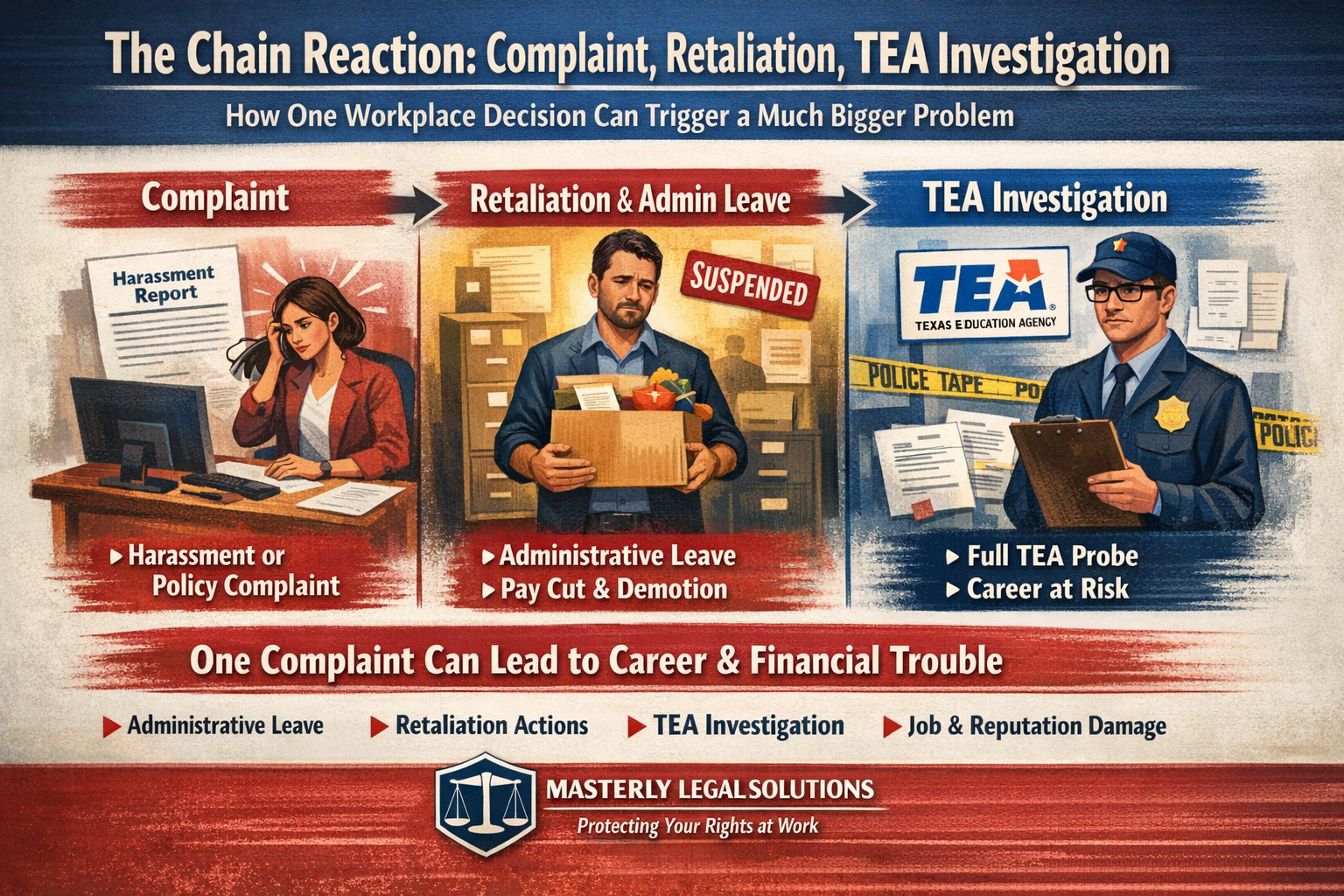
The Chain Reaction: Complaint, Retaliation, TEA Investigation
How One Workplace Decision Can Trigger a Much Bigger Problem
In today’s workplace, especially within education systems, a single complaint can set off a chain reaction that affects an employee’s career, reputation, and financial stability. What may begin as a simple report about harassment or a possible violation can quickly escalate into retaliation, administrative leave, and a full TEA investigation. For many workers, this process feels overwhelming and confusing, especially when employers begin taking adverse action that impacts their employee's current position, pay, and professional standing.
At Masterly Legal Solutions, we have seen firsthand how quickly these situations unfold. Employers often act based on agency judgments or internal pressures, sometimes overlooking the rights of the employee involved. Understanding how retaliation occurs, and what protections exist under federal laws and state laws, is critical for anyone navigating this difficult process.
Understanding the Initial Complaint in the Workplace
What Starts the Chain Reaction
A complaint is often the first step in this process. It may involve harassment, workplace safety concerns, or a possible violation of internal policies or agency policies. Employees who raise concerns are typically engaging in what the law defines as protected activity.
Protected activity includes actions such as:
- Reporting harassment or discrimination
- Participating in an investigation
- Filing complaints with authorized agency officials
- Assisting other employees in reporting wrongdoing
Even a reasonable employee who believes misconduct has occurred is protected when raising concerns. This protection is designed to maintain fairness and accountability in the workplace.
Why Employers Must Handle Complaints Carefully
Employers are required to follow internal policies consistent with federal laws, including Title VII and other provisions under the United States Code. When a complaint is filed, agency officials must carefully evaluate the situation without rushing into disciplinary action or placing employees in a less desirable position prematurely.
Poor handling of a complaint can lead to a negative impact on overall employee morale and may expose the employer to legal consequences.
What Happens After a Complaint Is Filed
The Employer’s Immediate Response
Once a complaint is submitted, the employer often begins an internal investigation. During this time, decisions may be made quickly to protect the agency's mission and workplace safety. However, these decisions can sometimes lead to unintended retaliation.
Employers may:
- Place the employee on administrative leave
- Adjust work hours or duties
- Reassign the employee to a different role
- Limit access to workplace systems
While these actions may be justified under certain circumstances, they must be handled in accordance with agency policies and applicable regulations.
Administrative Leave and Its Role
Administrative leave is commonly used during an investigation. This type of leave may be granted as paid leave, meaning the employee continues to receive pay while temporarily removed from duties, but employees should understand how administrative leave and pay work in practice.
Administrative leave can be used for:
- Investigative leave
- Safety leave
- Notice leave
- Excused absence for specific events
However, administrative leave must not be used as a disguised adverse action. If used improperly, it can signal retaliation and lead to further legal complications.
Retaliation in the Workplace
What Retaliation Looks Like
When an employer treats a worker unfairly because they participated in protected behavior, this is known as retaliation. This can happen subtly or overtly, but the impact is often significant.
Common examples of retaliation include:
- Demotion to a less desirable position
- Reduction in pay or hours
- Unjustified disciplinary action
- Placement on administrative leave without proper cause
- Exclusion from workplace opportunities
Even placing employees on administrative leave for brief periods or short periods without justification may be considered retaliation under certain circumstances.
The Legal Definition of Adverse Action
An adverse action is any action that would discourage a reasonable employee from engaging in protected activity. This standard is widely recognized under federal law and reinforced by regulations and court decisions.
Adverse action may include:
- Changes to the employee's current position
- Transfers to a less desirable position
- Denial of promotions
- Increased scrutiny or harassment
These actions, when directly related to protected activity, may form the basis of such claims against an employer.
The Role of Administrative Leave in Retaliation Cases
When Administrative Leave Becomes Problematic
Administrative leave is not inherently unlawful. In fact, it can be specifically authorized under certain agency policies and supported by OPM regulations and OPM guidance. However, misuse of administrative leave can lead to serious legal concerns.
For example:
- Placing employees on administrative leave without a valid investigation
- Using administrative leave as a punitive measure
- Extending administrative leave beyond brief or short periods without justification
These practices may indicate retaliation, especially when tied to protected activity.
Different Types of Administrative Leave
Administrative leave can take several forms depending on the situation:
- Investigative leave during an active investigation
- Notice leave when separation is anticipated
- Safety leave when workplace safety is a concern
- Excused absence for officially sponsored events such as blood donations or civic duties
Each type of administrative leave must be applied consistently and in accordance with agency judgments and regulations.
TEA Investigations and Their Impact
What Triggers a TEA Investigation
In education settings, complaints and allegations often lead to a TEA investigation. This process involves reviewing the actions of the employee and determining whether any violation of state laws or agency policies has occurred, and common causes of TEA investigations and available teacher protections can shape what happens next.
A TEA investigation may be triggered by:
- Allegations of misconduct
- Reports of harassment
- Concerns about workplace safety
- Complaints filed with agency officials
The stakes are high, as the outcome can affect an employee’s certification and career, making it critical for Texas educators to understand TEA investigations and teacher certification help.
How the Investigation Process Works
During the investigation, agency officials and other authorized agency officials gather evidence, interview witnesses, and review documentation. The agency head may play a key role in overseeing the process and making final decisions.
This process often includes:
- Placement on administrative leave
- Collection of statements and records
- Evaluation of agency policies and compliance
- Determination of whether a violation occurred
The investigation must follow established regulations and respect the rights of the employee involved, and educators who receive notice should take immediate steps after a TEA investigation notice to protect their license and employment.
The Intersection of Retaliation and TEA Investigations
When Retaliation Complicates the Process
Retaliation can significantly complicate a TEA investigation. If an employee is subjected to adverse action after engaging in protected activity, it may raise questions about the fairness of the investigation itself.
For example:
- An employee files a complaint and is immediately placed on administrative leave
- The employer reduces pay or hours during the investigation
- The employee is reassigned to a less desirable position
These actions may suggest retaliation rather than a legitimate response to the situation.
Protecting Employee Rights During Investigations
Employees have the right to fair treatment during an investigation. This includes protection from retaliation and the right to seek legal counsel.
Employers must ensure that:
- Actions are based on objective evidence
- Administrative leave is justified and limited
- Agency policies are applied consistently
- The agency's mission is not used as a blanket justification for adverse action
Failure to follow these principles can lead to legal challenges and damage to the employer’s credibility.
Federal and State Legal Protections
Key Laws That Protect Employees
Employees are protected under various federal laws, including Title VII and provisions within the United States Code. These laws prohibit retaliation and ensure that employees can report misconduct without fear of adverse action, and in some situations employees may also pursue retaliation and labor complaints with the Department of Labor.
In addition, state laws provide additional protections, particularly in education settings where TEA investigations are common.
The Role of Regulations and Guidance
OPM regulations and OPM guidance provide frameworks for managing administrative leave and other employment actions. These guidelines help agencies issue internal policies consistent with federal requirements.
Employers must also consider:
- Executive orders
- Presidential directives
- Presidential memoranda
These directives shape how agencies manage personnel and ensure compliance with broader federal standards.
The Human Impact on Employees
Emotional and Financial Consequences
Being placed on administrative leave or subjected to retaliation can have a profound impact on an employee. The uncertainty, loss of income, and damage to reputation can create significant stress.
Employees may experience:
- Loss of pay or reduced hours
- Damage to professional relationships
- Anxiety about the outcome of the investigation
- Concerns about long-term career prospects
These challenges highlight the importance of fair treatment and proper legal representation.
Impact on Workplace Culture
Retaliation and poorly handled investigations can also affect other employees. When workers see colleagues treated unfairly, it can lower employee morale and create a culture of fear.
This can lead to:
- Reduced trust in leadership
- Decreased productivity
- Reluctance to report misconduct
- Overall decline in workplace satisfaction
Employers must recognize that their actions have broader implications for the entire organization.
Best Practices for Employers
Maintaining Compliance and Fairness
Employers should focus on maintaining compliance with federal and state regulations while ensuring fairness in all employment actions.
Key practices include:
- Conducting thorough and unbiased investigations
- Limiting administrative leave to appropriate circumstances
- Avoiding ad hoc decisions that deviate from established policies
- Ensuring decisions align with the agency's mission
Supporting Employees During Investigations
Employers should also prioritize supporting employees during investigations. This includes clear communication, transparency, and respect for employee rights.
Providing guidance and maintaining professionalism can help reduce the negative impact on both the employee and the organization.
Why Legal Counsel Is Critical
Navigating Complex Legal Issues
Retaliation cases and TEA investigations involve complex legal issues that require experienced legal counsel. Understanding the interplay between federal laws, state laws, and agency policies is essential for protecting employee rights.
An experienced attorney can help:
- Evaluate whether retaliation occurred
- Challenge improper administrative leave decisions
- Represent the employee during the investigation
- Protect the employee’s professional license and career through TEA investigation defense and license protection
The Advantage of Working With Retaliation Lawyers
Retaliation lawyers understand the nuances of employment law and can identify when an employer’s actions cross the line. They provide strategic guidance and advocacy to ensure that employees are treated fairly, and an experienced retaliation lawyer for workplace retaliation can connect the facts of your case to the protections in the law.
Having the right legal support can make a significant difference in the outcome of a case.
Taking Action When You Suspect Retaliation
Recognizing the Warning Signs
Employees should be aware of the signs that retaliation may be occurring. These include sudden changes in job duties, placement on administrative leave without explanation, or being treated differently after engaging in protected activity.
Steps to Protect Yourself
If you suspect retaliation, consider taking the following steps:
- Document all relevant interactions and decisions
- Seek legal counsel as early as possible
- Avoid making statements without guidance
- Preserve evidence related to the investigation
Taking proactive steps can help protect your rights and strengthen your case.
Understanding Paid Administrative Leave in Workplace Investigations
Paid administrative leave is often used when an employer needs to temporarily remove an employee from their duties while an investigation is ongoing. In many cases, this type of leave allows the employee to continue receiving pay while the employer evaluates the situation and determines the next steps. While paid administrative leave can be appropriate, especially for workplace safety or compliance concerns, it must be applied fairly and not as a form of hidden discipline. When employers misuse paid administrative leave, it can raise concerns about retaliation, particularly if it follows protected activity.
When Employers Decide to Grant Administrative Leave
Employers may grant administrative leave when they believe it is necessary to protect the integrity of an investigation or maintain workplace stability. This decision often depends on agency policies, the seriousness of the allegations, and whether the employee’s presence could impact other employees or the process itself. However, the choice to grant administrative leave must be based on objective reasoning rather than assumptions or pressure. If not handled correctly, placing an employee on leave can be viewed as an adverse action, especially when it affects their role or reputation.
The Role of Personnel Management in Workplace Decisions
Personnel management plays a critical role in ensuring that employment decisions are consistent, fair, and compliant with applicable regulations. Effective personnel management involves balancing the needs of the business with the rights of the employee, particularly during sensitive situations like investigations. Employers must rely on structured decision-making processes rather than ad hoc actions to avoid creating legal risks. Proper personnel management also helps maintain trust and stability within the workplace.
How an Agency Determines the Appropriate Course of Action
When an agency determines how to respond to a complaint or allegation, it must consider multiple factors, including the severity of the issue, the evidence available, and the potential impact on the agency's mission. This decision-making process should be guided by established policies and supported by clear documentation. An agency determines its response not only to resolve the immediate issue but also to ensure compliance with laws and protect overall employee morale. Poor decisions at this stage can lead to claims of retaliation or unfair treatment.
Respecting Symbols and Conduct in the Workplace
Workplace expectations may also extend to professional conduct, including respect for symbols such as the U.S flag. While this may not be directly tied to most investigations, issues involving conduct, expression, or workplace behavior can sometimes become part of broader disputes. Employers must handle these matters carefully, ensuring that any action taken is directly related to legitimate workplace concerns and not used as a pretext for retaliation or discrimination.
Administrative Leave on a Time Limited Basis
In many situations, administrative leave should be applied on a time limited basis to prevent unnecessary harm to the employee. Keeping an employee on leave for extended periods without updates or justification can create a negative impact on both the individual and the organization. Employers should clearly define the duration of administrative leave and regularly review the status of the investigation. This approach helps ensure fairness and reduces the risk of claims related to adverse action.
Tracking Leave and Decisions Within a Calendar Year
Employers often track administrative leave, pay adjustments, and other employment decisions within a calendar year for reporting and compliance purposes. Monitoring these actions helps organizations identify patterns and ensure consistency in how employees are treated. It also provides valuable documentation if questions arise regarding how a particular situation was handled. Maintaining accurate records within a calendar year can be critical in defending against claims of retaliation or policy violations.
Recognizing Other Related Protected Activity
Employees are protected not only when they file formal complaints but also when they engage in other related protected activity. This may include supporting a coworker’s claim, participating in an internal investigation, or raising concerns about workplace conditions. Employers must be cautious when taking any action following such activity, as even indirect responses can be viewed as retaliation. Recognizing these protections is essential for maintaining compliance with employment laws.
Understanding What Qualifies as Related Protected Activity
Related protected activity can take many forms and is not always obvious. It may involve informal conversations, internal reports, or cooperation with agency officials during an investigation. The key factor is whether the employee is engaging in conduct that is protected under applicable laws. Employers should carefully evaluate whether any action taken could be perceived as a response to this activity, as this can form the basis for retaliation claims.
The Role of a Supervisor in Workplace Investigations
A supervisor often plays a central role in how complaints and investigations are handled. Their actions, communication, and decisions can significantly influence whether a situation escalates or is resolved appropriately. Supervisors must be trained to recognize protected activity and avoid taking actions that could be interpreted as retaliation. Clear guidance and oversight are essential to ensure that supervisors act in accordance with company policies and legal requirements.
Balancing Employee Rights With Business Needs
Every employer must balance the rights of the employee with the operational needs of the business. While maintaining productivity and protecting the organization are important, these goals should not come at the expense of fairness or compliance with employment laws. Decisions related to administrative leave, investigations, and disciplinary actions must be carefully considered to avoid unnecessary legal exposure. A well-managed approach benefits both the business and its employees by promoting trust and stability.
Speak With a Retaliation Lawyer Today
When a complaint leads to retaliation and a TEA investigation, the stakes are too high to handle alone. At Masterly Legal Solutions, we understand how these situations unfold and how quickly they can impact your career, your pay, and your future.
Our team works directly with employees facing administrative leave, adverse action, and complex investigations. We provide clear guidance, strong advocacy, and a strategy tailored to your unique circumstances. Whether you are dealing with harassment claims, workplace disputes, or a full TEA investigation, we are here to help you move forward with confidence.
If you believe retaliation has occurred or you have been placed on administrative leave unfairly, now is the time to act. Contact us at (972) 236-5051 for a free consultation so we can answer your questions and help you understand your options. Speaking with experienced retaliation lawyers and workplace employment attorneys can be the difference between protecting your career and facing unnecessary setbacks.
Disclaimer: This article is for informational and educational purposes only and does not constitute legal advice. Every situation is unique, and you should contact a qualified attorney to discuss your specific circumstances.



Teacher Rights When Assaulted by a Special Needs Student: Safety, Reporting and Investigation Issues



Looking for Legal & Business Solutions? Contact Us Now
Fill in the form or call us to set up a meeting