
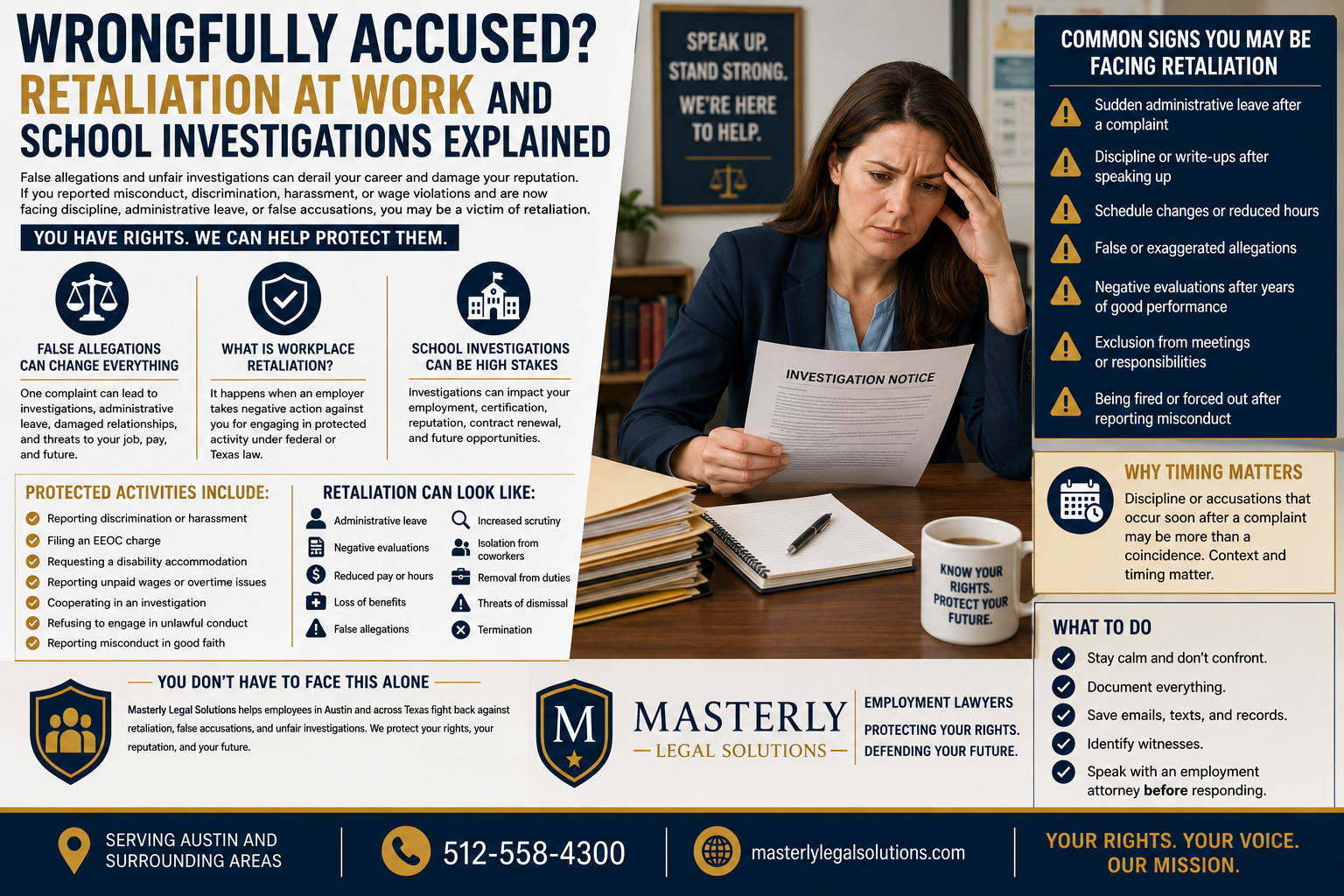
Wrongfully Accused? Retaliation at Work and School Investigations Explained
Being wrongfully accused at work can feel like your whole future is suddenly on the line. One day, you are doing your job, following procedures, and trying to protect your career. The next day, you may be called into a meeting, placed on administrative leave, or told that a complaint has been filed against you. For many employees, the most frightening part is not knowing whether the employer is truly investigating fairly or using the process as retaliation.
False allegations can be especially stressful in schools, offices, public agencies, and professional workplaces where reputation matters. A teacher, staff member, manager, or employee may face scrutiny after reporting misconduct, discrimination, harassment, unpaid wages, or unsafe practices. When the timing feels suspicious, it is important to understand your legal rights and the warning signs of workplace retaliation.
Masterly Legal Solutions helps workers understand how retaliation, school investigations, and false allegations can overlap. If you believe you were retaliated against after filing a complaint, cooperating with an investigation, or engaging in protected activity, speaking with an attorney may help you protect your job, pay, reputation, and future.
False Allegations Can Change Everything Quickly
False allegations can cause fear, anger, and confusion. Many employees immediately worry about being fired, losing benefits, being denied future opportunities, or damaging their professional name. These concerns are understandable because workplace accusations can affect more than one job.
In some cases, an employee is accused after making a report against a supervisor, manager, coworker, or department. The accusation may appear to be a coincidence, but sometimes it is part of a larger pattern of retaliation. This is why context matters when reviewing workplace allegations.
An employer may have the right to investigate a complaint, but the process should not be used as punishment. When an investigation is unfair, one-sided, or timed closely after protected conduct, it may raise serious legal concerns, and employers often rely on ongoing general counsel services for businesses to reduce those risks.
What Workplace Retaliation Means
Workplace retaliation happens when an employer takes negative action against an employee because the employee exercised protected rights. The Equal Employment Opportunity Commission explains that retaliation can occur when an employer takes a materially adverse action because a person engaged in activity protected by EEO laws.
Retaliation can follow reports of discrimination, harassment, wage violations, safety issues, or other misconduct. It may also happen after an employee participates as a witness or cooperates in an internal investigation. The Department of Labor notes that participation in an employment discrimination proceeding can be protected even if the underlying claims are not ultimately proven.
This means an employee should not be punished simply for speaking up in good faith. Federal law, Title VII, and related employment laws may prohibit retaliatory conduct depending on the facts.
Why Retaliation Often Looks Like Discipline
Retaliation rarely arrives with a label. An employer may not say, “We are retaliating against you.” Instead, the employee may suddenly receive write-ups, poor evaluations, schedule changes, or new accusations.
For example, an employee may file a complaint about harassment and then be accused of violating a minor workplace rule. Another worker may report unpaid wages and then lose overtime or face administrative leave. These examples show how retaliation can appear through ordinary employment decisions.
The key question is often whether the employer’s action was legitimate or whether it was connected to the protected complaint. An experienced retaliation lawyer for workplace retaliation can help determine whether the timing, evidence, and surrounding circumstances support retaliation claims.
Administrative Leave After a Complaint
Administrative leave can be confusing because it may sound neutral. In some workplaces, paid administrative leave and pay at work is used while an investigation is pending. In other situations, administrative leave may feel like punishment before the facts are known.
An employee placed on administrative leave should take the situation seriously. Even if the leave is paid, it may affect reputation, responsibilities, access to records, future assignments, and workplace relationships. If the administrative leave follows a discrimination complaint, harassment report, or wage complaint, the timing may matter.
Administrative leave is especially sensitive in schools because parents, coworkers, and students may notice the employee’s absence. A person may feel judged before having a chance to respond. That is why legal guidance can help protect both the employee’s rights and professional standing.
School Investigations and Workplace Retaliation
Schools often conduct investigations involving student safety, staff conduct, policy violations, or parent complaints. These investigations can be necessary, but they can also become unfair when used to target an employee who previously reported misconduct, which is why many educators turn to an education lawyer for teachers and schools for support.
For example, a teacher may report discriminatory treatment and later face allegations about classroom management. A coach may report harassment and then be removed from duties. A school employee may raise concerns about unpaid wages or labor violations and then face sudden scrutiny.
When schools investigate, the employee should understand the stakes. The outcome may affect employment, contract renewal, professional references, and future opportunities, particularly in higher education settings where higher education law services for schools may be needed.
False Allegations After Reporting Misconduct
False allegations may arise after an employee reports misconduct. This can include reports involving harassment, discrimination, unsafe practices, wage violations, or improper conduct by a supervisor. When a worker is accused shortly after making a report, the sequence of events matters.
An employer may claim the accusation is unrelated. However, retaliation claims often depend on timing, inconsistent treatment, and whether the employer handled similar issues differently for other employees.
Employees should avoid reacting emotionally, even when the allegations feel deeply unfair. A calm, documented response may help protect the employee and preserve important evidence.
Protected Activity in the Workplace
Protected activity generally means conduct that the law recognizes as protected from retaliation. This may include filing a complaint, opposing discriminatory behavior, requesting accommodations, reporting wage violations, or participating in an investigation.
Protected activity may include:
- Reporting discrimination or harassment
- Filing an EEOC charge
- Asking for disability accommodation
- Reporting unpaid wages or overtime issues
- Cooperating as a witness
- Refusing to engage in unlawful conduct
- Reporting misconduct in good faith
The Fair Labor Standards Act also prohibits retaliation against an employee who filed a complaint or cooperated in an investigation involving wage and hour issues.
Discrimination Complaints and Retaliation
Discrimination complaints can involve race, sex, national origin, religion, age, disability, or other protected categories. When an employee reports discriminatory conduct and then faces punishment, retaliation may be involved.
An employer cannot legally punish workers for opposing discriminatory practices. Retaliation may include demotion, exclusion, reduced pay, false allegations, denial of promotion, or termination. The law focuses on whether the action could discourage a reasonable employee from speaking up.
This is why many employees need help after filing a complaint. The complaint itself may be protected, but the employee still needs to protect their position during the investigation process.
Harassment Reports and Employer Response
Harassment complaints are often difficult to make. Many employees worry that reporting harassment will make them a target. Unfortunately, that fear is sometimes based on real workplace patterns.
An employee who reports harassment may suddenly be treated as the problem. A supervisor may question the employee’s attitude, performance, or professionalism. Human resources may appear more focused on protecting the employer than addressing the complaint fairly.
If harassment reporting leads to administrative leave, false allegations, or job threats, the employee should consult an attorney quickly. Early advice may help prevent mistakes that weaken the case.
Wage Complaints and Retaliation
Retaliation does not only involve discrimination or harassment. It may also involve wages, overtime, unpaid work, or pay disputes. The Fair Labor Standards Act establishes wage and overtime protections for many workers and prohibits retaliation tied to complaints or cooperation in investigations, which is why clear policies and legally compliant employee handbooks matter for both employers and employees.
For example, an employee may ask about unpaid overtime and then lose shifts. Another worker may report unpaid wages and then face discipline. A manager may complain about pay practices and then be removed from responsibilities, underscoring how a retaliation lawyer for workplace law help can be critical in wage-related disputes.
Workers should document wage concerns carefully. Pay records, schedules, emails, and time entries may be important if the employer retaliated.
Common Signs You May Be Facing Retaliation
Retaliation can take many forms. Some actions are obvious, while others are subtle and build over time. The pattern often matters as much as one single event.
Common examples include:
- Sudden administrative leave after a complaint
- Negative evaluations after years of good performance
- Reduced pay or hours
- Loss of benefits or opportunities
- False allegations
- Increased scrutiny
- Isolation from coworkers
- Removal from responsibilities
- Threats of dismissal
- Being fired after reporting misconduct
These examples do not automatically prove retaliation. However, they may justify a closer legal review.
Why Timing Matters So Much
Timing is often one of the most important facts in retaliation claims. If an employee files a complaint and is disciplined soon afterward, that timing may raise questions. The closer the events are, the more important it becomes to review the employer’s explanation.
For example, an employee who reports harassment on Monday and is placed on administrative leave on Friday may have reason to be concerned. The employer may still have a defense, but the sequence deserves attention.
An attorney can assess whether the employer had documented concerns before the complaint or only developed concerns afterward. That distinction can affect the strength of the claims.
Administrative Leave Is Not Always Neutral
Administrative leave may be presented as a routine step. However, employees should not assume it is harmless. It can affect pay, reputation, contract status, access to evidence, and workplace relationships.
In schools, administrative leave may create rumors even before facts are reviewed. In other workplaces, it can remove the employee from important projects or leadership duties. If the employee is placed on administrative leave after reporting discrimination, harassment, or unpaid wages, the situation should be evaluated carefully.
Paid leave is still important to review. The fact that pay continues does not always eliminate concerns about retaliation.
What to Do When You Are Wrongfully Accused
Being wrongfully accused can trigger panic, but the first response matters. Employees should avoid angry messages, social media posts, or emotional confrontations. Those reactions can be used against them later.
Instead, employees should focus on protecting themselves. They should document what happened, save communications, identify witnesses, and avoid signing statements they do not understand. They should also consider speaking with an employment attorney before responding in detail.
The goal is not just to defend against the accusation. The goal is to protect the employee’s future, legal rights, and ability to challenge retaliation if it occurred.
How to Document Your Side
Documentation can make a major difference. Memories fade, coworkers move on, and employers may control many internal records. Employees should keep organized notes and preserve documents when allowed by workplace policy and law.
Important documentation may include:
- Dates of complaints
- Names of witnesses
- Emails and written messages
- Pay records
- Leave notices
- Investigation letters
- Performance reviews
- Prior praise or awards
- Notes from meetings
Employees should not take confidential records unlawfully. However, maintaining a personal timeline and preserving documents they are allowed to keep can be helpful.
Why You Should Be Careful With Interviews
During an investigation, an employee may be asked to sit for an interview. This may feel informal, but it can have serious consequences. Statements made during interviews may later be used to justify discipline, termination, or dismissal.
Employees should listen carefully to each question and avoid guessing. They should ask for clarification when needed. They should not admit to misconduct they did not commit just to end the meeting.
If allegations are serious, it may be wise to consult legal counsel before the interview. An attorney can help the employee understand what is at stake and how to respond truthfully without creating confusion, and businesses may also benefit from independent internal investigation services to ensure the process is fair.
Retaliation and Human Resources
Many employees believe human resources will automatically protect them. HR may help in some cases, but HR usually works for the employer. That does not mean HR is always unfair, but employees should understand the role.
When a complaint is filed, HR may investigate, interview witnesses, and document findings. However, if the employee later faces retaliation, HR records may become important evidence. Employees should communicate clearly and professionally in writing when possible, and employers may rely on HR consulting services and training to handle these duties lawfully.
If HR ignores complaints or appears biased, that may become part of the broader retaliation analysis.
Retaliation by a Supervisor or Manager
Retaliation may come from a supervisor, manager, department leader, or higher executive such as a vice president. Sometimes the person retaliating is the same person accused of misconduct. In other cases, retaliation comes from someone trying to protect the organization.
A supervisor may retaliate through assignments, schedules, evaluations, discipline, or exclusion. A manager may create a record to justify future termination. These actions can be difficult to challenge without documentation.
Employees should track who made each decision and when. Identifying the decision-maker may help determine whether retaliation occurred.
When False Allegations Involve Police or Outside Agencies
Some workplace or school allegations may involve police or outside agencies. This can increase stress and create additional risks. Employees should be especially careful about statements in these situations.
If police are involved, the employee should avoid trying to explain everything without understanding the legal impact. A workplace investigation and a criminal investigation may overlap, but they are not the same. What is said in one setting may affect another.
False allegations involving police should be taken seriously. Employees should seek qualified legal support before making detailed statements.
Retaliation Based on Immigration Status
Retaliation may also involve threats related to immigration status. An employer should not use immigration concerns to silence workers who report wage violations, discrimination, harassment, or unsafe conditions. Threats of this kind can be deeply intimidating.
Workers may fear losing employment, being reported, or being unable to support their families. These fears can prevent people from filing a complaint or seeking help. However, retaliation laws may protect workers in many circumstances.
Anyone facing threats involving immigration status should consult an attorney. The right strategy depends on the facts and the type of claim involved.
Disability, FMLA, and Retaliation
Employees may also face retaliation after requesting disability accommodations or taking protected leave. A request for accommodation should not result in punishment. Employees should not be targeted for asserting rights related to disability or medical needs.
Retaliation may happen when an employer denies accommodation, changes duties, reduces pay, or starts discipline after a medical request. It may also arise when an employee uses FMLA leave and returns to a hostile workplace.
These cases often require careful review of medical documentation, communication history, and workplace policies. An attorney can help assess whether the employer’s actions were prohibited.
Retaliation Can Affect Pay, Benefits, and Future Work
Retaliation is not limited to being fired. It can affect pay, benefits, assignments, references, promotions, and career growth. Even when an employee keeps the job, the damage may still be serious.
For example, an employer may reduce overtime, deny approval for assignments, or remove leadership opportunities. A worker may keep the same title but lose responsibilities. Another employee may be pushed out slowly through isolation and unfair discipline.
These forms of retaliation can be just as damaging as immediate termination. Employees should not ignore patterns that affect their income or future.
Why Many Employees Stay Silent
Many employees stay silent because they fear making things worse. They may worry about being labeled difficult, losing income, or facing more accusations. This is especially true in schools and tight-knit workplaces where reputation travels quickly.
Silence may feel safer at first, but it can also allow the employer to control the narrative. If an employee never responds, documents concerns, or seeks advice, the record may become one-sided. That can make it harder to defend against allegations later.
Protecting yourself does not mean acting aggressively. It means being careful, informed, and strategic.
Filing With the EEOC
Some retaliation and discrimination claims may require filing with the EEOC before a lawsuit can proceed. The Equal Employment Opportunity Commission handles certain claims involving discrimination and retaliation under federal employment laws. The correct process depends on the facts, deadlines, and type of claim.
An employee should not assume there is unlimited time to act. Deadlines can pass quickly. Waiting too long may limit available remedies.
Because filing requirements can be technical, workers should seek legal advice early. A law firm can help determine whether an EEOC charge or other filing is appropriate.
What If the Complaint Against You Is Untrue?
If the complaint against you is untrue, your response should be thoughtful. Do not assume the truth will automatically come out. Investigations can be influenced by incomplete information, biased witnesses, or poor procedures.
You should ask what policy you are accused of violating, what facts are being reviewed, and whether you can provide documents or witnesses. You should also keep your own timeline of events.
False allegations can be corrected, but the process matters. A careful response can help protect your credibility and reduce the risk of an unfair outcome.
How Employers May Build a Paper Trail
Some employers build a paper trail after an employee complains. They may suddenly start documenting minor mistakes or creating disciplinary records. This can be a sign of retaliation, especially when prior performance was positive, and organizations may seek broader legal services for corporations and nonprofits to address systemic issues.
For example, an employee with strong reviews may suddenly receive written warnings after reporting harassment. A worker who complained about unpaid wages may suddenly be accused of poor attitude. A teacher who raised safety concerns may suddenly face administrative leave.
The paper trail should be compared to the employee’s full history. A sudden change may reveal retaliatory motives.
The Importance of Witnesses
Witnesses can help confirm what happened before and after a complaint. Coworkers may have seen harassment, heard discriminatory comments, or noticed retaliation. They may also know whether other employees were treated differently.
However, employees should be careful when contacting witnesses. Pressuring coworkers or discussing confidential matters can create new problems. It is often better to consult legal counsel about how to identify witnesses properly.
Witness information can be powerful when handled correctly. It may help challenge false allegations and support retaliation claims.
Retaliation in Schools Requires Special Care
School investigations often involve students, parents, administrators, and district procedures. Employees in schools may also worry about certification, contract renewal, and future references. Because of this, retaliation in school settings can carry long-term consequences.
A school employee may be placed on administrative leave while administrators investigate allegations. The employee may feel isolated and unable to access information needed for a defense. That isolation can make the process feel unfair.
Legal support can help the employee understand what to say, what to preserve, and how to respond. The goal is to protect both current employment and future professional opportunities.
When Retaliation Leads to a Lawsuit
Not every dispute becomes a lawsuit. Some matters resolve through internal correction, settlement discussions, or administrative processes. However, when retaliation causes serious harm, legal action may become necessary.
A lawsuit may seek remedies related to lost pay, emotional harm, reinstatement, policy changes, or other damages depending on the law involved. The available remedies depend on the claims, facts, and deadlines.
Before filing a lawsuit, an attorney will usually assess evidence, witnesses, damages, and risks. A strong legal strategy begins long before trial.
How Masterly Legal Solutions Helps Employees
Masterly Legal Solutions understands that employees facing false allegations need more than general information. They need clear direction, careful review, and a strategy designed to protect their future. Our firm helps workers evaluate whether retaliation, discrimination, harassment, wage violations, or unfair investigations may be involved.
We review the facts with attention to timing, documents, workplace history, and employer conduct. We help clients understand what steps may strengthen their position and what mistakes to avoid. We also work to protect employees from being pressured into unfair outcomes.
When your reputation and livelihood are at risk, having an attorney involved can provide clarity and protection.
Why Acting Early Can Protect Your Career
The earlier an employee seeks help, the more options may be available. Waiting until after termination or dismissal can make the situation harder to fix. Important evidence may disappear, witnesses may become harder to reach, and deadlines may approach.
Early legal review can help protect documents, prepare responses, and assess whether the employer is acting lawfully. It may also help prevent the employee from making statements that are incomplete or misunderstood.
If you believe you were retaliated against, do not wait until the damage becomes permanent. A timely consultation can help you understand your options.
Speak With Masterly Legal Solutions About Workplace Retaliation
If you were wrongfully accused after reporting misconduct, filing a complaint, opposing discrimination, questioning unpaid wages, or participating in an investigation, you deserve to know where you stand. False allegations can feel overwhelming, but you do not have to face the process alone.
Masterly Legal Solutions helps employees protect their rights when workplace retaliation, administrative leave, harassment, discrimination, or unfair investigations threaten their careers. We can review your situation, answer your questions, and help you understand possible next steps based on your circumstances.
Contact Masterly Legal Solutions at (972) 236-5051 for a free consultation. If your employer retaliated after you spoke up, our team is ready to help you protect your job, your pay, your reputation, and your future.
Disclaimer: This article is for educational and informational purposes only and is not legal guidance. Reading this article does not create an attorney-client relationship with Masterly Legal Solutions. If you need advice about your specific situation, contact a qualified attorney for guidance based on your individual facts.


Teacher Rights When Assaulted by a Special Needs Student: Safety, Reporting and Investigation Issues


Looking for Legal & Business Solutions? Contact Us Now
Fill in the form or call us to set up a meeting