
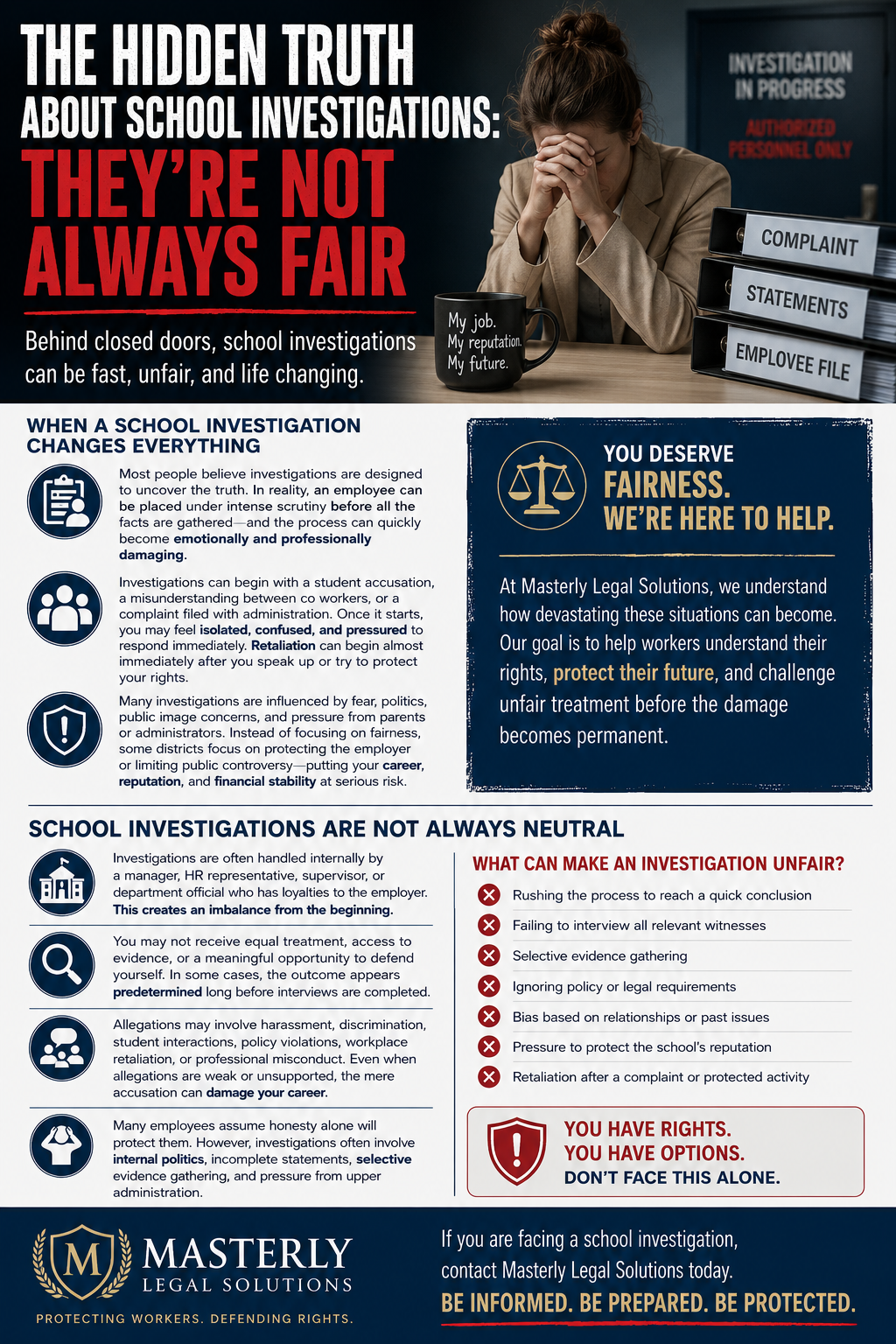
The Hidden Truth About School Investigations: They’re Not Always Fair
When a School Investigation Changes Everything
Most parents, teachers, administrators, and school employees believe that school investigations are designed to uncover the truth. In theory, an investigation should be fair, balanced, and focused on facts. Unfortunately, that is not always what happens behind closed doors. In many situations, an employee may suddenly find themselves under intense scrutiny before all the facts are gathered, and the process can quickly become emotionally and professionally damaging.
A school investigation can begin with something as simple as a student accusation, a misunderstanding between co workers, or a complaint filed with administration. Once the process starts, the employee may feel isolated, confused, and pressured to respond immediately. In some cases, retaliation begins almost immediately after a worker speaks up about misconduct or attempts to protect their rights.
The reality is that many school investigations are influenced by fear, politics, public image concerns, and pressure from parents or administrators. Instead of focusing on fairness, some school districts focus on protecting the employer or limiting public controversy. This creates serious risks for workers whose careers, reputations, and financial stability are suddenly placed in jeopardy.
At Masterly Legal Solutions, we understand how devastating these situations can become. Our goal is to help workers understand their rights, protect their future, and challenge unfair treatment before the damage becomes permanent.
School Investigations Are Not Always Neutral
Many people assume a school investigation is conducted by an unbiased professional searching for the truth. Unfortunately, investigations are often handled internally by a manager, human resources representative, supervisor, or department official who already has loyalties to the employer.
This can create a serious imbalance from the beginning. The employee being investigated may not receive equal treatment, access to evidence, or even a meaningful opportunity to defend themselves. In some situations, the outcome appears predetermined long before interviews are completed.
A workplace investigation inside a school system may involve allegations connected to harassment, discrimination, student interactions, policy violations, workplace retaliation, or professional misconduct. Even when allegations are weak or unsupported, the mere accusation can create a negative impact on the employee’s career.
Many school employees make the mistake of assuming honesty alone will protect them. However, investigations often involve internal politics, incomplete statements, selective evidence gathering, and pressure from upper administration. A reasonable employee may feel intimidated or fearful during this process, especially when their job and professional license are at risk.
The Emotional Toll on School Employees
Being accused of wrongdoing inside a school environment can be overwhelming. Teachers, counselors, coaches, aides, and administrators often dedicate years to helping students and supporting the community. When an investigation begins, the emotional damage can feel immediate and personal.
An employee may experience anxiety, embarrassment, fear, depression, and uncertainty about or her job and future. In many cases, the worker becomes socially isolated from co workers or excluded from meetings and school activities while the investigation is ongoing.
The emotional pressure becomes even worse when rumors begin spreading through the workplace. False rumors can quickly damage professional relationships and reputations. Some workers find themselves treated differently by administrators even before evidence is reviewed.
In certain circumstances, the employee may experience retaliatory conduct after raising concerns about unfair treatment or misconduct. This is especially common when the worker previously engaged in protected activity such as reporting discrimination, filing a complaint, or participating in another investigation.
How Retaliation Can Enter the Process
Retaliation is one of the most overlooked problems during school investigations. A worker who speaks up about misconduct may suddenly face disciplinary action, hostile treatment, or professional setbacks shortly afterward.
Under federal law, employers cannot retaliate against workers for engaging in protected activity. This protection applies to many forms of workplace actions, including reporting harassment, discrimination claims, wage concerns, safety issues, or other related protected activity.
Unfortunately, retaliation occurs more often than many people realize. In schools, retaliation may appear subtle at first. An employee could suddenly receive negative evaluations, reduced responsibilities, exclusion from committees, or increased scrutiny from a supervisor.
Over time, the conduct may escalate into more serious adverse action. This can include demotion, denial of promotion opportunities, transfer to a less desirable position, suspension, or termination. Some employees are reassigned from a desirable position into duties designed to pressure them into quitting.
Retaliation can also affect overall employee morale inside a school district. When workers see another employee punished for speaking up, many become afraid to report misconduct themselves.
Understanding Protected Activity in Schools
One of the most important legal concepts in employment law is protected activity. Employees often do not realize they are legally protected when reporting certain workplace concerns.
Protected activity may include:
- Filing a discrimination complaint
- Reporting harassment
- Participating in an internal investigation
- Cooperating with the eeoc
- Opposing unlawful workplace conduct
- Reporting wage violations
- Reporting verbal or physical abuse
- Raising concerns about disability accommodations
- Reporting possible discrimination based on national origin
- Reporting inappropriate sexual advances
- Supporting another employee involved in protected activity
Schools and other employers cannot legally punish workers simply because they exercise these rights. Federal laws and state laws exist to protect workers from retaliation connected to legally protected conduct.
However, retaliation claims can become difficult to prove without proper documentation and legal guidance. Many employers attempt to disguise retaliatory conduct as performance concerns or policy enforcement.
The Role of Discrimination in School Investigations
Discrimination remains a serious issue in many educational workplaces. School employees may face unfair treatment connected to age, race, disability, sex, religion, immigration status, or family responsibilities.
In some cases, an investigation itself becomes a tool for discrimination. One employee may receive aggressive discipline while another worker accused of similar conduct receives little or no punishment. This unequal treatment can become evidence of discrimination.
Title vii and other federal protections prohibit retaliation and discrimination in employment settings. Schools must follow these laws regardless of their size or public status.
An employee may notice signs of discrimination during an investigation when:
- Certain witnesses are ignored
- Complaints from one group are taken more seriously
- A supervisor uses biased language
- Discipline is inconsistent
- Workers with disability accommodations face harsher treatment
- Employees from certain backgrounds face greater scrutiny
These circumstances can create grounds for legal claims if the investigation process becomes unfair or discriminatory.
Why Teachers Often Feel Powerless
Teachers and school staff frequently feel trapped during investigations because they fear losing their professional reputation or certification. Even a false allegation can affect future employment opportunities.
Many employees worry that challenging the employer will only make matters worse. This fear is understandable because retaliation may occur in subtle forms that are difficult to identify immediately.
For example, a teacher who previously reported harassment might suddenly lose leadership duties or coaching assignments. Another worker may be excluded from training opportunities or denied promotion opportunities without explanation.
Some employees experience hostile treatment from administration after filing concerns. Others may notice a sudden change in evaluations, communication, or disciplinary standards.
When retaliation begins, many workers second guess themselves and wonder whether they are overreacting. In reality, the behavior may represent a serious possible violation of employment laws.
Common Examples of Unfair School Investigations
Every situation is different, but certain patterns appear repeatedly in unfair school investigations. Understanding these warning signs can help workers recognize when their rights may be at risk.
Investigations Based on One-Sided Information
Some investigations rely heavily on accusations without thoroughly reviewing evidence. A manager or supervisor may accept one version of events without interviewing all witnesses.
This creates an unfair process where the employee never receives a meaningful chance to respond.
Pressure to Resign Quickly
In certain cases, the employer pressures the worker to resign before completing the investigation. Employees may be told resignation is their “best option” even when allegations remain unproven.
Resigning too quickly can seriously affect future legal claims and employment opportunities.
Selective Enforcement of Policies
An employer may punish one employee while ignoring similar conduct from others. This selective enforcement can become evidence of retaliation or discrimination.
Retaliation After a Complaint
A worker files a complaint about harassment or discrimination and soon afterward faces disciplinary action, reassignment, or termination. Timing can become important evidence in a retaliation claim.
Ignoring Important Witnesses
Sometimes investigators refuse to interview witnesses who support the employee’s version of events. This creates an incomplete and biased investigation process.
Harassment Complaints Can Become Complicated
Schools must take harassment allegations seriously, but investigations must still remain fair. Unfortunately, some employers overcorrect by assuming accusations automatically equal guilt.
Harassment allegations may involve students, parents, co workers, administrators, or outside contractors. The complexity of these situations often creates confusion and emotional tension.
In some cases, workers who report harassment later experience retaliation themselves. An employee may report inappropriate sexual advances or hostile conduct only to face negative treatment afterward.
Federal laws protect workers from retaliation connected to harassment complaints. The law recognizes that employees should feel safe reporting misconduct without fear of punishment.
However, employers sometimes attempt to isolate or silence the reporting employee instead of addressing the underlying problem.
The Impact on Career and Reputation
A school investigation can follow an employee long after the matter ends. Even when allegations are disproven, rumors and suspicion may remain inside the workplace.
Some workers lose future promotion opportunities or leadership positions because administrators view them as a “problem employee.” Others struggle to find new employment after being forced out during an investigation.
The financial consequences can also become severe. Lost wages, reduced employment opportunities, emotional distress, and damage to reputation may affect a worker for years.
Many employees underestimate how quickly a workplace issue can escalate into a career crisis. Seeking legal guidance early can help protect both professional and personal interests.
How Employers Attempt to Protect Themselves
Many school districts prioritize protecting the company or institution from public criticism and liability exposure. Unfortunately, this sometimes means sacrificing fairness toward individual employees.
An employer may attempt to create documentation supporting discipline after an employee engages in protected activity. In other situations, administration may suddenly begin documenting minor mistakes that were previously ignored.
This pattern often appears in retaliation cases. The worker reports misconduct, and shortly afterward the employer begins building a negative record against them.
Some school employees are shocked to discover how quickly attitudes change after filing a report or complaint. Administrators who once appeared supportive may suddenly become distant or adversarial.
The Legal Definition of Retaliation
The legal definition of retaliation generally involves an employer taking adverse action against an employee because they engaged in protected activity.
Adverse action can include many forms of punishment or professional harm. It does not always require termination. Courts recognize that retaliation can involve subtle actions that discourage workers from reporting misconduct.
Example situations may include:
- Demotion
- Reduced wages
- Denial of promotion
- Unfair disciplinary write-ups
- Exclusion from meetings
- Schedule changes
- Increased scrutiny
- Transfer to a less desirable position
- Threats or intimidation
- Hostile treatment
Retaliation laws exist because lawmakers understand employees are less likely to report misconduct if they fear punishment.
Federal Protections for School Workers
Several federal laws protect school employees during workplace disputes and investigations. These protections apply to many public and private educational institutions.
The equal employment opportunity commission enforces important federal anti discrimination laws. The eeoc investigates claims involving retaliation, harassment, and workplace discrimination.
Federal employees working in educational settings may also receive additional protections under federal employment rules.
Title vii protects workers from discrimination connected to race, sex, religion, and national origin. Other laws protect workers with disability accommodations or workers reporting unlawful conduct.
These protections exist to encourage workers to report wrongdoing without fear of retaliation.
Retaliation Often Happens Gradually
Many workers expect retaliation to appear immediately and dramatically. In reality, retaliation often develops slowly over time.
An employee may first notice subtle changes in behavior from a manager or supervisor. Communication becomes colder. Meetings suddenly occur without them. Performance criticism increases without clear explanation.
Over time, these small changes may grow into more serious adverse action. The worker may eventually face suspension, transfer, or termination.
Because retaliation may develop gradually, documentation becomes extremely important. Employees should keep records of complaints, meetings, emails, disciplinary actions, and timeline details.
How Workplace Morale Suffers
Unfair investigations do not only harm the targeted employee. They also damage overall employee morale throughout the school system.
Workers who witness unfair treatment often become fearful of speaking honestly. Employees may avoid reporting misconduct because they worry the employer will retaliate against them.
This fear creates a toxic workplace culture where problems remain hidden instead of addressed properly.
Healthy schools depend on trust, accountability, and fairness. When retaliation and discrimination are ignored, employee morale declines and workplace relationships suffer.
The Importance of Documentation
One of the most powerful tools an employee has during an investigation is documentation. Clear records may later help establish timelines, inconsistencies, or retaliatory conduct.
Workers should consider documenting:
- Emails
- Text messages
- Meeting summaries
- Performance reviews
- Witness information
- Disciplinary notices
- Complaint filings
- Schedule changes
- Promotion denials
Proper documentation may become critical evidence if legal claims later arise.
What Employees Should Avoid During an Investigation
When emotions run high, workers sometimes make decisions that unintentionally hurt their case. Remaining calm and strategic is extremely important.
Avoid Emotional Confrontations
Angry confrontations with a supervisor or manager may later be used against the employee.
Avoid Deleting Information
Destroying emails or records can create additional problems during an investigation.
Avoid Assuming the Investigation Is Fair
Employees should not assume the employer is fully neutral. Protecting your interests matters.
Avoid Resigning Too Quickly
Some employers pressure workers into resigning before they fully understand their legal rights.
School Investigations Involving Disability Concerns
Employees with disability accommodations may face additional challenges during workplace disputes. Sometimes performance concerns are connected to medical limitations the employer failed to address properly.
Federal laws require employers to consider reasonable accommodations in many circumstances. Punishing an employee for requesting accommodations may create legal issues for the employer.
Workers dealing with disability concerns should carefully document all communication related to accommodations, job duties, and disciplinary action.
When Harassment Complaints Lead to Retaliation
Ironically, workers who report harassment often become targets themselves. After filing a complaint, the employee may suddenly experience exclusion, criticism, or disciplinary pressure.
Retaliation connected to harassment complaints is prohibited under federal laws. Employees should not face punishment for reporting unlawful conduct in good faith.
Example situations may include:
- Negative schedule changes
- Increased monitoring
- Unfair evaluations
- Exclusion from training
- Reduction in responsibilities
- Hostile comments from management
Recognizing these warning signs early can help workers respond strategically.
The Role of Human Resources
Many employees assume human resources exists primarily to protect workers. In reality, HR departments often focus on protecting the employer from legal liability.
This does not mean every HR professional acts unfairly. However, workers should understand that HR investigations may prioritize institutional interests over employee concerns.
Employees should remain professional and cooperative while also protecting their rights throughout the process.
Why Timing Matters in Retaliation Claims
Timing frequently becomes important evidence in retaliation cases. If adverse action occurs shortly after protected activity, the connection may raise legal concerns.
For example, an employee files a report about discrimination and then suddenly receives disciplinary write-ups weeks later. This timing may support a retaliation claim depending on the circumstances.
Courts often examine whether the employer’s explanation is consistent, documented, and supported by evidence.
Workers Have Rights Even During Investigations
Many school employees mistakenly believe they lose all rights once an investigation begins. That is not true.
Workers still have legal protections against discrimination, retaliation, harassment, and unfair treatment. Employers must follow applicable laws during disciplinary processes and workplace investigations.
An employee does not have to simply accept unfair treatment without questioning the process.
Internal Complaints Should Be Taken Seriously
Filing an internal complaint can be stressful, especially when the complaint involves a supervisor or manager. However, documenting concerns internally may later become important evidence.
Employees should remain factual, professional, and organized when submitting concerns. Emotional accusations without supporting details may weaken credibility.
Including dates, witnesses, and specific examples often strengthens a complaint.
How False Allegations Can Escalate Quickly
False allegations inside a school environment can spread rapidly. Once rumors circulate, the employee may struggle to restore their reputation even if cleared of wrongdoing.
Some investigations become influenced by politics, parental pressure, or media concerns instead of objective facts.
Workers facing false accusations should seek guidance early instead of assuming the truth will automatically prevail.
Training Failures Can Create Legal Problems
Poor training inside schools often contributes to investigation mistakes and unlawful workplace behavior.
Managers and supervisors should receive proper training on:
- Retaliation prevention
- Harassment investigations
- Discrimination laws
- Documentation procedures
- Employee rights
- Complaint handling
Without proper training, school leaders may unintentionally create legal exposure for the employer.
Retaliation Can Affect Families Too
The consequences of retaliation often extend beyond the workplace. Lost wages, emotional stress, and career instability can affect an employee’s family member relationships and financial security.
Workers with family responsibilities may feel especially vulnerable during investigations because they depend on stable employment and benefits.
This emotional pressure sometimes causes employees to remain silent even when facing unfair treatment.
Recognizing When Legal Help May Be Necessary
Not every workplace dispute requires legal action. However, certain warning signs suggest an employee should seek additional information about their rights.
These warning signs may include:
- Sudden termination after filing a complaint
- Reassignment to a less desirable position
- Repeated retaliation
- Severe harassment
- Discrimination connected to disability or national origin
- Pressure to resign
- Retaliatory conduct after protected activity
- Unfair investigation procedures
Early legal guidance may help workers avoid mistakes that could damage future claims.
The Long-Term Impact of Unfair Investigations
Many workers focus only on surviving the immediate crisis. However, the long-term impact of unfair investigations can last for years.
Professional licenses, future employment, emotional health, and financial stability may all be affected. Some employees leave the profession entirely after experiencing retaliation or discrimination.
Protecting your career requires understanding your rights before the situation escalates further.
Schools Must Follow Employment Laws
Educational institutions are not exempt from employment laws simply because they serve students. Schools still have legal obligations to protect workers from retaliation, discrimination, and harassment.
Employers who ignore these responsibilities may face legal claims, investigations, or even lawsuit exposure under federal and state laws.
Workers deserve fair treatment regardless of their role within the school system.
Why Silence Helps the Wrong People
Many employees remain silent because they fear retaliation or professional damage. Unfortunately, silence often allows misconduct to continue.
When workers are punished for reporting concerns, the workplace culture becomes more toxic over time. Other employees become afraid to engage in protected activity, report misconduct, or cooperate with investigations.
This environment benefits those abusing power rather than the workers trying to protect students and staff.
Protecting Yourself During a School Investigation
Employees facing investigations should remain calm, organized, and proactive. Taking proactive steps early may help protect both professional and legal interests.
Important actions may include:
- Preserving documentation
- Remaining professional
- Avoiding emotional confrontations
- Understanding workplace policies
- Seeking legal guidance when necessary
- Tracking timelines carefully
- Identifying potential witnesses
These actions may strengthen the employee’s position if disputes escalate further.
Fairness Should Never Be Optional
Every worker deserves fairness, dignity, and respect during a workplace investigation. Unfortunately, many school employees discover too late that investigations are not always objective or balanced.
Retaliation, discrimination, and harassment can quietly influence workplace decisions in ways that seriously harm careers and reputations.
Understanding your rights is one of the strongest ways to protect yourself when facing scrutiny from an employer or school administration. Workers should never assume they must navigate these situations alone.
How Federal Agencies Investigate Retaliation and Workplace Misconduct
Many school employees do not realize that federal agencies may become involved when serious retaliation, discrimination, or harassment allegations arise inside the workplace. Agencies such as the Equal Employment Opportunity Commission and other federal enforcement offices are responsible for reviewing complaints connected to unlawful employment practices. When an employee reports misconduct involving discrimination, disability violations, or retaliation for protected activity, these agencies may investigate whether the employer violated federal laws. In some situations, the findings of a federal review can significantly affect both the worker and the school district involved.
An employer that ignores workplace complaints or fails to properly address misconduct may face legal and financial consequences. Federal agencies often examine whether the company followed proper procedures, treated the employee fairly, and responded appropriately to reports of harassment or retaliation. These investigations can also uncover patterns of misconduct affecting multiple workers within the same department or school system. For employees facing unfair treatment, understanding how federal oversight works may help them recognize that they are not powerless during the process.
Negative Action Can Be a Warning Sign of Retaliation
Retaliation does not always begin with termination or suspension. In many cases, the first warning sign is a subtle negative action taken against the employee shortly after they engage in protected activity. A worker who previously received positive evaluations may suddenly face increased scrutiny, exclusion from meetings, or criticism from a supervisor or manager. These actions may appear minor individually, but together they can create a hostile workplace environment that places significant pressure on the employee.
A negative action may also include reduced responsibilities, sudden schedule changes, denial of resources, or unfair disciplinary write-ups. Some employers attempt to justify these decisions as routine management actions even when the timing strongly suggests retaliation. Employees should carefully document any sudden workplace changes that occur after filing a complaint, participating in an investigation, or reporting discrimination or harassment. Recognizing these patterns early may help protect the worker’s legal rights and future employment opportunities.
Retaliation Can Damage Promotional Opportunities
One of the most frustrating forms of retaliation occurs when an employee quietly loses access to promotional opportunities after speaking up about workplace concerns. A worker who once appeared on track for leadership roles may suddenly be overlooked for advancement without a clear explanation. In many school environments, administrators control committee assignments, leadership positions, coaching responsibilities, and other opportunities that can influence long-term career growth.
An employer may attempt to hide retaliation by claiming another candidate was simply “a better fit” for the position. However, when promotional opportunities disappear shortly after protected activity or a complaint, the timing may raise serious legal concerns. Employees who experience this type of treatment often feel trapped because the retaliation is harder to prove than outright termination. Even so, the long-term financial and professional impact can be severe, especially when lost advancement affects wages, benefits, and future career prospects.
Illegal Retaliation Is More Common Than Many Workers Realize
Many employees assume retaliation must involve dramatic or obvious misconduct to be considered illegal. In reality, unlawful retaliation can take many forms inside the workplace. An employer may retaliate against a worker for reporting harassment, discrimination, safety concerns, wage violations, or other protected activity under federal or state laws. Even subtle acts designed to punish or intimidate an employee may violate employment protections depending on the circumstances.
Illegal retaliation can include demotion, reassignment, unfair discipline, hostile treatment, reduced wages, or termination after a complaint or workplace report. Some employers attempt to disguise retaliatory conduct as ordinary policy enforcement, making it difficult for workers to immediately recognize what is happening. Employees should never assume they must tolerate unfair treatment simply because the retaliation is indirect or gradual. Understanding your rights and seeking guidance early may help protect your career, reputation, and future employment opportunities.
Workplace Retaliation Can Happen After Speaking Up
Many school employees are shocked to discover how quickly workplace retaliation can begin after they report misconduct or raise concerns about unfair treatment. A teacher, counselor, administrator, or staff member may believe they are doing the right thing by reporting harassment, discrimination, or policy violations, only to face sudden hostility from a supervisor or manager afterward. In many situations, retaliation appears through subtle actions at first, including exclusion from meetings, increased scrutiny, or unfair criticism related to job performance.
Over time, the retaliation may become more serious and damaging to the employee’s career. Some workers experience disciplinary write-ups, reduced responsibilities, denial of leadership opportunities, or even termination shortly after engaging in protected activity. Workplace retaliation not only harms the targeted worker, but it can also damage trust throughout the entire workplace. When employees become afraid to report concerns, serious misconduct often continues unchecked inside the school environment.
The Equal Employment Opportunity Commission Plays an Important Role
The equal employment opportunity commission, commonly known as the EEOC, is responsible for enforcing federal employment laws that protect workers from retaliation, harassment, and discrimination. School employees who believe they have experienced unlawful treatment may file complaints with this federal agency to begin the process of reviewing potential violations. The EEOC investigates claims involving race, disability, sex, religion, age, and other protected categories under federal law.
In some circumstances, the EEOC may request documents, interview witnesses, or review workplace policies to determine whether an employer acted unlawfully. These investigations can become extremely important when a school district fails to properly address employee concerns internally. Workers should understand that filing with the equal employment opportunity commission may involve deadlines and procedural requirements that affect their legal rights. Seeking guidance early may help employees better understand the process and avoid costly mistakes.
Workplace Discrimination Can Be Difficult to Prove
Workplace discrimination does not always appear through obvious statements or direct admissions. In many schools, discrimination occurs through patterns of unequal treatment that slowly affect an employee’s career, reputation, or advancement opportunities. A worker may notice they are disciplined more harshly than others, excluded from important meetings, or denied support provided to other employees in similar situations.
Workplace discrimination may involve race, disability, religion, age, sex, family responsibilities, or national origin. In some cases, a supervisor or manager may attempt to disguise discriminatory conduct as routine discipline or policy enforcement. Unfortunately, employees often question themselves and wonder whether the treatment is truly unfair. Careful documentation and understanding employment laws can become extremely important when trying to identify and challenge discrimination in the workplace.
Immigration Status Should Never Be Used as a Tool for Intimidation
Some workers fear reporting misconduct because they worry their immigration status could be used against them during a workplace dispute. Employers who exploit these fears may create an intimidating and hostile work environment that discourages employees from speaking honestly about harassment, retaliation, or discrimination. Workers should understand that many employment protections still apply regardless of immigration status.
Retaliation or threats connected to immigration concerns may create serious legal issues for an employer. School employees should never feel pressured into silence because of fear or intimidation tactics. When an employer attempts to use immigration status as leverage during an investigation or complaint process, the emotional and professional impact can become overwhelming for the worker and their family member relationships. Understanding your rights is critical in these circumstances.
Discrimination Claims Often Begin With Small Warning Signs
Many discrimination claims start with subtle workplace changes that employees initially dismiss or overlook. A teacher or staff member may suddenly receive negative evaluations after years of positive performance reviews. Another employee may lose committee assignments, training opportunities, or support from administration without clear explanation.
Over time, these patterns may reveal larger problems involving discrimination, retaliation, or harassment. Employees should pay close attention to changes in treatment that occur after protected activity or complaints about workplace misconduct. Keeping records of conversations, evaluations, and disciplinary actions may later become valuable evidence if discrimination claims arise. Workers who recognize warning signs early are often in a stronger position to protect their careers and legal rights.
Family Responsibilities Can Increase Workplace Pressure
School employees with family responsibilities often face additional stress during workplace investigations or retaliation disputes. Many workers rely on stable employment, healthcare benefits, and predictable wages to support children, spouses, or aging relatives. When an employer suddenly places an employee under investigation or disciplinary pressure, the emotional toll can affect the entire household.
Some employees remain silent about harassment or discrimination because they fear losing financial stability for their family. Others feel pressured to accept unfair treatment because they cannot risk interruption to their employment. Employers should never exploit these vulnerabilities to pressure workers into silence or resignation. Fair treatment and respect in the workplace are essential regardless of an employee’s personal responsibilities outside of work.
Adverse Action May Take Many Different Forms
An adverse action is not limited to termination or suspension. Under employment laws, many workplace decisions can qualify as adverse action when they negatively affect an employee after protected activity or a complaint. For example, a worker may suddenly lose leadership duties, coaching assignments, schedule flexibility, or professional development opportunities after reporting misconduct.
In some situations, adverse action appears through increased scrutiny, hostile treatment, or reassignment to less favorable duties. Employers sometimes believe subtle retaliation will go unnoticed because the employee technically remains employed. However, courts and enforcement agencies recognize that many actions can discourage workers from reporting discrimination or harassment. Understanding how adverse action works can help employees recognize potential retaliation before the situation escalates further.
National Origin Discrimination Still Occurs in Schools
Although many schools promote diversity and inclusion, national origin discrimination remains a serious concern in some workplaces. Employees may face unfair treatment because of their accent, ethnicity, cultural background, or perceived nationality. In certain situations, co workers, parents, or supervisors may make inappropriate comments or assumptions that create a hostile environment for the employee.
National origin discrimination may also appear through unequal discipline, denial of opportunities, or harsher scrutiny during workplace investigations. Employees who experience this type of treatment may feel isolated or fearful about reporting concerns. Schools and employers have a legal obligation to address discriminatory conduct and maintain a professional workplace where all workers are treated fairly and respectfully.
Title VII Protects Employees From Discrimination and Retaliation
Title vii is one of the most important federal employment laws protecting workers from discrimination and retaliation. This law prohibits employers from discriminating against employees based on race, sex, religion, color, or national origin. It also protects workers who report misconduct, participate in investigations, or oppose unlawful workplace practices.
School employees often do not realize how broad these protections can be. A worker may still have legal protections even if they were not the direct target of discrimination. Employees who support another worker’s complaint or participate in an investigation may also be protected from retaliation under title vii. Understanding these protections can help workers recognize when an employer’s conduct may cross legal boundaries.
Seeking Additional Information Can Help Protect Your Rights
Employees facing retaliation, discrimination, or workplace investigations often feel overwhelmed and uncertain about what steps to take next. Seeking additional information early in the process may help workers better understand their legal protections and avoid decisions that could negatively affect their future claims or employment opportunities.
Every workplace situation is different, and the facts surrounding a complaint or investigation can significantly affect the outcome. Speaking with a legal professional may help employees evaluate documentation, identify possible violations, and develop a strategy for protecting their rights. Workers should never assume they must face retaliation, harassment, or discrimination alone, especially when their career and reputation are on the line.
Speak With Masterly Legal Solutions About Your Concerns
If you are facing retaliation, harassment, discrimination, or an unfair school investigation, Masterly Legal Solutions is here to help you understand your rights and options. Workplace disputes can become overwhelming very quickly, especially when your career, reputation, and financial stability are at stake. Our team understands how stressful these circumstances can feel, and we are committed to helping workers protect themselves against unfair treatment.
Whether you recently filed a complaint, reported misconduct, experienced adverse action, or believe your employer may be violating workplace laws, we encourage you to reach out for additional information about your situation. Every case is different, and speaking with a legal professional early may help you avoid costly mistakes during the investigation process.
Contact Masterly Legal Solutions at (972) 236-5051 for a free consultation. We can answer your questions, discuss your concerns, and help you better understand your legal protections related to workplace retaliation, discrimination, harassment, and employment disputes.
Disclaimer: This article is provided for educational and informational purposes only. It does not create an attorney-client relationship and should not be considered legal advice. Every situation is unique, and laws may vary depending on specific facts and circumstances. For legal guidance regarding your particular case, contact Masterly Legal Solutions directly.


Teacher Rights When Assaulted by a Special Needs Student: Safety, Reporting and Investigation Issues


Looking for Legal & Business Solutions? Contact Us Now
Fill in the form or call us to set up a meeting