

UIL Violations and Disciplinary Actions: What Students and Coaches Need to Know
For many families across Texas, participation in the University Interscholastic League represents much more than an extracurricular activity. It provides opportunities for students to develop leadership, discipline, teamwork, and confidence while participating in athletics, academics, fine arts, and other competitive programs. Whether a student dreams of playing high school football, performing in music contests, competing in academic contests, or representing their campus at the state level, eligibility often determines whether those opportunities remain available.
When questions arise about possible UIL violations, however, the situation can become stressful very quickly. A misunderstanding involving paperwork, residency, transfers, recruiting allegations, academic performance, or compliance with UIL rules may lead to investigations, disciplinary actions, or disputes that affect both individual students and entire teams. In some situations, a single decision can influence awards, schedules, championships, or future opportunities.
At Masterly Legal Solutions, we understand how overwhelming these situations can feel. Students, parents, coaches, and school administrators often find themselves trying to interpret detailed regulations while balancing educational responsibilities and competitive goals. Having a clear understanding of the rules and knowing how to respond can make an important difference when questions about compliance arise.
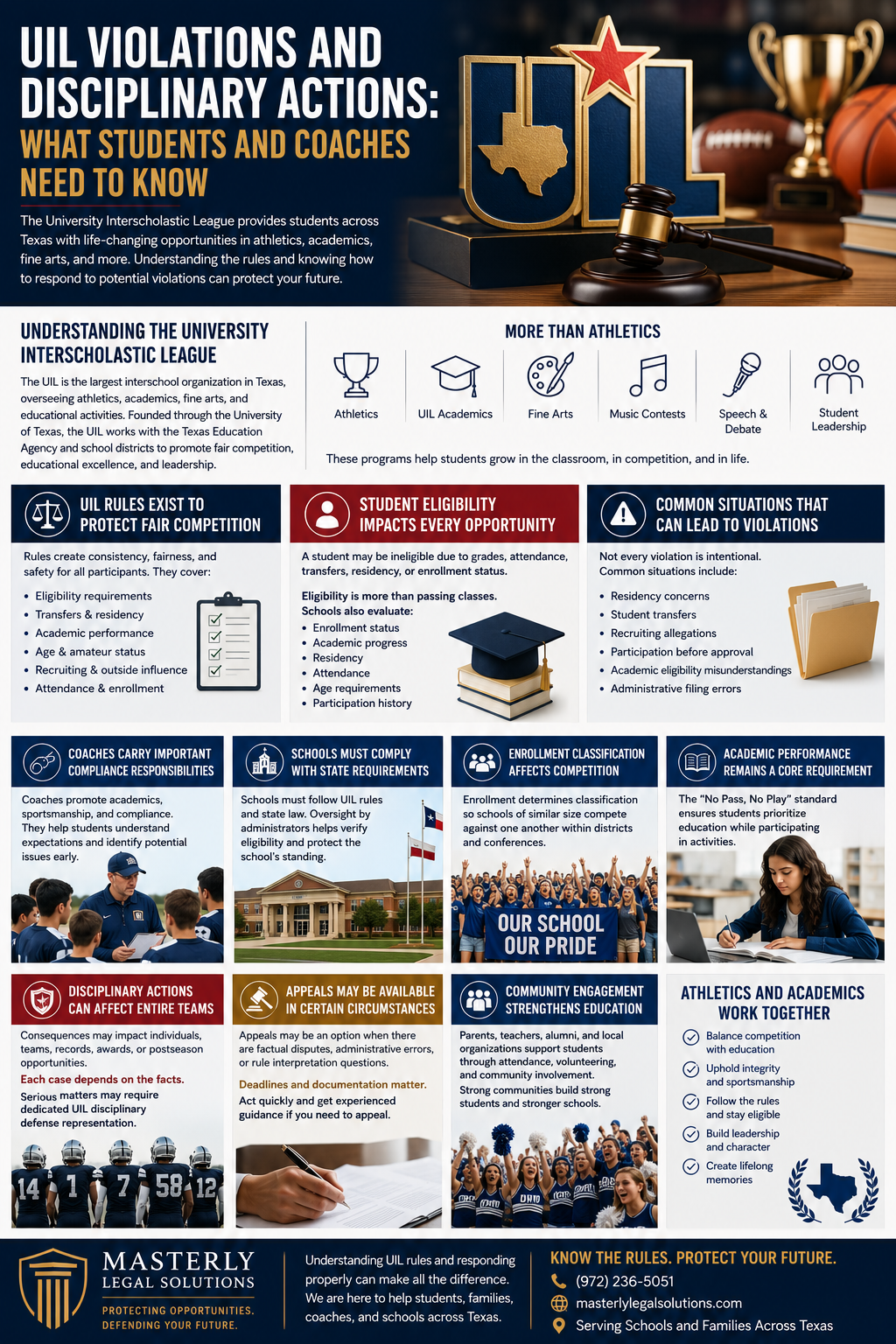
Understanding the Role of the University Interscholastic League
The University Interscholastic League is recognized as the largest inter school organization in Texas responsible for administering a wide variety of educational extracurricular academic and athletic activities. The organization oversees competitions involving athletics, academics, fine arts, music, speech, debate, and many other student activities conducted during the school year.
Originally established through the University of Texas, the University Interscholastic League continues to provide governance for public school competitions throughout the state. Working alongside the Texas Education Agency, school districts, and participating campuses, the organization establishes eligibility standards, competition procedures, and administrative requirements that schools are expected to follow.
Its mission extends beyond competition. The organization promotes educational excellence, sportsmanship, leadership, and personal development while encouraging fair participation among schools of varying enrollment sizes.
More Than Athletics
Many people associate UIL only with athletics, but its responsibilities are much broader.
The organization oversees:
- UIL academics
- Fine arts
- Music contests
- Speech and debate
- Athletic competitions
- Academic enrichment programs
- Student leadership opportunities
These activities provide students with opportunities to grow inside and outside the classroom.
UIL Rules Exist to Protect Fair Competition
Every competitive organization requires standards that create consistency and fairness. UIL rules help establish those expectations by outlining eligibility requirements, participation standards, safety procedures, and administrative responsibilities for schools throughout Texas.
These rules apply to many areas of student participation, including transfers, residency, enrollment, age limitations, academic standing, amateur status, recruiting concerns, and attendance requirements.
While many regulations appear straightforward, certain situations involve exceptions that require careful review before decisions are made.
Student Eligibility Impacts Every Opportunity
One of the most important areas governed by UIL involves student eligibility.
A student may excel academically and athletically but still become temporarily or permanently ineligible if eligibility requirements are not satisfied. Eligibility questions frequently involve grades, attendance, transfers, enrollment status, age requirements, residency documentation, or academic progress.
Understanding eligibility before problems develop helps reduce the likelihood of unexpected disciplinary action later in the school year.
Eligibility Is More Than Passing Classes
Although grades are important, they represent only one portion of the eligibility process.
Schools also evaluate factors such as:
- Enrollment status
- Academic progress
- Residency
- Attendance
- Age requirements
- Participation history
Every factor contributes to determining whether a student remains eligible to compete.
Common Situations That Can Lead to Violations
Not every alleged violation results from intentional misconduct.
Many cases develop because families misunderstand regulations or because schools encounter unexpected administrative issues.
Examples may include:
- Residency concerns
- Student transfers
- Recruiting allegations
- Participation before approval
- Academic eligibility misunderstandings
- Administrative filing errors
Each situation requires careful evaluation because the surrounding facts often determine how the matter is resolved.
Coaches Carry Important Compliance Responsibilities
Successful coaches do far more than prepare athletes for competition.
They also help students understand expectations regarding conduct, academics, attendance, practice requirements, and compliance with UIL regulations.
Because coaches work directly with students throughout the season, they frequently identify potential concerns before they become larger problems.
Maintaining accurate communication between students, parents, and school administrators helps reduce misunderstandings.
Schools Must Comply With State Requirements
Every participating school is expected to comply with rules established by the University Interscholastic League and applicable state law.
School administrators often coordinate with athletic directors, counselors, principals, and district personnel to verify eligibility before competition begins.
Failure to comply may affect individual participants, entire teams, or the school's standing within competition.
Administrative oversight remains an important part of maintaining compliance throughout the year.
Enrollment Classification Affects Competition
The number of enrolled students influences how schools are grouped for competition.
Enrollment determines classification, allowing schools of similar size to compete against one another within designated districts and conferences.
This structure promotes competitive balance across Texas while helping schools participate against institutions with comparable student populations.
Changes in enrollment may affect future classifications and competitive schedules.
Competing Within the Same Conference
Schools assigned to the same conference generally compete against one another during regular-season competition before advancing toward regional and state contests.
These classifications help create fairness while maintaining organized competition throughout the state.
Understanding conference assignments allows schools to properly prepare schedules and postseason expectations.
Academic Performance Remains a Core Requirement
Athletics represent only one portion of the UIL experience.
Academic success remains central to participation because students are expected to maintain satisfactory academic progress while representing their schools.
The "No Pass, No Play" requirements remind participants that education remains the primary purpose of school-sponsored extracurricular activities.
Maintaining strong classroom performance protects eligibility throughout the season.
Disciplinary Actions Can Affect Entire Teams
Certain violations may extend beyond one individual.
Depending on the circumstances, disciplinary actions sometimes affect coaches, teams, schools, competitive records, awards, or postseason advancement.
Potential consequences vary depending upon the specific facts involved.
Every allegation deserves careful review before conclusions are reached, and in serious cases students, coaches, and schools may need dedicated UIL disciplinary defense representation.
Appeals May Be Available in Certain Circumstances
Not every eligibility determination represents the final outcome.
Some situations permit appeals, particularly when factual disputes, administrative errors, or questions regarding rule interpretation exist.
Understanding available appeal procedures can provide schools and families with an opportunity to present additional information before final decisions are made.
Because appeal procedures often involve deadlines and documentation requirements, prompt action becomes important, and many families benefit from experienced guidance when navigating complex UIL appeal processes across Texas.
Community Engagement Strengthens Educational Programs
Participation in UIL activities extends well beyond competition.
Communities frequently support students through attendance, volunteer efforts, fundraising, and community engagement initiatives that celebrate academic and athletic achievement.
Parents, teachers, alumni, and local organizations contribute to environments where students develop confidence and leadership skills.
These experiences often create lifelong memories while strengthening connections between schools and their communities.
Athletics and Academics Work Together
The University Interscholastic League encourages students to balance competitive success with educational achievement.
Whether students participate in football, basketball, baseball, softball, soccer, volleyball, cheer, academic competitions, or fine arts events, the expectation remains the same: pursue excellence while maintaining integrity and compliance.
Students who understand both academic and athletic responsibilities are better positioned to enjoy positive experiences throughout their educational careers.
Mastering the rules before problems arise is one of the most effective ways to protect future opportunities.
Eligibility Rules Require Careful Attention Throughout the School Year
Understanding eligibility rules is essential for every student, coach, and school administrator because even a minor oversight can affect participation in UIL activities. Whether a student transfers from other schools, competes in sports, or experiences a change in enrollment, each situation is subject to the applicable UIL guidelines and the authority responsible for interpreting them. Depending on the circumstances, questions may be reviewed by district officials, committees, or a vice president representing the organization, including those serving areas such as Region II. These standards apply equally to schools in San Antonio, Austin, and communities across Texas, helping create consistency despite the state's educational diversity. In limited situations, an exception may be granted when the facts and supporting documentation satisfy the applicable requirements. Taking the time to understand these expectations before problems arise helps students avoid situations that could fall into disciplinary review and allows winners to be recognized based on fair competition. In an increasingly competitive educational world, following established procedures protects both individual opportunities and the integrity of every UIL program.
Families Should Respond Promptly to Eligibility Questions
Receiving notice of a potential UIL violation can be overwhelming for students and their families. In many situations, emotions run high because participation in athletics, fine arts, or academic activities may represent years of hard work and dedication. While every situation is different, responding quickly and gathering accurate information can help prevent additional complications.
Rather than relying on rumors or incomplete information, families should work closely with school administrators to understand the specific concern. Reviewing documents, timelines, and communication records often provides important context when eligibility questions arise. Staying organized can make the process more manageable.
Documentation Can Make a Significant Difference
School records frequently play an important role when eligibility or disciplinary concerns arise. Enrollment documents, academic records, residency information, attendance records, and communication with school officials may all become relevant depending on the circumstances.
Keeping accurate documentation throughout the school year helps schools and families respond more effectively if questions develop later. Even simple administrative details can become important when reviewing eligibility decisions.
Organized Records Help Everyone
Useful records may include:
- Enrollment paperwork
- Grade reports
- Attendance documentation
- Residency information
- Competition schedules
- Communication with school officials
Having these materials readily available can simplify discussions and reduce unnecessary delays.
Practice, Preparation, and Compliance Work Together
Success in UIL activities requires more than talent. Students devote countless hours to practice, classroom preparation, and personal development throughout the school year.
Understanding eligibility expectations should become part of that preparation. Coaches, teachers, and school administrators all play a role in helping students recognize responsibilities before competition begins.
When compliance becomes part of everyday preparation, schools reduce the likelihood of avoidable eligibility concerns.
Different Activities Can Present Different Challenges
The University Interscholastic League oversees a broad range of competitions, and each activity may involve unique participation requirements.
Students participating in athletics may face different administrative considerations than those competing in academics or fine arts. Likewise, music contests, speech competitions, and athletic events often follow activity-specific procedures in addition to general UIL regulations.
Understanding the requirements that apply to a particular activity helps students and schools prepare appropriately.
Schools Benefit From Proactive Communication
Many eligibility concerns can be avoided through early communication.
When parents notify schools about transfers, residency changes, or unusual circumstances as soon as they occur, administrators have more time to review applicable rules and determine whether additional documentation is needed.
Open communication also allows schools to address concerns before competition schedules are affected.
Investigations Do Not Always Mean Misconduct
The opening of a UIL review does not automatically mean a violation has occurred.
Many investigations simply involve gathering information to determine whether rules were followed correctly. During this process, schools may be asked to provide documentation or explain specific circumstances.
Allowing the review process to move forward while responding accurately and promptly often helps clarify the facts, and knowledgeable support can help schools and families avoid common mistakes in UIL investigations.
Every Case Depends on Its Own Facts
No two situations are identical.
Important considerations may include:
- The student's enrollment history
- Applicable UIL regulations
- School documentation
- Administrative procedures
- Available evidence
Careful review is often necessary before any final determination is made.
Protecting Opportunities Beyond High School
For many students, participation in UIL activities extends beyond winning games or earning awards.
Leadership experience, academic achievement, fine arts participation, and athletic competition often strengthen future educational opportunities while helping students prepare for college and career goals.
Protecting eligibility means protecting opportunities that may influence a student's future long after graduation, and in some cases that includes seeking expert sports law counsel to protect coaching and athletic careers as well as specialized higher education law guidance for college programs.
Schools Should Encourage Ongoing Rules Education
UIL regulations can change over time, making continuing education valuable for coaches, administrators, and school personnel.
Regular training sessions, policy reviews, and communication with district leadership help ensure everyone understands current expectations before each new school year begins, and many districts rely on counsel experienced in U.S. sports law and athletics compliance to support those efforts.
An informed school community is better equipped to prevent misunderstandings and respond appropriately when questions arise.
Fair Competition Benefits Every Student
The purpose of eligibility standards is not simply to enforce regulations; they also intersect with broader sports law and the role of law in school athletics.
The broader objective is to create fair opportunities for every participating student while maintaining confidence in the competitive process.
When schools consistently follow established procedures, students can focus on developing their talents, representing their communities, and competing with integrity.
Fair competition strengthens confidence in both educational and extracurricular programs.
Masterly Legal Solutions Helps Families Understand Complex UIL Matters
Questions involving UIL eligibility, disciplinary actions, or appeals can quickly become confusing. Regulations often involve detailed procedures, strict timelines, and documentation requirements that may be unfamiliar to students, parents, coaches, and school officials.
At Masterly Legal Solutions, we understand how important these opportunities are to students and their families. Our team works with individuals seeking guidance regarding eligibility concerns, disciplinary issues, appeals, and related matters involving the University Interscholastic League, providing specialized legal help for UIL disputes in Texas.
Every situation deserves careful attention because no two cases are exactly alike. Understanding available options early may help families make informed decisions during an already stressful process.
Protecting Student Opportunities Starts With the Right Information
A student's opportunity to participate in academics, athletics, music, or other UIL activities often represents years of dedication and personal growth. When eligibility questions or disciplinary concerns arise, understanding the rules and responding appropriately can help protect those opportunities.
While every case depends on its unique facts, taking concerns seriously and seeking reliable guidance can reduce uncertainty. Families, students, and coaches who stay informed are often in a stronger position to address challenges before they become larger problems.
Preparation, communication, and careful attention to UIL requirements remain some of the most effective ways to support student success throughout the school year.
Contact Masterly Legal Solutions for a Free Consultation
If you or your family is facing questions involving the University Interscholastic League, eligibility disputes, disciplinary actions, or appeals, Masterly Legal Solutions is here to help. We understand how important extracurricular participation can be for students and how quickly these situations can affect academic, athletic, and future educational opportunities.
Our team works with families throughout Texas, providing knowledgeable guidance on matters involving UIL rules, student eligibility, and related legal concerns, including defense for Texas UIL athletes and coaches. If you have questions about your situation, we encourage you to speak with us before making important decisions.
Contact Masterly Legal Solutions today at (972) 236-5051 for a free consultation. We'll take the time to understand your concerns, answer your questions, and discuss the options available based on your unique circumstances.
Disclaimer: This article is provided for general informational purposes only and should not be interpreted as legal advice or legal guidance. Reading this content does not create an attorney-client relationship with Masterly Legal Solutions. Every UIL matter is unique, and the laws, regulations, and facts applicable to a particular situation may differ. If you have questions regarding a specific University Interscholastic League issue, eligibility dispute, disciplinary action, or appeal, you should consult with a qualified legal professional regarding your individual circumstances, particularly one experienced in UIL-focused education law and student representation.








Looking for Legal & Business Solutions? Contact Us Now
Fill in the form or call us to set up a meeting





