
What Happens After a Complaint Is Filed Against a Texas Teacher
Understanding Your Rights When Filing Texas Education Agency (TEA) Complaints Against Educators
When a teacher's conduct crosses the line - whether it involves inappropriate behavior toward students, academic fraud, criminal activity, or other ethics violations - a TEA complaint against a teacher is a formal allegation filed with the Texas Education Agency that can trigger an investigation and, in serious cases, lead to disciplinary action against the teacher's certificate. For parents, students, school staff, administrators, community members, and educators in Texas, knowing how this process works helps protect student safety, enforce professional standards, and avoid having a serious complaint misdirected or ignored.
Any person can file a TEA complaint: parents, students, school staff, administrators, and community members all have standing. Third parties may file on behalf of a student, though a FERPA release may be required if the student is over 18. The critical question isn't who can file - it's when TEA involvement is appropriate versus when your concerns should be resolved through your local school district's grievance process. TEA handles violations of state law, the Texas Educators' Code of Ethics, and conduct affecting educator certification. General dissatisfaction with a teacher's classroom style or grading approach is typically addressed at the district level first. Concerns should usually begin with a written complaint to the teacher's immediate supervisor. If the issue is not resolved locally, the next step may be escalation to the district superintendent or school board before or alongside considering TEA, as applicable.
Documentation and timing matter. Your complaint must include a written narrative of facts, supporting evidence, names, dates, and identification of which laws or rules were breached. For special education complaints, the violation must have occurred within one calendar year before filing. For general education and educator preparation program complaints, TEA may decline to investigate violations older than two years.
This guide explains the rights of complainants, TEA's authority, the difference between a TEA complaint and a local grievance, the misconduct TEA investigates, investigation timelines and outcomes, and what educators should know before responding to a complaint.
Why TEA Handles Teacher Misconduct Complaints
Under texas law, the Texas Education Agency holds statutory authority under Texas Education Code Chapter 22A - updated effective June 20, 2025 via SB 571 (89th Legislature) - to oversee employee and service provider misconduct across Texas public schools. This chapter, along with 19 Texas Administrative Code Chapter 249, gives TEA and the State Board for Educator Certification (SBEC) direct oversight of certified Texas educators, contractors, and service providers employed by public school districts, charter schools, and regional education service centers. Mandatory reporting also applies to both certified and non-certified employees under TEC §21.006 and §22.093.
State-level oversight ensures that educator conduct is held to uniform, established standards. Without TEA's role, individual school districts could apply very different rules for the same misconduct - meaning a teacher disciplined in one district could move to another with no record. TEA eliminates that gap by maintaining a statewide "Do Not Hire" registry and a centralized investigation process.
Student safety sits at the center of this authority. TEA investigates violations of the Texas Educators Code of Conduct, including abuse, inappropriate relationships, criminal offenses, and testing fraud. Critically, TEA can exercise certification suspension or revocation powers that local districts simply cannot. A district can terminate a teacher's employment, but only TEA and the SBEC can suspend or permanently revoke a teaching certificate, impose sanctions, or place an educator on the statewide registry - actions that follow the person across every district in Texas.
TEA also holds subpoena power under §22A.103 during investigations, giving it tools that go well beyond what a local school district can deploy.
What Makes TEA Complaints Different from Local School Grievances
A local school grievance and a TEA complaint serve fundamentally different purposes. Understanding the distinction helps you direct your concerns to the right organization and set realistic expectations for outcomes.
Scope: Local grievance processes focus on district policies, teacher or principal decisions, and contract disputes. They're designed to resolve concerns within 30–60 days through informal or semi-formal channels. TEA complaints, by contrast, focus on violations of state law, certification rules, criminal conduct, and ethics breaches that affect an educator's fitness to hold a certificate.
Outcomes: A local process may result in coaching, internal discipline, or remediation - but it cannot lead to statewide sanctions. TEA and the SBEC can permanently revoke certification, issue reprimands, or place educators on the Do Not Hire Registry, creating statewide employment restrictions that follow the educator regardless of where they seek work.
Mandatory reporting: Under Education Code Chapter 22A, superintendents must report misconduct allegations to TEA within specific timelines. Superintendents must report misconduct allegations within seven days of becoming aware of certain offenses, and in severe cases involving risk to student health or safety, notice may be required within 48 hours. Failure to report is itself a violation that can lead to disciplinary action against the administrator. This mandatory reporting requirement means some cases reach TEA regardless of whether a parent files a complaint.
Due process: Both complainants and accused educators receive protections under state law. Educators under TEA review receive written notice of allegations, an opportunity to respond, and - if the case is contested - a formal proceeding through the State Office of Administrative Hearings (SOAH). Local grievances do not always afford this level of formal administrative hearing procedure.
Types of Teacher Misconduct TEA Investigates
TEA's investigative scope covers violations of the Texas Education Code, the Educators' Code of Ethics, and related state rules. The categories below represent the most common types of misconduct that lead to formal investigation and potential disciplinary action.
Criminal Conduct and Student Safety Violations
Physical abuse, sexual misconduct (including grooming), inappropriate romantic or sexual relationships with students, threats, and intimidation all fall squarely within TEA's jurisdiction. These violations trigger mandatory reporting requirements regardless of whether the educator has resigned or been terminated. Private school educators must also notify the appropriate authorities about misconduct incidents where the law requires it. Texas Education Code §22A requires educational entities to complete investigations even if the educator leaves during the process.
Drug or alcohol-related incidents - whether on campus or off - can also affect educator certification if they impact the person's fitness to serve in Texas public schools. Criminal offenses that result in arrest or conviction, even those occurring off school property, may be reviewed if they affect the educator's certificate.
Academic Integrity Violations
Test security violations - including unauthorized access to or manipulation of state assessments - represent a significant category of TEA investigation. Grade falsification, misreporting data in PEIMS (Public Education Information Management System), and certification fraud (such as misrepresenting credentials or altering official records) all fall under this heading. These schemes undermine the integrity of the education system and can lead to revocation of an educator's certificate.
Professional Ethics Breaches
The Texas Educators' Code of Ethics establishes baseline professional conduct standards for all certified educators. Violations include discrimination, harassment, abuse of power, failure to maintain appropriate boundaries, and unprofessional communication with students or staff. TEA investigates these breaches when they rise beyond what a local district can or should address - particularly when the conduct reflects a pattern or involves a power imbalance between educator and student.
How the TEA Complaint Investigation Process Works
The investigation process involves multiple stages, and understanding each one helps you set appropriate expectations about timeline and involvement after your complaint is submitted.
Initial Complaint Review and Assessment
After a complaint is submitted, TEA's Compliance & Investigations Department conducts a jurisdictional review. This assessment determines whether TEA has authority over the educator (i.e., whether the person holds a valid certificate), whether the alleged facts constitute a violation of state law or ethics rules, and whether the complaint falls within applicable time limits. Not every complaint moves forward - some are referred back to the local district, and others are closed if TEA lacks jurisdiction.
Formal Investigation and Evidence Gathering
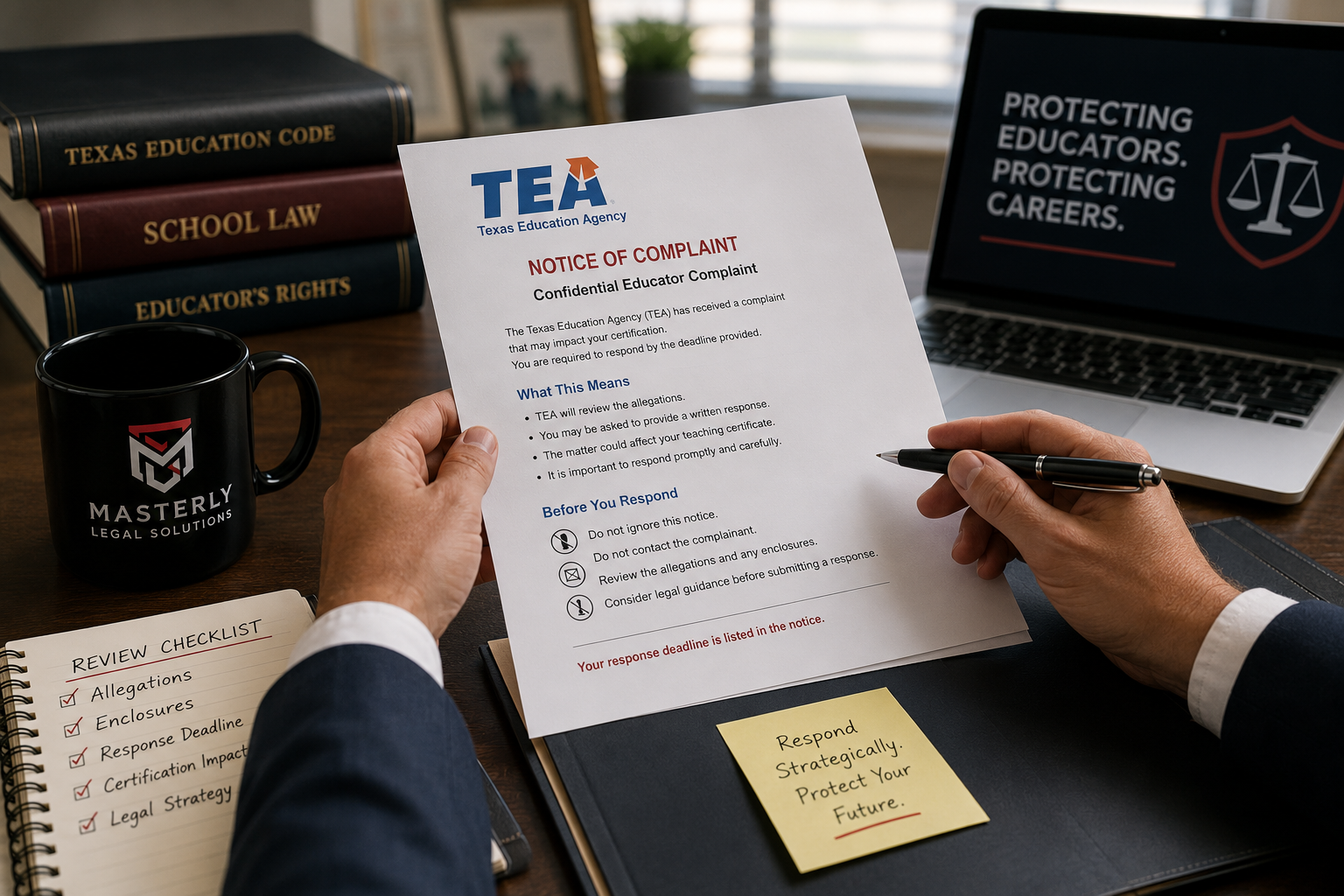
If the case proceeds, TEA investigators interview witnesses, collect documentation from the district, and review law enforcement or DFPS reports where applicable. The educator receives an investigation notice - TEA issues an investigation notice to teachers after receiving reports, typically in writing - and is given the opportunity to respond, often with legal assistance and representation from an attorney. That notice may arrive by letter, and expectations or deadlines are typically discussed in that communication.
Importantly, under Chapter 22A, districts cannot simply close out a case because the teacher resigned. The investigation continues regardless, and evidence gathering proceeds through completion. TEA has subpoena authority to obtain records and testimony.
Disciplinary Decision and Appeals Process
Possible outcomes include: no action taken; sanctions such as a formal reprimand; temporary suspension of certification or an educator’s license; permanent revocation; or placement on the Do Not Hire Registry. Sanctions for misconduct can include suspension or revocation of certification, depending on severity and the evidence gathered, as determined by the conduct involved and the evidence in the record.
If the educator contests the decision, the case moves to a formal hearing through the State Office of Administrative Hearings. Final action may also involve review by the commissioner where applicable under the administrative framework. Administrative hearings follow procedural rules established under 19 TAC Chapter 249, which provide due process protections including the right to present a defense, cross-examine witnesses, and appeal the outcome.
What to Expect from Your TEA Complaint
Timeline: Investigations may not always result in public action or discipline, and the process itself takes time. Typical investigation timelines range from 6 to 18 months depending on complexity, criminal involvement, and whether DFPS is also investigating. Simple cases may close in a few months; complex matters involving multiple witnesses, criminal charges, or abuse allegations stretch well beyond a year.
Confidentiality: Complaints and investigations remain confidential while ongoing. TEA rules under Education Code Chapter 22A and Government Code §552 keep records private until a final action is taken. Student identifying information provided during the investigation may be redacted in any public documents.
Notification: You will receive notice when your complaint is closed or moves forward in the process. In cases involving risk to student health or safety, TEA may place a notice of alleged misconduct on the educator's certification records during the investigation itself - a measure that became effective September 2025 under SB 571.
Outcome vs. expectation: Even if TEA determines a violation occurred, the outcome may not match your personal expectation. Some sanctions affect only the educator's certificate without changing their current district employment status. Some cases are resolved through alternative dispute resolution rather than punitive action. TEA's role is to protect students and uphold certification standards - not to deliver a specific result for an individual complainant.
Case Examples and Investigation Outcomes
In Fiscal Year 2025, TEA received over 6,456 misconduct reports - a figure that underscores both the scale of the system and the seriousness with which Texas approaches educator accountability. In May 2026, TEA placed 21 individuals on the Do Not Hire Registry, demonstrating active enforcement for serious misconduct.
The Educator Misconduct Dashboard, launched June 2, 2026 as required by SB 571, publicly displays data on misconduct reports, active investigations, SBEC sanctions, and registry placements. This transparency tool allows parents, administrators, and community members to review aggregate data on how complaints are being addressed statewide.
High-profile cases have involved testing irregularities, falsification of student data, and sexual misconduct. TEA has revoked certifications in cases where the evidence established clear violations, though specific educator names often remain confidential until a final order is issued. These examples illustrate that the process, while slow, produces meaningful consequences for educators who fail to meet professional standards.
Note that general patterns of investigation outcomes are publicly available through the dashboard, even when individual case details remain sealed during the proceeding.
Texas School Districts and TEA Oversight
All public school districts in Texas fall under TEA jurisdiction for educator misconduct investigations. This includes the roughly 1,200 districts across the state, from major urban systems in Austin, Houston, Dallas, and San Antonio to small rural districts.
Charter schools and open-enrollment charter schools are also subject to TEA investigation authority, as are regional Education Service Centers and shared services arrangements. Contracted service providers working for approved educational entities are included under Chapter 22A's expanded definitions.
Private schools are generally excluded from TEA's certification-related oversight unless their educators hold state certifications issued by SBEC. In those limited cases, TEA may still exercise jurisdiction over the certificate itself, even if it cannot direct the private school's employment decisions.
Understanding teacher contract types matters here as well. Texas has three types of teacher contracts: probationary, term, and continuing. Probationary contracts can last up to four years in Texas. Term contracts in Texas are typically set for one to two years. Continuing contracts in Texas have no fixed duration and are rare. Teachers on probationary contracts cannot appeal non-renewal decisions, while term contract teachers must receive notice of non-renewal at least 10 days prior and can appeal term contract non-renewals within 15 days. Continuing contract teachers are entitled to a fair hearing.
Texas teachers have constitutional rights under state law, and teachers have a right to due process before termination - meaning teachers can challenge terminations if proper procedures are not followed. Probationary teachers can request a hearing within 15 days, and probationary teachers can be terminated for good cause. Teachers must receive notice of non-renewal at least 10 days prior.
Frequently Asked Questions About TEA Teacher Complaints
How much does it cost to file a TEA complaint against a teacher?
There is no fee to file a TEA complaint. The submission process is free for all complainants - parents, students, staff, or community members. You do not need to pay for legal services or hire an attorney to file, though you may choose to consult one if your situation is complex. Districts may not charge you for reviewing a local grievance either. Costs arise only if you choose private legal representation or if the matter moves to litigation.
How long does a TEA investigation take and what happens during it?
Typical timelines range from 6 to 18 months, and some complex cases stretch longer. During the investigation, TEA investigators gather evidence, interview witnesses, and request documentation from the school district. The accused educator is notified, given the opportunity to respond, and may retain an attorney. In serious cases involving risk to student safety, the educator may be placed on administrative leave by the district (a local decision) while the TEA investigation proceeds.
Can I file a complaint anonymously and will my identity be protected?
Anonymous complaints are permitted in some contexts, but for educator misconduct complaints, verifiable contact information is typically required under 19 TAC §249.3(12). Without it, TEA may close the case. Your identity as a complainant is protected by confidentiality rules during the investigation. However, if the case proceeds to a contested administrative hearing, your identity may need to be disclosed as part of the formal proceeding.
What if my local school district won't address my concerns about a teacher?
TEA provides a state-level complaint process specifically for situations where local resolution fails or where the issue involves a breach of state law or educator ethics. Use TEA's Parent Complaint Navigator to determine whether a state complaint is appropriate; if district-level efforts fail, the next step may include the appropriate state or federal authority depending on the nature of the complaint, an important idea when deciding where to escalate. Keep in mind that TEA cannot overturn local grievance decisions unless those decisions themselves constitute violations of law. The distinction is between general dissatisfaction (addressed locally) and certification-related or criminal violations (addressed by TEA).
Request Texas Educator Certification Counsel
A certification investigation deserves immediate legal attention. The decisions made during the early stages of the process may affect your educator certificate, professional reputation, and future career opportunities. Many educators benefit from expert help with Texas TEA investigations and teacher certification, especially when facing complex allegations or potential certificate sanctions.
Masterly Legal Solutions represents educators responding to a TEA complaint against teacher, a Texas teacher certification investigation, and other educator licensing matters. As an education law firm focused on protecting Texas educators, our attorneys serve as an experienced educator defense attorney Texas, review every TEA referral, evaluate each notice of investigation, prepare a thorough written response, advise clients regarding potential sanctions and certificate suspension, and carefully analyze the available evidence to build a strategic response. Our broader education law services for protecting teacher rights include guidance on TEA educator certification requirements and disciplinary risks, defending against TEA allegations and potential license termination, and advising on what Texas educators should do after receiving a TEA complaint notice. We also provide access to an education law attorney for teachers facing investigations or termination, an education lawyer for Texas teachers needing guidance on TEA discipline, and comprehensive education law legal services for educators and schools, as well as insight into why Texas educators lose their TEA certificates and how to avoid it.
Masterly Legal Solutions
Website:
https://www.masterlylegal.com/
Phone:
(972) 236-5051





Teacher Rights When Assaulted by a Special Needs Student: Safety, Reporting and Investigation Issues

Looking for Legal & Business Solutions? Contact Us Now
Fill in the form or call us to set up a meeting