

CPS Investigations in Texas: Timeline, Stages, and What Happens Behind the Scenes
When CPS Gets Involved in Your Family
For many parents, the first contact from child protective services can feel overwhelming and unexpected. One moment, everything feels normal, and the next, you are being told that an investigation has begun involving your child. It is natural to feel confusion, fear, and urgency all at once.
Understanding what is happening behind the scenes during a cps investigation can help you regain a sense of control. While every case is different, there are clear stages and procedures that child protective services cps follows in Texas. Knowing what to expect allows parents to respond thoughtfully instead of reacting out of panic.
What Child Protective Services Does in Texas
Child protective services cps operates under the Texas Department of Family and Protective Services, a state agency responsible for protecting children. Their role is to investigate reports of child abuse or neglect and ensure the child's safety. These reports can come from teachers, medical providers, or even concerned community members.
CPS workers are tasked with reviewing allegations and determining whether a child may be at risk. This includes evaluating safety concerns, speaking with family members, and gathering information about the child’s home environment. Their goal is not only to investigate but also to assess whether intervention is necessary.
Common Reasons CPS Opens a Case
A cps case can begin for many reasons, and not all reports involve actual wrongdoing. Sometimes, misunderstandings or incomplete information can lead to an investigation.
Common triggers include:
- Allegations of abuse or neglect involving a child
- Reports of unsafe living conditions or supervision concerns
- Concerns related to substance use or domestic conflict
- Claims of sexual abuse or physical harm
Even if the report is not accurate, CPS is required to investigate reports to determine if there is any immediate risk.
How Long Does a CPS Investigation Take in Texas
One of the most common questions parents ask is how long does a cps investigation take. In Texas, most investigations are completed within a set timeframe, often around 30 days, although this can vary depending on the complexity of the case.
Factors that influence the timeline include the seriousness of the allegations, availability of witnesses, and whether additional steps like a criminal investigation are involved. While the process may feel slow or uncertain, important decisions are often being made quickly behind the scenes.
The Initial Response from CPS
After a report is made, CPS workers will begin the investigation process by evaluating the urgency of the situation. If there is a belief that a child is in immediate danger, action may be taken quickly to protect the child.
In some cases, CPS may seek a court order or even a search warrant to enter a child’s home. This step is typically reserved for situations where cooperation is limited or safety concerns are significant. Parents should understand that these actions are part of a structured process, not random decisions.
The Role of the CPS Investigator
A cps investigator is responsible for leading the case and gathering information. This individual may interview parents, children, teachers, and other family members to understand the situation.
The cps investigator will also review documents, conduct a risk assessment, and evaluate whether abuse or neglect occurred. Their findings will influence the direction of the cps case and any decisions about the child’s care.
What Happens During the Investigation Stage
The investigation stage is where most of the fact-finding occurs. CPS workers are focused on building a clear picture of the family’s situation and identifying any safety issues.
During this time, parents may be asked to participate in interviews, provide records, or comply with requests such as a drug test or criminal background check. While these requests can feel intrusive, they are part of the process used to complete investigations.
Evaluating Risk and Safety Concerns
A key part of any cps investigation is determining whether there is immediate risk to the child. CPS workers conduct a risk assessment to evaluate potential harm and the likelihood of future issues.
This includes reviewing the child’s living environment, relationships within the household, and any history of prior reports. Identifying risk factors helps CPS decide whether intervention is necessary to protect the child’s well being.
Safety Plans and Their Impact on Families
In many cps cases, a safety plan is created to address concerns without removing the child from the home. A safety plan may include specific conditions that parents must follow to ensure the child’s safety.
These plans can involve:
- Supervision requirements involving a relative or family friend
- Temporary adjustments to the child’s home environment
- Participation in voluntary services or counseling
While a safety plan is often presented as voluntary, parents should understand its implications before agreeing.
Voluntary Agreements and Placement Options
Sometimes, CPS may propose a voluntary agreement or voluntary placement arrangement. This can involve temporarily placing the child with a family friend or relative while the investigation continues.
Although these options may seem cooperative, they can still affect parental rights and future decisions. Understanding the long-term impact of a voluntary placement agreement is critical before signing anything.
When CPS Seeks Court Involvement
If CPS believes that the child is in immediate danger or that safety concerns cannot be resolved informally, they may seek a court order. This can lead to involvement in juvenile dependency court.
A judge may review the case, consider the investigation results, and determine whether temporary custody or additional restrictions are necessary. Court involvement often marks a more serious stage of the cps case.
Temporary Custody and Foster Care
In more serious cases, CPS may remove a child from the home and place them in foster care. This decision is typically based on concerns about immediate danger or serious harm.
The goal of foster care placement is to ensure the child’s safety while the case is reviewed. However, this step can be emotionally challenging for both parents and children.
The Role of Juvenile Dependency Court
Juvenile dependency court oversees cases involving allegations of child abuse or neglect. The court evaluates evidence, hears testimony, and determines the best course of action for the child.
Parents may be required to attend hearings and comply with court directives. Decisions made in this setting can have long-term effects on custody and parental rights.
Investigation Results and Possible Outcomes
Once the cps investigation is complete, CPS will determine the outcome of the case. This may include administrative closure if no evidence of abuse is found.
Other outcomes may involve continued monitoring, required services, or further legal action. Understanding these possibilities helps parents prepare for what comes next.
Administrative Closure and What It Means
Administrative closure occurs when CPS determines that the allegations are not supported. This means the case is closed without further action.
While this is often the desired outcome, the process leading up to it can still be stressful. Even closed cases may remain part of CPS records.
When Cases Lead to a Criminal Investigation
In some situations, a cps investigation may overlap with a criminal case. Allegations involving serious abuse or neglect can trigger involvement from law enforcement.
This adds another layer of complexity, as parents may face both civil and criminal consequences. Understanding how these processes interact is important for protecting your rights.
The Importance of Legal Representation
Facing a cps case without guidance can be risky. Legal representation helps parents understand their rights, responsibilities, and options throughout the investigation process.
An experienced attorney can provide clarity, help respond to CPS requests, and ensure that your voice is heard. Early involvement often leads to better outcomes.
Protecting Parental Rights During an Investigation
Parents have legal rights during a cps investigation, even when CPS workers are involved. These rights include the ability to seek legal counsel and understand the process.
Being informed helps parents make better decisions and avoid actions that could negatively affect the case.
How CPS Workers Make Decisions
CPS workers rely on evidence, interviews, and professional judgment to make decisions. Their goal is to ensure the child’s safety while balancing the rights of the parents.
However, decisions are not always perfect, and misunderstandings can occur. This is why it is important to stay engaged and informed throughout the investigation.
Family Assessment and Support Services
In some cases, CPS may offer family assessment services or voluntary services to address concerns. These programs are designed to support families and reduce risk factors.
Participating in these services can be beneficial, but parents should understand the expectations and potential consequences.
The Role of Community and Family Resources
CPS may connect families with community resources or family and community resources to address underlying issues. These can include counseling, parenting classes, or support programs.
While these services can be helpful, they should be approached with a clear understanding of their role in the cps case.
How Investigations Affect Families Emotionally
The investigation process can take a toll on families, especially when children are involved. Stress, uncertainty, and fear of losing custody can create significant emotional strain.
Maintaining communication and seeking support can help families navigate this difficult time.
Why Early Action Matters in CPS Cases
The early stages of a cps investigation are often the most important. Decisions made during this time can influence the direction of the entire case.
Taking action early allows parents to protect their rights and respond effectively to CPS concerns.
How Masterly Legal Solutions Helps Families
At Masterly Legal Solutions, we focus on proactive CPS defense and administrative representation. Our approach is designed to guide parents through the cps investigation process with clarity and preparation.
We help families understand their options, respond strategically, and protect what matters most.
Preparing for Every Stage of the Process
Every cps case is unique, but preparation is always key. Understanding the investigation timeline and possible outcomes helps parents make informed decisions.
Being proactive rather than reactive can make a meaningful difference in the outcome.
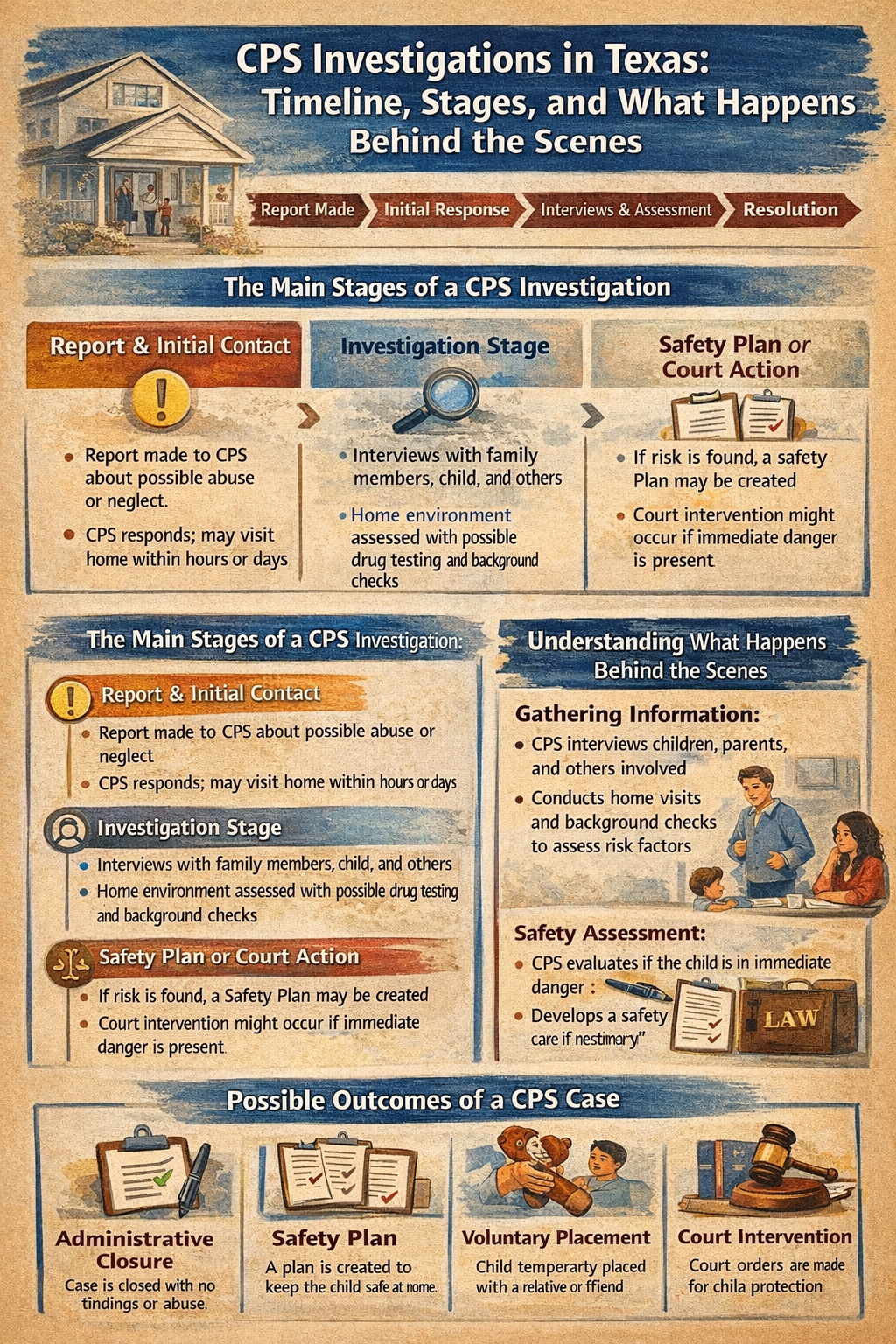
Understanding Child Protective Investigations in Texas
Child protective investigations are structured processes designed to evaluate reports of child abuse or neglect and determine whether a child may be at risk. These investigations are conducted by CPS workers who gather information from multiple sources, including parents, teachers, and other individuals involved in the child’s life. The goal is to assess the situation carefully while prioritizing the child’s safety. Although the process may feel overwhelming, understanding how child protective investigations work can help families respond more effectively.
The Role of Child and Family Services
Child and family services are often involved during or after a CPS case to support families and address concerns identified during the investigation. These services may include counseling, parenting resources, or referrals to community programs, and in some situations may be complemented by specialized legal services for families and organizations. The intention is to strengthen the family unit while reducing risk factors that could impact the child’s well being. While these services can be helpful, parents should understand how participation may affect their case.
Identifying the Alleged Victim in a CPS Case
In every cps investigation, there is typically an alleged victim, meaning the child who is believed to have experienced harm or risk. CPS workers focus closely on the alleged victim’s environment, relationships, and overall well being. Interviews and observations are often conducted to understand the child’s situation. This part of the process can be sensitive, and parents should be aware of how these interactions may influence the investigation.
Resources Like the Texas Legal Services Center
Organizations such as the Texas Legal Services Center can provide general information and resources for families navigating CPS involvement. While these organizations may offer helpful guidance, they may not replace the need for individualized legal representation, such as personalized estate planning and legal services in Houston or tailored estate planning representation in Dallas. Each cps case involves unique facts and circumstances that require careful attention. Understanding available resources is helpful, but personalized support is often essential.
Addressing Alleged Abuse in CPS Cases
When CPS receives a report of alleged abuse, the agency is required to investigate the claim thoroughly. This may involve interviews, home visits, and reviewing records related to the child’s care. Even when allegations are not supported, the process can still be stressful for families. Responding appropriately and understanding your rights is critical during this stage.
The Role of Legal Aid in CPS Matters
Legal aid organizations may provide assistance to families who need help navigating CPS involvement but have limited resources. These services can offer basic guidance and support during the process, while full-service Texas law firms like Masterly Legal Solutions provide broader representation when cases become more complex. However, legal aid may not always be able to provide the level of representation needed for complex cases. Families should consider whether additional legal support is necessary based on their situation.
Why a Thorough Investigation Matters
A thorough investigation is essential to ensure that decisions are based on accurate and complete information. CPS workers are expected to review all relevant evidence, speak with appropriate individuals, and assess the child’s environment carefully. However, no process is perfect, and misunderstandings can occur. Being proactive and organized can help ensure your perspective is clearly presented.
The Connection Between CPS and Family Services
Family services often work alongside CPS to provide support and address underlying concerns. These services may focus on improving parenting skills, addressing safety issues, or connecting families with resources. While participation can be beneficial, it is important to understand how involvement may be viewed within the cps case. Clear communication and documentation are key.
How Family Law Intersects with CPS Cases
Family law often overlaps with CPS investigations, especially when issues of custody, visitation, or parental rights arise. Decisions made during a cps case can influence family law proceedings and vice versa, and firms with family, education, and compliance law experience like Masterly Legal Solutions can help families navigate these overlapping systems. Understanding how these areas connect can help parents better navigate the legal landscape. Seeking guidance early can help avoid complications later.
Preparing for a Court Hearing in CPS Cases
A court hearing may occur if CPS seeks judicial involvement in a case. During this hearing, a judge will review evidence, hear arguments, and determine next steps, often relying on evidence that has been organized with the help of experienced Texas litigators and investigators. Parents may be required to present information or respond to allegations. Preparation is critical, as decisions made during a court hearing can have lasting effects on the family.
Understanding the Alleged Perpetrator’s Role
The alleged perpetrator is the individual accused of causing harm or risk to the child. CPS will evaluate this person’s actions, history, and relationship to the child. This part of the investigation can be complex, especially when multiple perspectives are involved. It is important to approach this stage carefully and with a clear understanding of the process.
Investigating Allegations and Gathering Evidence
Investigating allegations involves collecting information from various sources, including interviews, documents, and observations. CPS workers aim to determine whether the claims are supported by evidence. This process can take time and may involve multiple steps. Families should be prepared to provide information and cooperate while also protecting their rights.
The Role of Social Workers in CPS Cases
Social workers play a central role in CPS investigations, often serving as the primary point of contact for families. They are responsible for assessing safety concerns, conducting interviews, and making recommendations, similar to how education law attorneys defending school employees and license holders work within investigative systems affecting children and schools. While their role is to protect the child, their decisions can significantly impact the family. Maintaining clear communication with social workers is important throughout the process.
Reasonable Accommodations During an Investigation
In certain situations, families may need reasonable accommodations during a CPS investigation. This could include adjustments for language barriers, disabilities, or other needs. CPS is expected to consider these factors when conducting the investigation. Ensuring that accommodations are requested and documented can help support a fair process.
Comparing CPS Processes Across Regions Like Southern California
While CPS procedures are governed by state law, there are similarities in how cases are handled across regions such as Texas and southern california. Both systems focus on investigating reports, assessing risk, and protecting children. However, specific timelines and policies may differ. Understanding these distinctions can provide helpful context, especially for families familiar with other states.
The Importance of a Written Agreement with CPS
In some cases, CPS may ask parents to sign a written agreement outlining certain conditions or expectations. This could include participation in services or compliance with a safety plan. While these agreements may appear straightforward, they can have significant implications, much like other essential legal documents families should have in place. Parents should review any written agreement carefully before signing.
When CPS May Order Services for Families
CPS may order services as part of a case plan to address concerns identified during the investigation. These services can include counseling, parenting classes, or substance use programs. The goal is to reduce risk and support the family’s stability, just as structured estate planning services and trusts are designed to provide long-term stability and protection for families. Understanding what it means when CPS order services can help families respond appropriately and stay compliant.
Speak With Our Team About Your CPS Case
If you are asking how long does a cps investigation take or trying to understand what happens next, now is the time to seek guidance. CPS cases move quickly, and early decisions can shape the entire process.
At Masterly Legal Solutions, we provide strategic, investigation-focused support for families dealing with child protective services. We are here to help you navigate each stage with confidence and clarity.
Call us today at (972) 236-5051 for a free consultation. We will take the time to understand your situation, answer your questions, and help you move forward with a plan.
This article* is for educational purposes only and does not constitute legal advice. For advice specific to your situation, please contact our office directly.*




Teacher Rights When Assaulted by a Special Needs Student: Safety, Reporting and Investigation Issues



Looking for Legal & Business Solutions? Contact Us Now
Fill in the form or call us to set up a meeting





