

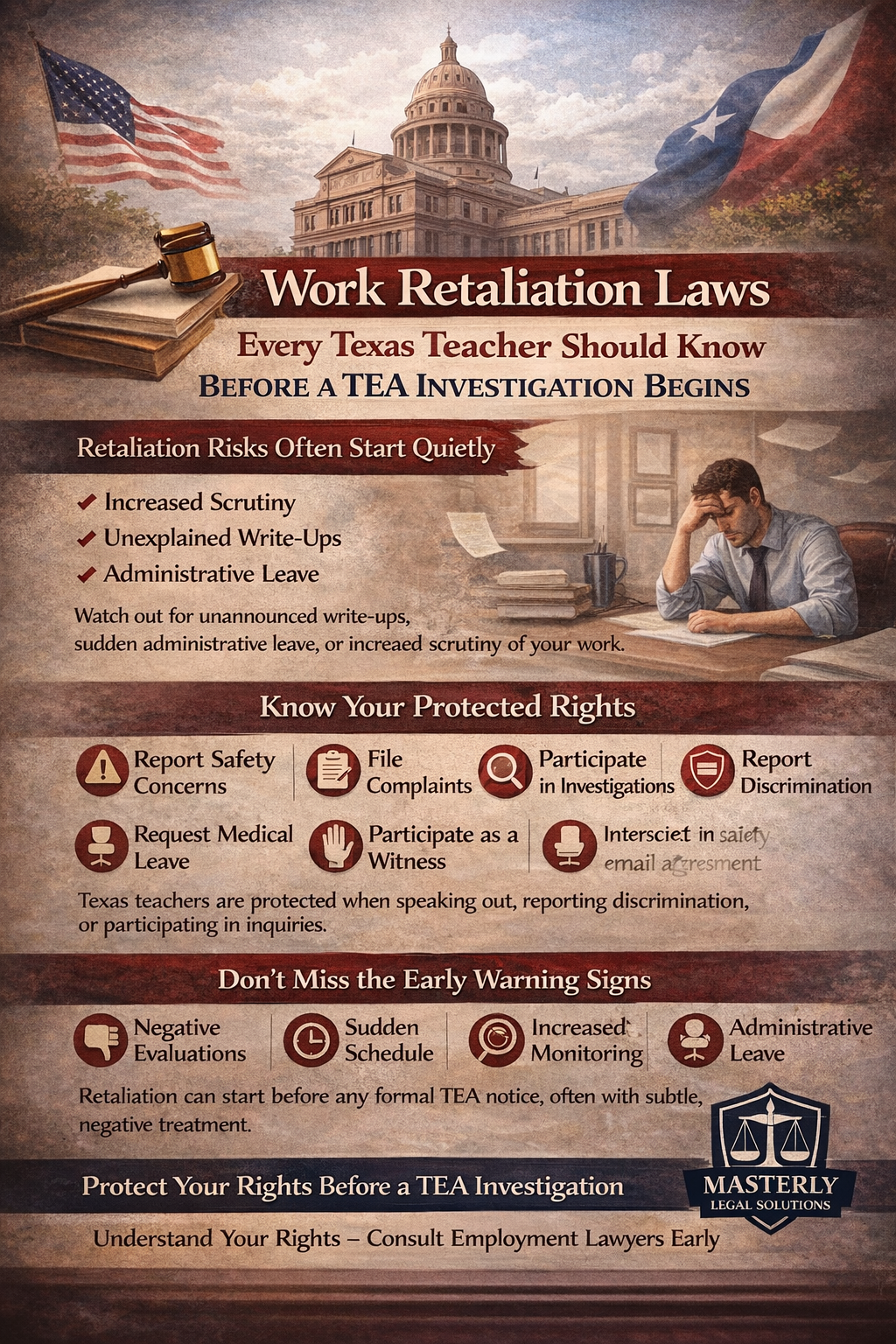
Work Retaliation Laws Every Texas Teacher Should Know Before a TEA Investigation Begins
Why Retaliation Risks Start Earlier Than Most Teachers Expect
Many Texas teachers believe retaliation only becomes an issue after a formal Texas Education Agency investigation begins. In reality, retaliation often starts quietly well before any official notice arrives. Subtle changes in treatment, sudden write-ups, or unexplained administrative leave can signal deeper problems forming behind the scenes. These early warning signs are frequently overlooked because educators are focused on their students and classrooms.
Understanding work retaliation laws early gives teachers the ability to recognize when something is wrong. These laws exist to protect employees who speak up, report concerns, or engage in legally protected conduct. At Masterly Legal Solutions, we see how early intervention can preserve careers and prevent long-term damage. Knowing your rights before an investigation begins can make a meaningful difference.
How TEA Investigations Create Vulnerable Moments for Teachers
A TEA investigation creates stress not only for teachers but also for school administrators and supervisors. During this time, employers may feel pressure to limit liability or control outcomes. Unfortunately, that pressure sometimes leads to retaliation against the very employees who are entitled to protection under federal and state laws.
Retaliation may surface as increased scrutiny, isolation, or disciplinary action that appears disconnected from actual performance. A reasonable employee would likely feel discouraged from speaking up under these circumstances. Teachers who recognize this pattern early are better positioned to protect themselves.
What Retaliation Really Means Under the Law
Retaliation occurs when an employer takes negative action against an employee because the employee engaged in protected activity. This includes actions taken before, during, or after an investigation. Retaliation can appear in many forms, not just termination.
Examples of retaliation include:
- Sudden placement on administrative leave
- Negative evaluations without prior warning
- Changes to hours, pay, or working conditions
- Increased monitoring by a supervisor
Even actions that seem minor can be considered retaliatory if they create a negative impact.
Protected Activity Teachers Often Overlook
Protected activity includes far more than filing a formal complaint. Many teachers unknowingly engage in protected activity long before a TEA investigation is announced. Reporting concerns to a principal, cooperating in an internal investigation, or raising safety issues are all protected actions.
Other examples of protected activity include reporting harassment, discrimination, or violations of occupational safety standards. Teachers who report concerns under whistleblower laws are also protected. These actions are legally protected even if no wrongdoing is ultimately found.
Why Timing Matters More Than Intent
In retaliation cases, timing is often more important than intent. If adverse action follows closely after protected activity, that timing alone may indicate a possible violation. Courts and agencies look closely at how quickly retaliation occurs after an employee speaks up.
A negative performance review issued shortly after a complaint can raise serious concerns. Administrative leave imposed immediately after a report may also be questioned. Teachers should document timelines carefully to help determine whether retaliation occurred.
Administrative Leave as an Early Retaliation Tool
Administrative leave is one of the most common early warning signs of retaliation in school environments. While administrative leave can be appropriate in some circumstances, it is frequently misused. Excessive or unexplained administrative leave can function as punishment rather than protection.
Administrative leave may involve paid time, but it still removes teachers from the workplace. Extended administrative leave can harm employee morale and overall employee morale across a campus. When used improperly, administrative leave may qualify as an adverse action.
Paid Administrative Leave Does Not Eliminate Harm
Some employers argue that paid administrative leave cannot be retaliatory because the employee continues receiving pay. This is a misunderstanding of the law. Paid administrative leave can still cause reputational harm, emotional stress, and long-term career consequences.
Teachers on paid administrative leave may lose access to classrooms, colleagues, and professional opportunities. This can create a chilling effect on other employees. Courts recognize that paid time away does not automatically remove legal protections.
How Supervisors Influence Retaliation Before Investigations
A supervisor often plays a key role in retaliation that occurs before formal investigations. Supervisors may begin documenting minor issues, issuing warnings, or shifting responsibilities. These actions may later be used to justify disciplinary action.
If a supervisor is involved in the original complaint or report, conflicts of interest may arise. Teachers should be cautious about informal conversations that later appear in official records. Documentation becomes critical in these situations.
Common Retaliation Examples in School Settings
Retaliation in schools often looks different from retaliation in corporate workplaces. Teachers may be reassigned, excluded from committees, or suddenly labeled as difficult. These actions can feel personal and isolating.
An example includes a teacher reporting harassment and then being removed from extracurricular duties. Another example involves a teacher who reports discrimination and later receives reduced hours or unfavorable classroom assignments. Each example highlights how retaliation can quietly escalate.
Harassment Complaints and Retaliation Risks
Harassment complaints frequently trigger retaliation concerns. Teachers who report harassment often experience changes in tone, treatment, or expectations. These changes may occur before any investigation findings are reached.
Harassment retaliation is prohibited under Title VII and related statutes. Retaliation for reporting harassment is a separate violation, even if the underlying harassment claim is disputed. Teachers should understand that the law protects the act of reporting itself.
Discrimination Reports and Legal Safeguards
Discrimination based on age discrimination, disability, or other protected traits is unlawful. Teachers who report discrimination are engaging in protected activity. Retaliation for making such reports is prohibited under the Civil Rights Act and other federal laws.
The Disabilities Act and related state laws also protect teachers who request accommodations. Retaliation for asserting these rights may constitute an illegal practice. Teachers should not assume silence is safer than reporting.
The Role of Federal and State Laws
Federal and state laws work together to protect teachers from retaliation. Federal statutes such as Title VII, the Employment Act, and whistleblower laws provide broad protections. State laws may offer additional remedies or extended deadlines.
Federal employees and public school workers are covered by overlapping regulations. Understanding which laws apply requires careful legal analysis. Employment lawyers often review both federal and state frameworks to determine the strongest claims.
Equal Employment Opportunity Commission Oversight
The Equal Employment Opportunity Commission plays a central role in retaliation claims. Teachers may file complaints with the EEOC when retaliation involves discrimination or harassment. Filing deadlines are strict and missing them can bar claims.
EEOC investigations focus heavily on timing, documentation, and consistency. Teachers who maintain clear records are better positioned during the filing process. Legal guidance is critical before submitting information to the EEOC.
Occupational Safety Reports and Retaliation
Teachers who report occupational safety concerns are protected under labor regulations. Unsafe classroom conditions, facility hazards, or security risks fall under occupational safety protections. Retaliation for reporting these concerns is unlawful.
Schools have an obligation to address safety issues without punishing the reporting worker. Retaliation in this context often involves subtle actions rather than termination. Teachers should take safety reports seriously and document responses.
Medical Leave and Family Protections
The Medical Leave Act protects teachers who take qualifying leave for health or family reasons. Retaliation for requesting or using medical leave is prohibited. This includes negative evaluations, reduced hours, or threats of termination.
Teachers returning from leave may experience increased scrutiny or exclusion. These actions may be considered retaliatory if linked to the leave request. Legal protections extend beyond the leave period itself.
Adverse Action Beyond Termination
Wrongful termination is not the only form of retaliation. Adverse action includes any employer behavior that would discourage a worker from engaging in protected activity. This includes pay reductions, benefit changes, or undesirable schedule adjustments.
Even subtle actions can qualify if they create a negative impact. Teachers should not assume retaliation must involve being fired. Many claims involve ongoing patterns rather than a single event.
How Retaliation Affects Employee Morale
Retaliation damages trust within the workplace. When teachers see colleagues punished for speaking up, employee morale suffers. Overall employee morale declines when fear replaces transparency.
This environment harms students as well. Teachers distracted by retaliation concerns cannot focus fully on instruction. Protecting workers ultimately supports healthier school communities.
The Importance of Documentation
Documentation is one of the strongest tools teachers have. Keeping records of complaints, reports, emails, and evaluations helps establish timelines. Notes should be factual and detailed.
Documentation helps attorneys determine whether retaliation occurred. It also strengthens claims during filing and investigation stages. Teachers should store records securely and consistently.
Filing a Retaliation Claim
Filing a retaliation claim involves careful preparation. Claims may be filed internally, with a government agency, or both. Filing too early or too late can affect outcomes.
Teachers should seek guidance before filing. Employment lawyers help evaluate factors such as timing, evidence, and employer defenses. Proper filing protects legal rights and preserves options.
Employer Defenses Teachers Should Expect
Employers often argue that actions were based on performance or policy. They may claim changes were unrelated to protected activity. Documentation inconsistencies often weaken these defenses.
Teachers should not be discouraged by employer explanations. Attorneys analyze whether explanations are supported by records. Shifting justifications can indicate retaliation.
Police, Government, and Authority Considerations
Teachers working with school police or government entities face additional complexities. Authority structures may complicate reporting and investigations. Retaliation may involve misuse of authority or policy enforcement.
Government employers are still bound by retaliation laws. Federal oversight applies even when internal policies differ. Legal counsel helps navigate these layered systems.
Protecting Your Pay, Wages, and Benefits
Retaliation often targets financial stability. Reduced pay, lost wages, or benefit changes can pressure teachers into silence. These actions may violate employment law.
Protecting pay and benefits is a core goal of retaliation claims. Teachers should track changes carefully. Legal protections extend to compensation-related actions.
When to Hire Employment Lawyers
Early consultation is critical. Employment lawyers help teachers recognize retaliation before it escalates. Waiting until termination limits available remedies.
Attorneys provide guidance during investigations, administrative leave, and disciplinary proceedings. Hiring counsel early can prevent missteps that employers exploit. Early legal support often changes outcomes.
How Attorneys Assess Possible Violations
Attorneys evaluate retaliation claims by reviewing statutes, timelines, and evidence. They determine whether conduct was legally protected and whether adverse action followed. Each claim is assessed based on specific circumstances.
This process helps determine whether a violation occurred. Teachers benefit from objective legal analysis rather than assumptions. Accurate assessment leads to stronger strategy.
Why Early Action Makes All the Difference
Retaliation often intensifies once a TEA investigation begins. Addressing concerns early can stop escalation. Teachers who act promptly protect their professional standing.
Early action also preserves evidence and strengthens credibility. Silence rarely protects teachers in these situations. Proactive steps provide leverage and clarity.
Taking Control Before an Investigation Starts
Teachers do not have to wait for formal notice to protect themselves. Understanding work retaliation laws empowers educators to act before damage occurs. Knowledge reduces fear and increases confidence.
Masterly Legal Solutions believes informed teachers make better decisions. Preparation is the strongest defense against retaliation. Early legal guidance creates stability during uncertainty.
Contact Masterly Legal Solutions for Trusted Guidance
If you are a Texas teacher concerned about retaliation before or during a TEA investigation, Masterly Legal Solutions is here to help. We offer a free consultation to answer your questions and provide clear guidance based on work retaliation laws and employment protections. Our focus is on protecting teachers, their careers, and their peace of mind through proactive legal support. Contact us at (972) 236-5051 to schedule your free consultation and take the next step toward protecting your rights.
Disclaimer: This article is for informational purposes only and does not constitute legal guidance or create an attorney-client relationship. Laws and circumstances vary, and you should consult a qualified attorney regarding your specific situation.



Teacher Rights When Assaulted by a Special Needs Student: Safety, Reporting and Investigation Issues



Looking for Legal & Business Solutions? Contact Us Now
Fill in the form or call us to set up a meeting