

Appealing a Title IX Decision: How Experienced Attorneys Can Reverse an Unfair Ruling
Getting a Title IX decision that labels you “responsible” can feel like the floor drops out from under you. One minute you’re trying to finish classes, keep your scholarship, or hold onto your job, and the next you’re facing serious consequences that can follow you for years. Many people assume a Title IX ruling is final, like a courtroom verdict that can’t be touched. In reality, an appeal can be the most powerful opportunity to challenge an unfair outcome—but only if you act fast and do it correctly.
At Masterly Legal Solutions, we’ve seen how quickly a Title IX case can go sideways, even when the accused student or employee did nothing wrong. Sometimes the issue is bad evidence. Sometimes it’s bias, procedural mistakes, or a rushed investigative process. Sometimes it’s an educational institution trying to protect its image, its federal funding, or its relationship with school administrators. Whatever the cause, a Title IX appeal is not just “asking them to reconsider”—it’s a strategic legal response that focuses on deadlines, process rights, and the school’s own Title IX procedures.
This article explains the appellate process, what schools typically allow in a Title IX appeal, and why quick legal action matters. We’ll also explain how experienced attorneys build Title IX defense strategies that can reverse findings, reduce sanctions, or secure a more fair outcome. If you’re reading this because you feel the system failed you, you’re not alone—and you still have options.
What Title IX Really Covers and Why Decisions Carry So Much Weight
A federal civil rights legislation known as Title IX forbids sex-based discrimination in educational programs or institutions that receive government support. Title IX is part of the education amendments framework, and it impacts schools ranging from elementary schools to major universities. Because Title IX ties directly to federal financial assistance, schools treat Title IX compliance as a high-stakes requirement. Title IX regulations and Title IX laws guide how the Title IX process must operate, but schools still have significant control over how they apply rules internally.
A Title IX case can involve sex based discrimination claims, gender discrimination concerns, or allegations of sexual harassment and sexual misconduct. It can also include accusations of sexual violence, domestic violence, or behavior categorized as unwelcome sexual conduct. Even when the facts are disputed, a Title IX complaint can trigger immediate restrictions, housing changes, class schedule adjustments, or removal from activities. That’s why Title IX proceedings feel intense from the beginning—because the consequences can hit before you ever reach a Title IX hearing.
Why a Title IX Appeal Is Not “Optional” If You Want Real Relief
After a Title IX investigation ends, many people feel exhausted and want to move on. But if you were found responsible or punished unfairly, skipping the appeal can lock in the worst outcome. In most schools, the appeal is the final internal step before the decision becomes permanent on your record. That record can affect your education program, your future employment, and your ability to transfer.
A Title IX appeal is also often required before you can pursue certain outside options. If a university fails to provide a fair Title IX process, your appeal helps preserve your process rights and shows you attempted to use the school’s procedures. That can matter later if your case turns into a lawsuit or a civil rights dispute. The appeal is your moment to force the school to confront its mistakes in writing.
This is why Title IX defense attorneys often treat the appeal as a critical phase, not an afterthought. You may only have a short window, and missing it can destroy your leverage. If you want real change, quick action is essential.
The Title IX Process Moves Fast, But the Consequences Last Longer Than a Year
Many Title IX cases feel like they drag on forever, but the deadlines inside the Title IX process can be shockingly short. Some schools give you only a few days to appeal. Others may allow a slightly longer period, but it can still be tight. Meanwhile, the consequences—suspension, expulsion, transcript notations, termination, or loss of campus access—can last more than a year or become permanent.
A Title IX violation finding can follow a college student long after graduation. It can affect licensing boards, graduate school admissions, and professional opportunities. It can also trigger criminal proceedings if law enforcement becomes involved, especially in cases involving sexual assault or alleged sexual misconduct. Even if no criminal charges are filed, the reputational impact can be severe.
That’s why you should not wait for the stress to “settle down” before appealing. The appeal is the time to defend your name while you still have procedural tools available. Delay is one of the biggest mistakes Title IX defendants make.
Common Reasons Title IX Decisions Are Unfair
Not every Title IX case is handled properly, even when schools claim they follow Title IX regulations. The Title IX procedures may look fair on paper, but the real-world implementation can be rushed, inconsistent, or biased. Some Title IX investigations are built around assumptions rather than evidence. Others rely on incomplete witness interviews or selective documentation.
Here are common reasons a Title IX case becomes unfair:
- Investigators ignore key witnesses or refuse to interview supportive testimony
- The school misapplies its own educational institution's code or school's code
- The accused student is denied meaningful ability to respond
- The Title IX hearing process is rushed or disorganized
- The school’s decision-maker shows bias or conflicts of interest
- Sanctions are disproportionate compared to the evidence
In some cases, the school acts as if “believing the complainant” means skipping fairness. But Title IX rights include fairness for both parties, and Title IX defense exists for a reason. An appeal is how you expose these failures.
Understanding the Title IX Complaint vs. the Title IX Finding
A Title IX complaint is an allegation, not a verdict. It is the beginning of the investigative process, not proof that you are guilty. Unfortunately, many students accused feel like they are treated as if they are already responsible the moment the complaint is filed. That can lead to biased decision-making and unfair restrictions.
A Title IX case becomes more dangerous when the school frames the issue as “protecting campus” rather than determining facts. Schools may justify extreme actions as risk management to preserve federal funding or protect the school's education program. But that mindset can lead to shortcuts that violate process rights. A Title IX appeal challenges whether the school actually followed the required legal structure.
If you were found responsible, it doesn’t automatically mean the evidence was strong. It may mean the process was flawed. Appeals exist to correct that.
What a Title IX Appeal Usually Allows You to Challenge
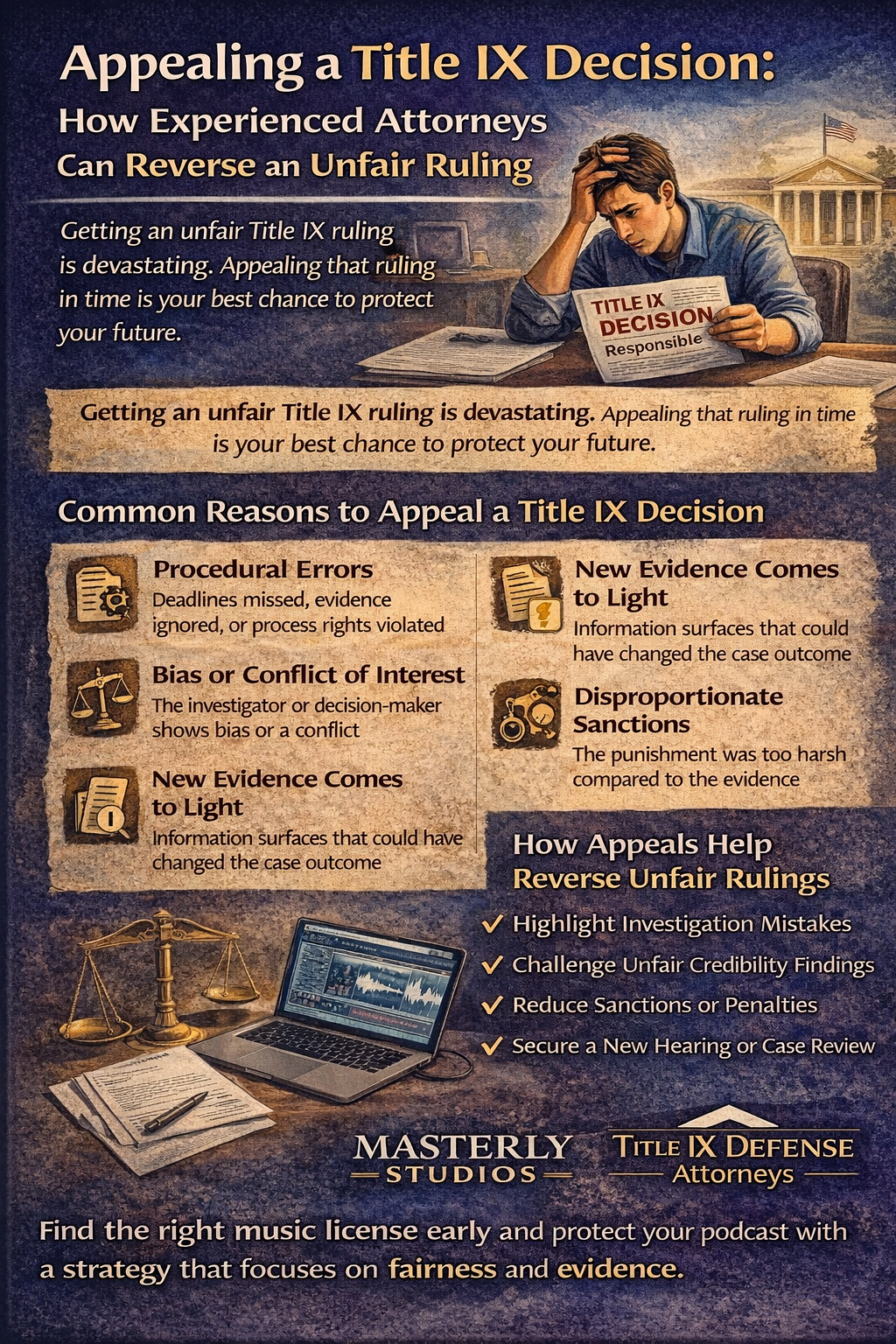
Most educational institutions limit Title IX appeals to specific grounds. You can’t always appeal just because you disagree. But many schools allow appeals when there were procedural errors, new evidence, or bias. Some also allow appeals when sanctions are excessive.
Typical appeal grounds include:
- Procedural errors that affected the outcome
- New evidence that was not reasonably available earlier
- Bias or conflict of interest by investigators or decision-makers
- Disproportionate sanctions or unfair discipline
- A flawed interpretation of policy or Title IX issue standards
This is why the appeal must be written carefully. It must match the school’s appeal rules and clearly explain how the error changed the outcome. A skilled Title IX attorney focuses on what the school must correct, not just what feels unfair.
Why Deadlines Matter More Than People Realize
The most heartbreaking Title IX cases are the ones where someone had a strong appeal but missed the deadline. Schools often enforce deadlines strictly, even when a student is under emotional distress or facing other crises. A deadline may be five days, seven days, or ten days. That is not much time to gather evidence and prepare arguments.
If you wait too long, the school may refuse to review the appeal at all. That can leave you stuck with the finding and the sanctions. It can also make later legal action harder because the school can claim you failed to follow the Title IX process. Quick legal action protects your ability to fight back.
This is where experienced Title IX defense attorneys provide value immediately. They know how to move fast without making sloppy arguments. They focus on building a clear, persuasive record that challenges the ruling effectively.
The Importance of Gathering Evidence Immediately
Once the decision is issued, your first priority should be to gather evidence and preserve everything. That includes emails, text messages, screenshots, social media messages, witness names, and any school communications. It also includes the investigative report, interview summaries, and hearing recordings if available. Evidence can disappear quickly, especially if witnesses graduate or leave campus.
Many accused students assume the school already has everything. But schools sometimes omit critical details or interpret evidence unfairly. Your job is to build a clear timeline and show what was missed. Even small details can shift credibility.
In Title IX defense, evidence is power. A strong appeal is built on proof, not emotion. The earlier you gather evidence, the stronger your appeal can be.
How a Title IX Hearing Can Go Wrong
A Title IX hearing is supposed to be structured, but it often feels chaotic to students accused. Some hearings limit meaningful questioning. Some do not allow proper cross-examination, even when credibility is central. Some decision-makers rely heavily on written statements instead of live testimony.
This is especially damaging in cases involving sexual assault allegations or alleged sexual misconduct where the story is disputed. If the school treats the hearing as a formality, the outcome may feel predetermined. A Title IX appeal can challenge whether the hearing was conducted according to Title IX procedures and school policy.
A Title IX defense lawyer will often focus on hearing irregularities. They will identify what was denied, what was mishandled, and how that affected the final decision. These errors can be appeal-winning issues.
What “Reasonable Doubt” Means in a Title IX Context
Many accused students assume Title IX works like criminal court. It does not. Title IX cases typically use a lower standard than “reasonable doubt,” even though the allegations may involve sexual violence or sexual assault. That can feel unfair because the consequences are serious, yet the burden of proof is lighter.
Even though “reasonable doubt” may not be the formal standard, the concept still matters. If the evidence is inconsistent, unsupported, or contradictory, your appeal can argue that the school’s finding was not supported by the weight of the evidence. A strong appeal shows where the case lacks reliability.
If you were accused of sexual assault and found responsible based on weak evidence, your appeal should highlight those weaknesses clearly. A skilled Title IX attorney knows how to present those issues in a way the appeal panel must address.
The Role of Process Rights and Why They Matter in Appeals
Process rights are the protections that make a Title IX process fair. They include notice of allegations, access to evidence, a chance to respond, and a neutral decision-maker. When schools violate process rights, the outcome can be legally vulnerable. Appeals are designed to address those violations.
Students accused often don’t realize their process rights were violated until after the decision. They may learn they never received key documents. They may realize the investigator misquoted them. They may discover the school relied on evidence they never saw.
A Title IX appeal should focus on specific violations of process rights, not general complaints. The more specific you are, the harder it is for the school to dismiss your arguments. This is why experienced Title IX attorney guidance is so valuable.
How Unlawful Retaliation Can Show Up After a Title IX Decision
Unlawful retaliation can happen when a student or faculty member is punished for participating in a Title IX process. Retaliation may include harassment, threats, exclusion, or disciplinary actions tied to the complaint. It can also include academic punishment or removal from opportunities.
Sometimes, students accused experience retaliation from peers or faculty members. Other times, complainants experience retaliation. Title IX prohibits retaliation, but schools do not always enforce it well. If retaliation occurred, it may become part of your appeal or a separate legal issue.
A Title IX defense lawyer can help identify whether unlawful retaliation occurred and how to document it. Retaliation can affect the fairness of the case and the safety of the student involved. It should not be ignored.
When Criminal Charges or a Criminal Investigation Overlap
Some Title IX cases involve a criminal investigation or the risk of criminal charges. This is common in sexual assault cases and serious allegations of sexual misconduct. A student may be facing school discipline and criminal exposure at the same time. That creates a high-risk situation where every statement matters.
Students accused often think they should “tell their side” to everyone. But what you say in a Title IX investigation can be used against you later in criminal proceedings. Even if the school says the process is separate, information can travel. This is where the fifth amendment right and legal strategy become critical.
If criminal charges are possible, you should speak with a Title IX attorney immediately. Your defense must be coordinated to protect you in both systems. One wrong statement can damage both cases.
Why Schools Sometimes Push for Fast Outcomes
Educational institutions are under pressure to resolve Title IX complaints quickly. They want to show compliance with Title IX regulations and avoid federal scrutiny. They also want to protect federal funding and public reputation. That pressure can lead to rushed investigations and incomplete analysis.
A rushed process often harms the Title IX defendant. It can lead to missed witnesses, shallow evidence review, and unfair conclusions. It can also lead to harsh sanctions that the school believes will “prove” it takes allegations seriously.
Appeals are the tool to challenge rushed decisions. A Title IX appeal can force the school to slow down and correct mistakes. Quick legal action is essential to make that happen.
How Experienced Attorneys Build Winning Title IX Appeals
A strong Title IX appeal is not just emotional writing. It is structured, strategic, and grounded in the school’s own rules. An experienced Title IX attorney reviews the record like a lawyer, not like a student. They identify where the school violated Title IX procedures and where the decision lacks support.
A strong appeal often includes:
- A timeline that highlights contradictions and missing facts
- A breakdown of procedural errors and why they mattered
- A clear explanation of how evidence was ignored or misread
- A focused request for relief (reversal, rehearing, reduced sanctions)
- A professional tone that increases credibility
This is why title ix defense attorneys are so important. They know what appeal panels take seriously. They know how to present arguments that force the school to respond.
What a Title IX Appeal Can Actually Change
Some people believe appeals never work. That is not true. Appeals can reverse findings, reduce sanctions, or require a new hearing. Appeals can also lead to policy corrections or reassignment of decision-makers. The outcome depends on the facts and how well the appeal is written.
Possible appeal results include:
- The decision is reversed and the student is not found responsible
- A new Title IX hearing is ordered
- Sanctions are reduced or modified
- The case is remanded for further investigation
- Errors are acknowledged and corrected in the record
Even if the school does not reverse the outcome fully, an appeal can improve your standing. It can preserve arguments for future legal action. It can also create leverage in negotiations with the educational institution.
The Long-Term Stakes for Students and Faculty
A Title IX violation finding can affect a college student’s future for years. It can block internships, professional licensing, graduate admissions, and employment. It can also impact housing and campus access immediately. For faculty and staff members, a Title IX case can damage career reputation and future job opportunities.
Students accused often feel like their life is over, but it doesn’t have to be. Title IX defense exists because unfair rulings happen. Your rights matter, and your future matters. A Title IX appeal is your chance to fight for fairness.
Masterly Legal Solutions, we approach these cases with urgency and strategy. We understand the serious consequences and how fast deadlines move. You deserve representation that treats your case like it matters—because it does.
Why Quick Legal Action Is the Smartest Move
The best time to hire a Title IX defense lawyer is before the appeal deadline hits. The earlier you involve attorneys, the more time there is to review the record and gather evidence. Quick legal action can prevent you from submitting a weak appeal that fails on technical grounds. It can also protect you from writing something that harms your case.
Title IX is a specialized area. The process is unique, and the stakes are high. A skilled Title IX attorney knows how to work within Title IX proceedings and challenge unfair outcomes effectively. If you are a Title IX defendant, you need guidance that is focused and fast.
This is not the moment to “wait and see.” It is the moment to act. Your appeal window may be the only chance to reverse the ruling internally.
How Masterly Legal Solutions Defends Title IX Respondents
At Masterly Legal Solutions, we provide Title IX defense for students accused and individuals facing Title IX allegations in educational institutions. We understand how Title IX investigations work, how hearing procedures can be manipulated, and how appeal deadlines can destroy options. Our focus is protecting your rights and challenging unfair outcomes with a structured strategy.
We have represented students in high-stakes Title IX cases where the evidence was weak and the process was flawed. We know how to challenge credibility findings, expose procedural violations, and fight for fair results. Whether you are a college student, a student or faculty member, or a professional in an education program, we take your case seriously. You deserve an advocate who can defend you before your future is permanently damaged.
If you need a nationwide Title IX lawyer mindset with Texas-level urgency and focus, our team is ready. Title IX appeals require precision, speed, and confidence. That’s what we deliver.
Title IX Claims and How They Can Reshape a Student’s Future
Title IX claims can start with a single report, but they often expand into a full investigation that impacts your education, housing, and reputation. Even when the facts are disputed, schools may treat Title IX claims as high-risk matters because they involve sensitive allegations and public pressure. That is why it’s critical to respond strategically and protect your record from the very beginning. A strong Title IX defense focuses on evidence, fairness, and the process that the school is required to follow.
Federal Law Requirements Schools Must Follow in Title IX Cases
Title IX is grounded in federal law, which means schools cannot simply make up rules as they go. Even though each institution has its own policies, the Title IX process must still meet minimum fairness standards, including notice, opportunity to respond, and unbiased decision-making. When a school cuts corners, those errors can become powerful appeal issues later. Understanding the federal law framework helps students recognize when their rights were violated and when quick legal action is necessary.
How a Title IX Case Can Affect Your Educational Program
A Title IX allegation can disrupt your educational program in ways that go far beyond discipline. Students may be removed from classes, blocked from labs, restricted from campus buildings, or prevented from participating in athletics and organizations. Even temporary restrictions can delay graduation or derail scholarships and career plans. Protecting your ability to stay in your educational program is one of the most urgent goals of effective Title IX defense.
The Role of the Education’s Office in Title IX Appeals and Enforcement
Many schools manage Title IX matters through an education's office or compliance department that oversees investigations, hearings, and appeals. This office often controls the timeline, selects decision-makers, and manages how evidence is collected and reviewed. Because the education's office has significant influence, it is important to ensure the process is fair and properly documented. When mistakes happen at this level, they can become key grounds for appeal and reversal.
Legal Rights That Still Apply Even When the School Is Investigating
Students often feel powerless during a Title IX case, but you still have legal rights that matter. These include the right to notice of allegations, access to evidence, the ability to respond, and protection against biased procedures. Even when the school claims it is “following policy,” those legal rights should not be ignored or minimized. The appeal stage is often where violations of legal rights become clear—and where experienced attorneys can challenge them effectively.
What Happens During a Disciplinary Hearing in Title IX Proceedings
A disciplinary hearing can be one of the most stressful parts of a Title IX case because it may determine whether you are found responsible. During a disciplinary hearing, schools may present evidence, review statements, and evaluate credibility, sometimes without the safeguards students expect. If questioning is limited or evidence is incomplete, the outcome can be unfair. This is why preparation matters—because a disciplinary hearing record often becomes the foundation of the appeal.
Sex Discrimination Issues and How Bias Can Influence Outcomes
Title IX exists to address sex discrimination, but ironically, bias can still show up inside the process. Some students feel they are presumed guilty, while others feel their statements are dismissed, depending on the school culture and the decision-maker’s assumptions. Sex discrimination can also appear in unequal treatment, inconsistent sanctions, or a refusal to consider exculpatory evidence. When bias impacts the outcome, it becomes a major issue that Title IX appeals can expose and correct.
Disciplinary Procedures That Must Be Followed for a Fair Outcome
Schools must follow their disciplinary procedures closely, especially when the consequences are severe. If a school skips steps, ignores deadlines, blocks witness testimony, or changes standards mid-case, it can undermine the fairness of the decision. These procedural failures are often the strongest appeal arguments because they show the process was flawed, not just the outcome. A detailed review of disciplinary procedures is one of the most important parts of building a powerful appeal.
Accused of Sexual Misconduct: Why Timing and Strategy Matter Immediately
Being accused of sexual misconduct can feel like an instant judgment, even before a hearing happens. The accused student may face restrictions, social fallout, and academic disruption while the school investigates. In these cases, what you say early can shape the entire record, and one rushed statement can be misinterpreted as an admission. If you are accused of sexual misconduct, quick legal action can protect your rights, challenge unfair assumptions, and strengthen your defense before the case becomes harder to reverse.
Contact Masterly Legal Solutions for a Free Consultation
If you were found responsible in a Title IX case, you may feel like you’ve been labeled without being heard. You may be facing suspension, expulsion, transcript damage, or a professional fallout that affects your entire future. The most important thing to know is this: a Title IX appeal is time-sensitive, and waiting can cost you the chance to reverse the decision.
Masterly Legal Solutions works with individuals who need immediate Title IX defense and strategic appeal support. If you’re searching for title ix defense attorneys who understand deadlines, procedures, and how to challenge unfair findings, we’re here to help. Call (972) 236-5051 today for a free consultation. We will review what happened, explain your appeal options, and help you take quick legal action to protect your education, reputation, and future.
Disclaimer: This article is for educational purposes only and does not constitute legal advice or legal guidance. For advice about your specific situation, consult with a licensed attorney.

Teacher Rights When Assaulted by a Special Needs Student: Safety, Reporting and Investigation Issues







Looking for Legal & Business Solutions? Contact Us Now
Fill in the form or call us to set up a meeting