
Common Mistakes Teachers Make After Receiving a Civility Policy Violation Notice
The moment a civility policy violation notice lands in your inbox, your body often reacts before your brain does. You may feel embarrassed, angry, blindsided, or even betrayed by a co worker you thought you could trust. Many teachers try to “fix it fast” because they still have students to teach, lessons to plan, and a classroom to run. Unfortunately, the fastest reaction is often the one investigators later rely on as strong evidence.
At Masterly Legal Solutions, we regularly see the same preventable errors—choices that feel reasonable in the moment, but later become the very reasons a district escalates the case. A notice is not just paperwork; it is a document that shapes the legal process, the agency judgments inside your employer’s system, and the narrative that human resources may share with agency officials. If you treat the notice like a minor workplace scolding, you can accidentally walk into administrative leave, constructive termination arguments, or even forced resignation pressure. This article explains the most common mistakes, why they matter, and how to protect yourself while staying professional.
What a Civility Policy Violation Notice Really Signals
A civility policy violation notice is usually the first formal step in a broader personnel management response. The notice often means the employer has decided the circumstances warrant a documented allegation, even if the alleged misconduct is vague. It is also a signal that internal policies may be activated, including internal reviews and information sharing with authorized agency officials. In many districts, the agency head or leadership team is briefed early, especially if the agency’s mission includes public trust and workplace safety.
A notice is also designed to create a record that supports the employer’s options later. If the employee responds poorly, the employer may argue the employee’s conduct confirms the violation. If the employee resigns too quickly, the employer may frame it as voluntary, even when it was essentially a forced resignation. If the employee stays but the working conditions shift, the district may position the outcome as constructive discharge means the employee chose to leave, rather than a wrongful termination scenario.
Why Investigators Focus on “After Notice” Behavior
Investigators know the first few days after a notice are when errors happen. They watch what the employee writes, who the employee contacts, and whether the employee respects internal policies. They also evaluate whether the employee seems credible, cooperative, and consistent. Your employer may claim it is simply following agency policies, but the reality is that the paper trail is being built.
What you do after the notice can become directly related to outcomes like administrative leave, disciplinary action, or a recommendation that the employee quits. The investigator may look for admissions, contradictions, or statements that can be quoted later. A single emotional email can be used as “strong evidence” of a violation, even if the original incident was minor. This is why protecting yourself early is often the difference between a short period of disruption and a career-altering legal dispute.
The Most Common “Immediate Reaction” Mistake
Responding While You’re Still Upset
Many teachers respond the same day, sometimes within minutes. They write an email trying to defend themselves, “set the record straight,” or call out other employees. In the moment, it feels like self-advocacy; later, it can read as hostility or insubordination. Even when you are right, an emotional response can be framed as a violation of internal policies and used to justify administrative leave on a time limited basis.
A reasonable person standard is often applied informally in these cases. If your tone looks aggressive to a reasonable person, the employer may argue your response confirms the civility violation. If your email includes blame, sarcasm, or threats of legal action without strategy, it can trigger a more serious internal review. In some cases, it becomes the bridge from a basic violation notice to investigative leave.
The Mistake of “Over-Explaining” the Facts
Giving a Long Narrative That Creates New Problems
Teachers often believe more detail will help. They write multiple paragraphs, include side issues, attach screenshots, and describe the workplace history. The problem is that over-explaining often introduces inconsistencies, exaggerations, or unnecessary admissions. Investigators compare your statement to witness accounts and prior documentation, and small differences become big credibility issues.
Over-explaining can also expand the scope of the case. You might bring up the supervisor’s behavior, workplace safety concerns, or a hostile environment complaint that you are not ready to pursue. Once you introduce new claims, the employer may route the matter to human resources and agency officials for broader personnel management handling. That can increase the likelihood of administrative leave, extended administrative leave, and pressure that looks like constructive discharge.
The “Apology Trap” That Becomes an Admission
Apologizing in a Way That Sounds Like You Admit a Violation
Some teachers apologize because they want peace. A short apology can be fine, but certain wording can be twisted into an admission that you committed the violation. A simple “I’m sorry for violating the policy” can later be quoted as proof that the employee accepted wrongdoing. That quote can follow you into internal reviews, disciplinary action, and even claims of repeated violation behavior.
If you want to apologize for tension without admitting alleged misconduct, the language matters. You can acknowledge that the interaction felt tense, that you want professionalism, and that you want clarity about expectations. The goal is to avoid writing something that later becomes strong evidence used to justify administrative leave or a forced resignation.
The Mistake of Talking to Too Many People
Turning a Notice Into a Staff-Wide Topic
After a notice, many employees vent. They talk to a co worker, then another, then a friend on campus, and soon the story spreads. Investigators love this because it creates potential witnesses, conflicting versions, and additional alleged misconduct. A conversation can be repeated in a way that makes you look like you were retaliating or trying to influence the process.
It can also violate internal policies about confidentiality. Your employer may argue you undermined the investigation or created a hostile environment for other employees. That argument can support administrative leave, notice leave restrictions, or additional disciplinary action. The safest move is to limit discussions and focus on obtaining legal guidance before you speak broadly.
The “Delete and Clean Up” Mistake
Trying to Fix the Record After the Notice
Some teachers panic and start deleting emails, editing notes, or asking others to remove messages. This is one of the worst errors you can make. Even if your intent was harmless, it can be framed as evidence tampering or dishonesty. Your employer may claim the circumstances show you knew you did something wrong.
District systems often preserve records, and forensic retrieval is common. Deleting can backfire and become stronger evidence than the original incident. It can also support an agency determines decision to place the employee on investigative leave or paid administrative leave. If you are worried about what exists, the better approach is to preserve records and speak to attorneys about strategy.
The Mistake of Ignoring the Notice
Assuming “It Will Blow Over”
Some employees do nothing, hoping the matter disappears. But a notice is often timed and procedural, and silence can be interpreted as avoidance. The employer may say the employee failed to cooperate, which can justify escalating administrative leave or discipline. A notice also sets deadlines for response, and missing them can be used against you.
Ignoring the notice can also create a narrative that you are not taking public policy expectations seriously. In school settings, public policy is often cited to support civility rules, workplace safety goals, and agency’s mission concerns. When the employer frames the issue as public policy driven, the employee’s silence looks worse than it should.
The Mistake of Resigning Too Fast
How “Voluntary” Resignation Gets Rewritten
A surprising number of teachers resign within days of receiving a notice. They want to escape the stress, protect their reputation, or avoid administrative leave. But resigning can be framed as voluntary even when it was driven by fear and pressure. Later, if you try to challenge what happened, the employer may argue the employee quits by choice.
This is where constructive discharge and constructive termination often come into play. Constructive discharge means the employee felt forced to leave because working conditions became intolerable. Constructive discharge means you may have legal arguments, but it also means you must be careful about documentation and timing. When a worker's resignation happens quickly, the employer may argue there was no constructive discharge, no constructive dismissal, and no constructive termination—just a voluntary exit.
The Mistake of Accepting Administrative Leave Without Questions
Understanding What Administrative Leave Really Means
Administrative leave is often presented as neutral, but it can be strategic. Administrative leave can be paid leave, unpaid leave, or safety leave, and it may be described as investigative leave. The employer may say it is for brief periods or brief or short periods, but administrative leave can stretch into weeks or months. Administrative leave also affects how your case is perceived internally.
If the agency head decides to grant administrative leave, the employer may later claim it was necessary for workplace safety or to protect the agency's mission. Some employees accept administrative leave and stop paying attention to the process, assuming it is a vacation. But the investigator is building a file, and the employee’s silence can be used as part of agency judgments. Administrative leave should be treated as a serious employment event, not a casual break.
The Mistake of Not Confirming Whether Leave Is Paid Administrative Leave
Why Pay and Benefits Questions Matter Immediately
Paid administrative leave is not always guaranteed. Some districts use notice leave categories, excused absence rules, or paid leave banks differently. You should understand whether you are receiving paid administrative leave, whether the period is time limited basis, and what happens to pay and benefits. Your employer may describe leave generally, but the details matter.
This is not only about money; it is also about leverage. If pay is reduced, or benefits are threatened, pressure increases and forced resignation risk rises. Some employees resign because they fear loss of pay, which can later be framed as voluntary. Clarifying leave status is part of protecting your employee's current position.
The Mistake of Treating Human Resources as Your Advocate
HR Works for the Employer
Human resources can be professional, helpful, and polite. But human resources represents the employer, not the employee. HR is focused on personnel management, internal policies, agency policies, and risk reduction. That often means building documentation that supports agency judgments if discipline becomes necessary.
Many employees reveal too much to human resources, thinking it is confidential counseling. Later, HR notes become evidence and are shared with agency officials or other authorized agency officials. If the matter involves outside reporting, HR may coordinate with authorized agency officials or other authorized agency officials under agency policies. If you are unsure what to say, obtain legal guidance first.
The Mistake of Turning the Issue Into a Personal War With the Supervisor
Escalation Makes the Record Worse
A civility dispute often involves a supervisor or leadership figure. Some teachers react by confronting the supervisor, sending angry emails, or demanding immediate retractions. That escalation becomes new evidence. Even if the supervisor acted unfairly, your reaction can be framed as another violation.
Investigators look for patterns, and conflict escalation is easy to document. If the employer wants to move toward administrative leave or constructive termination, your confrontations can be used as strong evidence that the working conditions are deteriorating because of you. It is usually better to keep interactions short, professional, and documented carefully.
The Mistake of Gathering “Support Letters” From Other Employees
Well-Meaning Allies Can Become Witnesses
Teachers sometimes ask other employees to write letters of support. It feels like building a defense, but it can create problems. Those letters may contradict each other, contain rumors, or raise new allegations. They can also trigger retaliation fears among other employees, especially if the workplace is tense.
If the employer believes you are influencing witnesses, it may impose additional restrictions or justify investigative leave. Sometimes it becomes the reason the agency determines the matter requires a broader internal review. A better approach is to identify potential witnesses privately and let attorneys guide how and when to involve them.
The Mistake of Posting Online About the Notice
Social Media Turns Into Evidence Fast
Posting about a civility notice is risky. Even vague posts can be matched to the circumstances, and screenshots travel quickly. The employer may argue the post violates internal policies, undermines workplace safety, or creates a hostile environment. It can also lead to disciplinary action unrelated to the original notice.
Investigators often treat social media posts as direct admissions of attitude and intent. If you are trying to show you were treated unfairly, the post may still be used against you as a violation. In many cases, online posting becomes stronger evidence than the original complaint.
The Mistake of Forgetting That Public Policy Is a Quiet Driver
Civility Policies Are Often Justified Under Public Policy
School districts frequently frame civility as public policy—respectful communication supports students, families, and safe workplaces. You may hear public policy language in meetings, notices, and HR communications. Public policy is also used when the employer wants to justify administrative leave, discipline, or forced resignation decisions as “necessary.”
Public policy can be repeated throughout the process, and it becomes a theme in agency judgments. When the employer ties the violation to public policy, it is trying to position itself as protecting the agency’s mission. That is why your responses should show professionalism and focus, even if you feel the notice was unfair.
The Mistake of Not Understanding Constructive Discharge Means
How Working Conditions Become a Legal Issue
Constructive discharge means the employee was pushed out by intolerable working conditions. Constructive discharge means the employee did not truly choose to leave, even if the worker's resignation paper says “voluntary.” Constructive discharge means you must show a reasonable person would feel forced to resign. That reasonable person standard is a big part of constructive discharge disputes.
Teachers often experience subtle pressure: increased scrutiny, isolation, changing assignments, or repeated administrative leave “extensions.” Those changes can support constructive termination or constructive dismissal arguments. But you must be careful—if you resign too early or write the wrong email, the employer may defeat the constructive discharge means argument and claim the employee quits voluntarily.
The Mistake of Assuming Forced Resignation Is Always Obvious
Pressure Can Be Quiet and Still Be Powerful
Forced resignation is not always someone yelling, “Resign or else.” Forced resignation can look like repeated administrative leave, threats about pay, vague warnings about termination, or comments implying you are “not welcome.” Forced resignation can also be created by scheduling changes, denial of benefits, or public humiliation that affects your reputation.
If you suspect forced resignation tactics, document carefully and get legal guidance. Forced resignation is often paired with constructive termination, and investigators may later rely on your emails and behavior as justification. When forced resignation is happening, your strategy should be calm, consistent, and focused on the record.
The Mistake of Using the Word “Wrongful Termination” Too Casually
Words Create Legal Positions
Teachers often tell HR or a supervisor, “This is wrongful termination,” before termination is even discussed. Wrongful termination is a legal concept, and using it loosely can trigger defensiveness and escalation. It can also make the employer more careful about building a termination file through administrative leave and documentation.
Wrongful termination cases depend on facts, timing, and law. Wrongful termination may overlap with wrongful discharge, constructive discharge, and constructive termination arguments. If your goal is to protect your employee's current position, it is often better to avoid dramatic legal labels until attorneys review the situation. Your approach should aim for clarity, not confrontation.
The Mistake of Not Tracking the “Period” of Leave and Events
Timelines Shape Outcomes
Every period matters: the period between notice and response, the period on administrative leave, and the period of internal reviews. Employers often describe leave as brief periods, short periods, or brief or short periods, but those phrases can be stretched. If a calendar year ends during your leave, pay and benefits can shift in ways you did not anticipate.
Tracking dates is essential. If the employer keeps extending administrative leave, that may support constructive termination arguments. If notice leave is repeated, it may show pressure and unfair treatment. A clear timeline helps attorneys evaluate whether the employer’s actions were reasonable under the circumstances.
The Mistake of Not Understanding Who “Agency Officials” Are
Why Titles Like “Agency Head” Matter
In some systems, the district is treated like an agency for policy and process. You may see references to agency officials, authorized agency officials, and other authorized agency officials. You may also see mentions of the agency head, especially when the matter is deemed sensitive or tied to workplace safety. These titles can signal that the file is moving up the chain.
When more agency officials get involved, the risk of administrative leave and formal discipline increases. The agency determines whether the case remains internal or becomes more formal. The agency judgments may influence whether your employee's current position is protected or threatened. Understanding who is involved helps you respond strategically, not emotionally.
The Mistake of Ignoring “Investigative Leave” Labels
Administrative Leave vs. Investigative Leave
Investigative leave is often a form of administrative leave, but the label matters. Investigative leave signals the employer is actively collecting statements, reviewing records, and deciding next steps. Investigative leave may be presented as paid leave, safety leave, or a time limited basis arrangement. It may also include restrictions on accessing the workplace.
When you are on investigative leave, everything you write can be reviewed. The employer may rely on strong evidence from your communications to justify next steps. If you treat investigative leave casually, you may miss deadlines, fail to preserve records, or make statements that later appear inconsistent. This is where early legal guidance is most helpful.
The Mistake of Bringing Up Unrelated Issues Like Employing Undocumented Workers Without Strategy
Serious Allegations Require Careful Handling
Sometimes teachers believe the notice is retaliation for raising concerns about illegal activities, including employing undocumented workers or the presence of undocumented workers on a worksite. These are serious topics, and they can involve complex rules, policy, and law. Dropping these allegations casually into an email can backfire and make you look reckless or retaliatory.
If your concern is legitimate, it may relate to public policy protections, and it may require careful reporting channels. Some issues are tied to specific authorities and may touch on the united states code or other provision rules depending on the context. If you suspect these factors are part of your case, attorneys can help you decide how to address them without creating new risk.
The Mistake of Overlooking OPM Regulations and OPM Guidance References
Why Some Notices Use Government-Style Language
Occasionally, districts or agency-like entities borrow language from broader compliance frameworks, including opm regulations and opm guidance. You might see references to executive order language, presidential directive phrasing, or even presidential memorandum style terminology in policy documents. This can happen when internal policies are designed to issue internal policies consistent with a broader compliance culture.
Even if those references seem irrelevant to your campus, they can influence the tone and structure of the legal process. The employer may argue it is “specifically authorized” to act a certain way, including to grant administrative leave. If you see unfamiliar policy language, do not guess—get legal guidance so you do not respond based on assumptions.
The Mistake of Forgetting That “Claim” Language Creates Stakes
Complaints, Claims, and the Record
A civility notice can evolve into a claim. A claim can be internal, administrative, or eventually legal, depending on the circumstances. When you write, you are not only responding to a notice—you are shaping the record that may later be used in a claim about wrongful discharge, constructive termination, or employment discrimination.
Teachers sometimes write, “I will file a claim,” without understanding what they are triggering. That can cause the employer to tighten communication, increase administrative leave use, and route everything through human resources. It can also make the process colder and more formal. Strategic language matters when a claim is possible.
The Mistake of Underestimating Emotional Distress Consequences
Stress Can Affect Decision-Making
Emotional distress is real in these cases, and it can lead to rushed mistakes. Teachers may stop sleeping, feel panic in the morning, and dread every email notification. When emotional distress rises, employees may resign, lash out, or make impulsive statements that later look irrational.
Your wellbeing matters, but your strategy matters too. If you are overwhelmed, pause and seek support. Protecting yourself includes protecting your decision-making. A calm approach reduces the risk of creating strong evidence for the employer’s file and helps avoid forced resignation outcomes.
The Mistake of Assuming Punitive Damages Are the Goal
Focus First on Career Protection
Punitive damages can exist in some legal contexts, but most teachers need immediate stability first. Your priority is often protecting your employee's current position, protecting pay and benefits, and preventing the case from escalating into wrongful termination. If you make the process about punishment, you may miss the chance to secure a better outcome early.
That said, punitive damages can become relevant when an employer’s behavior is extreme and documented. The key is not to chase punitive damages emotionally, but to build a clear record and pursue the best legal options. This is part of why legal guidance early can help keep your goals realistic and focused.
The Mistake of Not Knowing How Wrongful Discharge Differs From Wrongful Termination
Clarity Helps You Make Better Choices
Wrongful discharge is often used broadly to describe improper ending of employment, while wrongful termination is frequently used in more specific legal contexts. Teachers sometimes mix the terms, which can confuse the record. In some situations, the employer uses your language against you to argue you misunderstood the process or were acting out of hostility.
Constructive dismissal and constructive discharge are also distinct concepts that can matter. Constructive termination is another term districts may try to avoid by labeling your exit as voluntary. The better path is to describe facts, not labels, until attorneys evaluate the situation.
The Mistake of Misusing Examples When Defending Yourself
Examples Can Help or Harm
Teachers love examples because teaching is built on them. But when you respond to a notice, examples can introduce new disputes. If you compare yourself to other employees, you may trigger investigations into those other employees. If you describe a past incident, you may reopen it.
Examples should be used carefully and sparingly. If you need to show context, keep it short and factual. A long story with multiple examples can look like deflection, and investigators may focus on the side issues rather than your main defense. Your goal is to avoid feeding the file with extra alleged misconduct.
The Mistake of Not Understanding “Generally” and “Notice” Language
Words That Sound Soft Are Often Legal Markers
Notices often use words like generally, period, and circumstances in ways that seem casual but are meaningful. “Generally” can signal discretion, meaning the employer can choose how to act. “Notice” can trigger formal deadlines and internal steps. “Period” can define how long administrative leave can last, at least on paper.
If you misunderstand these markers, you may miss your chance to respond correctly. You may also inadvertently accept administrative leave terms you could have questioned. Reading carefully is part of protecting your position and preventing unnecessary escalation.
The Mistake of Forgetting That “Public Policy” Repetition Is Intentional
The File Is Built Around Themes
Public policy language will be repeated. Public policy will appear in memos, policy statements, and meeting notes. Public policy will be cited to justify administrative leave decisions. Public policy will be used to position the employer as protecting students and the community.
When public policy is used this way, it is not personal—it is strategy. Your responses should not attack public policy; they should show that you respect it while disputing the facts of the violation. That balance helps protect credibility with investigators and agency officials.
The Mistake of Assuming Leave Will Be Brief or Short Periods
Administrative Leave Can Expand Quietly
Teachers are often told administrative leave is for brief periods or brief or short periods, implying it will end quickly. But administrative leave can be extended, sometimes repeatedly, especially if internal reviews are slow. Administrative leave can also shift from paid leave to a different category without much warning. Administrative leave can become a pressure tool that nudges forced resignation.
If you are placed on administrative leave, track every communication. Clarify whether it is paid administrative leave, investigative leave, or safety leave. Ask whether the leave is on a time limited basis. Administrative leave can be managed, but only if you treat it as a serious employment event.
The Mistake of Thinking a Former Employer Reference Doesn’t Matter
Past Records Can Get Pulled In
Sometimes the district asks about your former employer, especially if the notice involves patterns or prior conflicts. Teachers may assume that prior issues are irrelevant, but investigators may request records or references. This can feel unfair, yet it happens.
If you have documentation from a former employer that supports your professionalism, preserve it. If you have sensitive history, do not volunteer it casually. Legal guidance helps you decide what is relevant and what is risky.
The Mistake of Not Understanding “Other Provision” Authority Claims
“We’re Allowed to Do This” Is Not the Same as “We Should”
Some notices cite policy authority in broad terms: other provision language, “specifically authorized,” or references to executive order type frameworks. The employer may argue it is authorized to take certain actions, including administrative leave or limitations on access. But authorization does not mean fairness, and it does not guarantee the action is reasonable under the circumstances.
If the employer claims it must act because of a presidential directive or similar policy framing, do not be intimidated. Ask for clarity and get legal guidance. Many employees accept pressure simply because the language sounds official.
The Mistake of Missing How Personnel Management Shapes the Outcome
Process Often Matters as Much as Facts
In civility cases, the facts are important, but personnel management choices shape what happens next. Who reviews the file, what internal policies are applied, and how the agency determines next steps can decide whether you return quickly or face long administrative leave. If the process is handled poorly, it can lead to constructive discharge dynamics, even if the original incident was minor.
This is why strategy matters early. The right response can keep the file narrow. The wrong response can expand it into a broader claim, a discipline case, or a forced resignation scenario. The goal is to protect your employment and your professional future.
A Practical “Do This Instead” Framework After a Notice
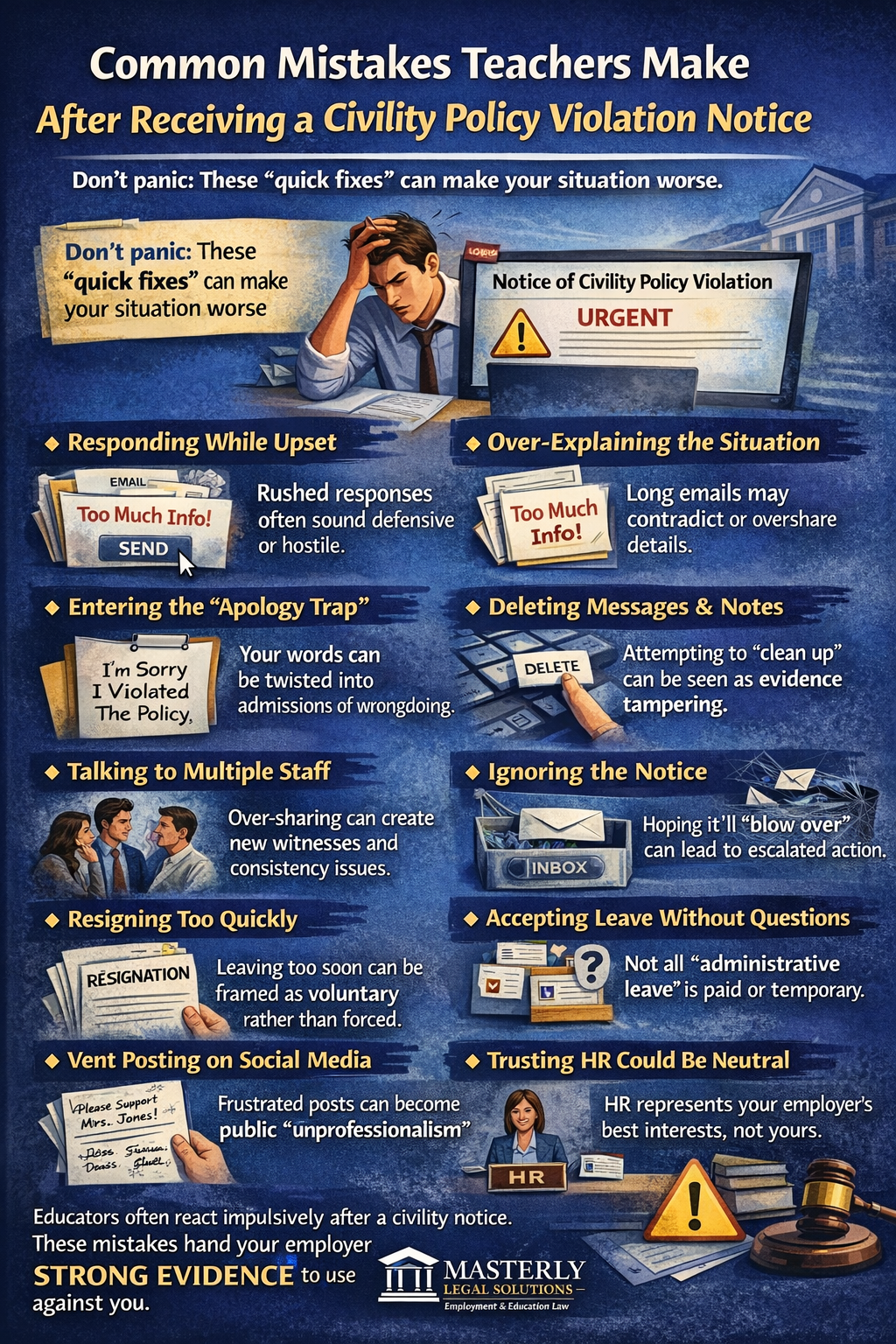
When you receive a notice, you do not need to become a lawyer overnight. You do need to avoid easy traps that investigators later rely on. Here are steps that often help employees protect themselves without escalating conflict:
- Pause before responding, especially if emotions are high
- Preserve records instead of deleting anything
- Keep communication short, factual, and professional
- Track all dates, periods, and leave status changes
- Limit conversations with other employees about the case
- Confirm whether administrative leave is paid administrative leave and whether it is time limited basis
- Seek legal guidance before major decisions like resigning
These steps are simple, but they prevent the most common errors that transform a notice into long-term consequences.
How Masterly Legal Solutions Helps Teachers Facing Civility Notices
A civility policy notice can feel like a stain on your name, even before anyone proves anything. Teachers often worry about reputation, future hiring, and whether the district is quietly building a case for wrongful termination. Others fear constructive termination pressure through prolonged administrative leave and shifting working conditions. Our job is to help you see the situation clearly, protect your position, and respond strategically.
We help employees understand what the notice means, what the employer may be trying to document, and how to avoid giving the district “free evidence.” We also help employees evaluate whether administrative leave is being used fairly or as leverage for forced resignation. If the file is drifting toward constructive discharge, wrongful discharge, or a future claim, we help you protect the record with calm, credible steps.
We work with educators across Texas, including matters connected to san antonio texas school districts, where policies and processes can move quickly once a notice is issued. Whether your goal is to return to the classroom, protect pay and benefits, or prevent your situation from becoming a career-ending dispute, our firm focuses on practical, high-stakes advocacy for the employee who needs stability.
Contact Masterly Legal Solutions for a Free Consultation
If you just received a civility policy violation notice, you are standing at a crossroads. The next few days often decide whether this stays a short administrative moment or turns into administrative leave extensions, investigative leave restrictions, or a forced resignation situation that gets labeled as voluntary. You do not have to guess your way through it, and you should not have to carry that stress alone.
Call Masterly Legal Solutions at (972) 236-5051 for a free consultation. We’ll help you understand what your notice is really setting in motion, how to protect your employee's current position, and how to avoid preventable mistakes that later get used as strong evidence. You deserve a plan that fits your circumstances, protects your pay and benefits when possible, and guards against outcomes like constructive termination, constructive discharge, wrongful discharge, or wrongful termination.
Disclaimer: This article is for educational purposes only and does not constitute legal advice or legal guidance. For advice about your specific situation, consult with a licensed attorney.

Teacher Rights When Assaulted by a Special Needs Student: Safety, Reporting and Investigation Issues






Looking for Legal & Business Solutions? Contact Us Now
Fill in the form or call us to set up a meeting