

How School District Notes and Emails Become Evidence in TEA Investigations
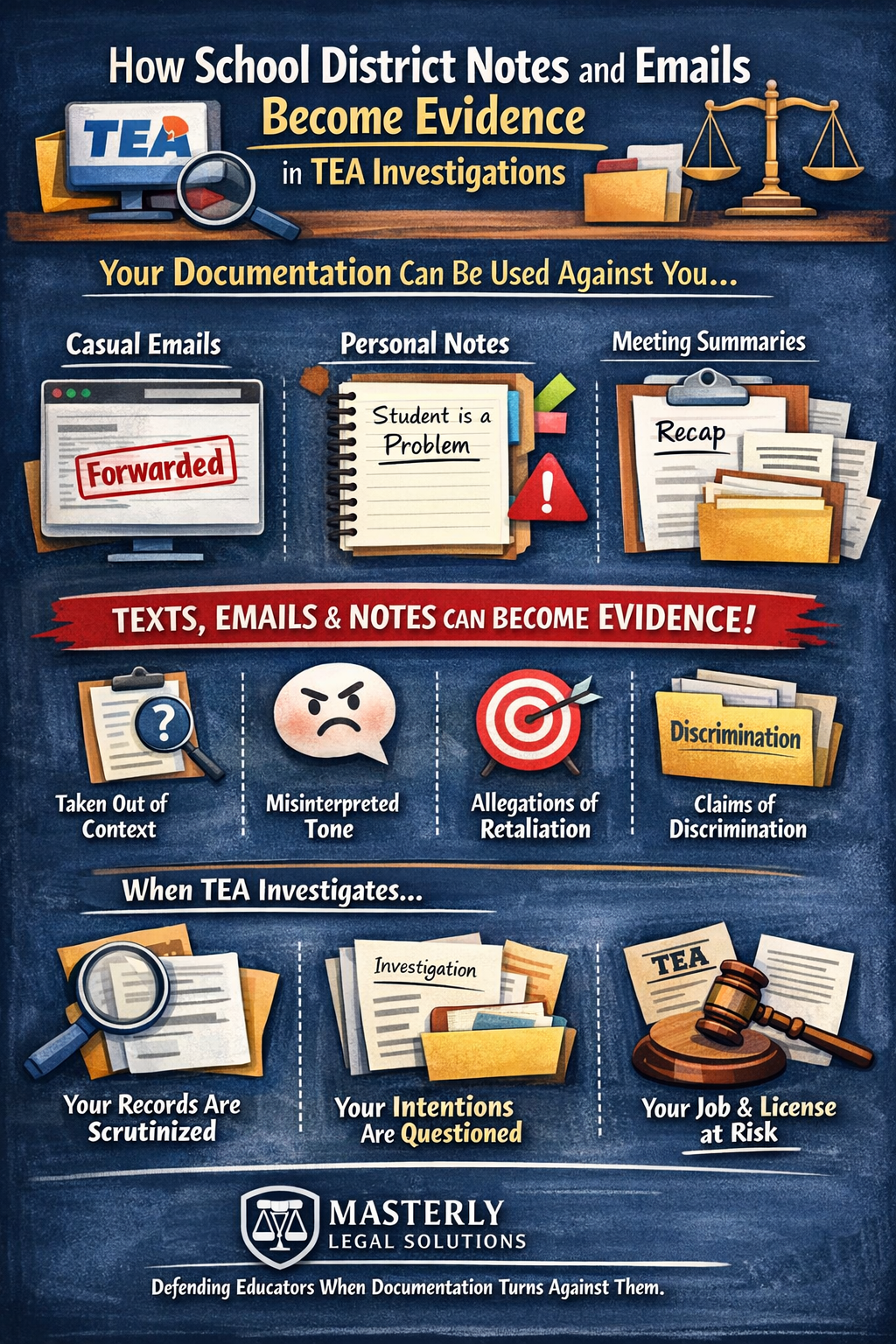
If you’re a teacher or campus administrator, you probably think of “documentation” as something you create to stay organized, support students, and protect yourself. That’s a reasonable mindset—until a TEA investigation begins. In that moment, routine notes, casual emails, and quick messages that felt harmless can suddenly become the center of the case.
At Masterly Legal Solutions, we’ve seen how educators underestimate documentation traps. A single sentence typed in frustration, a “quick recap” after a tense meeting, or a note written for your own memory can be taken out of context and presented as proof of wrongdoing. What you intended as clarity may be interpreted as admission, retaliation, or unprofessional conduct.
This article explains how school district documentation becomes evidence, what investigators tend to focus on, and what steps educators can take to reduce risk. We’ll also cover how employment law issues can overlap with TEA matters, including retaliation, discrimination, and adverse actions that impact your job. If you’re already feeling uneasy about what exists in your inbox or personnel file, you’re not alone—and there are practical ways to respond.
Why TEA Investigations Often Start With Paper, Not People
Many educators assume TEA investigations begin with witness interviews. In reality, the first “witness” is often documentation. TEA investigators and district representatives may review written records before they ever ask you a question.
Emails, notes, logs, and internal communications can feel more reliable than memories. They create a timeline, establish what someone knew, and show what actions were taken. In a legal process, that kind of detail carries weight.
Documentation can also shape how your intentions are viewed. Even if your conduct was appropriate, the way something was written may be interpreted as harsh, retaliatory, or biased. This is why it’s so important to understand what records exist and how they may be used.
The Documentation Trap Teachers Don’t See Coming
The biggest trap is believing that “private” notes are private forever. Many educators keep informal records to help them remember events, student behavior, or interactions with colleagues. But those notes can be requested, copied, forwarded, or attached to a complaint.
Another trap is writing when emotions are high. A stressful day can lead to a rushed email or message that sounds more aggressive than intended. Later, it may be presented as evidence of hostility, retaliation, or poor judgment in the workplace.
Finally, many employees assume they can explain away a poorly worded message. Unfortunately, investigators may rely on the plain text more than your explanation. Once something is written down, it can become a permanent part of the record.
What Counts as “Evidence” in a TEA Investigation
Educators are often shocked by how broad “evidence” can be. It’s not just formal reports or disciplinary paperwork. Almost any written communication connected to the allegation may be relevant.
Common evidence sources include:
- Emails between teachers, administrators, and parents
- Campus behavior logs and incident reports
- Meeting notes, including informal summaries
- Performance reviews and negative performance reviews
- Text messages or app-based messages tied to work
- HR records and employee complaints
- Lesson plans, grading records, or accommodation notes
Even if the documentation wasn’t written for TEA, it can still be used. A case may involve the texas board or a state agency review, and documentation is often the foundation.
Why Emails Carry More Weight Than Teachers Expect
Emails feel routine, but they are often the most damaging evidence in TEA investigations. That’s because emails usually include timestamps, recipients, and exact language. They can show who was notified, how quickly someone responded, and whether a teacher’s tone was professional.
Emails also tend to live forever. Even if you delete an email, the district may still have it on a server. The employer may retrieve it during an internal review or when responding to legal matters.
A message sent in five seconds can be reviewed for five months. That’s the reality of modern workplace investigations, especially when your license and career are on the line.
The “Forwarded Email” Problem That Escalates Cases Fast
One of the most underestimated risks is the forwarded email. Teachers often send messages thinking they’re communicating with one trusted person. But emails can be forwarded to supervisors, HR, investigators, or legal counsel.
A private frustration shared with a colleague can become a formal complaint attachment. A “heads up” email can be reframed as retaliation or an attempt to influence reporting discrimination. A sarcastic line can be presented as hostility in a hostile work environment claim.
In TEA matters, forwarded emails often create a narrative before you even know an allegation exists. That’s why careful wording matters, even when you believe you’re speaking “off the record.”
How Notes Written for “Memory” Become Official Records
Teachers frequently keep notes to track student behavior, parent interactions, or campus incidents. The intention is usually good—organization, safety, and consistency. But notes can become evidence if they are shared, uploaded, or referenced in an official communication.
Once your notes are used to justify a decision, they may be treated like formal documentation. If a dispute arises, those notes may be reviewed for bias, inconsistency, or exaggeration.
The most common issue we see is unclear language. If your note sounds like an opinion instead of an objective observation, it can be attacked as unfair or retaliatory. This is especially risky when the issue later becomes a legal dispute.
The Difference Between “Objective Notes” and “Opinion Notes”
In an investigation, objective notes are usually safer. Opinion notes are more vulnerable to criticism. TEA investigators and district administrators may question whether your statements were supported by facts.
Objective notes focus on what happened. Opinion notes focus on what you think someone meant. In the workplace, that distinction matters.
A strong note often includes:
- Date and time
- Specific behavior observed
- Direct quotes when appropriate
- Actions taken and who was notified
- Follow-up steps
A risky note often includes conclusions like “they’re lying,” “they’re lazy,” or “they’re always causing problems.” Those phrases can create the impression of bias or hostility.
How “Quick Recap” Emails Create a Timeline That Can Hurt You
Educators often send recap emails after tense meetings to “document what was said.” While that can be useful, it can also backfire. A recap email can lock you into a specific version of events.
If the recap includes emotional language or blame, it may be used as evidence of retaliation or escalating conflict. If it’s inaccurate, it may damage your credibility. If it includes confidential information, it may raise compliance concerns.
Recap emails can be valuable, but they must be written carefully. In many cases, teachers should seek legal assistance before sending documentation that may later be reviewed by TEA.
When Documentation Looks Like Retaliation (Even If It Isn’t)
Retaliation is one of the most misunderstood issues in education employment disputes. Teachers may believe retaliation only exists if someone is fired. In reality, retaliation can involve many adverse actions.
Examples may include:
- Pay cuts or changes to work schedules
- Reassignment to an equivalent position that is less desirable
- Increased scrutiny or unfair performance reviews
- Sudden disciplinary write-ups after a complaint
- Being excluded from meetings or opportunities
A retaliation complaint can grow quickly when documentation exists. If an email suggests someone is being “targeted,” that language may be used to argue retaliation occurred.
A retaliation lawyer can help analyze whether the documentation supports or weakens your position. The goal is to protect your license and your employment future.
The Role of “Protected Activities” in Education Workplaces
Many educators don’t realize how often protected activities come up in school disputes. Reporting concerns about illegal activities, requesting reasonable accommodations, or participating in an investigation can be protected.
Protected activities may include:
- Reporting discrimination
- Requesting accommodations under the americans with disabilities act
- Taking leave under a medical leave act
- Participating in internal complaints or investigations
- Raising concerns tied to federal and state laws
If a teacher engages in protected activities and then faces negative treatment, documentation becomes critical. The wrong email at the wrong time can be interpreted as retaliation.
This is where labor and employment lawyers often become essential, especially when a TEA investigation overlaps with employment law issues.
How Discrimination Issues Show Up Inside TEA Investigations
TEA investigations often focus on educator conduct, but employment-related issues may still be part of the story. Discrimination allegations can arise alongside complaints about professionalism, communication, or classroom decisions.
Examples include:
- Age discrimination concerns tied to assignment changes
- Claims under the disabilities act involving accommodations
- Concerns connected to the pregnancy discrimination act
- Allegations related to title vii protections
Even if TEA is not deciding a discrimination claim, documentation may reveal patterns. This can influence district decisions, employment cases, or future legal action.
When discrimination is involved, employment lawyers often review whether the employer complied with federal laws and state laws. Documentation is often the difference between speculation and proof.
Why Tone Matters More Than You Think in Written Communication
In education, tone can be misunderstood easily. Teachers often write quickly between classes or late at night after stressful days. Unfortunately, investigators may interpret tone as intent.
Words like “finally,” “obviously,” “you people,” or “I’m done with this” can sound hostile. Even if you meant them casually, they may be read as disrespectful or retaliatory.
In a hostile work environment dispute, tone can become a major issue. If documentation shows sarcasm, insults, or dismissive language, it can be used to argue unprofessional conduct.
This is why we advise educators to write like every message may someday be read in a meeting room by strangers. Because sometimes, it will be.
What TEA Investigators and Districts Look for in Documentation
When documentation is reviewed, investigators often focus on patterns. A single email may not be enough to prove misconduct, but multiple messages may create a story.
Common patterns include:
- Escalating conflict with colleagues or parents
- Inconsistent explanations of the same event
- Lack of reporting or delayed reporting
- Harsh tone or repeated blame-shifting
- Signs of bias or unequal treatment
Documentation also helps identify potential witnesses. If your email references someone being present, that person may be interviewed. If you mention a conversation, it may trigger a request for additional records.
This is why even “minor” notes can become major in the legal process.
The Hidden Risk of Performance Reviews in TEA-Related Employment Conflicts
Many teachers think performance reviews are separate from TEA investigations. But they can overlap. Performance reviews often contain language that can support or contradict the district’s position.
If a teacher is accused of misconduct but has strong performance reviews, that can help show credibility and professional consistency. If negative performance reviews appear suddenly after a complaint, that may support a retaliation argument.
Performance reviews can also be used to justify adverse actions like termination or reassignment. If a teacher is wrongfully terminated, these records may be reviewed in employment cases.
Because performance reviews are formal documents, they often carry significant weight in both district decisions and legal proceedings.
How “Informal Complaints” Become Formal Allegations
Teachers are often blindsided when an informal concern becomes a formal complaint. A parent email, a colleague message, or a casual remark can trigger documentation that spirals into an investigation.
The district may open an internal file, gather records, and begin interviewing staff. Once that begins, your written communications become part of the evidence pool.
This is why it’s important to take early warning signs seriously. If you sense conflict building, careful documentation and legal guidance can reduce risk. A law firm experienced in education-related matters can help you avoid missteps.
The Role of HR, Administrators, and District Counsel
District investigations often involve HR, administrators, and sometimes outside counsel. These groups may evaluate documentation with a different lens than teachers expect.
HR may focus on employment contracts, policy compliance, and risk management. Administrators may focus on campus culture and discipline consistency. Legal counsel may evaluate exposure under federal and state laws.
Even if you feel your actions were justified, documentation may be reviewed to determine whether the employer can defend its decisions. This is especially important if the dispute could reach federal court or state courts.
Teachers should never assume the district’s interpretation will match their intent. That’s why early legal assistance can matter.
When Documentation Supports Wrongful Termination Claims
Not every TEA investigation ends in termination. But when it does, documentation becomes central. If a teacher is wrongfully terminated, records may be reviewed to determine whether the decision was justified or retaliatory.
Wrongful termination cases often examine:
- Timing of discipline
- Consistency compared to other employees
- Whether policies were followed
- Whether protected activities occurred
- Whether the teacher was given a fair chance to respond
If you were wrongfully terminated after reporting concerns, requesting accommodations, or raising compliance issues, documentation may support a claim. In some cases, whistleblower retaliation may also be considered, depending on the facts.
A retaliation lawyer can help evaluate whether the evidence supports a claim and what next steps are realistic.
The Overlap Between TEA Cases and Employment Law Disputes
TEA investigations focus on educator conduct and licensing issues, but they often overlap with employment law. Teachers may face discipline, termination, or reputational harm at the same time.
Employment law issues may include:
- Retaliation and retaliation complaint allegations
- Discrimination concerns under federal laws
- Contract disputes involving employment contracts
- Workplace conflicts escalating into hostile work environment claims
This overlap is where labor and employment lawyers can play a critical role. A case may involve both TEA procedures and employment protections under federal and state courts.
At Masterly Legal Solutions, we understand that your license and your livelihood are connected. A strategy must consider both.
Why Teachers Should Be Careful With “Vent Messages” and Side Chats
Group chats and quick vent messages can feel harmless. But if they relate to work, they can become evidence. A screenshot can change everything.
A message meant to blow off steam can be presented as proof of bias, hostility, or intent to retaliate. If the message references a student, parent, or colleague, it may raise confidentiality concerns.
Teachers should treat all workplace-related communication as potentially discoverable. Even if it’s not in your official email, it can still appear later in an investigation.
If you’re unsure what to do after sending a message you regret, it’s wise to speak with attorneys before trying to “fix” it. A rushed correction can create more problems.
Documentation Mistakes That Create Big Problems in TEA Cases
Most documentation mistakes are not made out of malice. They are made out of stress, exhaustion, and the pace of education. Still, they can have serious consequences.
Common mistakes include:
- Writing emotionally instead of factually
- Using sarcasm or accusatory language
- Guessing motives instead of describing actions
- Failing to document key steps taken
- Over-documenting minor issues in a way that looks targeted
Documentation should support your professionalism, not undermine it. The best approach is consistent, objective, and policy-aligned records.
If you’re already in a TEA investigation, it may be too late to rewrite the past—but you can still protect your future responses.
How “Missing Documentation” Can Be Used Against You
Sometimes the issue isn’t what you wrote. It’s what you didn’t write. Missing documentation can be interpreted as negligence, dishonesty, or failure to follow procedures.
If an incident occurred but there is no record of reporting, the district may argue you failed to act. If a parent complaint exists but there is no record of follow-up, it may look like the concern was ignored.
Missing documentation can also create credibility problems. If your story relies on memory but the paper trail is incomplete, investigators may rely on other sources.
This is why consistent documentation habits matter. They can protect you when questions arise months later.
What “Consistency” Means in an Investigation
Consistency doesn’t mean perfection. It means your documentation matches your actions and your explanations over time. Inconsistent statements can be damaging, even when they are accidental.
Investigators may compare:
- Your emails to your later interview statements
- Your notes to the district’s records
- Your timeline to other witnesses’ timelines
If small details change, it may raise suspicion. This is why teachers should avoid guessing, exaggerating, or filling in gaps when responding to questions.
If you are unsure, it’s better to say you don’t recall than to create a confident but inaccurate statement. Legal guidance can help you prepare.
The Importance of Understanding District Policy Language
Many documentation issues come from misunderstanding district policy. Teachers may use language that unintentionally triggers policy concerns.
For example, describing a student as “dangerous” or “out of control” may raise questions about reporting requirements. Describing a colleague as “harassing” may imply a hostile work environment complaint. Mentioning “discrimination” may trigger formal reporting discrimination protocols.
This doesn’t mean teachers should stay silent. It means words matter. The safest approach is to document facts clearly and follow reporting steps.
When in doubt, consulting with a law firm can help ensure your documentation aligns with legal protections and district expectations.
How Investigations Use Documentation to Identify “Intent”
Intent is one of the hardest things to prove, but documentation often becomes the tool used to suggest it. Investigators may argue that your words show what you meant to do.
A phrase like “I’m going to make sure this stops” may be interpreted as commitment to safety—or as retaliation, depending on context. A note like “she’s always causing trouble” may be interpreted as bias.
This is why teachers should avoid absolute statements. Words like “always,” “never,” or “everyone knows” are rarely helpful in an investigation.
A well-phrased message focuses on the specific event and what actions were taken. That approach reduces the risk of misinterpretation.
The Role of the Equal Employment Opportunity Commission in Education Disputes
Some educators assume the equal employment opportunity commission only applies to corporate workplaces. That’s not true. School employees can also pursue claims through the equal employment opportunity commission when discrimination is involved.
If a teacher faces discrimination under title vii, age discrimination protections, or disability-related concerns under the americans with disabilities act, documentation may become central. Emails, performance reviews, and HR records can support or undermine claims.
Even if the TEA investigation is separate, the documentation may overlap. A teacher may be defending a license while also protecting employment rights.
Employment lawyers often evaluate whether the evidence supports a claim and whether the employer complied with federal and state laws.
When a Case Moves Into Federal and State Courts
Not every case reaches court, but some do. Employment disputes, which can include issues such as false accusations, may proceed into federal and state courts depending on the claims involved.
For example, certain discrimination claims may be tied to federal laws. Contract disputes or retaliation claims may be handled under state laws. Some matters may involve both federal and state courts depending on the legal issues.
Documentation becomes even more important if a case escalates. What you wrote months ago may be reviewed by attorneys, judges, and juries.
This is why early strategy matters. A careful approach can improve the chances of favorable outcomes and reduce long-term damage.
How Attorney’s Fees and Consultation Costs Fit Into the Bigger Picture
Many educators hesitate to seek help because they worry about cost. That’s understandable, especially when finances are tight. But waiting too long can make the situation worse.
A consultation fee may be far less than the cost of losing your job or license. In some employment cases, attorney's fees may also become part of the broader dispute, depending on the claims and outcomes.
An initial consultation can help you understand your options and avoid mistakes that create long-term consequences. It can also help you respond appropriately without escalating the situation.
At Masterly Legal Solutions, we take these concerns seriously. Teachers deserve clear guidance, not confusion or fear.
How Teachers Can Document Safely Without Creating Risk
Good documentation is not about writing more. It’s about writing smarter. Teachers can protect themselves by focusing on objective facts and policy compliance.
Helpful documentation habits include:
- Stick to dates, times, and specific events
- Avoid sarcasm, insults, or emotional labels
- Use neutral language and direct quotes when needed
- Document what actions you took and who you notified
- Keep records consistent with district expectations
Teachers should also consider whether documentation is necessary. Over-documenting minor issues can sometimes create the appearance of targeting or retaliation.
When documentation is needed, it should reflect professionalism and clarity. That’s the safest foundation.
What to Do If You Think Your Emails or Notes Will Be Used Against You
If you suspect documentation may be used against you, don’t panic—and don’t try to “clean it up.” Deleting messages or altering records can create serious problems.
Instead, focus on preparation. Gather your records, identify what exists, and think about how the documentation might be interpreted. If you have supporting context, such as earlier messages or policy guidance, that may matter.
This is the moment to seek legal assistance. A lawyer can help you understand what matters most, what to avoid saying, and how to respond strategically.
Educators often feel alone in these moments, but you don’t have to handle it without support.
How Masterly Legal Solutions Helps Educators Facing Documentation-Based Allegations
When documentation becomes evidence, the case can feel unfair. You may feel like you’re being judged for wording instead of your actual work. That frustration is real, and it’s common.
Our attorneys help educators evaluate the evidence, understand the legal process, and respond with clarity. We also consider employment law concerns, including retaliation, discrimination, and wrongful termination risks.
We know these cases can affect your career, your reputation, and your family member responsibilities at home. Teachers often carry the emotional burden quietly, but they shouldn’t have to.
Whether the issue involves TEA concerns, labor and employment disputes, or overlapping legal matters, our firm approaches the situation with strategy and care.
Why Teachers Need a Plan Before They Respond to Investigators
When teachers are contacted about an investigation, the instinct is to explain quickly. But quick responses can create inconsistencies, admissions, or misunderstandings.
A plan should include:
If you are a Texas educator facing a TEA investigation, consider the following steps:
- Reviewing the documentation involved
- Understanding the allegations clearly
- Preparing a factual timeline
- Avoiding speculation or emotional statements
- Identifying potential witnesses and records
This isn’t about hiding the truth. It’s about communicating responsibly and protecting yourself within the law. A strong strategy can reduce risk and improve favorable outcomes.
Educators deserve a fair process, and preparation helps ensure your voice is heard accurately.
,Why Legal Specialization Matters in TEA-Related Employment Conflicts
Not all lawyers approach education employment issues the same way. These cases often require legal specialization because they involve unique systems, timelines, and professional consequences.
A teacher may face licensing concerns while also dealing with employment contracts, district discipline, and reputation damage. Some cases overlap with commercial litigation principles when disputes escalate, while others resemble civil rights act disputes involving discrimination.
It’s important to work with attorneys who understand the education workplace and the legal protections that may apply. Experience matters, especially when your career is at stake.
Our law firm focuses on practical strategy, not generic advice. Teachers need solutions that fit the reality of school systems.
The Reality: Many Employees Don’t Realize They’re Building a Case File
Most teachers aren’t trying to build a case file. They’re trying to survive a busy day. But every email and note can contribute to a record that follows you.
Even educators with strong job performance can be caught off guard by how documentation is interpreted. A small misunderstanding can grow into a major dispute.
That’s why awareness matters. Documentation is not just paperwork—it’s a legal record in the workplace. And when a case arises, that record can shape the outcome more than your intentions.
If you’re dealing with documentation concerns in Frisco Texas or surrounding areas, it’s worth getting clarity before the situation escalates.
Employment Act Issues That Can Affect Educators During Workplace Disputes
Even when a TEA investigation focuses on professional conduct, the employment act standards that shape workplace rights can still matter in the background. Teachers are employees, and the employer’s policies must align with legal expectations when discipline, investigations, or termination are involved. If documentation shows unfair treatment, inconsistent enforcement, or retaliation, those employment act concerns can become part of a broader strategy. At Masterly Legal Solutions, we help educators understand how workplace documentation connects to real legal exposure.
Family Law Stress Can Spill Into School Documentation Without Warning
Many educators are balancing intense responsibilities outside of campus, including family law matters like custody schedules, divorce, or protective order situations. While these issues may feel personal, they can sometimes affect communication patterns, attendance, or workplace interactions that end up documented. A stressful season can lead to rushed emails, missed deadlines, or misunderstandings that later get mischaracterized in an investigation. We help teachers protect their professional standing while also respecting the reality that life does not pause when legal matters arise.
Job Duties and Role Expectations Are Often Misrepresented in Investigations
A common issue in documentation-based cases is that job duties are not clearly defined or are unfairly expanded after a conflict begins. Teachers may suddenly be accused of failing responsibilities they were never properly assigned, trained on, or supported with. Emails and internal notes can be used to suggest you “should have known,” even when expectations were unclear. Our attorneys focus on aligning the facts with your actual job duties so the record reflects what you were truly responsible for.
Partnership Disputes Can Impact School Leaders and Education Professionals Too
While partnership disputes are often associated with businesses, they can also affect educators who operate side businesses, coaching programs, tutoring services, or professional partnerships outside the district. When those disputes spill into workplace communication, they may create distractions or conflicts that show up in school documentation. In some cases, outside disagreements can trigger internal complaints or reputational harm. Masterly Legal Solutions helps educators reduce the risk of personal business conflicts becoming professional liability.
Why Super Lawyers Recognition Matters When Your Career Is on the Line
When educators search for legal representation, they often look for trusted indicators of credibility, such as super lawyers recognition. While every case depends on facts, working with attorneys who are respected in their field can make a difference in strategy and confidence. A TEA investigation is serious, and you deserve guidance from professionals who understand both the pressure and the stakes. Our team is committed to delivering strong advocacy that protects your future.
Whistleblower Laws and Reporting Misconduct in School Systems
Educators sometimes report misconduct, unsafe conditions, or violations they believe are wrong—and then face backlash afterward. Whistleblower laws can apply when employees report certain wrongdoing and later experience retaliation or discipline. Documentation becomes critical because it can show timing, motive, and whether the employer took adverse actions after protected reporting. If you believe your case involves whistleblower laws, our attorneys can help you evaluate your options and respond carefully.
Personal Injury Issues Can Affect Employment Records More Than People Realize
A teacher dealing with a personal injury may need medical leave, modified duties, or time away from work, and those requests can become part of the documentation trail. Unfortunately, injuries sometimes lead to workplace misunderstandings, attendance concerns, or unfair assumptions about performance. Even when the injury occurred outside of school, it can still affect how administrators document your situation. Our firm helps educators protect themselves when health-related issues become part of the employment record.
Punitive Damages: When Employer Conduct Crosses the Line
In some serious workplace cases, punitive damages may be available when conduct is especially reckless or intentional. While not every dispute qualifies, documentation can help show patterns of retaliation, discrimination, or extreme misconduct by decision-makers. Teachers often feel powerless when a district controls the narrative, but written records can expose unfair behavior. Masterly Legal Solutions evaluates whether punitive damages may be a consideration based on the facts and applicable law.
Catastrophic Injury and Long-Term Career Impact for Educators
A catastrophic injury can change an educator’s life quickly, affecting mobility, stamina, and the ability to perform daily responsibilities. When that happens, teachers may need accommodations, schedule changes, or extended leave, and those requests can become heavily documented. If the employer responds negatively or creates pressure, that documentation may later become evidence in a dispute. We help educators protect their rights and preserve their professional stability during long-term medical challenges.
Board Certified Attorneys and the Value of Proven Legal Skill
When you’re facing a high-stakes investigation, working with board certified attorneys can provide added confidence in the quality of representation. Board certification often reflects advanced knowledge and tested skill in a legal field, which can be valuable when your license and career are at risk. Educators deserve more than surface-level advice—they need strategic advocacy. Our team takes pride in offering focused, professional support.
Practice Areas That Support Educators Beyond TEA Investigations
Many teachers assume they only need help with the TEA side of the case, but strong representation often involves broader practice areas. Employment conflicts can overlap with retaliation claims, discrimination concerns, contract disputes, and workplace investigations. Understanding the full picture helps prevent one problem from turning into multiple legal threats. Masterly Legal Solutions supports educators with strategy that considers every angle of risk and protection.
Years of Experience Can Shape Strategy in Documentation-Based Cases
When documentation becomes evidence, experience matters because small details can change outcomes. Attorneys with years of experience know what investigators focus on, how districts build narratives, and where teachers often get trapped in avoidable mistakes. A rushed response can create long-term damage, especially when written records already exist. Our firm uses practical experience to guide educators through the process with clarity and confidence.
Best Lawyers Understand That Educators Need Both Protection and Precision
Educators deserve representation from best lawyers who understand that your reputation is part of your livelihood. These cases are not only about rules—they’re about your career, your income, and your future opportunities. Documentation must be handled carefully because it can either defend you or damage you depending on how it’s presented. Masterly Legal Solutions focuses on protecting educators with a strategy built for real-world outcomes.
Well Versed Legal Guidance Makes a Difference When Evidence Is Already Written
When emails, notes, and reports already exist, you need a team that is well versed in handling documentation-based allegations. Teachers often feel like the evidence is “locked in,” but how that evidence is interpreted and explained can still be shaped. Strong representation focuses on context, policy, timelines, and credibility. Our attorneys help educators respond in a way that protects their license and reduces professional risk.
Supporting Clients Through Stressful Investigations With Clear Legal Strategy
At Masterly Legal Solutions, we understand that clients facing TEA investigations often feel overwhelmed, anxious, and frustrated. You may be trying to teach, protect your family, and defend your name at the same time. Our role is to bring structure to the chaos by helping you understand what the documentation means, what your options are, and what steps to take next. When your career is on the line, you deserve a legal team that treats your case with urgency and respect.
Contact Masterly Legal Solutions for a Free Consultation
If you’re a teacher, administrator, or school employee facing a TEA investigation—or you’re worried that your emails, notes, or performance reviews may be used against you—now is the time to protect yourself. Documentation cases move quickly, and the wrong response can create long-term consequences.
Masterly Legal Solutions is here to provide real legal assistance, not generic talking points. Whether you need an attorney frisco educators trust, guidance from employment lawyers, or support from labor and employment lawyers who understand retaliation, discrimination, and adverse actions, we’re ready to help you take the next step with confidence.
Call (972) 236-5051 today to schedule your free initial consultation. We’ll listen to what happened, explain the legal process in plain language, and help you build a strategy focused on your best interests and your future.
Disclaimer: This article is for educational purposes only and does not constitute legal advice or legal guidance. For advice about your specific situation, consult with a licensed attorney.

Teacher Rights When Assaulted by a Special Needs Student: Safety, Reporting and Investigation Issues





Looking for Legal & Business Solutions? Contact Us Now
Fill in the form or call us to set up a meeting





