
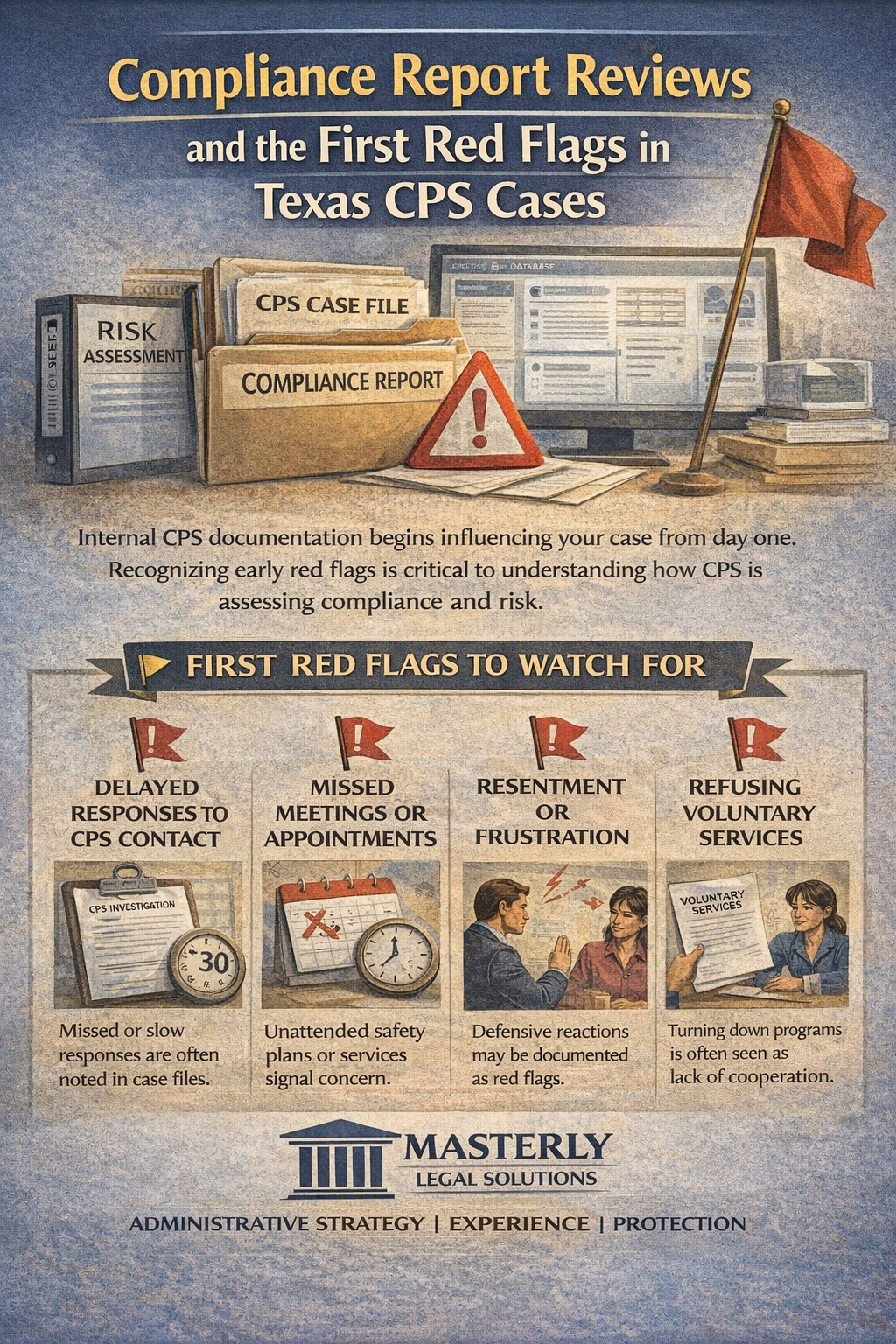
Compliance Report Reviews and the First Red Flags in Texas CPS Cases
When Child Protective Services reaches out to a parent or caregiver in Texas, the situation often feels urgent but unclear. Many families focus on interviews, home visits, and service requests without realizing that something else is happening quietly in the background. From the earliest moments of a cps investigation, CPS is building internal documentation that influences every later decision. One of the most important of these internal records is the compliance report.
At Masterly Legal Solutions, we regularly work with families who only learn about a compliance report after it has already shaped their cps case. By the time concerns appear in writing, options may be limited. Understanding how compliance report reviews work and recognizing the first red flags early can make a meaningful difference for a child, the parent, and the child’s family.
Understanding Child Protective Services in Texas
Child Protective Services CPS operates under the Texas Department of Family and Protective Services, often shortened to DFPS or the Texas Department. This state agency is responsible for receiving reports and conducting child protective investigations related to child abuse or neglect. CPS is an administrative agency, but its decisions can affect parental rights, court involvement, and even criminal investigation referrals.
Protective services are intended to protect children and support safety. However, the investigation process can feel overwhelming for a parent who has never experienced CPS involvement. Knowing how CPS evaluates compliance helps families avoid unintentional mistakes.
What a Compliance Report Means in a CPS Case
A compliance report is not a form parents typically see or sign. It is an internal CPS document used to record whether a parent or other individuals involved in a cps case are following expectations set by cps workers. These expectations may involve communication, cooperation, or participation in services.
Once created, the compliance report becomes part of the permanent case file. It may later be referenced in hearings, court filings, or administrative reviews. This is why early awareness is so important.
How Compliance Is Tracked During a CPS Investigation
Compliance tracking begins almost immediately after the report is accepted. During the investigation stage, CPS workers document interactions, responses, and observed behavior. Even brief phone calls or missed appointments may be interpreted as indicators of risk.
Parents often assume compliance only applies to formal orders. In reality, CPS tracks informal cooperation just as closely during the cps process.
Early Red Flags That Appear in Compliance Reports
Certain patterns frequently appear as early red flags in compliance report reviews. These red flags may not seem serious to a parent but can influence how CPS decides the next steps.
Common early concerns include:
- Delayed responses to CPS contact
- Missed meetings or home visit appointments
- Emotional or defensive communication
- Hesitation to agree to recommended services
These observations are often written into compliance documentation.
The Role of CPS Workers in Compliance Reporting
CPS workers are trained to investigate allegations and assess risk. As part of their duties, they record compliance observations throughout the investigation. Their notes are used to determine whether a child is safe and whether services are needed.
While cps workers aim to protect children, their assessments are subjective. Clear communication and preparation help reduce misunderstandings that can affect a compliance report.
Compliance Reports and Risk Assessment
Compliance reports directly influence CPS risk assessment decisions. Risk assessment is the process CPS uses to evaluate whether a child faces immediate risk or long-term safety concerns. Compliance is considered alongside evidence, allegations, and observations.
A negative compliance assessment may increase perceived risk even when abuse or neglect has not been proven. This can lead to more intrusive services or court involvement.
Allegations and Compliance Are Closely Linked
In cps investigations, allegations and compliance are evaluated together. General allegations of abuse or neglect may be weak or unsupported, but perceived noncompliance can make them appear more serious. This dynamic surprises many families.
Even when alleged abuse is later ruled out, compliance concerns may still affect outcomes. This is one reason compliance report reviews deserve early attention.
Compliance Does Not Require Admission of Abuse
One of the most common misunderstandings is the belief that compliance means agreeing with allegations. Compliance refers to participation in the investigation process, not an admission that child abuse or neglect occurred.
However, poorly managed compliance can unintentionally suggest acceptance of CPS conclusions. Strategic guidance helps parents cooperate without compromising their position.
Safety Plans and Compliance Expectations
A safety plan is often introduced early in a cps investigation. CPS may describe it as a temporary step to keep the child safe while the investigation continues. Safety plans often include supervision requirements, restrictions, or service participation.
Compliance with a safety plan is monitored closely. Any deviation may be documented as noncompliance, even when circumstances are misunderstood.
Voluntary Services and Their Impact on Compliance Reports
CPS may recommend voluntary services such as parenting classes, counseling, or assessments. While these services are described as optional, refusal or delay is often noted in compliance reports.
Parents should understand that voluntary services still create expectations. How and when services are addressed can affect how CPS evaluates cooperation.
Parenting Classes and Service Participation
Parenting classes are a common recommendation in cps cases involving neglect or safety concerns. Participation may be used as a sign of compliance, while hesitation may be interpreted negatively.
These services may be appropriate in some situations, but parents should understand how participation is documented. Services provided early often influence case direction.
Compliance Reports and the Investigation Process
The investigation process in Texas CPS cases includes interviews, home visits, document review, and ongoing assessment. Compliance reporting runs parallel to these steps. It is not a separate phase but an ongoing evaluation.
This means compliance issues can arise at any point, even late in the investigation. Early awareness helps families stay consistent.
Home Visits and Compliance Observations
A home visit is one of the most visible parts of a cps investigation. During a home visit, cps workers observe the child’s home environment, interactions, and routines. These observations are documented in the case file.
Missed or rescheduled home visits may be interpreted as avoidance. Clear communication helps prevent unnecessary compliance concerns.
Child Safety and Compliance Evaluation
Child safety and the child’s safety are central to every CPS decision. Compliance is viewed as a measure of how seriously a parent takes safety concerns. Even small actions can be interpreted through this lens.
Demonstrating focus on the child’s well being without panic or overreaction often supports a more balanced assessment.
Immediate Risk and Escalation
If CPS believes a child faces immediate risk, compliance concerns may accelerate escalation. Immediate risk assessments can lead to court orders, temporary custody, or foster care placement.
Compliance report entries often help justify these urgent actions. Preventing escalation requires careful attention early.
Temporary Custody and Court Involvement
When CPS seeks temporary custody, compliance reports are often included in court filings. Judges may rely on these reports to decide whether removal is necessary.
Court involvement increases the stakes significantly. Early administrative strategy can help avoid unnecessary court intervention.
Foster Care Decisions and Compliance History
Foster care placement is one of the most serious outcomes in a cps case. Compliance history plays a role in whether CPS believes removal is necessary to protect children.
Families are often shocked to learn that early compliance concerns contributed to removal decisions. Understanding this risk early is critical.
Compliance Reports and Court Hearings
Compliance reports are frequently referenced during hearings in juvenile court. Judges may review CPS documentation when deciding whether to issue a court order or approve a case plan.
Once compliance issues are presented in court, correcting them becomes more difficult. Preparation before hearings is essential.
Case Plans and Ongoing Compliance
If a cps case continues beyond the investigation stage, CPS may create a case plan. Case plans outline required services, expectations, and goals. Compliance with the case plan is monitored closely.
Case plans often build on earlier compliance assessments. Early issues may carry forward into long-term requirements.
Complete Investigations and Final Findings
CPS aims to complete investigations within required timeframes. When investigations are complete, CPS makes findings such as whether neglect occurred or abuse occurred. Compliance reports often influence these findings.
Families sometimes assume findings are based only on evidence of abuse. In reality, compliance plays a significant role.
Administrative Findings and the Central Registry
In some cases, CPS findings may result in a parent or alleged perpetrator being listed in the central registry. This registry can affect employment, licensing, and future background checks.
Compliance history is often cited when determining whether to substantiate allegations. Early strategy helps protect against long-term consequences.
Criminal Investigation Referrals
While CPS investigations are administrative, some cases lead to criminal investigation referrals. Compliance issues do not cause criminal cases, but they may influence how allegations are perceived.
Careful communication helps reduce the risk of misunderstandings that could escalate matters.
Legal Counsel and Compliance Strategy
Legal counsel during CPS involvement focuses on preparation, communication, and documentation. This is not about fighting CPS but about managing the process intelligently.
An attorney helps parents understand compliance expectations and avoid actions that create red flags. Early guidance is often more effective than later appeals.
Assistance Beyond General Resources
Some families explore general resources such as the Texas Legal Services Center or legal aid organizations. While these resources may provide information, they often cannot offer case-specific CPS defense.
CPS cases require tailored administrative assistance. Relying solely on general information can leave families exposed.
Software Compliance Report Versus CPS Compliance Reports
Some parents confuse CPS compliance reports with unrelated concepts such as a software compliance report used in business settings. CPS compliance reports are entirely different and focus on behavior, cooperation, and safety.
Understanding this distinction helps parents take CPS documentation seriously.
Evidence and Compliance Documentation
Evidence in CPS cases includes more than physical proof. Compliance documentation is treated as evidence of cooperation or resistance. Notes, emails, and timelines matter.
Parents who document interactions carefully are better positioned to respond to inaccurate reports.
Investigating Allegations With Balance
CPS is tasked with investigating allegations while attempting to protect children. Compliance reports help CPS decide whether services are needed or whether further action is required.
Balanced responses help ensure that investigations remain fair and proportionate.
Family Based Safety Services and Compliance
Family based safety services are sometimes offered as an alternative to court involvement. Participation is monitored closely and documented in compliance reports.
Understanding how these services affect the cps case helps families make informed decisions.
Protecting Parental Rights During Compliance Reviews
Parental rights remain in place throughout a cps investigation unless a court orders otherwise. However, compliance issues can indirectly affect how those rights are exercised.
Early guidance helps parents protect rights while cooperating appropriately.
The Role of Family Members and Other Individuals
CPS may involve family members or other individuals as part of safety planning. Compliance expectations may extend to these individuals as well.
Clear coordination helps prevent misunderstandings that affect the case.
More Resources Versus Strategic Guidance
While there are many resources available online, CPS cases require more than general advice. Strategic guidance focuses on how CPS actually decides cases.
Preparation is often the most effective form of assistance.
Recognizing When Compliance Becomes a Problem
Parents should pay attention when CPS begins emphasizing compliance, cooperation, or participation. These signals often indicate concerns forming behind the scenes.
Addressing issues early can prevent them from becoming permanent.
How Masterly Legal Solutions Approaches Compliance Report Reviews
At Masterly Legal Solutions, we focus on administrative CPS defense and appeal representation exclusively for Texas cases. Our approach is proactive, investigation-focused, and designed to prevent escalation rather than react to crisis.
We help families understand compliance expectations, communicate strategically, and protect the cps case record.
Taking Action Before Compliance Reports Are Finalized
Once a compliance report is finalized and relied upon, correcting it becomes difficult. The most effective time to act is before CPS reaches conclusions.
Early action helps protect the child’s life, family stability, and long-term interests.
Sexual Abuse Allegations and Heightened CPS Scrutiny
Allegations involving sexual abuse trigger some of the most intensive CPS responses. These cases are treated as high-risk from the outset, even before facts are fully verified. CPS may accelerate interviews, involve additional agencies, and apply stricter compliance expectations. Because of the sensitivity and potential consequences, early guidance is critical to protect the child while also safeguarding the rights of the family.
When CPS Believes Serious Harm May Be Present
CPS intervention escalates quickly when caseworkers believe a child faces serious harm. This determination does not require confirmed injury but is based on perceived risk and early observations. Once serious harm is suspected, CPS may seek emergency measures, increased services, or court involvement. Preventing unnecessary escalation depends on addressing concerns clearly and strategically at the earliest stage.
How CPS Weighs the Above Factors in Decision-Making
CPS decisions are rarely based on a single issue. Caseworkers evaluate the above factors collectively, including allegations, family history, communication patterns, and compliance behavior. These combined elements shape how CPS views the overall case. Understanding how factors interact helps families avoid actions that unintentionally worsen CPS perceptions.
Evaluating the Child’s Situation During an Investigation
Every CPS investigation centers on the child’s situation at the time of contact. CPS assesses daily routines, supervision, emotional stability, and environmental conditions to determine safety. Even temporary stressors can influence how the child’s situation is interpreted. Clear explanations and preparation help ensure the full context is understood.
Identifying Risk Factors That Influence CPS Outcomes
Risk factors are central to how CPS determines next steps. These may include prior reports, substance use concerns, mental health challenges, or household instability. Risk factors do not automatically mean wrongdoing, but they shape CPS response intensity. Early identification and explanation of these factors can reduce misunderstandings.
When CPS Seeks to Provide Services to the Family
CPS often attempts to provide services as part of its mandate to support families and protect children. These services may include counseling, parenting education, or referrals to community programs. While intended to be supportive, services also reflect CPS concerns. Understanding the purpose and implications of services helps families make informed decisions.
What It Means When CPS Finds Concerns During a Case
When CPS finds concerns, it does not always mean abuse or neglect has been substantiated. Findings may reflect perceived risk, compliance issues, or unmet expectations. These findings influence case direction, service requirements, and potential court involvement. Addressing findings early can prevent long-term consequences.
Understanding CPS Allegations of Child Abuse and Neglect
Child abuse and neglect allegations initiate CPS involvement, but they are not conclusions. CPS must investigate to determine whether abuse occurred or whether neglect occurred under administrative standards. These standards focus on safety and risk rather than intent. Families benefit from understanding how CPS evaluates allegations throughout the investigation.
Professionals Facing CPS Investigations and Compliance Risks
Professionals such as teachers, healthcare workers, and childcare providers face additional scrutiny during CPS investigations. CPS may evaluate professional conduct, reporting obligations, and workplace policies alongside family concerns. Compliance issues can affect both personal and professional standing. Strategic guidance is especially important for professionals navigating CPS involvement.
Contact Masterly Legal Solutions for Compliance Report Guidance
If you are involved in a Texas cps case and concerned about a compliance report, early assistance matters. Masterly Legal Solutions provides strategic CPS defense and administrative appeal representation focused on protecting families through preparation and clarity.
We invite you to contact us at (972) 236-5051 for a free consultation. This conversation allows us to review your situation, explain the compliance concerns you may be facing, and discuss next steps before CPS decisions are locked in.
Disclaimer: This article is for informational purposes only and does not constitute legal guidance or legal advice. Reading this content does not create an attorney-client relationship. CPS cases are fact-specific, and outcomes depend on individual circumstances. Consult a qualified Texas CPS attorney for advice related to your specific situation.

Teacher Rights When Assaulted by a Special Needs Student: Safety, Reporting and Investigation Issues


Looking for Legal & Business Solutions? Contact Us Now
Fill in the form or call us to set up a meeting