FERPA Training: What School and University Employees Need to Understand Before Handling Student Records
A faculty member forwards an email containing student information to someone outside the department. An administrator receives a request for records and is unsure whether they can be released. A staff member assumes that anyone employed by the university can access a student's file.
These situations can become student privacy problems when employees do not understand where their authority ends.
Effective FERPA training prepares faculty, administrators, and staff before they access, discuss, store, or disclose student information. The purpose is not to make every employee an education-law expert. It is to help employees recognize when FERPA may apply, follow institutional policies, and escalate questions before making a decision that could affect a student's records.
For schools and universities, this is about more than explaining a federal law. It is about creating a consistent culture around student information and giving employees a clear process for handling sensitive records.
Student Records Pass Through More Hands Than Many Institutions Realize
The Family Educational Rights and Privacy Act, commonly called FERPA, is a federal law concerning access to and disclosure of student education records. Parents generally hold FERPA rights for younger students, while those rights transfer to the student when the student turns 18 or attends a postsecondary institution at any age, making that person an eligible student.
In practice, education records can reach many parts of an institution.
The U.S. Department of Education explains that education records are records directly related to a student and maintained by an educational agency, institution, or a party acting on its behalf. Examples can include grades, transcripts, schedules, certain student health records, financial information, disciplinary records, electronic files, emails, and other materials kept in electronic form.
That means FERPA is not merely an issue for the registrar.
Faculty members, administrators, counselors, admissions personnel, HR professionals, IT specialists, support staff, and teachers may qualify as school officials and may encounter education records as part of their work.
A credible school staff training program should reflect that reality.
FERPA Training Helps Employees Know When to Stop and Ask
Many privacy problems begin with assumptions.
An employee may assume that information can be shared because another person works for the same institution. A professor may believe that a student's information can be discussed because the discussion is academically related. Someone may receive a records request and treat it like an ordinary administrative request, even when the request is to obtain records or disclose information without the required process.
FERPA training should help employees recognize the point at which they need to stop, confirm whether prior written consent or written consent is required, and follow the school's established process.
This is particularly important because employment by the same institution does not automatically give every employee unrestricted access to every student record.
The U.S. Department of Education explains that education records can include grades, transcripts, disciplinary records, electronic files, and other materials that are directly related to a student, along with identifiers such as a Social Security number and other personal information. That means FERPA is not merely an issue for the registrar. It applies to each educational institution or district receiving federal funds, including postsecondary settings and covered early childhood education programs administered with Department funds.
The Department of Education explains that FERPA permits certain disclosures without consent to school officials whom the institution has determined have a legitimate educational interest. It also makes clear that the school-official exception does not allow every school official to review every student's records. Access should relate to the official's function and professional responsibilities, whether that involves administrators, advisers, teachers, or others who handle records as part of the wider school community's privacy practices.
For employees, the practical lesson is simple: access should not be based on curiosity, convenience, personal knowledge, or someone's job title alone. The same caution applies when requests involve a court order, safety concerns, or security issues affecting a student or other individuals. Non-compliance can put federal funding at risk.
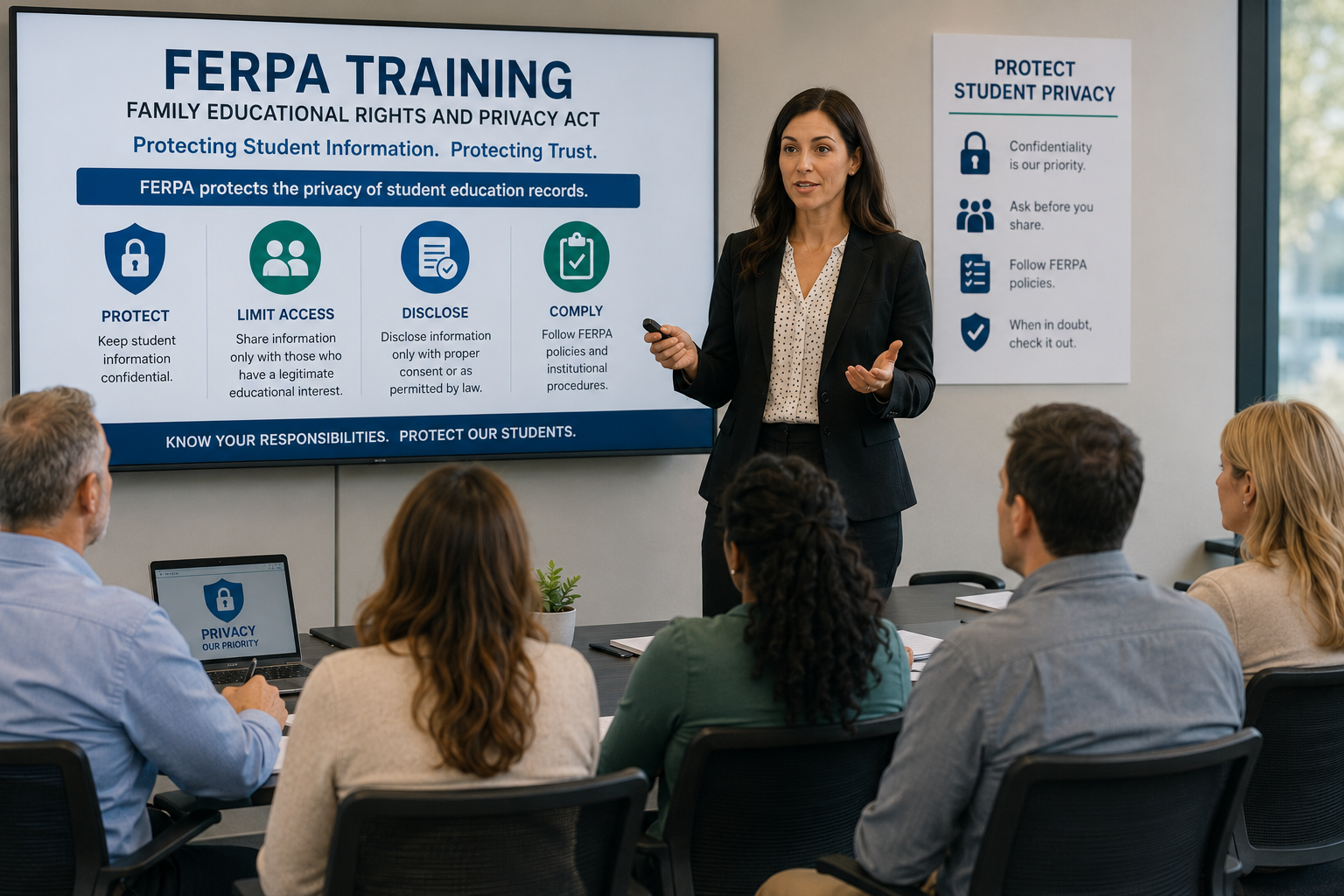
FERPA Compliance Training Should Address Real Workplace Decisions
Generic explanations of FERPA may provide useful background, but employees need to connect those principles with actual situations.
Consider a faculty member who asks an administrative employee for information about a student.
The question is not simply whether both people work for the institution. Employees may need to understand whether the requesting individual has an appropriate institutional reason to access that particular information and what the school's policy requires. Under the school-official exception, access still depends on a legitimate educational interest rather than convenience. Emergency disclosures are limited to situations involving the safety of the student or other individuals.
Now consider a third-party request for student information.
The person requesting the information may sound legitimate. The request may even involve information the employee believes is harmless. That does not mean the employee should make an immediate record disclosure decision without following institutional procedures. An employee should not disclose information unless the institution confirms an exception applies or the required written consent or prior written consent is in place.
When a records request is received, the institution may need to obtain proper authorization, such as consent or legal process, before acting, including when a court order is involved. Effective FERPA compliance training can establish boundaries so employees understand which matters they can handle and which should be referred to the registrar, privacy official, legal department, administration, or another designated contact. This is especially important where security responsibilities overlap with student records handling under the privacy act ferpa framework. Students can file complaints with the U.S. Department of Education when they believe disclosure rules were not followed.
Education Records and Personally Identifiable Information Are Not Limited to a Paper File
Employees may picture an education record as a transcript sitting inside a filing cabinet.
FERPA reaches much further.
Federal guidance explains that education records can exist in different formats, including handwriting, print, computer media, video, audio, email, electronic files, and an electronic form used for consent or record handling. Personally identifiable information can also include a direct personal identifier, a social security number, and other personal information capable of identifying or tracing a student.
That makes modern communication and security an important training subject.
Student data can appear in email chains, shared documents, learning platforms, databases, spreadsheets, departmental systems, messages, and other electronic environments.
Employees therefore need more than a warning not to hand someone a student file.
Training should help them understand that their responsibility can follow the information wherever it is maintained or communicated. Now consider a third-party request for student information: it may cite a subpoena or court order, but employees still should not obtain or release records on their own without institutional review, including legal counsel when questions involve written consent or review of a court order. Improper disclosure decisions can expose institutions to legal action, fines, and penalties, which is why escalation matters.
Record Disclosure to a Third Party Requires More Than Good Intentions
Employees often want to be helpful.
A parent calls with a question. An outside organization asks for information. Another department wants a student record. Someone requests a list of students for a project.
The employee may believe sharing the information serves a useful purpose. But a useful purpose does not, by itself, answer whether disclosure is appropriate.
FERPA gives eligible students and parents certain rights, including student's rights to access and seek amendment of education records. FERPA generally requires prior written consent before institutions disclose information from education records unless an exception applies, and that consent may be collected in electronic form. Federal guidance also explains that education records can exist in paper files, email, databases, audio, video, and other electronic form records. Personally identifiable information can include a social security number and other personal information maintained in electronic form, so institutions must obtain written consent when required and follow the rules carefully.
That is why record disclosure belongs in employee training.
Employees should understand that some requests need further review rather than an immediate answer. They should also know where those requests should be directed inside the institution. Training should also address student data security, including password protection and secure document disposal.
Training is most useful when staff members leave knowing not only that FERPA exists but what their next step should be when a disclosure question reaches them.
Directory Information Can Still Create Confusion
The phrase "directory information" can create another area of misunderstanding.
FERPA permits schools to designate certain information as directory information and, subject to applicable requirements, disclose it without prior written consent. Schools must provide notice identifying what they have designated as directory information and give parents or an eligible student the opportunity to restrict such disclosure.
FERPA generally requires written consent before disclosing non-directory education records, though that consent may be collected electronically when institutional procedures allow. Schools must also maintain records of requests for student information disclosures.
The Department of Education updated its model directory-information notice in April 2026, making current institutional procedures particularly important when reviewing training materials.
Employees should not simply assume that information is releasable because it seems ordinary.
The institution's designation, notice, applicable opt-out, and internal procedures matter because FERPA grants certain rights tied to access and control over records. Good training helps staff members recognize that distinction without requiring them to make complicated legal determinations on their own.
Institutions also notify students of their rights annually, so employees should follow the disclosure process consistently to protect student's rights.
School Staff Training Should Explain Who Needs Access
A particularly important concept in FERPA is legitimate educational interest under the federal regulations that apply to educational agencies and institutions.
This is where institutional policies, employee responsibilities, and day-to-day privacy practices intersect.
The Department of Education explains that a school official generally has a legitimate educational interest when access to an education record is needed to fulfill professional responsibilities, including work done by teachers when that access supports a defined role or is used to improve instruction, which is particularly important for special education teachers navigating FERPA and IDEA and for teachers who may need an experienced education law attorney when investigations or certification issues arise.
For school staff training, that concept can be translated into a practical question that reinforces working knowledge rather than assumption:
Do I need this information to perform the responsibility the institution has assigned to me, based on institutional need rather than personal knowledge or curiosity?
Training can then connect that question with the institution's actual access rules, notice requirements so parents and each eligible student receive the rights to choose whether directory information may be disclosed, and escalation procedures.
The objective is not to encourage employees to make independent legal interpretations. It is to help them recognize that institutional access is purposeful, not unlimited, and that employees should follow the institution’s notice and consent procedures instead of substituting their own judgment.
University Compliance Depends on Consistent Employee Decisions
A university may have detailed FERPA policies and still experience problems if employees do not understand how those policies apply to their jobs.
One department might consistently refer questionable requests to the registrar. Another may make informal disclosure decisions. A faculty member may handle student information differently from an administrator. A new employee may simply follow what coworkers have always done.
That inconsistency can weaken university compliance and expose teachers to risks that may ultimately require legal help to survive a TEA investigation and protect a teaching license.
It can also affect the institution's reputation.
Students and families expect schools to handle educational information professionally and protect student data. Faculty and staff need confidence that expectations are clear across the school community. Leadership needs employees across departments to understand where questions should go, including when a legitimate educational interest means a teacher may access information to carry out assigned responsibilities or improve instruction within institutional rules, and when they should consult an education law attorney for teachers and administrators or dedicated higher education attorneys for colleges and universities for legal support.
Consistent training helps connect those goals by supporting sound practices, stronger security, and access decisions based on institutional rules and employee knowledge rather than personal familiarity or curiosity, and can reduce the kinds of missteps that sometimes lead to TEA investigations into educator conduct and certification.
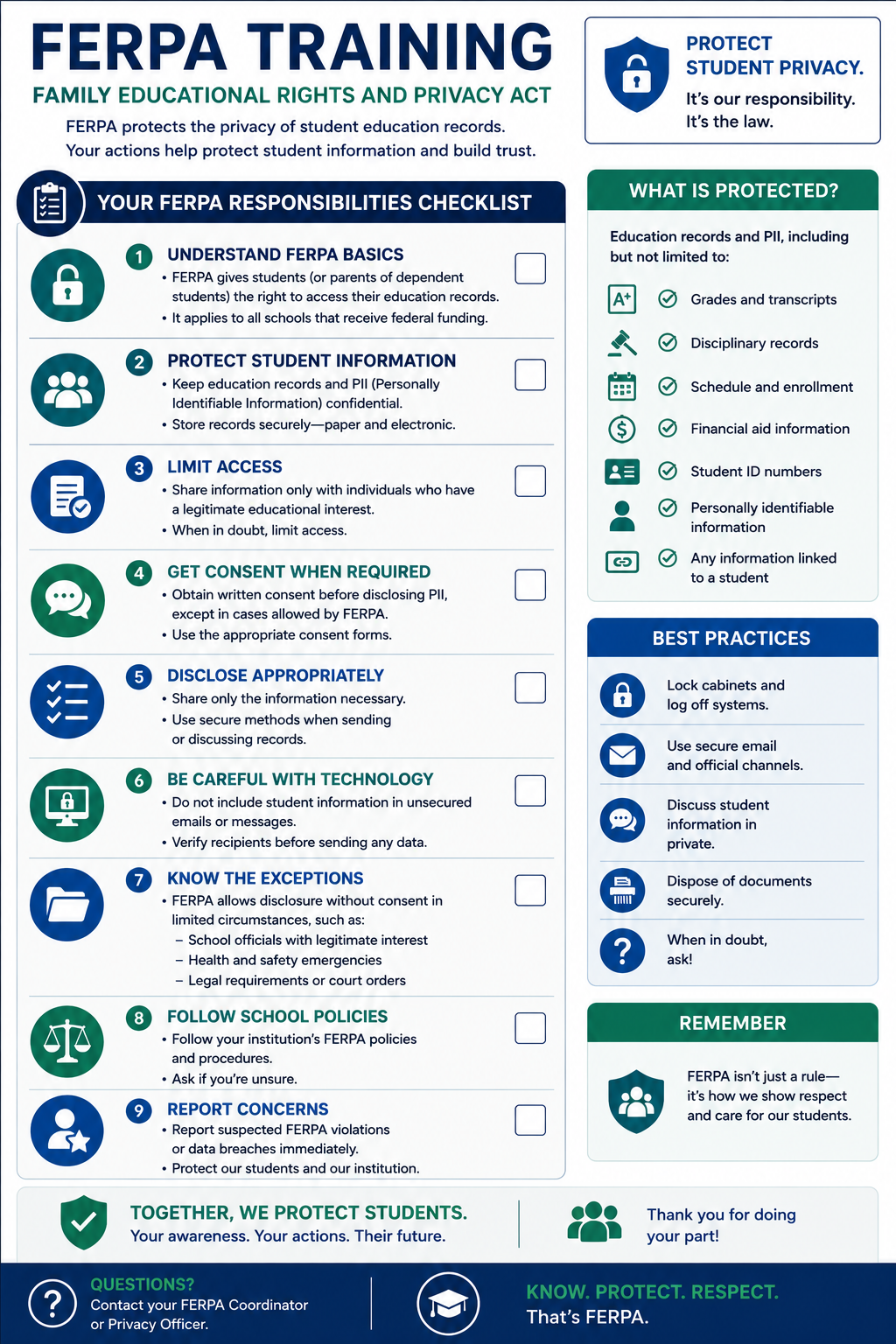
A Practical Framework for FERPA Employee Training
Institutions evaluating their training can focus on four areas: recognize, access, protect, and escalate. A strong training course should build working knowledge of FERPA expectations, reinforce day-to-day privacy practices, and give employees a clear framework they can apply consistently. Whether delivered through online training or interactive training, that consistency matters because inconsistent practices can weaken university compliance and student data security across the school community.
Recognize
Employees should understand what kinds of information may constitute education records and personally identifiable information, and a ferpa training course works best when it builds employee knowledge through practical, interactive training. This can include documents, electronic files, emails, and other materials that contain a personal identifier, a social security number, or other personal information related to a student.
Access
Personnel should understand that being a school employee does not automatically create unrestricted access to every student's records; under applicable regulations for educational agencies and institutions, access is limited to assigned duties, so teachers may obtain records only when those responsibilities support a legitimate educational interest.
Protect
Employees should understand institutional expectations for discussing, storing, transmitting, and disclosing student information, including concrete practices that protect student data and support security.
Escalate
Employees should know where to send uncertain record disclosure, access, or privacy questions rather than improvising an answer, and protecting student data should also include basic security practices such as password protection and secure document disposal.
This framework keeps FERPA training focused on employee decisions instead of turning the program into a technical legal lecture.
In escalation guidance, staff should know when they cannot disclose information without review, when a court order changes the response, and when a genuine safety emergency may justify limited sharing to protect a student or other individuals.
FERPA Training Should Reflect the Institution
K-12 schools, school districts, colleges, and universities do not all operate the same way.
Their departments, technology systems, employee roles, student populations, and internal reporting structures can differ significantly.
Their training should recognize those differences.
A registrar may need a different level of detail from a faculty member. Admissions employees may encounter different records than coaches. IT personnel may have system access that creates different responsibilities from those of frontline administrative staff.
A school in early childhood education may need different examples from a college, and a large district may need role-based guidance that fits multiple campuses. The right course can also show staff when to escalate questions, including whether to disclose information in response to a court order or during a safety emergency involving other individuals.
For many teams, online training with interactive training modules makes that guidance easier to deliver consistently.
Customized FERPA compliance training allows an institution to connect federal requirements with its actual policies, departments, and employee responsibilities at each educational institution covered by a program administered by the U.S. Department of Education. A role-specific training course also helps employees understand the privacy-related obligations tied to records connected to student services and benefits, and can be paired with guidance on common causes of TEA investigations and teacher protections so staff recognize when conduct may have licensing consequences and the immediate steps educators should take after receiving a TEA investigation notice.
That is where training can become more useful to the people receiving it.
Masterly Legal Solutions Supports Educational Institutions
Masterly Legal Solutions works with K-12 schools, districts, colleges, universities, covered early childhood education settings, educators, and other organizational clients, recognizing that ferpa training needs may differ across these environments, and draws on the broader firm’s education law and related legal services to support those clients, including Texas education lawyers who provide expert legal help for schools and educators. Its Higher Education Law services for colleges and universities include policy development, regulatory compliance, and training staff on policy implementation and enforcement.
The firm's broader legal-services practice also provides customized organizational training, with sessions available in person and virtually, and its business consulting services for organizations and outside general counsel services for businesses help leadership align policies, operations, and compliance strategies.
For educational institutions, that provides an opportunity to connect employee education with broader policies and compliance responsibilities rather than treating privacy training as an isolated presentation.
That customized FERPA compliance training can be structured as a training course delivered through online training or interactive training, depending on each educational institution’s roles and systems, and can be supported by Texas-based education lawyers who focus on protecting educators when compliance questions escalate into formal investigations. The course should also reflect institution-specific duties such as annual notice of students’ rights and records issues connected to benefits or other Department-administered programs.
Learn more about Masterly Legal Solutions' Higher Education Law services and customized legal training services.
Frequently Asked Questions About FERPA Training
What is FERPA training?
FERPA training helps school and university personnel understand responsibilities involving education records, student privacy, access, and disclosure under institutional policies and applicable FERPA requirements.
Who should receive FERPA compliance training?
Institutions should consider the employees and school officials who access, maintain, discuss, or make decisions involving student education records. Relevant personnel can extend beyond registrars and include faculty, administrators, counselors, admissions personnel, IT staff, and support personnel. In many cases, ferpa training may be delivered as a training course designed to build employee knowledge about how FERPA protects student data, with teachers included alongside others whose day-to-day practices affect privacy across the school community, and can be paired with legal services that support educators and schools.
What counts as an education record under FERPA?
Education records are records directly related to a student and maintained by an educational agency or institution, or by someone acting for it. They can include documents, electronic files, emails, video, audio, other materials, and disciplinary records, and staff, teachers, and administrators should apply the same privacy practices across the school community. Information such as a social security number or another personal identifier can also be protected when it appears in those records.
Can any university employee access student records?
No. FERPA's school-official exception does not give every employee access to every record. Access without consent under that exception depends in part on the institution determining that the school official, including teachers, has a legitimate educational interest under regulations that apply to educational agencies and institutions, and may obtain access only to education records needed for that role, including electronic files, disciplinary records, and other materials containing a personal identifier such as a social security number.
Can schools disclose directory information?
FERPA permits disclosure of properly designated directory information when applicable notice and opt-out requirements have been satisfied, while preserving student's rights and certain rights that shift to an eligible student under FERPA. Employees, including teachers or other staff, should follow their institution's policies rather than assuming particular information can be released, and may obtain access only when the institution has determined a legitimate educational interest tied to their role in instruction or another assigned duty.
Does FERPA only apply to universities?
No. FERPA notice and opt-out requirements protect certain rights of parents and each eligible student, and ferpa apply to an educational institution or agency covered under a program administered by the U.S. Department of Education when it receives federal funds. That can include K-12 schools, a college or university, an early childhood education provider in a covered setting, or a district entity within the law’s scope. Institutions must notify students of their rights annually, which is why employees should rely on the school’s current directory-information procedures.
Why customize school staff training?
Customized training can connect FERPA principles with the institution's actual departments, access rules, policies, technology, and escalation procedures. It can be delivered as a tailored online training or interactive training format, and each training course can reinforce the institution's day-to-day practices through role-based examples and knowledge checks. This helps employees understand what is expected in their own roles. FERPA applies to every covered educational institution receiving federal funds, not only universities—for example, K-12 schools, districts, postsecondary institutions, and applicable early childhood education programs administered with Department funds. Non-compliance can jeopardize federal funding.
Does Masterly Legal Solutions provide organizational training?
Yes. Masterly Legal Solutions states that it provides a customized FERPA training course to organizations, aligned to the institution’s actual privacy practices and escalation paths, and offers the course both in person and virtually. This online training or interactive training format can build role-specific knowledge more effectively. Its Higher Education Law practice also includes training staff on policy implementation and enforcement.
Protect Student Records Before an Employee Has to Make the Call
Faculty and staff should not have to guess whether they can access, discuss, forward, or disclose student information.
Practical FERPA training can help school and university personnel recognize education-record issues, understand student privacy expectations, follow institutional procedures, and escalate uncertain disclosure questions before a mistake occurs to better protect students and safeguard student data.
Masterly Legal Solutions works with educational institutions on higher education law, policy development, compliance, and customized organizational training, including a customized FERPA training course or training course series with online training delivery, supported by an education lawyer who advises teachers and schools on broader compliance issues.
Call Masterly Legal Solutions at (972) 236-5051 or visit MasterlyLegal.com to discuss your institution's course needs.

Teacher Rights When Assaulted by a Special Needs Student: Safety, Reporting and Investigation Issues


Looking for Legal & Business Solutions? Contact Us Now
Fill in the form or call us to set up a meeting