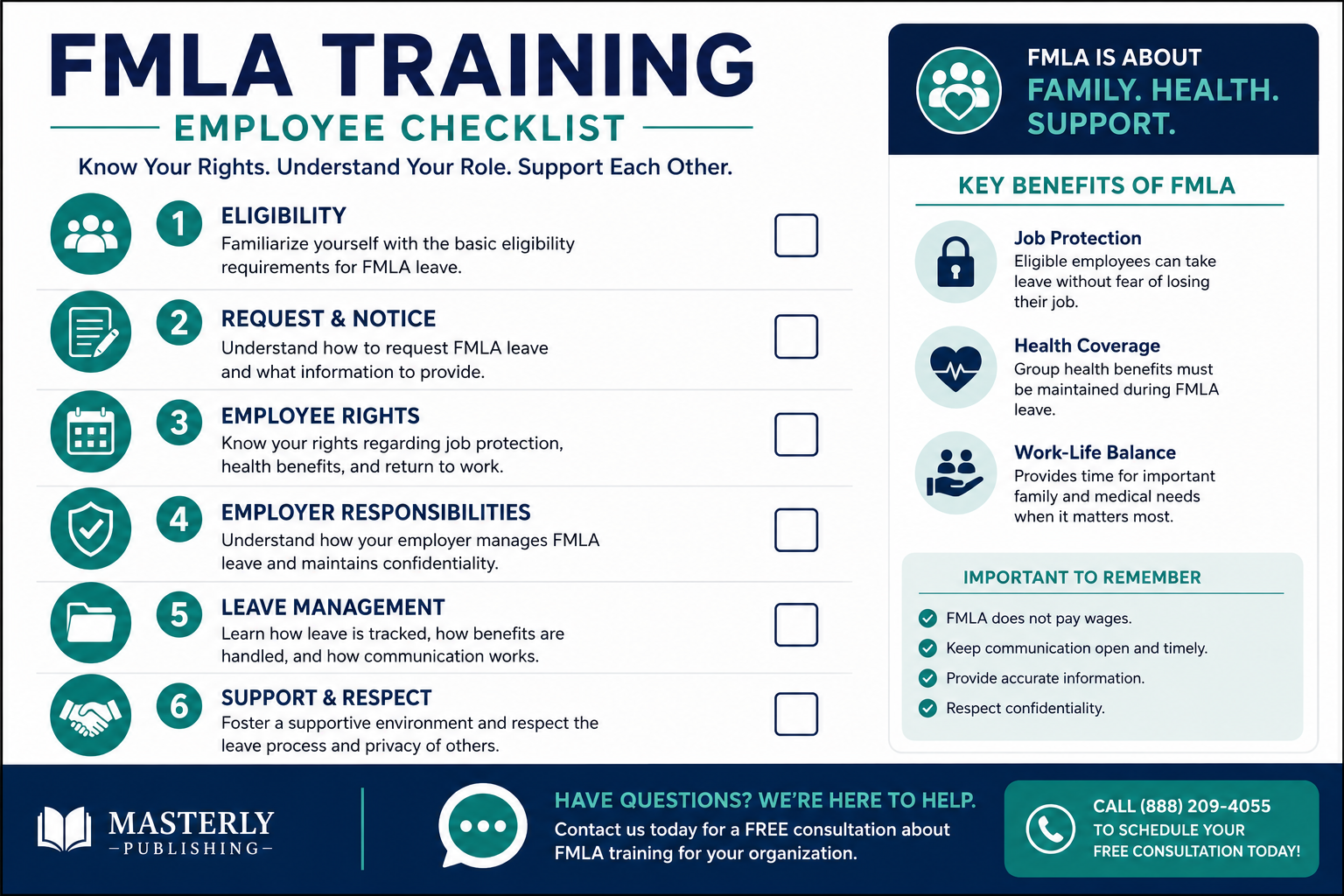
FMLA Training What Managers Need to Know Before Handling Leave Requests
An employee tells a supervisor that a health issue is causing repeated absences. Another employee says they need time away to care for a family member. A manager notices that an employee who has been approved for intermittent leave is missing work more often.
These conversations can seem routine, but they can create serious problems when managers do not know when to involve Human Resources or another designated company contact. Supervisors are often the first people to hear information that may relate to an employee's need for protected leave.
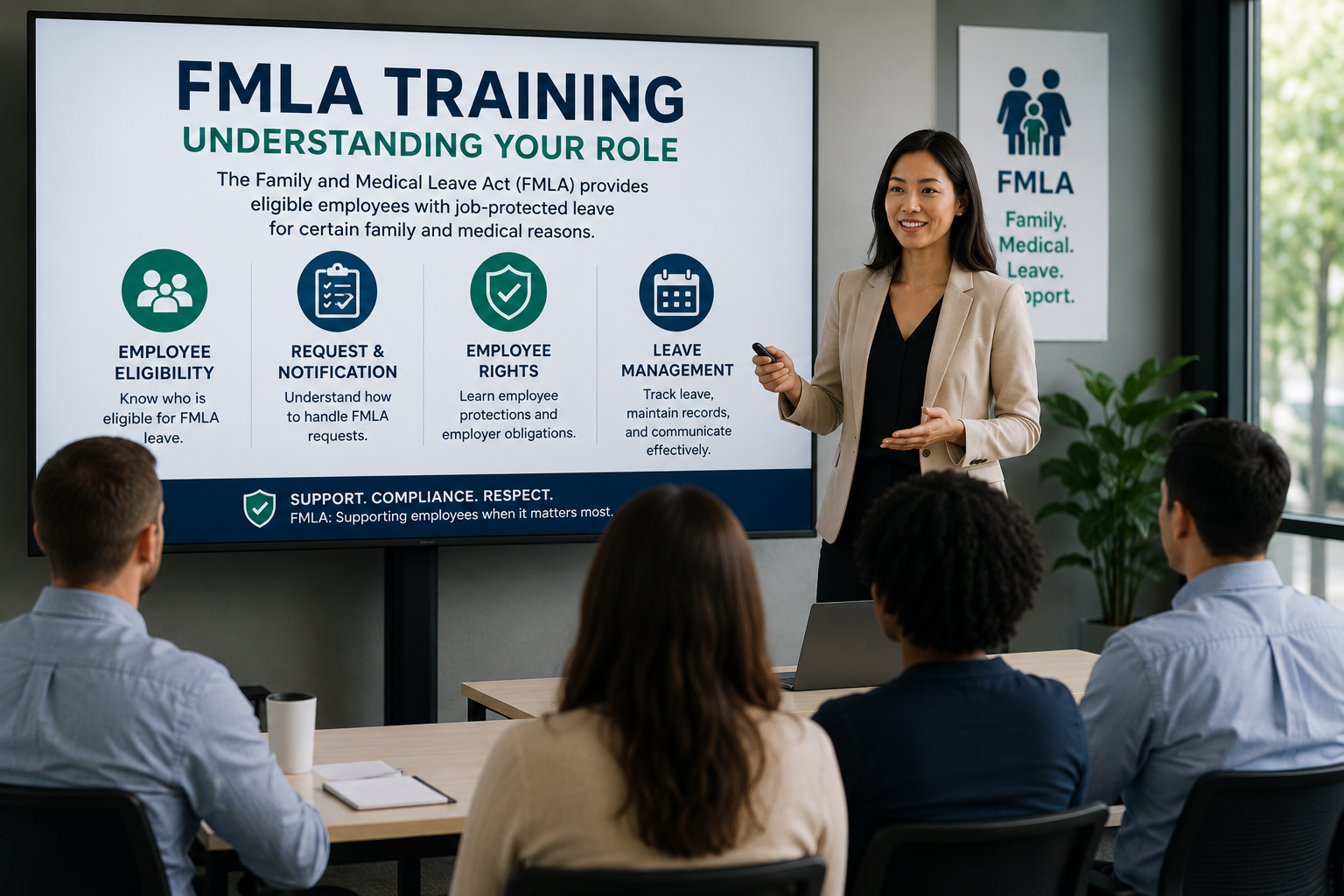
Effective FMLA training helps managers recognize these situations, respond professionally, document what should be documented under company procedures, and escalate questions instead of making decisions they are not responsible for making.
For employers, the goal is not to turn every supervisor into an FMLA expert. The goal is to give managers enough knowledge to recognize potential issues and follow the organization's process consistently.
The FMLA Problem Often Reaches a Manager Before HR
Employees do not always walk into a supervisor's office and say, "I am requesting FMLA leave."
They may say they need surgery. They may mention that a parent has become seriously ill. An employee could explain that a medical condition has caused several absences or that they need recurring appointments.
Under Department of Labor regulations, an employee generally does not have to specifically mention the FMLA when first requesting leave, although the employee must provide enough information for the employer to reasonably determine whether the FMLA may apply.
That creates an important role for frontline management.
A manager who does not recognize a possible leave issue might treat the conversation as nothing more than an attendance problem. Another manager might make promises about leave without involving the appropriate person. A third might ask unnecessary questions or discuss an employee's circumstances with people who do not need the information.
FMLA manager training helps front line managers respond appropriately to possible family and medical leave issues by recognizing them early, documenting what was shared, and escalating them to the right person.
FMLA Training Helps Managers Recognize Leave Requests
One of the most important subjects in FMLA training is recognizing when an ordinary employee conversation may need further review.
This does not mean managers should determine employee eligibility or whether an employee qualifies for leave. Instead, supervisor training should help managers recognize information tied to fmla requirements that should be directed to HR or the employer's designated leave contact.
Consider a simple comparison.
An employee says, "I may need time away because of a serious health condition." That may call for more review than an ordinary time-off request.
Another employee says, "My spouse is being deployed, and I may need to take some time away from work." That statement contains different information. A trained manager can recognize that the situation may need to be escalated rather than simply approved or denied under the normal vacation process.
Front line managers do not need to provide an immediate legal answer. They need to know the organization's process for getting the request to the right person.
Under Department of Labor regulations, the Family and Medical Leave Act is a federal law, and HR typically reviews whether eligible employees meet the rules for FMLA, including qualifying reasons like military family leave and hours-worked standards. Once the issue is identified, employers must provide required notices within the required timeframes.
Managers Need a Clear Escalation Process
A strong training program should make manager escalation easy to understand.
Managers should know who receives potential leave questions, what information should be passed along, and what the manager should do while the matter is being reviewed.
This is particularly important in organizations with several departments, locations, or levels of management. If each supervisor handles leave conversations differently, employees can receive inconsistent responses.
One manager might immediately contact the HR department. Another may try to resolve the matter independently. A third may wait until the employee misses additional work.
That inconsistency can become a business problem.
Clear escalation procedures help managers understand the limits of their role. They also help HR, leadership, or other designated personnel receive information earlier, when questions involving compliance, employee eligibility, both the FMLA and state leave laws, or other leave requirements can be reviewed through the employer's established process.
Training should also cover eligibility rules and leave types, including the requirement that eligible employees have worked at least 1,250 hours during the previous 12 months, so managers know when to escalate rather than decide.
Intermittent Leave Can Create Difficult Leave Management Situations
Intermittent leave can be especially challenging for frontline supervisors because recurring absences often become an HR department challenge rather than one continuous period away from work.
Federal FMLA law permits qualifying leave to be taken intermittently or on a reduced leave schedule in certain circumstances.
For managers, the practical issue is often what happens after an employee begins missing work, especially when managing intermittent leave becomes part of day-to-day FMLA administration.
A supervisor may be focused on schedules, deadlines, attendance, and staffing. The employee may be dealing with an approved leave arrangement. Without appropriate training and internal procedures, those two realities can collide.
A manager might become frustrated by recurring absences and make a comment about reliability. Another might treat an absence as a standard attendance violation without first following the organization's leave procedures. Someone else might question the employee about personal medical details or medical certifications rather than escalating the concern to HR.
Training can help managers understand what to do when questions arise about intermittent leave, attendance, scheduling, or an employee's use of leave, reducing the risk of costly litigation from mishandled leave issues.
The answer should not depend on which supervisor happens to be working that day, and across multiple departments or locations, consistent escalation supports compliance when both the FMLA and state leave laws may apply.
Documentation Should Support Consistent FMLA Compliance and Handling
Documentation is another area where managers benefit from clear expectations, especially because managing intermittent leave can create repeated scheduling and communication issues.
A supervisor may receive important information during a hallway conversation, telephone call, text message, email, or regular meeting. If that information never reaches the people responsible for reviewing leave matters, the organization may be left trying to reconstruct what happened later, and FMLA administration can lead to costly lawsuits if mismanaged.
Training should address the employer's procedures for recording and communicating relevant information.
Managers also need to understand what should not be included in casual workplace communications. Sensitive employee information should not become unnecessary office conversation simply because a supervisor was the first person to hear it.
For managers, the practical issue is often what to do in the moment. Questions about scheduling, recertification, or medical certifications should be escalated through the employer's FMLA administration process.
The objective is a consistent process.
When an employee raises a possible leave issue, managers should understand where the information goes, what company procedures apply, and who is responsible for the next stage of review to reduce non-compliance, avoid retaliation claims, and lower the risk of costly litigation if intermittent leave is mishandled.
FMLA Manager Training Should Focus on Real Workplace Conversations
Managers do not need training that only gives them legal terminology to memorize.
They need training that helps them recognize the types of conversations they may actually encounter.
For example, imagine that an employee who has recently had several absences tells a supervisor:
"My treatment schedule changed, and I may need to miss a few mornings next month."
An untrained supervisor might immediately focus on attendance.
A trained supervisor should be better prepared to recognize that the statement may relate to unpaid leave and may need to be escalated according to the organization's leave procedures.
Training should address the employer's procedures for recording and communicating relevant information. It should also cover maintaining confidentiality of medical information.
Now consider another situation. An employee tells a manager:
"I need a few weeks away because my spouse is having a medical procedure."
Again, the manager does not need to make an immediate eligibility decision. The manager needs to understand whether the information could involve family and medical leave and should be sent to HR or another designated person for review.
Careless comments or poor documentation practices around these conversations can also contribute to retaliation claims or other non-compliance concerns when employees exercise their leave rights.
This is where effective training creates practical business value.
Consistent Supervisor Training Protects More Than a Leave Process
Leave management affects more than HR.
Employees notice how managers respond when they raise difficult personal circumstances. Supervisors notice whether leadership has given them clear direction. HR teams experience the consequences when managers make decisions before involving the appropriate people, especially when issues could later require outside counsel for internal investigations.
Inconsistent handling can also create frustration inside a management team.
One supervisor may believe an employee's request for time off to care for a parent after surgery should be handled one way, while another supervisor handles a similar situation differently. Employees can then begin comparing how different departments treat leave requests.
That can affect trust in management and confidence in company policies.
A consistent supervisor training program helps establish shared expectations. Managers can learn what their role is, what it is not, and when they should seek help. It should also help them avoid treating FMLA as one law that stands alone when leave decisions may also involve other laws, including the Americans with disabilities act, and other sources of leave. Managers should understand that eligible employees may have up to 12 weeks of unpaid leave in the applicable 12-month period, with a minimum of 12 weeks of unpaid leave per year under FMLA, and are generally entitled to return to the same or an equivalent position, while HR handles administration and relies on clear employee handbook policies and procedures.
A Practical Framework for Manager-Facing FMLA Training
Employers evaluating an FMLA training program can focus on four practical areas: recognition, response, escalation, and consistency, often in coordination with broader HR consulting and compliance initiatives.
Recognition: Can managers recognize conversations or circumstances that may involve a leave issue? This calls for a deep understanding of how leave issues first show up in day-to-day conversations.
Response: Do supervisors understand how to respond professionally without making promises, assumptions, or unnecessary inquiries? Comprehensive training helps managers stay within their role while responding appropriately.
Escalation: Does every manager know when and how to involve HR or another designated company contact? Leave management affects more than HR. Supervisors may encounter situations where FMLA overlaps with other laws, including the Americans with Disabilities Act.
Consistency: Are supervisors across the organization working from the same expectations and procedures? In this critical area, a manager cannot rely on one law or one policy lens when other sources of leave or accommodation rules may also be involved.
This framework keeps manager training focused on the decisions supervisors actually face and works best when supported by specialized training for those responsible for administration.
It also preserves an important distinction. Managers can be prepared to recognize and escalate potential FMLA matters without being expected to independently administer the organization's entire leave process.
Why Generic FMLA Training May Not Address Your Organization's Needs
Every employer has its own workforce structure.
A company with several locations may have different management challenges from a smaller organization where employees work closely with senior leadership. An organization with shift workers may encounter different leave conversations from an office-based employer, and colleges or universities may need FMLA guidance as part of broader higher education compliance and training.
Internal reporting structures can also vary, and some employers may pair FMLA training with broader business consulting and operational planning.
That is why employers should consider whether their training reflects the situations their supervisors are likely to encounter and the internal procedures managers are expected to follow. A practical four-part framework is to define who needs the training, what topics must be covered, which delivery method fits best, and how the employer will document completion. FMLA is a critical area for managers, and effective programs should provide specialized training that builds a deep understanding of recognition and escalation responsibilities. That may mean selecting a course tailored to frontline supervisors, using online courses that fit different schedules, reviewing online training courses for distributed teams, or choosing a broader training course that aligns with related compliance programs or broader HR consulting services and training.
Training becomes more useful when employees can connect the information to their actual responsibilities. Comprehensive training should also be updated regularly to reflect changes in laws or regulations, including related areas such as regular sexual harassment training.
Masterly Legal Solutions Provides Customized Workplace Training
Masterly Legal Solutions provides comprehensive legal services and customized training sessions for entities and organizations. The firm's legal services include Labor & Employment, and Masterly Legal Solutions states that its training sessions can be provided in person or virtually. For employers evaluating a program, that can also mean choosing a training course format that fits their workforce, whether the goal is stronger fmla compliance or broader support for the hr field.
That combination can be valuable for organizations seeking manager-focused workplace training. Some organizations may prefer online courses or online training courses, while others may want live programs tied to internal procedures.
Instead of asking supervisors to become leave-law specialists, employers can focus training on practical management responsibilities such as recognizing potential leave requests, following internal reporting procedures, understanding manager escalation, addressing intermittent leave situations appropriately, and maintaining consistent practices. That is why employers should consider who needs training, what tools and data support the program, how much access teams need to follow-up resources, and whether the instructors bring the right compliance expertise for the issues managers actually face.
The purpose is straightforward: prepare managers before the difficult conversation happens. It also helps organizations build the ability to respond consistently as leave administration needs shift and internal demand changes, especially for HR professionals and education-sector clients who need practical guidance. The law does not set specific training hours for HR professionals, but formal training is still encouraged and can be integrated into broader client-focused legal services.
Employers interested in customized workplace training can learn more about Masterly Legal Solutions' legal services and training.
Frequently Asked Questions About FMLA Training
What is FMLA training for managers?
FMLA training for managers focuses on helping supervisors recognize potential leave situations, understand their workplace responsibilities, and know when to escalate questions through the employer's established process.
Why do supervisors need FMLA training?
Supervisors are often among the first people to learn that an employee needs time away because of a medical or family situation. Training helps them recognize when a conversation may require further review.
Does an employee have to say "FMLA" when requesting leave?
Not necessarily. Department of Labor regulations state that an employee does not have to expressly assert FMLA rights or mention the FMLA when first seeking potentially qualifying leave, but must provide sufficient information for the employer to reasonably determine whether the FMLA may apply.
Should managers decide whether an employee qualifies for FMLA?
Organizations should establish clear responsibilities for reviewing and administering leave. Manager training can focus on recognition and escalation so supervisors know when to involve the employer's designated personnel. In practice, eligibility and administration may be handled by HR or trained leave personnel, and FMLA certification is one form of certification that validates HR professionals' expertise in FMLA administration.
Should FMLA manager training address intermittent leave?
Yes. Intermittent leave can create practical questions involving attendance, scheduling, communication, and escalation. Managers should understand the organization's procedures for handling those situations, while HR professionals or designated leave personnel may also benefit from training or certification that supports consistent FMLA administration.
What should supervisors document about leave requests?
Training should explain that intermittent leave is often one of the more difficult parts of FMLA administration for employers, along with the employer's documentation and reporting procedures. Managers should understand what information needs to be communicated, how medical certifications fit into verifying qualifying conditions and documenting leave properly, and where it should be sent.
Can FMLA training be customized for an employer?
Masterly Legal Solutions states that it provides customized training sessions for entities and organizations and offers training in person, virtually, or in a classroom setting. Supervisors should follow employer procedures for forwarding medical certifications or related information to the appropriate person rather than handling them informally. Training can also be tailored as part of broader compliance programs for HR teams and managers.
Discuss an FMLA Training Program for Managers and Supervisors
Managers should not have to guess when an employee conversation may require attention under the organization's leave process.
Effective FMLA training can give supervisors clearer expectations for recognizing potential leave requests, responding appropriately, escalating questions, and following consistent workplace procedures that support FMLA compliance.
Masterly Legal Solutions works with organizations seeking customized legal training, general counsel support, and employment-related guidance, delivered virtually or in a classroom setting and tailored to the employer's internal procedures or related training programs.
Call Masterly Legal Solutions at (972) 236-5051 or visit MasterlyLegal.com to request a consultation.



Teacher Rights When Assaulted by a Special Needs Student: Safety, Reporting and Investigation Issues



Looking for Legal & Business Solutions? Contact Us Now
Fill in the form or call us to set up a meeting