

ADA Training: Helping Managers Recognize Accommodation Requests Before Problems Escalate
An employee tells a supervisor, "My condition is making it difficult for me to work this schedule." Another employee says a medical issue makes one part of the job difficult. A third asks whether they can work differently because of a health limitation.
The manager's response matters.
Employees do not always use legal terms when raising disability-related workplace concerns. A supervisor who does not recognize a possible request may dismiss the conversation, make an unnecessary promise, ask the wrong questions, or fail to involve the people responsible for handling accommodations.
Practical ADA training helps employers, managers, supervisors, and organizations responsible for workplace accommodations recognize disability-related accommodation requests, understand their role in responding, and know when HR escalation or another internal referral is needed. It also prepares them to handle the interactive process, protect confidentiality, maintain consistency, and respond professionally when disability-related issues come up on the job.
The goal is not to make supervisors employment lawyers. It is to help them identify potential issues, communicate appropriately, and follow the organization's established process. For employers, that preparation supports employee trust, more professional handling of sensitive workplace conversations, stronger ADA compliance, and fewer legal, compliance, and operational problems.
A Disability or Accommodation Request May Not Sound Like an ADA Request
One of the biggest challenges for managers is recognizing what an employee is actually asking for.
Under Equal Employment Opportunity Commission guidance, an individual may request a workplace change because of a medical condition using "plain English" and does not have to mention the ADA or use the phrase "reasonable accommodation."
That distinction is important.
Imagine an employee tells a supervisor:
"I am having trouble getting to work at 7:00 because of my medical treatments. Is there any way my schedule could change?"
The employee has not said "ADA." The employee has not asked to begin an "interactive process." The employee has simply described a medical issue and asked for a workplace change.
A manager who is listening only for legal terminology could miss the significance of that conversation.
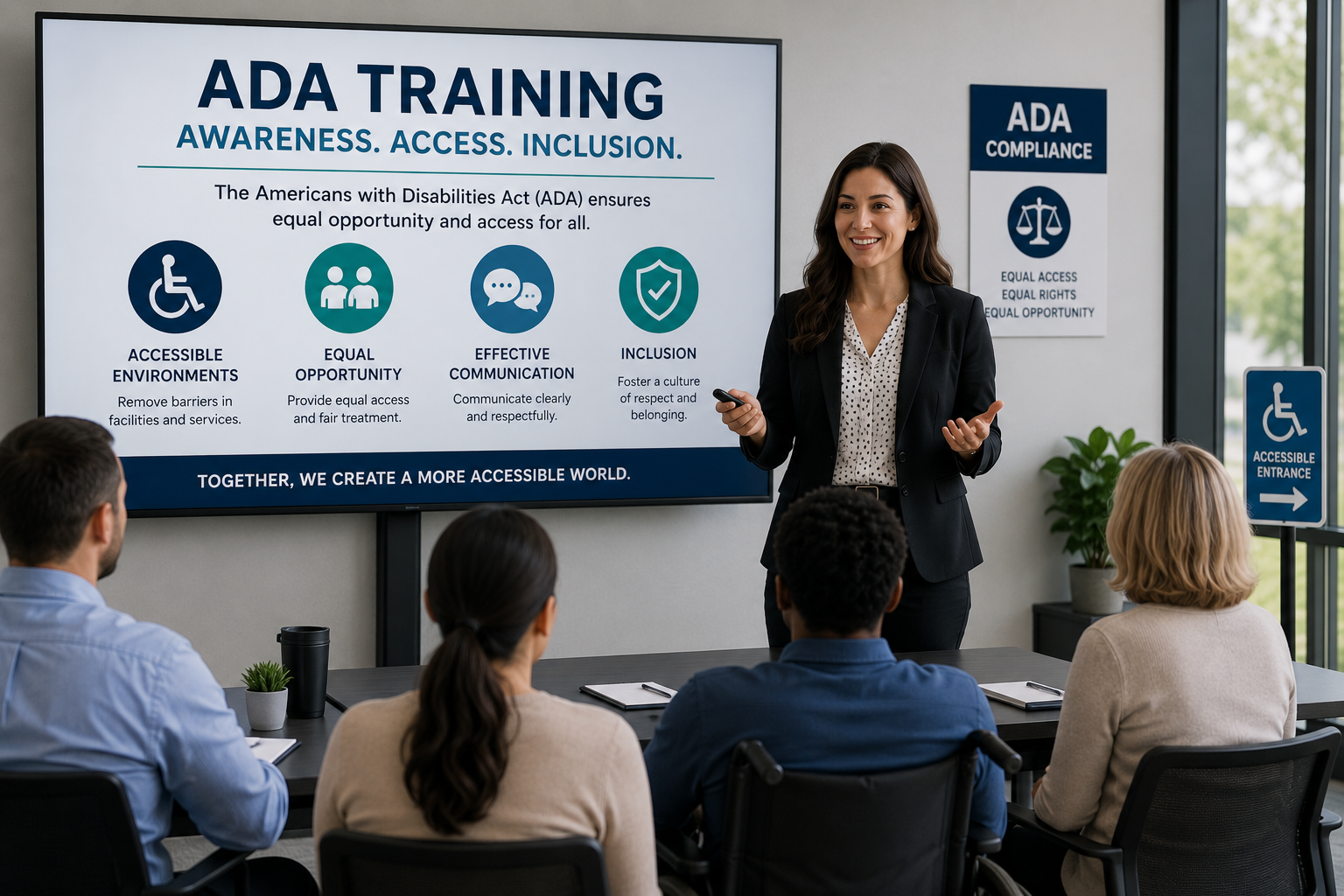
Effective ADA training for managers helps supervisors recognize when an ordinary workplace discussion may need to be routed through the employer's accommodation process.
ADA Training Helps Managers Understand Their Role
Managers are often on the front line of employee communication, but that does not mean they should independently resolve every disability-related issue.
Training should give supervisors clear boundaries.
When an employee raises a potential accommodation issue, the manager should understand the organization's procedure for responding and where the matter should go next. That may mean involving HR or another person designated by the employer.
This is where supervisor training becomes especially valuable, and where many organizations pair ADA-focused content with broader HR consulting services and training to keep manager responses aligned with employment law requirements.
Managers can learn how to recognize a possible request without being expected to reach their own legal conclusions. They can also understand the importance of avoiding quick promises or denials before the appropriate internal process occurs.
A simple principle can guide the training:
Recognize. Respond. Refer.
Managers recognize that an employee may be asking for a workplace change related to a disability or medical condition. They respond professionally and appropriately. Then they refer or escalate the matter according to the organization's procedures.
Managers Need to Recognize Requests for Reasonable Accommodation
The Americans with Disabilities Act (ADA) requires covered employers to provide reasonable accommodations to qualified individuals with disabilities unless doing so would cause undue hardship. What is reasonable depends on the employee's ability to perform the position's essential functions and the particular circumstances.
For managers, the important training issue is recognition.
Requests for reasonable accommodations can arise in many ways. Depending on the circumstances, an employee might ask about a change to a work schedule, equipment, a workplace procedure, job tasks, or another aspect of performing the job.
A supervisor should not assume that every request is an ADA accommodation. The opposite assumption can also cause problems.
Instead, managers need a reliable internal path for getting potential disability requests to the appropriate person for review, rather than deciding on their own that an employee is unable to do the job.
A Manager's First Response Can Shape What Happens Next
Consider two supervisors receiving the same employee statement:
"My medical condition has gotten worse, and I am having trouble completing this part of my job."
The first supervisor immediately says, "If you cannot do the job, maybe this position isn't right for you."
The second recognizes that the employee has connected a medical condition with difficulty performing work and follows the company's escalation procedure.
The difference is not that the second manager has personally decided the employee is entitled to an accommodation. The difference is that the manager recognizes a conversation requiring appropriate review.
That is a practical purpose of ADA training.
Understanding the Interactive Process
The interactive process is another important concept for managers to understand without expecting them to become responsible for making legal determinations.
EEOC guidance describes the accommodation process as an informal process in which the employer and individual can clarify what the individual needs and identify an appropriate reasonable accommodation. In some situations, the disability and need for accommodation are obvious. In others, further discussion or appropriate information may be needed, and documentation may be required when the disability or need for accommodation is not obvious.
Managers need to understand where they fit within the employer's process.
A supervisor may receive the first request. That does not necessarily mean the supervisor should personally decide what information is needed, whether an accommodation is reasonable, or whether another option should be considered; the appropriate internal contact may determine what information is needed and whether an accommodation is appropriate.
Training can establish who handles those questions within the organization.
This helps keep managers from improvising when the issue requires more careful review.
HR Escalation Should Be Clear and Consistent
A manager who recognizes a potential accommodation request still needs to know what happens next, and supervisors need clear reporting channels for disability-related or accessibility barriers so issues reach the right internal contact quickly.
That makes HR escalation or another designated internal referral process a central part of effective manager training.
Employers should consider whether supervisors can answer basic process questions such as:
Who should be contacted when an employee raises a disability-related workplace concern, or what request form should be used if the organization has one?
What information should the supervisor communicate?
How should the manager respond to the employee while the issue is being reviewed?
What should the supervisor avoid promising or deciding independently so the matter moves to a timely referral and review?
How should questions about an existing accommodation be escalated?
If supervisors do not know the organization's process, employees can receive very different responses depending on which manager they approach.
That inconsistency can create confusion, while a clear escalation path helps both the employer and the employee.
Disability Requests Can Arise After an Accommodation Is in Place
Manager awareness should not stop after a request reaches HR.
Workplace circumstances can change.
An employee may tell a supervisor that an existing accommodation is no longer working. A manager may notice operational issues and have questions about an accommodation. Job responsibilities may change, or an employee may raise a new limitation.
Those situations should be reviewed on a case by case basis.
Training can help managers understand that they should not simply change, withdraw, or renegotiate an accommodation on their own when the organization's process requires further review.
Instead, they should know when to return the issue to the appropriate internal contact and that the organization may need to engage again in the interactive process before changes are implemented, with any updated accommodation handled through the designated process to implement it rather than by the supervisor alone.
Confidentiality Is Part of the Conversation
Disability-related workplace discussions can involve sensitive information.
The ADA includes confidentiality requirements concerning medical documentation and other disability-related documentation obtained through certain employment-related inquiries, examinations, and accommodation processes. EEOC guidance explains that medical information generally must be treated as confidential, with limited exceptions.
That makes confidentiality an important subject for manager awareness.
A supervisor who learns about an employee's medical condition should understand that this information should not become ordinary workplace conversation. Managers should know the organization's procedures for handling and communicating sensitive information.
This can be particularly important when coworkers ask why someone has a different schedule, workspace, responsibility, or arrangement.
Managers need a professional response that respects appropriate confidentiality rather than explaining another employee's medical circumstances, and supervisors should route documentation through the organization's designated process instead of discussing it informally.
Poor Manager Responses Can Become Business Problems
The way managers handle disability-related conversations can affect more than the individual request.
Employees watch how leadership responds when someone raises a sensitive concern. Managers also notice whether the organization gives them clear guidance or leaves them to make difficult decisions alone.
An inconsistent response can undermine confidence in company procedures.
For example, one supervisor might immediately escalate a possible accommodation request. Another may tell an employee to provide a doctor's note before even speaking with HR. A third may decide independently that the requested change is unreasonable.
Different managers making different decisions can create unnecessary risk and confusion.
Consistent ADA training for managers gives supervisors a shared framework for responding.
A Practical Framework for ADA Supervisor Training
Employers evaluating supervisor training can focus on four questions.
Can Managers Recognize a Potential Request?
Supervisors should be aware that an employee or applicant may ask for a workplace change related to a medical condition without using legal terminology. The key issue is whether the person is connecting a medical condition to the ability to perform the position or participate in the employment process.
Do Managers Know What to Say Next?
Training should help supervisors respond in good faith without immediately promising, denying, or judging the request, while listening for the employee's ideas about what change may help.
Do Managers Know Where to Escalate the Issue?
Every supervisor should understand the organization's procedure for referring possible accommodation matters to human resources or another designated contact, and those internal practices should make that referral path easy to follow.
Do Managers Understand Their Continuing Role?
Training should address what happens when an employee raises concerns about an existing accommodation or when a manager has questions after the organization implements an accommodation, including whether it continues to provide reasonable accommodation in practice.
This framework keeps training practical and focused on real management responsibilities, and it works best when it is reinforced in written policies such as a well-drafted employee handbook with ADA-compliant procedures.
ADA Training Supports a More Consistent Workplace
Managers make decisions every day. Some are routine. Disability-related employment questions may require a more careful process.
Training gives supervisors a clearer line between what they can handle themselves and what needs additional review, so accommodation questions are determined through the employer's established process rather than ad hoc supervisor judgment.
That clarity can support more consistent employee experiences across a department, departments, and locations. It can also give managers greater confidence that they are following the organization's procedures rather than inventing an answer during a difficult conversation.
For leadership, this is also a matter of reputation.
Employees should be able to raise legitimate workplace concerns without wondering whether the response will depend entirely on which supervisor receives the request.
A consistent process communicates professionalism and respect, especially when a disability-related concern affects not only day-to-day tasks but also a benefit or privilege of employment.
Customized ADA Training From Masterly Legal Solutions
Broader ADA training may cover the legislation, protected classes, and general compliance topics. Employers often need something more practical for the people actually managing employees, which is where a full-service firm like Masterly Legal Solutions’ comprehensive legal and business services can support both training and broader compliance planning.
Masterly Legal Solutions provides Labor & Employment legal services and customized training sessions for organizations, and also advises colleges and universities on higher education law, Title IX, and related compliance. The firm's website states that customized training can be conducted in person or virtually. Additional resources include ADA.gov, the Department of Justice portal, and the ada national network, which consists of 10 regional centers across the U.S. Employers looking for broader programs may also use the ADA Basic Building Blocks Webcourse or attend the National ADA Symposium.
Customized ADA training can focus manager attention on the situations that matter to the organization, including recognizing potential accommodation requests, understanding escalation procedures, responding to employee questions, maintaining appropriate professional boundaries, and applying workplace accommodation guidance from the job accommodation network. Organizations may also need related training on digital accessibility under WCAG, standards for physical accessibility such as accessible routes and entrances, and other compliance resources, with guidelines for public spaces developed by the U.S. Access Board.
The purpose is not to turn managers into lawyers or place responsibility for legal decisions on individual supervisors.
It is to prepare them for the moment when an employee walks into their office and says something that may require action.
Learn more about Masterly Legal Solutions' Labor & Employment services and customized training.
Building Practical ADA Knowledge Across the Workplace
Effective ADA training should give managers the knowledge and skills to recognize when an employee's job duties or work area may raise an accommodation question and identify the point when the issue should be escalated for appropriate review, just as regular sexual harassment prevention training helps set clear behavioral expectations. Training may address relevant ADA topics, including employment practices and, when appropriate to the organization, accessibility or transportation concerns, while distinguishing workplace responsibilities from requirements involving the federal government or other government officials.
Organizations may also encounter educational resources and training opportunities from sources such as the ADA National Network, which offers information and online resources, but general information is not a substitute for training tailored to an employer's policies and workforce or for strategic business consulting to align HR practices with organizational goals. Masterly Legal Solutions can provide training designed around an organization's management needs, support schools and educators through dedicated education law and teacher defense services, while employers may also consult an appropriate rehabilitation professional or other specialist when a particular situation calls for specialized expertise. Managers should know where to find official guidance and, more importantly, understand the internal process they are expected to follow when an ADA-related workplace concern arises.
Connecting ADA Training to the Accommodation Process
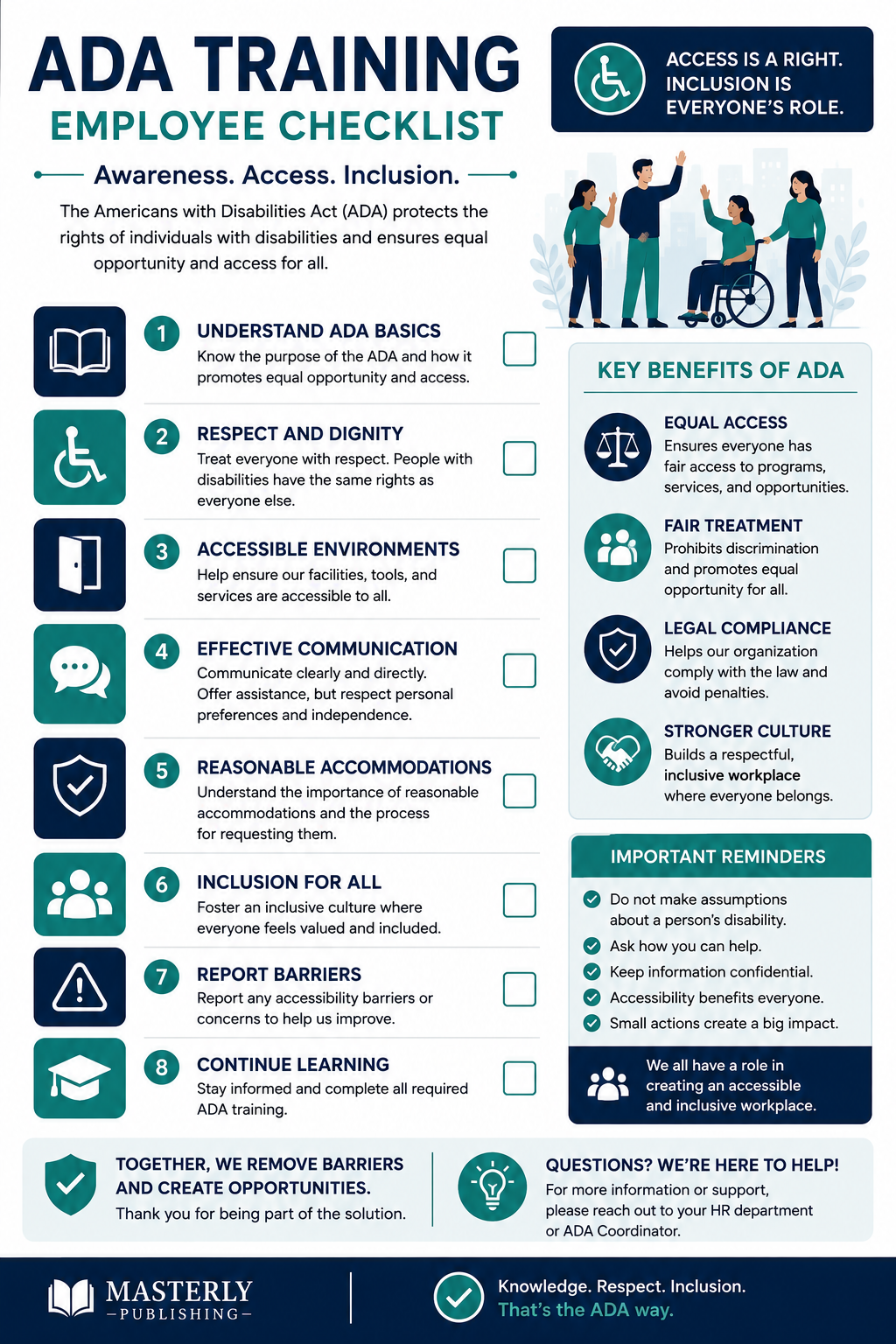
Effective manager training should help supervisors understand their role in the accommodation process and recognize when a disability-related request needs to be referred for further review, much like sexual harassment training that explains legal requirements for employers clarifies when managers must escalate complaints. Employers and employees may encounter educational resources from organizations such as the Job Accommodation Network and the ADA National Network, but general resources cannot replace an employer's own procedures or training designed around its workforce, including manager accountability training for preventing workplace sexual harassment. Masterly Legal Solutions can provide customized ADA training in person or virtually, helping managers understand how to recognize potential accommodation requests, follow internal escalation procedures, and respond consistently when workplace concerns arise.
Frequently Asked Questions About ADA Training and the Equal Employment Opportunity Commission
What is ADA training for managers?
ADA training often covers the americans with disabilities act, who is protected under the disabilities act, and the workplace responsibilities managers need to understand, including recognizing possible accommodation requests and knowing when to escalate them through the employer's established process.
Does an employee have to say "ADA" when requesting an accommodation?
No. EEOC guidance explains that an individual may request an accommodation in plain English and does not have to mention the ADA or use the phrase "reasonable accommodation."
Why should supervisors receive ADA training?
Supervisors may be the first people to hear about a medical condition or requested workplace change. Training can help them recognize when a disability may affect essential functions or when the conversation should be referred for further review.
What are reasonable accommodations and essential functions?
A reasonable accommodation is generally a change or adjustment to a job or work environment that enables a qualified individual with a disability to participate in the employment process or perform essential job functions, and when relevant it can also address a service, program, or workplace access issue, subject to the ADA's applicable requirements. Common examples include schedule changes, equipment changes, or other workplace adjustments.
What is the interactive process?
It is a communication process used to clarify an employee's needs and identify a potential reasonable accommodation on a case by case basis, and it may involve relevant documentation when needed.
Should a manager approve or deny an accommodation immediately?
Managers should follow their organization's established procedures for accommodation requests. Training can clarify when a request should be escalated rather than decided independently by a supervisor.
Should ADA training address confidentiality?
Yes. Managers may receive sensitive disability and medical information, including medical documentation, making appropriate handling of confidential information an important training subject. Any confidential medical documentation should be handled through the employer's established procedures and only shared as permitted.
Can Masterly Legal Solutions provide customized workplace training?
Masterly Legal Solutions states that it provides customized training sessions for entities and organizations, with training available in person and virtually, supported by broader education law and institutional compliance services.
Request a Customized ADA Compliance Training Consultation
Your managers should not have to guess what to do when an employee connects a medical condition or disability with a workplace need.
Practical ADA training helps managers recognize possible requests for reasonable accommodations, respond in a timely way, follow the interactive process, and route issues for review before they escalate.
Masterly Legal Solutions can help organizations provide managers and supervisors with customized workplace training focused on their responsibilities and organizational needs.
Call Masterly Legal Solutions at (972) 236-5051 or visit MasterlyLegal.com to discuss customized training for your organization, support compliance with the law, and improve day-to-day workplace response.



Teacher Rights When Assaulted by a Special Needs Student: Safety, Reporting and Investigation Issues




Looking for Legal & Business Solutions? Contact Us Now
Fill in the form or call us to set up a meeting





