

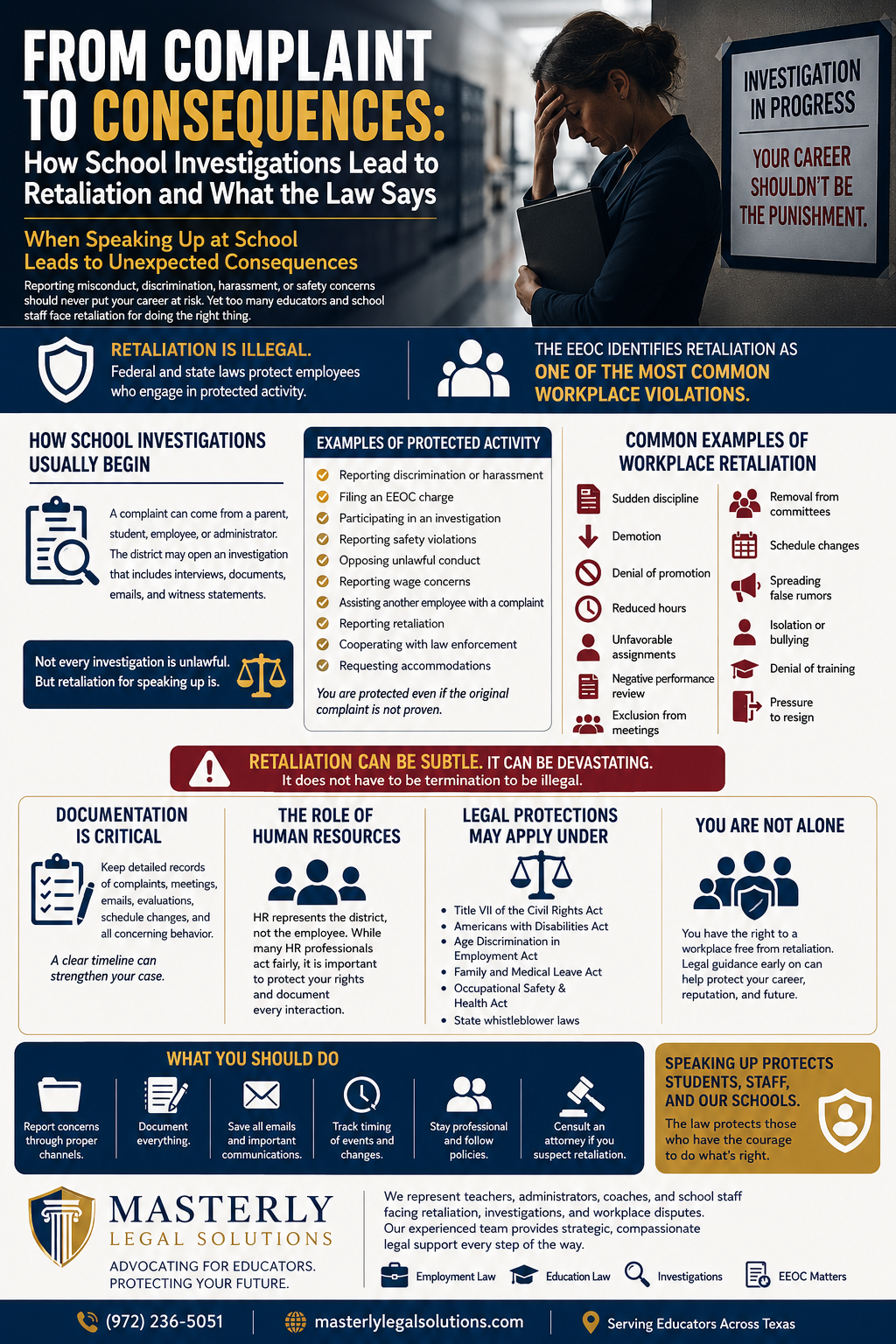
From Complaint to Consequences: How School Investigations Lead to Retaliation and What the Law Says
When Speaking Up at School Leads to Unexpected Consequences
Many teachers, school staff members, coaches, administrators, and support personnel enter the education field because they care deeply about students and their communities. They work long hours, manage stressful environments, and often place the needs of others before their own. However, when an employee decides to report misconduct, discrimination, harassment, safety concerns, or unethical conduct within a school district, they may suddenly find themselves facing serious professional consequences.
In many school systems, a simple complaint can quickly evolve into an internal investigation that changes the course of a person’s career. Instead of receiving support for speaking up, some workers experience retaliation, intimidation, exclusion, or damage to their reputation. What begins as an effort to protect students, comply with the law, or improve workplace conditions can become emotionally and financially overwhelming.
School investigations are supposed to uncover facts and resolve problems fairly. Unfortunately, there are situations where investigations are mishandled or used as tools to punish individuals who engaged in protected activity. Employees may experience sudden discipline, denial of opportunities, hostile treatment, or even termination shortly after reporting concerns. These actions can create fear throughout the workplace and discourage others from coming forward.
At Masterly Legal Solutions, we understand how stressful these situations can become. Our legal team works with educators, administrators, coaches, and school employees facing retaliation and workplace disputes, providing legal support for educators navigating school investigations and TEA-related concerns. Understanding your legal rights is critical when your career, reputation, and livelihood are at risk.
How School Investigations Usually Begin
A school investigation may begin for many reasons. In some cases, a parent files a complaint against a teacher or coach. Other situations involve allegations between coworkers, accusations of harassment, reports of discrimination, concerns about student safety, or questions involving school policies.
Once a complaint is reported, the employer typically assigns someone to review the matter. This may involve human resources, district administration, outside investigators, or compliance personnel. The investigation process can include interviews, written statements, emails, surveillance footage, and witness testimony.
Sometimes investigations are necessary and appropriate. Schools have a responsibility to investigate claims involving misconduct or possible violation of policies and laws. However, the process can become problematic when an employee who reported wrongdoing begins experiencing retaliation shortly afterward.
In many situations, retaliation occurs quietly and gradually. The employer may not openly admit the reason for the mistreatment. Instead, the employee may notice subtle but damaging changes in treatment, assignments, evaluations, or opportunities.
The Difference Between an Investigation and Retaliation
Not every investigation is unlawful. Schools have the authority to review complaints and evaluate employee conduct. However, the law does prohibit retaliation against workers who engage in legally protected actions.
An investigation becomes concerning when negative treatment appears connected to the employee’s protected activity rather than legitimate performance issues. Timing often becomes important in these cases. For example, if a teacher reports discrimination and suddenly receives a negative performance review days later, questions naturally arise regarding motive.
Retaliation can happen before, during, or after an investigation. In some circumstances, the investigation itself may be conducted in a retaliatory manner. The employee may be isolated, publicly embarrassed, denied opportunities, or treated differently than others involved.
Federal and state law protect employees who report unlawful conduct, cooperate with investigations, or oppose discrimination. These protections exist because workers should not fear punishment for raising legitimate concerns.
Understanding Protected Activity Under Employment Law
One of the most important legal concepts in retaliation cases is protected activity. Protected activity refers to actions an employee takes that are legally safeguarded under employment laws.
Examples of protected activity may include:
- Reporting discrimination or harassment
- Filing an EEOC charge
- Participating in an investigation
- Reporting safety violations
- Opposing unlawful conduct
- Reporting wage concerns
- Assisting another employee with a complaint
- Reporting retaliation
- Cooperating with law enforcement or police investigations
- Requesting accommodations related to disability
Employees who engage in protected activity are protected from retaliation under various federal and state laws. The equal employment opportunity commission enforces many workplace protections related to retaliation claims and discrimination matters.
Importantly, the law may still protect a worker even if the original complaint is ultimately unproven, as long as the employee had a reasonable belief that misconduct occurred.
Why Retaliation in Schools Is So Common
Educational environments often involve complex power structures. Teachers answer to department leaders, principals, administrators, and district officials. Coaches may depend on athletic directors for assignments and promotions. Support staff may rely heavily on supervisors for scheduling and evaluations.
Because schools are closely connected communities, employees who speak up may quickly become isolated. Rumors can spread rapidly among coworkers. Management may begin viewing the reporting employee as a problem rather than someone attempting to improve the workplace.
Retaliation in schools can become especially damaging because many positions depend heavily on reputation and professional relationships. A teacher accused of misconduct may face scrutiny from parents, students, and administrators even before an investigation concludes.
Some employers unfortunately focus more on protecting the institution than addressing the underlying issue. This creates an environment where workers fear reporting wrongdoing because they worry about career consequences.
Common Examples of Workplace Retaliation in Schools
Workplace retaliation can take many forms. Some actions are obvious, while others are more subtle. Employees should recognize that retaliation is not limited to termination alone.
Common examples of workplace retaliation include:
- Sudden disciplinary write-ups
- Demotion to a less desirable position
- Denial of a promotion
- Reduced hours
- Increased scrutiny from a supervisor
- Exclusion from meetings
- Removal from committees
- Schedule changes
- Negative performance review
- Threats from management
- Spreading false rumors
- Isolation from coworkers
- Increased bullying or hostile behavior
- Transfer away from a desirable position
- Unfair classroom assignments
- Denial of professional development opportunities
- Unreasonable monitoring
- Pressure to resign
These acts can create a significant negative impact on both the employee and overall employee morale within the school system.
How Retaliation Impacts Teachers and School Staff
The emotional toll of retaliation can be severe. Many educators dedicate years to building careers and relationships within their schools. When retaliation begins, workers often experience anxiety, depression, stress, and fear about the future.
Some employees begin doubting themselves after repeated criticism or exclusion. Others fear losing their teaching certifications, coaching opportunities, or professional standing. Financial concerns also become significant when hours are reduced or termination becomes a possibility.
Retaliation may also affect physical health. Stress from hostile working conditions can contribute to sleep problems, high blood pressure, and emotional exhaustion. Teachers and staff members already operate in demanding environments, and retaliation adds another layer of pressure.
In many instances, retaliation damages not only the targeted employee but also other workers who witness the conduct. Fear spreads throughout the workplace when employees see coworkers punished for reporting concerns.
The Role of Human Resources During School Investigations
Human resources departments are often heavily involved in school investigations. Ideally, HR professionals should remain neutral and ensure fair procedures are followed. They may conduct interviews, gather documentation, and communicate investigation findings.
However, some employees become frustrated when they feel human resources is protecting the employer rather than seeking the truth. Workers sometimes report feeling dismissed, ignored, or pressured during internal investigations.
Employees should remember that HR departments generally represent the interests of the company or school district. While many HR professionals attempt to handle matters appropriately, conflicts can arise when protecting the institution becomes the priority.
This does not mean employees should avoid cooperating with HR. Instead, workers should carefully document interactions and consider seeking legal guidance when concerns about retaliation emerge.
What the EEOC Says About Retaliation
The eeoc recognizes retaliation as one of the most commonly reported workplace violations in the country. Federal laws prohibit retaliation against employees who report discrimination, harassment, or other unlawful conduct.
The EEOC investigates retaliation claims involving:
- Race discrimination
- Sex discrimination
- Religious discrimination
- Disability discrimination
- Age discrimination
- National origin discrimination
- Pregnancy discrimination
Retaliation protections apply even if the original discrimination claim is not ultimately proven. The law focuses heavily on whether the employee reasonably believed misconduct occurred and whether retaliation followed protected conduct.
An employer cannot legally retaliate against a worker simply because the employee reported concerns, participated in an investigation, or exercised legal rights.
Retaliation After Reporting Harassment
Harassment complaints are among the most common triggers for retaliation in schools. An employee may report inappropriate comments, sexual harassment, bullying, or hostile conduct only to later experience punishment for speaking up.
For example, a teacher who reports harassment by a manager may suddenly receive unfavorable assignments or be excluded from leadership opportunities. A coach who raises concerns about inappropriate conduct may find themselves under intense scrutiny shortly afterward.
These situations create fear among workers who may otherwise report misconduct. When retaliation follows harassment reporting, employees often feel trapped between protecting themselves and protecting their careers.
Schools have a legal obligation to address harassment complaints appropriately and prohibit retaliation against those who report concerns.
Discrimination Complaints and School Retaliation
Discrimination complaints involving race, gender, age, disability, religion, or immigration status can also trigger retaliation concerns. Employees who oppose discrimination often become targets after raising concerns.
An administrator may suddenly question an employee’s performance after a complaint is filed. A teacher may lose leadership responsibilities or experience exclusion from decision-making opportunities. In other cases, subtle acts of hostility emerge over time.
Retaliation claims often rely on patterns of conduct rather than one isolated event. A lawyer may examine timing, communication records, witness statements, and changes in treatment to determine whether unlawful retaliation occurred.
How Supervisors and Managers Contribute to Retaliation
A supervisor or manager plays a major role in many retaliation cases. Supervisors often control evaluations, schedules, assignments, discipline, and promotion opportunities.
Because of this authority, retaliatory acts can significantly affect an employee’s career. A supervisor may suddenly document minor issues that were previously ignored. A manager may begin excluding an employee from meetings or assigning unreasonable workloads.
In some situations, retaliation becomes personal. Administrators may perceive the complaint as a challenge to their authority or reputation. Instead of addressing the concern objectively, they focus on discrediting the employee.
Retaliation does not always involve direct threats. Sometimes it involves a series of smaller acts designed to pressure the employee into resigning or remaining silent.
The Importance of Documentation During an Investigation
Documentation can become extremely important in retaliation cases. Employees should carefully preserve records related to complaints, meetings, evaluations, and communications.
Helpful documentation may include:
- Emails
- Text messages
- Performance evaluations
- Witness names
- Written complaints
- Investigation notices
- Schedule changes
- Notes regarding conversations
- Disciplinary records
Employees should also maintain a timeline showing when the complaint was made and when retaliatory acts occurred. Timing often becomes a critical factor in proving retaliation claims.
Clear documentation can help establish patterns that might otherwise be difficult to recognize.
Can a Negative Performance Review Be Retaliation?
Yes, a negative performance review may qualify as retaliation under certain circumstances. This is especially true when an employee previously received positive evaluations before engaging in protected activity.
For example, imagine a teacher consistently receives strong evaluations for several years. Shortly after filing a discrimination complaint, the administrator suddenly issues harsh criticism and places the teacher on a corrective plan. This type of shift may raise legal concerns.
A reasonable employee could interpret such actions as punishment for speaking up. Courts often evaluate whether the adverse action would discourage an ordinary worker from reporting misconduct in the future.
Not every poor evaluation is unlawful, but suspicious timing and inconsistent treatment can strengthen retaliation claims.
Promotion Denials and Career Damage
Retaliation frequently affects career advancement. An employee who reported misconduct may suddenly lose opportunities for promotion, leadership roles, or specialized assignments, making legal protection for teachers facing career-impacting decisions especially important.
For educators, these opportunities may include:
- Department chair positions
- Coaching assignments
- Curriculum leadership roles
- Administrative advancement
- Committee appointments
- Professional recognition
When a promotion denial occurs shortly after reporting concerns, questions about retaliation may arise. Employers sometimes attempt to justify these decisions using vague explanations or subjective criteria.
Career damage caused by retaliation can follow workers for years, especially in close-knit educational communities.
Reduced Hours and Unfavorable Assignments
Some employers avoid direct termination and instead pressure workers through unfavorable assignments or reduced hours. These actions can place financial and emotional strain on employees while allowing management to claim no formal discipline occurred.
A school employee may suddenly lose supplemental duties, overtime opportunities, or preferred schedules after filing a complaint. Coaches may lose athletic assignments. Teachers may receive difficult classroom placements or burdensome workloads.
Even smaller changes in working conditions can qualify as adverse action when they significantly affect the employee’s career or well-being.
Retaliation Against Employees Who Assist Others
The law may also protect workers who assist others involved in investigations or complaints. This includes employees who serve as witnesses, provide statements, or support coworkers reporting misconduct.
Other related protected activity can include helping another employee prepare documentation or participating in internal interviews. Employers cannot lawfully retaliate simply because a worker cooperated with an investigation.
This protection is important because retaliation often extends beyond the person who originally filed the complaint. Coworkers who support the reporting employee may also face hostility or exclusion.
What Happens When Employers Ignore Complaints
Some retaliation situations escalate because employers fail to address concerns early. When workers report harassment, discrimination, or misconduct and receive no meaningful response, tensions often increase.
Employees may feel forced to escalate complaints externally through the eeoc or other agencies, including filing retaliation and labor complaints with the Department of Labor. At that point, relationships within the workplace may deteriorate further.
Ignoring complaints can also expose schools and districts to legal liability. Employers should take proactive steps to investigate concerns promptly and fairly.
Failure to respond appropriately may encourage additional claims, damage employee morale, and create distrust throughout the organization.
How Workplace Culture Encourages Retaliation
Workplace culture plays a major role in whether retaliation develops after complaints are reported. In some school systems, employees fear speaking up because prior incidents created an atmosphere of intimidation.
If management discourages reporting or labels employees as troublemakers, workers may remain silent about serious concerns. This culture can allow misconduct to continue unchecked.
Healthy organizations foster transparency, accountability, and respectful communication. Schools should encourage reporting rather than punish workers for raising concerns.
Leadership decisions greatly influence whether employees feel protected from retaliation or fearful of consequences.
Retaliation Can Occur Even Without Termination
Many employees assume retaliation only matters if they lose their jobs. In reality, retaliation can involve many other forms of harm.
An adverse action does not always require termination. Courts may consider whether the employer’s conduct would discourage a reasonable employee from engaging in protected activity.
For example, repeated hostility, exclusion, schedule manipulation, or denial of opportunities may qualify as retaliation depending on the circumstances. Even subtle changes in treatment can become legally significant when viewed collectively.
The Link Between Bullying and Retaliation
Bullying often overlaps with retaliation in educational settings. Employees who file complaints may suddenly face public criticism, ridicule, or hostility from supervisors and coworkers.
False rumors may spread throughout the school community. The reporting employee may become isolated socially or professionally. In some situations, coworkers are encouraged to avoid the individual entirely.
These tactics create emotional pressure and may push employees toward resignation. Retaliation involving bullying can be especially harmful in schools where professional reputations matter greatly.
What Employees Should Do After Reporting Concerns
Workers who report misconduct should remain alert for signs of retaliation afterward. Taking early action can help protect legal rights and preserve evidence.
Employees should consider seeking guidance from an education law attorney who understands school investigations and teacher discipline and also consider:
- Saving written communications
- Keeping detailed notes
- Following school policies
- Remaining professional during interactions
- Reporting retaliation promptly
- Avoiding emotional confrontations
- Consulting an attorney when concerns escalate
Employees should not assume retaliation will simply disappear over time. Early legal guidance may help workers better understand available options.
How Federal Employment Laws Protect Workers
Several federal laws protect employees from retaliation. These laws cover a wide range of workplace conduct and reporting activities, and an experienced retaliation lawyer for workplace law and employment issues can help explain how they apply in specific situations.
Protections may arise under laws involving:
- Civil rights
- Labor standards
- Wage disputes
- Disability accommodations
- Family leave
- Safety violations
- Equal employment protections
Federal protections often apply regardless of whether the employee ultimately proves the original allegation. The key issue frequently involves whether the employer retaliated because the worker exercised protected rights.
The Role of Reporting in Protecting Students and Staff
Reporting misconduct is often necessary to protect students, teachers, and school communities. Employees who speak up may expose serious concerns involving safety, abuse, discrimination, or unethical conduct.
Without reporting, harmful behavior may continue unchecked. Workers who raise concerns often do so because they believe action is necessary to protect others.
Unfortunately, fear of retaliation discourages some employees from coming forward. Schools should recognize the value of reporting rather than punish individuals who attempt to improve the environment.
When Retaliation Leads to Legal Claims
Retaliation can eventually lead to formal legal claims or litigation. Employees may file complaints with the EEOC or pursue claims under state employment laws, and many choose to work with a retaliation lawyer focused on workplace retaliation claims to navigate this process.
A retaliation lawsuit may seek compensation for:
- Lost wages
- Emotional distress
- Career damage
- Reputational harm
- Lost benefits
- Attorney fees
Every case is different, and outcomes depend heavily on evidence and specific facts. However, retaliation laws exist to protect workers from unfair punishment for engaging in lawful conduct.
Why Timing Matters in Retaliation Cases
Timing is one of the most important factors in retaliation investigations. Courts and agencies often examine how quickly adverse treatment followed protected conduct.
For example, if a teacher files a complaint and receives discipline days later, the timing may suggest retaliatory motive. Similarly, sudden changes in evaluations, assignments, or behavior shortly after reporting concerns can strengthen claims.
Timing alone may not prove retaliation, but it often becomes important supporting evidence.
School Districts Must Investigate Complaints Properly
School districts have a responsibility to investigate complaints thoroughly and fairly. A proper investigation should involve impartial review, accurate documentation, and respectful treatment of all individuals involved, and many choose to work with an education lawyer providing legal support for teachers and schools to maintain compliance.
Retaliation concerns increase when investigations appear one-sided or predetermined. Employees may lose trust in the process when administrators dismiss concerns without serious review.
Schools should ensure investigators remain objective and avoid actions that discourage reporting.
The Long-Term Impact of Retaliation on Education
Retaliation affects more than one employee. When workers fear punishment for reporting concerns, entire school systems suffer.
Teachers may hesitate to report safety issues. Coaches may avoid raising ethical concerns. Support staff may remain silent about misconduct. This environment can ultimately harm students, staff, and educational quality.
Protecting workers who engage in protected activity helps foster accountability and transparency within educational institutions, and many educators benefit from education law counsel that explains why teachers need legal protection before issues escalate.
Why Legal Guidance Matters Early
Many employees wait too long before speaking with an attorney. By the time legal guidance is sought, important evidence may already be lost or deadlines may be approaching.
An experienced employment attorney can help workers understand:
- Whether retaliation may have occurred
- What evidence should be preserved
- Which deadlines apply
- Whether federal or state laws may apply
- How to communicate with investigators
- Possible legal strategies moving forward
Early legal support can help employees avoid mistakes that may weaken potential claims, especially when experienced education law attorneys move quickly during TEA investigations.
Protecting Your Career After a School Investigation
When an employee becomes the target of retaliation, protecting professional reputation becomes essential. Workers should remain calm, professional, and careful in all communications.
Even when emotions run high, reacting impulsively can complicate matters. Employees should focus on preserving evidence, following procedures, and seeking reliable legal advice.
Retaliation cases often involve complex facts and conflicting narratives. Careful preparation and documentation can make a major difference in protecting long-term career interests.
Standing Up Against Workplace Retaliation
No employee should feel forced to choose between protecting their career and reporting legitimate concerns. Laws exist to protect workers who speak up about misconduct, discrimination, harassment, or safety issues.
When retaliation occurs after a complaint or investigation, employees may feel isolated and overwhelmed. However, legal protections are available for many workers facing these situations.
At Masterly Legal Solutions, we understand the challenges educators and school employees face when retaliation affects their careers and reputations. Our team works with clients dealing with complex workplace disputes, investigations, and employment concerns throughout the education system, and our education law attorneys for teachers and administrators provide guidance across these issues.
How Retaliation at Work Can Affect School Employees
Retaliation at work can have devastating consequences for teachers, coaches, administrators, and support staff who report misconduct or participate in investigations. In many school environments, an employee who raises concerns may suddenly notice changes in treatment from a manager or supervisor shortly afterward. These actions may include exclusion from meetings, increased scrutiny, reduced responsibilities, or denial of advancement opportunities. Even subtle conduct can create stress and uncertainty for workers trying to protect their careers. When retaliation becomes part of the workplace culture, it can discourage other employees from reporting serious concerns involving discrimination, harassment, or policy violations.
Other Type of Retaliation Employees May Experience
Not every retaliation case involves termination or formal discipline. In some situations, an employee may experience another type of retaliatory conduct that still creates significant harm in the workplace. For example, a worker may be reassigned to less favorable duties, excluded from professional opportunities, or subjected to ongoing hostility from coworkers and supervisors. Some employees also report sudden schedule changes, unfair criticism, or being isolated from important workplace communication. Even when these actions appear minor individually, they may collectively create a hostile environment that affects professional growth and emotional well-being. Schools and employers should take all forms of retaliation seriously to help protect employees and maintain a respectful work environment.
What Happens After an Employee Is Notified of an Investigation
Once an employee is notified about a school investigation, the situation can quickly become stressful and emotionally overwhelming. Many workers immediately worry about their reputation, future employment opportunities, and relationships with coworkers or administrators. In some cases, the employee may feel pressured to remain silent or avoid discussing the matter with others. It is important for workers to remain professional, preserve documentation, and carefully monitor how they are treated after the investigation begins. If negative actions occur shortly after the employee was notified or after they engaged in protected activity, those circumstances may raise concerns about possible retaliation under employment law.
How the Equal Employment Opportunity Commission Handles Retaliation Cases
The equal employment opportunity commission plays a major role in enforcing federal employment laws that protect workers from unlawful retaliation and discrimination. Employees who believe they were punished for reporting misconduct, harassment, or discriminatory treatment may file a charge through the agency for review. The EEOC investigates complaints involving schools, businesses, and other employers to determine whether unlawful workplace conduct may have occurred. In many retaliation cases, the agency examines timelines, disciplinary actions, witness statements, and communication records to evaluate whether the employee’s protected activity contributed to the employer’s decision-making. Understanding how the EEOC process works can help educators and school staff recognize the legal protections available when retaliation becomes a serious concern.
Understanding What Qualifies as an Adverse Action
An adverse action occurs when an employer takes negative steps against an employee after the worker engages in legally protected conduct. In school settings, this may involve termination, demotion, reduced responsibilities, denial of opportunities, or reassignment to unfavorable duties. However, adverse actions are not always obvious or dramatic. A teacher may suddenly receive unfair evaluations, lose leadership opportunities, or face increased scrutiny from a supervisor shortly after reporting concerns. Courts often evaluate whether the employer’s conduct would discourage a reasonable employee from speaking up about misconduct or participating in an investigation. Even smaller workplace changes can become legally significant when they create harm or negatively affect the employee’s career.
Employees Are Protected From Retaliation Under Federal Law
Workers who report discrimination, harassment, safety concerns, or other unlawful conduct are often protected from retaliation under federal and state employment laws. These protections exist to encourage employees to come forward without fear of punishment or intimidation from an employer. Teachers, administrators, coaches, and support staff should not have to choose between protecting students and protecting their careers. When retaliation occurs after an employee files a complaint, participates in an investigation, or opposes unlawful behavior, legal protections may apply depending on the circumstances. Employees who understand their rights are often in a stronger position to recognize warning signs early and take steps to help protect their professional future.
Speak With Masterly Legal Solutions About Your Rights
If you believe you have experienced workplace retaliation after reporting misconduct, participating in an investigation, or opposing unlawful conduct, you do not have to navigate the situation alone. The legal team at Masterly Legal Solutions understands how stressful and confusing these situations can become for educators, administrators, coaches, and school staff members.
Our firm works closely with clients to evaluate the facts, review documentation, and help protect their professional futures. Whether you are facing termination, harassment, denial of opportunities, or other retaliatory acts, we are prepared to help you better understand your legal options.
Contact Masterly Legal Solutions at (972) 236-5051 for a free consultation. We can answer questions about school investigations, retaliation claims, discrimination concerns, and other workplace legal matters affecting your career and reputation.
Disclaimer: This article is provided for educational and informational purposes only and does not constitute legal advice. Reading this article does not create an attorney-client relationship with Masterly Legal Solutions. Every situation is unique, and individuals should consult directly with a qualified attorney regarding their specific legal concerns.
Teacher Rights When Assaulted by a Special Needs Student: Safety, Reporting and Investigation Issues





Looking for Legal & Business Solutions? Contact Us Now
Fill in the form or call us to set up a meeting





