

How School Districts Handle Investigations and Where Retaliation at Work Comes In
Understanding the Pressure Employees Face During School District Investigations
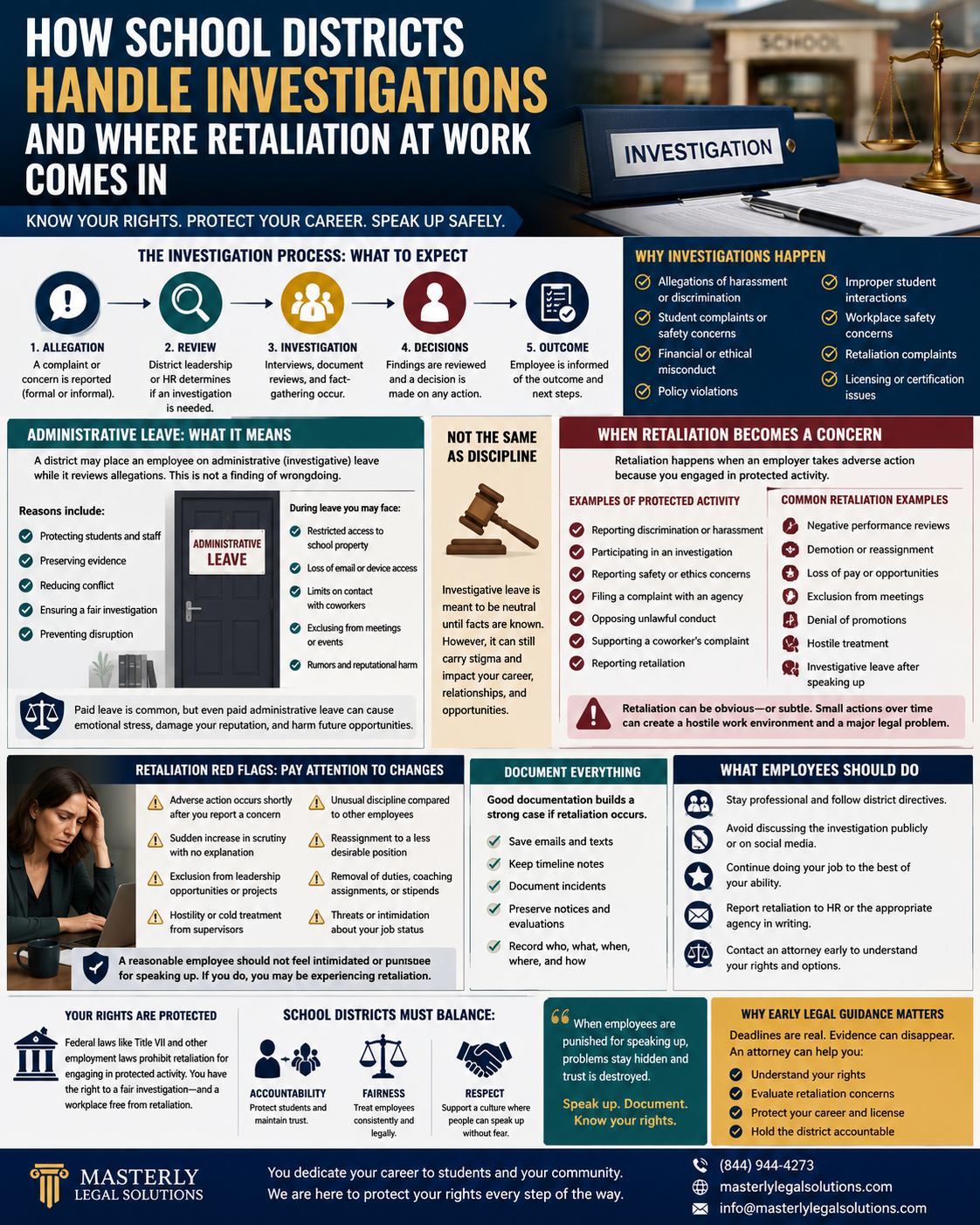
School districts are expected to maintain safe learning environments for students, teachers, administrators, and support staff. When allegations involving misconduct, policy violations, discrimination, harassment, or ethical concerns arise, the district often begins an internal investigation to determine what happened and whether any corrective action is necessary. These situations can quickly become stressful for any employee involved, especially when the process affects their reputation, career opportunities, or emotional well-being.
For many workers, the fear does not stop with the investigation itself. A teacher, coach, counselor, administrator, or support staff member may worry that speaking up about misconduct will lead to retaliation at work. In many situations, employees are concerned about losing leadership opportunities, receiving unfair discipline, being reassigned, or facing hostility from supervisors and coworkers after reporting misconduct or participating in a protected activity.
School district investigations are often more complicated than many people realize. They may involve federal law, district policies, employee handbooks, union agreements, student rights, public records obligations, and workplace safety concerns. An employer may claim its actions are routine administrative decisions, while the employee believes those same actions were intended to punish them for speaking up.
At Masterly Legal Solutions, we understand how overwhelming these situations can become. Employees frequently contact our office after they believe a school district crossed the line between conducting a lawful investigation and engaging in retaliation that violates employment law. Understanding how these investigations work is important for protecting both your career and your legal rights.
Why School District Investigations Happen
A school district may launch an investigation for many reasons. Some investigations involve student complaints, while others focus on employee conduct, financial concerns, ethics issues, discrimination allegations, or safety concerns. In some cases, a district receives anonymous reports that trigger a review by agency officials or outside investigators.
An investigation may begin after a formal complaint is submitted, but districts can also initiate reviews based on informal reports or concerns raised internally. The agency head or district leadership may determine that immediate action is needed to protect students, staff, or the agency's mission. In some situations, the district may place an employee on administrative leave while reviewing the allegations.
Examples of issues that may lead to an investigation include:
- Allegations of harassment in the workplace
- Claims involving discrimination
- Reports of improper student interactions
- Financial misconduct allegations
- Workplace safety violations
- Ethics concerns involving administrators
- Retaliation complaints
- Licensing or certification issues
- Concerns involving inappropriate communication
- Possible violation of district policy
Some investigations remain internal, while others involve outside entities or authorized agency officials. Depending on the allegations, the district may work with state education agencies, law enforcement, or other authorized agency officials during the process.
What Administrative Leave Means During an Investigation
One of the most misunderstood parts of a school district investigation involves administrative leave. Many employees panic when they are told they are being removed from their duties pending review. While being placed on administrative leave does not automatically mean an employee did something wrong, it can still have a serious emotional and professional impact.
Administrative leave is commonly used when a district believes it is necessary to temporarily remove an employee from the workplace while an investigation continues. In many cases, the leave is paid leave, although the exact circumstances depend on district policies, employment agreements, and the nature of the allegations.
A school district may grant administrative leave for several reasons. The employer may argue that removing the employee helps preserve evidence, protects students, reduces conflict between workers, or prevents disruption during the investigation process. In other situations, the district may claim the leave is necessary because the agency determines that the employee’s continued presence could negatively affect employee morale or interfere with the agency's mission.
However, employees often question whether the leave was truly necessary or whether retaliation occurs behind the scenes. Sometimes the employee believes the investigation started shortly after they reported discrimination, harassment, or another protected activity. When timing raises concerns, the situation deserves closer legal review.
The Difference Between Administrative Leave and Discipline
Many school district employees assume that administrative leave automatically means they are being disciplined. That is not always true. A district may place workers on investigative leave before reaching any final decision about misconduct. In theory, the leave is supposed to be neutral until the investigation is complete.
Still, administrative leave can carry a stigma. Even when the leave is temporary, coworkers may assume the employee committed misconduct. Rumors can spread quickly throughout the workplace, creating a negative impact on professional relationships and overall employee morale.
An employee may also face limitations during leave, such as:
- Restricted access to school property
- Loss of district devices or email access
- Prohibitions on contacting coworkers
- Temporary reassignment duties
- Exclusion from meetings or events
- Reduced opportunities for advancement
In some cases, a district may place the employee in a less desirable position after the investigation concludes. Even if the employee keeps their job, reassignment decisions can still create long-term career consequences.
When Retaliation Becomes a Serious Concern
Retaliation occurs when an employer takes adverse action against an employee because that worker engaged in protected activity. School district employees often report retaliation after filing complaints involving discrimination, harassment, wage issues, ethics concerns, or other legal violations.
A protected activity can include:
- Reporting discrimination
- Participating in an internal investigation
- Reporting workplace safety concerns
- Filing a complaint with an agency
- Cooperating with federal investigators
- Opposing unlawful conduct
- Reporting a possible violation of policy or law
- Supporting another employee’s complaint
- Reporting retaliation itself
Many workers do not realize that retaliation protections extend beyond formal complaints. Even informal reports to a supervisor or manager may qualify as protected activity under certain circumstances, and speaking with a retaliation lawyer about workplace protections can help clarify which actions are covered.
For example, a teacher who reports racial discrimination to human resources may later notice sudden disciplinary scrutiny, exclusion from leadership meetings, or poor evaluations. Another example may involve a coach who raises concerns about student safety and is later reassigned to a less desirable position. In both situations, the employee may suspect retaliation.
Common Examples of Retaliation in School Districts
Retaliation does not always involve termination. In many cases, the employer takes smaller actions that collectively create a hostile workplace environment. A reasonable employee may feel intimidated, isolated, or pressured to remain silent after experiencing retaliation.
Examples of retaliation may include:
- Sudden negative performance evaluations
- Demotion or reassignment
- Reduction in pay opportunities
- Exclusion from meetings or committees
- Increased scrutiny from a supervisor
- Denial of promotions
- Transfer to a less desirable position
- Threats of disciplinary action
- Hostile treatment from management
- Changes to work schedules
- Loss of coaching assignments or stipends
- Investigative leave shortly after reporting misconduct
Another example may involve an employee who reports harassment and later loses leadership duties. A different example could involve workers who participate in an investigation and later receive harsher treatment than other employees.
Retaliation can damage employee morale throughout an entire district. When workers see coworkers punished for speaking up, overall employee morale often declines because employees fear similar treatment.
Protected Activity Under Employment Laws
Protected activity is a key concept in retaliation claims. Employees are legally protected when they engage in certain actions related to workplace rights, discrimination concerns, or legal compliance issues.
Protected activity may involve complaints related to:
- Race discrimination
- Sex discrimination
- Disability discrimination
- Religious discrimination
- Age discrimination
- Harassment
- Wage and hour issues
- Workplace safety concerns
- Ethical violations
- Fraud concerns
- Retaliation complaints
Federal law, including Title VII, prohibits retaliation against employees who engage in related protected activity. Other related protected activity may involve participating in interviews during an investigation or assisting another employee with a discrimination claim.
Many school district employees worry that even cooperating with investigators could put their career at risk. Unfortunately, some districts create environments where workers fear being labeled “difficult” after speaking honestly during an investigation.
How School Districts Justify Investigative Leave
School districts frequently argue that investigative leave is necessary to preserve the integrity of the investigation process. The employer may state that placing employees on administrative leave helps reduce conflict or allows investigators to review evidence without interference.
The district may also claim the leave was necessary because:
- Witnesses felt uncomfortable
- Students needed protection
- The employee held a leadership role
- The investigation involved sensitive allegations
- There were concerns about workplace safety
- The agency determines temporary separation is appropriate
Some districts rely heavily on agency policies and internal procedures when making these decisions. Others use ad hoc approaches that vary depending on leadership preferences, sometimes without consulting HR consulting and workplace investigation guidance that could promote consistency.
Problems arise when the district treats employees inconsistently. For example, one employee may be placed on administrative leave for brief periods during an investigation, while another worker facing similar allegations remains actively employed. Inconsistent treatment can raise concerns about retaliation or discrimination.
How Timing Can Reveal Retaliation
Timing often plays a major role in retaliation cases. When adverse action occurs shortly after an employee engages in protected activity, courts and investigators may closely examine the employer’s motives.
For example, if an employee reports discrimination and is placed on administrative leave days later, the timing may create suspicion. Another example could involve a teacher who participates in an investigation and suddenly faces disciplinary action shortly afterward.
A district may insist the investigation was already underway or that the adverse action was unrelated. However, patterns sometimes suggest otherwise. Employees should pay close attention to documentation, communications, and sudden changes in treatment after engaging in protected activity.
The Role of Human Resources During Investigations
Human resources departments often coordinate investigations within school districts. HR personnel may interview witnesses, gather documents, review district policies, and advise administrators regarding personnel decisions.
Although HR departments are supposed to remain neutral, employees sometimes feel the process favors district leadership. Workers may believe the employer is focused more on reducing legal exposure than protecting employee rights.
An employee should never assume that conversations with HR are automatically confidential or entirely neutral. Statements made during interviews can later become part of disciplinary records or legal proceedings.
Can Paid Administrative Leave Still Harm an Employee?
Many districts argue that paid administrative leave is not punitive because the employee continues receiving pay and benefits. However, even paid leave can create substantial professional harm.
An employee placed on paid administrative leave may experience:
- Damage to professional reputation
- Emotional stress
- Isolation from coworkers
- Loss of leadership opportunities
- Community speculation
- Reduced future advancement opportunities
In school environments, rumors can spread quickly among parents, staff, and community members. Even if the employee is eventually cleared, the experience may leave lasting damage.
A reasonable employee may view the leave as punishment, especially if the district publicly handles the situation poorly or fails to maintain confidentiality.
The Impact Investigations Have on Employee Morale
Investigations do not only affect the individual employee involved. They can also create broader problems throughout the workplace. When employees fear retaliation, they may stop reporting concerns altogether.
Poorly managed investigations can damage employee morale by creating:
- Distrust of leadership
- Fear of reporting misconduct
- Increased workplace tension
- Reduced collaboration among workers
- Anxiety regarding job security
Overall employee morale often suffers when employees believe administrators use investigations to target certain workers rather than address legitimate concerns.
The agency's mission can also suffer when employees no longer trust district leadership to act fairly.
Federal Laws That Protect Employees
Several federal laws prohibit retaliation and discrimination in the workplace. These laws may apply to school district employees depending on the circumstances of the case.
Title VII prohibits retaliation connected to discrimination complaints involving race, sex, religion, or national origin. Other laws protect employees who report wage violations, safety concerns, or disability discrimination.
Certain federal agencies also provide guidance regarding retaliation protections. OPM guidance, presidential directives, and executive order requirements may influence how federal employees are treated, although public school systems typically operate under state and local employment structures, and firms that advise on internal investigations and labor and employment issues often draw on these broader standards.
Still, federal employment principles sometimes shape broader workplace expectations in education settings, especially regarding due process, fairness, and employee protections.
Administrative Leave Policies and Internal Procedures
Many school districts maintain written agency policies addressing administrative leave procedures. These policies may explain when administrators can grant administrative leave and how long employees may remain out of work during investigations.
Some policies allow leave for short periods or brief periods while investigators review allegations. Others permit extended investigative leave depending on the complexity of the situation.
Agency policies often address topics such as:
- Notice leave procedures
- Employee interview requirements
- Confidentiality expectations
- Communication restrictions
- Documentation requirements
- Reassignment procedures
However, even when districts have written internal policies, administrators do not always follow them consistently. Employees frequently discover that agency judgments vary depending on who is involved.
What Happens After the Investigation Ends
Once the investigation concludes, the district usually decides whether additional action is necessary. The outcome may include:
- No findings against the employee
- Written warnings
- Reassignment
- Training requirements
- Suspension
- Termination
- Return to the employee's current position
Sometimes the district quietly returns the employee to work without acknowledging the emotional and reputational damage caused by the process. Other times, the employee faces ongoing hostility even after being cleared.
An employee who experiences retaliation after returning from administrative leave may still have legal options available, including consulting an education law attorney for teachers and administrators to evaluate next steps.
The Problem With Informal Retaliation
Not all retaliation appears in official records. In many cases, retaliation occurs informally through subtle behavior changes in the workplace.
Examples include:
- Exclusion from meetings
- Lack of communication from leadership
- Removal from desirable projects
- Social isolation
- Increased micromanagement
- Sudden criticism from a manager
These actions may seem minor individually, but together they can create a hostile environment. A reasonable employee may feel pressured to resign or stop raising concerns.
How Investigations Affect Career Advancement
School district employees often depend on recommendations, committee work, coaching assignments, and leadership opportunities to advance professionally. Even temporary investigations can interfere with those opportunities.
For example, a teacher placed on administrative leave during hiring season may lose opportunities for promotions or transfers. Another example may involve an administrator who misses professional development opportunities because of an ongoing investigation.
The long-term negative impact can continue even if the district never formally disciplines the employee.
Why Documentation Matters
Employees involved in investigations should carefully document important events and communications. Documentation may become extremely valuable later if retaliation concerns arise.
Important records may include:
- Emails
- Text messages
- Performance evaluations
- Investigation notices
- Witness communications
- Timeline notes
- Meeting summaries
An employee should also document when protected activity occurred and when adverse action followed. Establishing a timeline often becomes critical in retaliation cases.
How Workplace Safety Concerns Trigger Investigations
Workplace safety concerns frequently lead to investigations in school environments. Employees may report unsafe student behavior, threats, building hazards, or policy violations involving student supervision.
Workers who report safety issues are often protected from retaliation. However, some employees later believe district leadership targeted them for raising concerns that embarrassed administrators or created public scrutiny, leading them to consider filing labor-related retaliation complaints.
Another example could involve a school employee reporting violence concerns and later being transferred to a less desirable position. When retaliation occurs after reporting safety issues, legal protections may apply.
The Relationship Between Harassment Complaints and Retaliation
Harassment complaints commonly lead to retaliation claims. An employee may report inappropriate conduct, only to later experience hostility from supervisors or coworkers.
In some situations, the employer focuses more heavily on the employee who reported misconduct than the person accused of harassment. Employees sometimes describe feeling punished for speaking up rather than protected.
This pattern can create serious legal concerns under employment law.
Investigations Involving Federal Standards
Although local school districts are not federal agencies, many districts still follow procedures influenced by federal employment standards. Concepts involving investigative leave, due process, personnel management, and workplace fairness often overlap with broader employment practices.
Some federal guidance references concepts such as:
- Safety leave
- Investigative leave
- Excused absence
- Notice leave
- Paid leave
- Administrative leave
Federal guidance may also discuss agency judgments involving employee placement decisions, workplace safety, and protecting the agency's mission during sensitive investigations.
When Reassignment Becomes Retaliation
Reassignment decisions can become legally significant when they negatively affect an employee’s career. A transfer to a less desirable position may qualify as adverse action if it materially harms the employee’s professional opportunities.
For example, moving an educator from a highly respected program into a time limited basis assignment with reduced visibility may raise concerns. Another example could involve removing coaching responsibilities that significantly affected the employee’s pay.
An employer may claim the reassignment was operationally necessary, while the employee believes it was directly related to protected activity.
The Emotional Impact on Employees and Families
Investigations can affect far more than an employee’s job status. Workers often experience anxiety, depression, embarrassment, and financial stress during these situations.
Families may also suffer because of uncertainty surrounding the employee’s future. Even when the worker continues receiving pay during administrative leave, emotional pressure can become overwhelming.
The stress often increases when employees believe district leadership is intentionally damaging their reputation or career.
How Employers Defend Retaliation Claims
School districts rarely admit retaliation occurred. Instead, the employer usually argues that all employment decisions were based on legitimate operational concerns.
Common defenses include claims that:
- The investigation was routine
- The employee violated policy
- Leadership acted consistently with agency policies
- The adverse action was unrelated to protected activity
- The district acted to protect students or staff
- Agency officials followed standard procedures
However, courts and investigators may examine whether those explanations are consistent with the evidence and treatment of other employees.
What Employees Should Avoid During an Investigation
Employees involved in investigations should remain careful and professional throughout the process. Emotional reactions can sometimes complicate the situation further.
Workers should avoid:
- Discussing the investigation publicly
- Deleting communications
- Retaliating against coworkers
- Ignoring district directives
- Posting details on social media
At the same time, employees should not assume the district is fully protecting their interests. Seeking legal guidance early may help employees better understand their rights and responsibilities.
Why Early Legal Guidance Matters
Many employees wait too long before speaking with an attorney. By the time they seek help, critical evidence may already be lost or deadlines may be approaching.
Legal counsel, including an expert education lawyer for schools and teachers, may help employees:
- Understand retaliation protections
- Evaluate adverse action concerns
- Review investigation procedures
- Preserve evidence
- Respond to disciplinary notices
- Protect professional licenses
- Address discrimination claim issues
Every investigation involves unique circumstances. What appears routine on the surface may actually involve serious legal concerns once the full timeline is reviewed.
School Districts Must Balance Fairness and Accountability
School districts have legitimate responsibilities to investigate complaints and protect students. At the same time, districts must also respect employee rights and avoid retaliatory conduct, and many choose to work with an education lawyer who supports teachers and schools to help maintain that balance.
Problems arise when administrators prioritize protecting the district’s image over conducting fair and balanced investigations. Employees deserve procedures that are consistent, professional, and legally compliant.
When districts fail to issue internal policies consistent with employment laws and fair investigative standards, legal disputes often follow.
Understanding Adverse Action in the Workplace
Adverse action is one of the most important concepts in retaliation cases. An adverse action occurs when an employer takes action that could discourage a reasonable employee from engaging in protected activity.
Examples of adverse action include:
- Termination
- Demotion
- Suspension
- Investigative leave
- Reduced pay
- Negative evaluations
- Unwanted reassignment
- Denial of advancement opportunities
An adverse action does not always have to involve termination. Even smaller employment changes may qualify if they significantly affect the employee’s professional standing or workplace environment.
Investigations Can Affect the Entire Workplace Culture
When retaliation concerns spread throughout a school district, the effects often extend beyond a single employee. Workers may become afraid to report misconduct, safety issues, or policy concerns.
This fear can create a culture where problems remain hidden rather than addressed. Over time, the district may experience declining trust, reduced collaboration, and weakened employee morale.
Healthy workplace environments depend on employees feeling safe enough to report concerns without fear of retaliation.
Understanding Agency Judgments During Investigations
District administrators often exercise broad discretion during investigations. Agency judgments may involve decisions about employee placement, leave status, communication restrictions, and disciplinary recommendations.
While administrators may have authority to act under district procedures, those decisions still must comply with employment law and prohibit retaliation.
An employee who believes leadership abused that discretion should take the situation seriously.
How Retaliation Impacts Long-Term Careers
Retaliation can create lasting professional damage even if the employee remains employed. Workers may lose future leadership opportunities, professional relationships, and community trust.
Another example may involve an educator who remains employed but is no longer considered for promotions after reporting misconduct. A different example could involve a counselor who experiences years of hostility after participating in an investigation.
These long-term consequences are one reason retaliation protections exist under the law, and why many educators turn to an education law attorney for guidance during investigations.
Why School Employees Should Take Concerns Seriously
Many school employees initially try to handle retaliation concerns quietly because they fear conflict with administrators. Unfortunately, delaying action sometimes allows the situation to worsen.
Employees should pay attention when they notice:
- Sudden treatment changes after protected activity
- Increased scrutiny without explanation
- Exclusion from opportunities
- Hostility from supervisors
- Unusual disciplinary measures
- Threats involving job status
Recognizing these warning signs early may help employees better protect themselves.
Administrative Leave Rules for Brief or Short Periods
School districts sometimes place an employee on administrative leave for brief or short periods while reviewing allegations or gathering information connected to an investigation. In many situations, district leadership argues that temporary removal from the workplace helps protect students, preserve evidence, or reduce disruption during the review process. However, even when leave only lasts a few days, the decision can still affect employee morale, professional reputation, and future career opportunities. Employees should understand that districts are still expected to follow fair procedures and applicable employment law standards, even when the leave involves short-term administrative action.
How the United States Code Influences Workplace Protections
Many workplace protections involving retaliation, discrimination, and employee rights are connected to provisions found within the United States Code. Although public school districts primarily operate under state and local policies, federal employment laws still influence how investigations and disciplinary decisions are handled. These legal standards help prohibit retaliation against workers who engage in protected activity such as reporting discrimination, harassment, or safety concerns. School employees who believe their rights were violated during an investigation may need to evaluate both state laws and federal protections when reviewing their legal options.
Why Districts Cannot Target Only Employee Complaints Selectively
A school district should avoid creating policies or practices that unfairly focus on only employee complaints involving certain workers while ignoring similar concerns raised by others. When administrators selectively investigate or discipline one employee while overlooking similar conduct from other workers, questions about retaliation or discrimination may arise. Consistency matters during any workplace investigation because unequal treatment can damage trust throughout the workplace. Employees often become concerned when district leadership appears to single out one individual after that person engages in protected activity or reports misconduct.
Administrative Actions Must Be Specifically Authorized
School districts are expected to ensure that major employment decisions are specifically authorized under district policies, employment agreements, or applicable law. This includes decisions involving administrative leave, reassignment, suspension, or disciplinary action connected to an investigation. When administrators exceed their authority or apply policies inconsistently, employees may question whether retaliation or unfair treatment occurred. Proper oversight and clear procedures are important because investigations can significantly affect an employee’s professional reputation and long-term career opportunities.
Wage Concerns During Workplace Investigations
Employees involved in school district investigations sometimes worry about how leave status or reassignment decisions could affect their income. While many workers placed on administrative leave continue receiving pay, concerns may still arise involving stipends, coaching compensation, overtime opportunities, or other financial benefits. In some situations, workers may also raise questions about minimum wage protections or whether compensation practices comply with employment laws. Financial uncertainty often increases stress during investigations, especially when employees fear long-term career consequences connected to retaliation concerns.
Presidential Memorandum Guidance and Employment Standards
Certain workplace policies involving investigations, administrative leave, and employee protections have been influenced over time by federal employment guidance, including standards discussed in presidential memorandum directives. While public school districts are generally governed by local and state procedures, broader employment principles involving fairness, accountability, and retaliation protections still influence workplace expectations. Employees often expect districts to conduct investigations professionally and consistently rather than relying on inconsistent or ad hoc decision-making practices. When leadership fails to follow fair procedures, workers may begin to question the legitimacy of the investigation itself.
OPM Regulations and Administrative Leave Concepts
Although OPM regulations primarily apply to federal employment systems, many concepts surrounding administrative leave and investigative procedures have influenced broader workplace management practices. Guidance involving investigative leave, notice requirements, employee protections, and workplace fairness often shapes discussions involving employment investigations across different sectors. School district employees sometimes encounter administrative practices that resemble standards commonly discussed in federal employment settings. Understanding these concepts may help workers better recognize when district actions appear excessive, inconsistent, or potentially retaliatory.
Administrative Leave for Blood Donations and Community Service Activities
Some employment policies recognize limited administrative leave opportunities connected to blood donations, volunteer service, or officially sponsored workplace initiatives. School districts occasionally allow employees excused absences for approved civic participation activities that benefit the community or support employee wellness programs. However, districts should apply these opportunities fairly and consistently among workers. Unequal treatment involving leave approvals can sometimes contribute to broader concerns regarding favoritism, retaliation, or inconsistent enforcement of workplace policies.
Differences Between Public Education and Private Sectors
School district investigations often operate differently from employment disputes within private sectors because public education systems may involve additional regulations, transparency obligations, and public accountability standards. Public school employees may also face licensing concerns, board reviews, or public scrutiny that private-sector workers do not experience in the same way. Despite these differences, retaliation protections still apply when employees engage in protected activity or report workplace misconduct. Workers in both public and private employment settings deserve fair treatment during investigations and disciplinary proceedings.
Officially Sponsored Workplace Activities and Employee Rights
School districts frequently encourage employees to participate in officially sponsored training events, conferences, student activities, and professional development programs. Participation in these events may affect networking opportunities, career advancement, and leadership visibility within the district. Problems can arise when employees who previously reported misconduct suddenly lose access to these opportunities after engaging in protected activity. Excluding workers from officially sponsored events or leadership opportunities may contribute to retaliation concerns when the timing suggests a connection to workplace complaints or investigations.
Understanding Other Provision Requirements in Employment Policies
Many school district employment policies contain references to other provision requirements that affect investigations, leave procedures, disciplinary standards, or employee conduct expectations. These additional provisions may involve confidentiality obligations, reporting procedures, or timelines connected to internal reviews. Employees should carefully review district policies and employment agreements to better understand how these provisions may apply during an investigation. Misunderstanding policy language can create confusion regarding employee rights, administrative authority, and available legal protections.
Why Timing Throughout the Calendar Year Matters
Patterns involving investigations, evaluations, transfers, or disciplinary actions throughout the calendar year can sometimes become important in retaliation cases. Employees may notice that adverse action occurs shortly after they report discrimination, harassment, or other workplace concerns. Timing can help reveal whether an investigation appears routine or whether the district’s actions may have been directly related to protected activity. Careful documentation of workplace events over the course of the year may help employees better understand whether retaliation concerns should be evaluated more closely.
Speak With Masterly Legal Solutions About Retaliation at Work
If you believe your school district handled an investigation unfairly or you are experiencing retaliation at work after engaging in protected activity, you do not have to face the situation alone. Investigations involving administrative leave, disciplinary action, discrimination concerns, or retaliation can place enormous pressure on both the employee and their family.
At Masterly Legal Solutions, we understand the real-world impact these workplace disputes can have on your reputation, income, professional future, and peace of mind. Whether you are dealing with investigative leave, reassignment, a hostile workplace environment, or concerns involving adverse action, our team can help you better understand your legal options.
Every situation is different, and the details matter. Contact Masterly Legal Solutions at (972) 236-5051 for a free consultation so we can answer your questions, discuss your concerns, and help you evaluate the circumstances surrounding your workplace investigation or retaliation concerns. Taking action early may help protect your rights, your career, and your future.
Disclaimer: This article is provided for educational and informational purposes only and should not be considered legal advice. Reading this article does not create an attorney-client relationship with Masterly Legal Solutions. Employment law matters, retaliation claims, and school district investigations depend on the specific facts of each case. Individuals should speak directly with a qualified attorney regarding their own legal situation.








Looking for Legal & Business Solutions? Contact Us Now
Fill in the form or call us to set up a meeting





