

How an Education Law Attorney Defends Teaching Credentials
A teaching certificate is more than a piece of paper—it is a career, a calling, and a reputation that you’ve built one day at a time. When your credential is threatened, it can feel like everything you’ve worked for is suddenly unstable. Many teachers describe the process as confusing, stressful, and unfair, especially when they’re trying to keep working while defending themselves at the same time. In those moments, having the right legal support can change the entire outcome.
At Masterly Legal Solutions, we help educators protect their professional standing when accusations, complaints, or investigations put their certification at risk. A skilled education lawyer understands how these cases move through the education system, what evidence matters, and how a single allegation can escalate into serious disciplinary proceedings. Our goal is not only to defend your license, but to defend your future in education.
This guide explains how education law attorneys defend teaching credentials and what you can expect when you hire legal representation. If you are facing an investigation, potential suspension, or professional discipline, this is the type of legal strategy that can make all the difference.
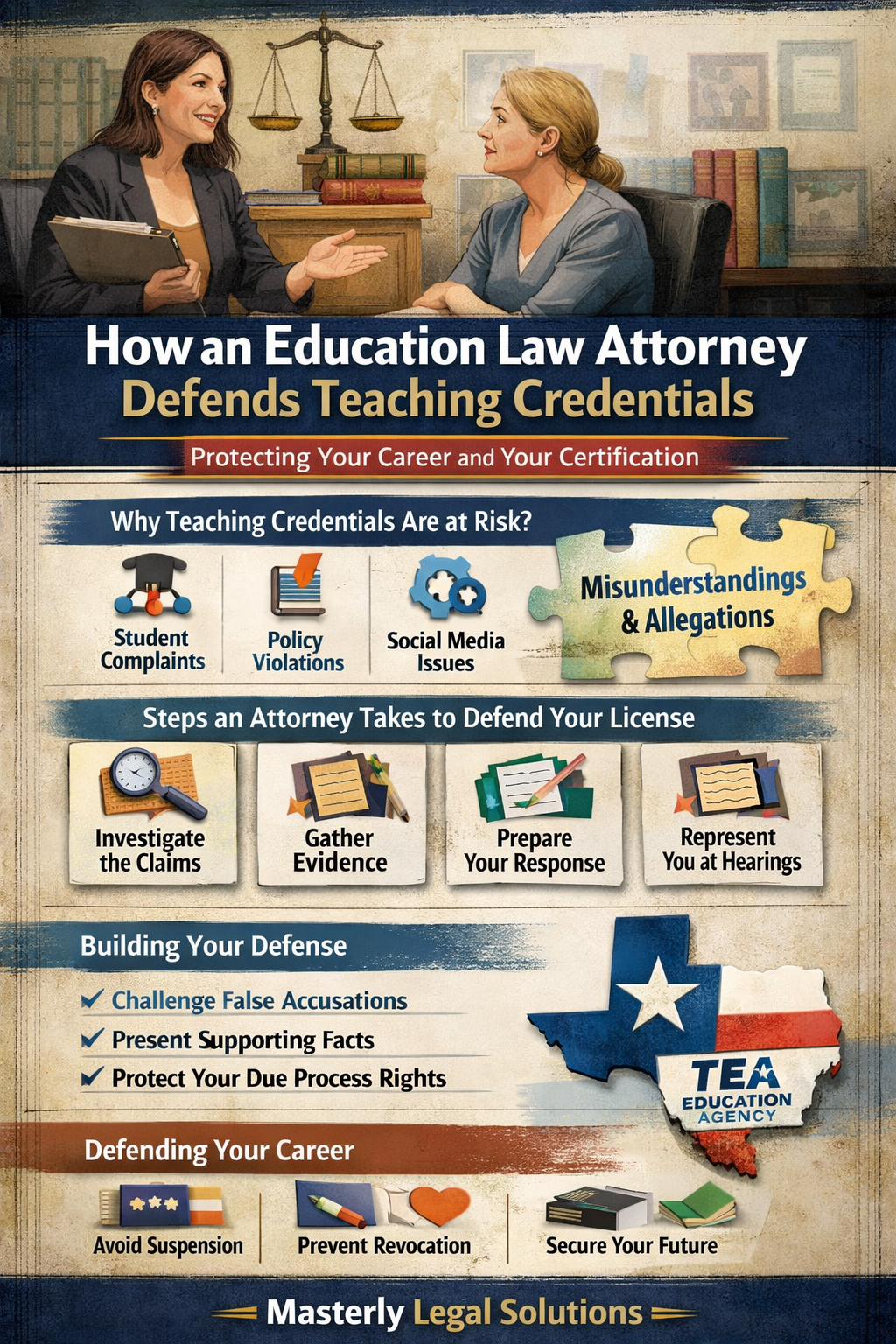
Why Teaching Credentials Are at Risk More Often Than Educators Expect
Many professionals assume they will only face discipline if they’ve done something intentionally wrong. In reality, credential cases often start from misunderstandings, workplace conflict, social media complaints, or policy confusion. In a public school or private school, the rules can be strict, and even small mistakes may trigger formal reviews. That creates new challenges for good educators who are simply trying to manage classrooms, deadlines, and expectations.
Teaching credentials may be challenged due to legal issues connected to workplace disputes, student complaints, or allegations involving professional boundaries. Even if you believe the situation is exaggerated or untrue, the school district may still act quickly to protect itself. In many cases, educators are placed on administrative leave before they’ve had a real chance to defend themselves. That’s why early legal support matters.
When your certification is questioned, the process can move fast and involve multiple departments, including district leadership and state oversight. Some cases also involve employment law concerns, which makes it even more important to work with experienced legal professionals.
What “Defending Teaching Credentials” Actually Means
When someone says an attorney “defends a license,” they are talking about a full strategy that covers paperwork, investigations, evidence, and hearings. An education credential defense is not the same as a general workplace complaint. These cases often involve administrative rules, strict timelines, and intense scrutiny of your decisions.
Defending a credential may include responding to an official investigation, preparing for an interview, challenging accusations, and presenting the teacher’s side clearly and professionally. In some situations, it also means protecting the client’s employment and reputation during a disciplinary process.
An experienced attorney understands that your teaching certificate is connected to your entire livelihood. A credential defense should include both legal strategy and practical guidance, especially when your career is on the line.
The Role of Education Law Attorneys in Protecting Educators
Education law attorneys focus on issues that arise in schools, districts, and academic environments. Their work often involves policy enforcement, student discipline, civil protections, and credential disputes. These attorneys understand how a school system operates and how educator investigations differ from other legal matters.
At Masterly Legal Solutions, we represent professionals across the education community, including classroom teachers, instructional coaches, and support personnel. In some cases, credential investigations also impact other school employees and school employees who are licensed or regulated.
Because these cases can evolve into serious professional consequences, choosing the right education attorneys matters. It’s not just about knowing general law—it’s about knowing the real-world expectations inside the educational setting.
How the Investigation Process Usually Begins
Most credential threats begin with a report, complaint, or internal referral. That referral may come from a principal, a parent, a coworker, or even a student. In many cases, school administrators have a duty to report certain allegations, even if they personally believe the educator is not at fault. This can feel frustrating, but it happens often in public education.
Once a report is made, the educator may be asked to provide a written statement. They may also be invited—or pressured—to participate in an interview. Some teachers believe cooperating immediately will “clear everything up,” but those interviews can create long-term problems if you aren’t prepared. A single sentence can be taken out of context or used to suggest guilt.
This is where a strong attorney can step in, guide the response, and prevent avoidable mistakes. Early strategy can protect both your credential and your professional reputation.
Why You Should Not Handle a Credential Case Alone
A teacher’s instinct is often to explain, apologize, or “make it right.” While that may be appropriate in everyday communication, credential defense is different. Credential cases can involve formal disciplinary hearings, legal procedures, and policies that are designed to protect the institution first.
Without legal guidance, educators may unknowingly admit to policy violations, waive their rights, or submit incomplete responses. They may also miss deadlines that can weaken their case. Even if you believe you are innocent, you still need a clear defense strategy.
An education law firm provides structure, advocacy, and legal clarity when you’re facing overwhelming pressure. And the earlier you get legal support, the better your chances of controlling the narrative.
What a Teaching Credential Defense Attorney Does First
When we begin helping a teacher, we focus on immediate stabilization and risk management. That means we look at what triggered the investigation, what has already been documented, and what the school is likely to do next. We also help our clients understand what they should not say, send, or sign without review.
An early legal plan may involve gathering records, saving communications, and preparing a timeline of events. We also evaluate whether the school is following proper procedures and whether the educator’s teachers rights are being respected.
In many cases, our job is to protect the client from being rushed into the wrong decision. The goal is to prevent escalation and build a defense that is clear, factual, and persuasive.
Understanding the Texas Education Agency’s Role in Certification Defense
In many credential cases, the texas education agency becomes part of the story. This can happen when a district reports a teacher, when there is a complaint involving professional conduct, or when there are allegations that fall under required reporting rules. These cases often reflect broader issues within texas education, and they can affect a teacher’s career statewide.
Some teachers are shocked when they realize a local dispute has become a state-level risk. They may feel like the process is out of their hands. But a strong legal strategy can still protect the educator and reduce long-term consequences.
Working with attorneys who understand texas education lawyers practices and credential defense systems can be essential when the stakes are high. Masterly Legal Solutions works to make the process more manageable and less intimidating.
Common Allegations That Trigger Disciplinary Proceedings
Credential cases can involve many types of complaints. Some are serious, and some are based on misunderstandings. Either way, they can result in disciplinary proceedings and official reports that may follow you for years.
Some of the most common triggers include:
- Allegations of unprofessional communication
- Classroom management complaints
- Improper boundaries with students
- Social media issues
- Policy violations involving documentation
- Reporting errors or misunderstandings
- Conflicts with staff members or administrators
In high-risk cases, allegations may include physical or sexual abuse, sexual harassment, or sexual abuse accusations. These require immediate legal representation because they can trigger serious consequences beyond employment.
When these allegations arise, your attorney’s role is to protect you from assumptions and ensure the process follows fair standards.
How an Education Lawyer Separates Allegations From Proof
One of the biggest problems in credential cases is that an accusation is often treated like evidence. In reality, the legal system requires proof, context, and credibility. A strong attorney challenges vague claims and focuses on facts.
Your attorney may analyze witness statements, compare timelines, and review communications that show what actually happened. They may identify inconsistencies or missing information that weakens the complaint. Even in difficult cases, the defense may focus on intent, training, policy clarity, and professional history.
A thoughtful defense strategy is designed to present the teacher’s reality, not just the institution’s assumptions. That approach protects both the educator and the integrity of the process.
The Importance of Due Process in Credential Defense
Credential discipline should never be based on shortcuts or assumptions. Teachers have the right to a fair process, and that includes transparency about the accusations and the opportunity to respond. In some cases, formal due process hearings or administrative steps are required before the case can move forward.
When districts skip steps, withhold information, or pressure educators into agreements, the situation can become legally complicated. That’s why legal guidance matters early. An attorney can protect your rights while helping you respond professionally.
Even when the process feels unfair, the right legal strategy can bring structure and accountability back into the case.
Administrative Hearings and What They Mean for Your Future
Some credential cases lead to administrative hearings, which can feel intimidating if you’ve never been in a formal proceeding. These hearings may involve evidence presentations, testimony, district documents, and cross-examination. For teachers, it can feel like their entire career is on trial.
These hearings are not casual meetings. They are structured environments where a record is created and decisions are made based on formal standards. Even if you are confident in your innocence, representing yourself is risky.
A strong credential defense attorney prepares you, protects your communication, and helps you present your case clearly. Your future depends on the outcome, so the process should be handled with seriousness and professionalism.
Disciplinary Hearings and the Risk of Credential Consequences
When a case reaches disciplinary hearings, the teacher’s credential may be directly threatened. Outcomes can include reprimands, suspension, restrictions, or revocation. Even minor discipline can affect future employment opportunities in other schools and districts.
Some teachers assume that leaving one job ends the problem. But credential discipline can follow you across the state and affect your ability to work in any public school or charter setting.
An attorney’s role is to defend your credentials and minimize the long-term impact, even when the situation is complex.
When the Appeal Process Becomes Necessary
Not every case ends fairly. Sometimes the educator receives a disciplinary outcome that is unsupported by evidence or exaggerated by institutional pressure. In those cases, the appeal process may be the next step.
An appeal is not simply “asking for another chance.” It requires legal reasoning, procedural arguments, and a detailed review of the record. Missing an appeal deadline can eliminate your chance to challenge the result.
A credential defense attorney evaluates whether the outcome can be overturned or reduced. That legal analysis can protect your certification and help restore your professional standing.
How School District Investigations Often Create Unfair Pressure
Teachers are often expected to cooperate quickly, even when they don’t understand what’s happening. In some cases, districts push educators to resign, accept discipline, or sign agreements that protect the institution more than the teacher.
This is where having an attorney matters. Your attorney can communicate with the school district, request key records, and respond strategically. They can also protect you from being pressured into a decision that hurts your future.
In an educational setting, emotions run high. Your defense must remain calm, factual, and legally grounded.
How We Support Teachers on Administrative Leave
Being placed on administrative leave can feel humiliating and isolating, even when the teacher has done nothing wrong. Many educators worry about their finances, their colleagues, and the impact on their professional record.
At Masterly Legal Solutions, we help teachers navigate the leave period responsibly. We advise clients on communications, documentation, and risk prevention. We also monitor how the district handles the process and whether policies are being applied fairly.
This is not just about protecting a credential. It is about protecting your life and livelihood during an unstable moment.
Representation in Grievance Hearings and Workplace Disputes
Not every credential risk begins with a student complaint. Sometimes credential problems begin with internal conflict, retaliation, or workplace miscommunication. Teachers may face discipline after a dispute with administrators or disagreements over classroom practices.
In those situations, grievance procedures may apply. Attorneys may represent educators in grievance hearings and respond to claims that are being used to justify discipline. These cases often overlap with employment issues and contract concerns.
Your attorney’s goal is to prevent workplace conflict from turning into permanent professional damage. That kind of defense can protect both your job and your long-term career.
Title IX Accusations and Professional Risk in Schools and Universities
Certain allegations trigger heightened scrutiny under title ix, particularly in higher education settings. While Title IX is commonly associated with colleges, it can also impact K-12 employees depending on policies and reporting requirements.
If a teacher or staff member is accused of misconduct involving a student, the school may initiate a Title IX response that includes interviews, restrictions, or disciplinary action. These cases can move quickly and create immediate reputational harm.
An attorney helps manage communication, protects the teacher’s rights, and ensures the process is handled correctly. Proper representation is vital when Title IX allegations intersect with credential discipline.
Representing Teachers While Protecting Student Rights
Credential defense must be handled with care because it often involves students and families. A strong attorney can defend educators while still respecting student safety concerns and students rights. This is not about dismissing concerns—it’s about ensuring fairness and accuracy.
In some matters, the teacher’s defense may involve:
- Clarifying what was observed versus what was assumed
- Establishing appropriate context for teacher decisions
- Showing consistency with policy and training
- Demonstrating a strong professional history
Masterly Legal Solutions focuses on balanced advocacy. We defend teachers firmly while recognizing the serious responsibilities that exist in the classroom.
Supporting Educational Institutions While Focusing on Fair Process
Some education law attorneys also work with educational institutions, and that gives them insight into how schools respond to complaints. Understanding the institution’s perspective can help create smarter defense strategies for educators.
At the same time, defending a teacher means pushing back when institutional systems become overly aggressive or unfair. Teachers often feel that the school system is trying to protect itself, not the truth. That concern is valid in many cases.
The right legal approach keeps the process focused on evidence and fairness.
IEP Meetings and Documentation Risks Teachers Don’t Expect
Many disputes involving special education begin with communication issues during iep meetings. Teachers may be accused of failing to support a student, failing to implement a plan, or not communicating correctly with parents.
Even when teachers did their best, incomplete paperwork or unclear meeting notes can create serious risk. Investigators may treat the record as the truth, even if it’s missing context. That is why teachers should protect their documentation and work with legal professionals when serious allegations arise.
A defense attorney may help prepare meeting records, clarify timelines, and ensure the teacher’s work is presented accurately.
Protecting the Child’s Rights While Defending the Teacher
Special education matters often include emotional family concerns, and the focus is frequently on a child's rights and the student’s access to appropriate learning opportunities. Teachers may feel like they are being treated as the enemy in a situation that is actually administrative or systemic.
A credential defense attorney helps keep the process fair. The defense can respect student needs while also preventing a teacher from becoming a scapegoat.
That balance is critical when your career depends on how the story is told.
Charter Schools and Credential Enforcement Challenges
Credential disputes are not limited to traditional districts. Charter schools often have their own policies, staffing structures, and management styles. Some charter environments create unique compliance challenges, especially when staff members have limited training or inconsistent leadership.
Teachers may face discipline due to unclear rules, inconsistent enforcement, or administrative conflict. When credential complaints come from charter environments, the defense must focus on documentation, fairness, and procedural correctness.
An attorney who understands the broader education system can protect the educator from unfair professional consequences.
Public School System Realities That Increase Credential Risk
A modern public school system can be stressful, high-pressure, and politically complicated. Teachers often face large class sizes, staffing shortages, behavior challenges, parent complaints, and strict administrative oversight.
In this environment, small issues can become major incidents quickly. What started as a classroom conflict may become a formal allegation, especially if a parent demands action or a student complaint becomes emotional.
Credential defense requires understanding these realities and communicating them effectively during investigations and hearings.
Private School Cases Can Still Threaten Your Career
Some teachers assume credential discipline only happens in public districts. But private school employees can still face professional consequences if allegations involve licensing standards, reporting, or conduct concerns.
Even if the private institution handles discipline differently, teacher credentials remain regulated beyond one campus. A complaint that seems local can still impact future employment.
Legal support is important in private settings because teachers may have fewer protections than they would in public systems.
Civil Rights Issues That Can Intersect With Credential Defense
Credential defense sometimes overlaps with civil rights concerns, particularly when the educator believes they are being targeted unfairly. Teachers may face discipline after reporting harassment, resisting unethical instructions, or advocating for students.
In some cases, credential complaints are connected to discrimination, retaliation, or unequal enforcement. Those claims must be handled carefully, using evidence and legal standards—not emotion or assumptions.
An attorney may evaluate whether civil rights violations have occurred and whether legal action or defense strategy should include those issues.
When Educators Are Accused of Misconduct Toward Students
Accusations involving student harm are among the most serious credential threats. Even unproven allegations can create permanent damage if not addressed properly.
Teachers may face allegations involving discipline, communication, supervision, or boundaries. In extreme cases, claims may involve physical or sexual abuse accusations, which require immediate legal guidance.
Masterly Legal Solutions approaches these matters with strong defense strategy while maintaining professional responsibility. These are complex legal issues where careful legal representation matters deeply.
Representing Students and Teachers in Education Law Matters
Not all education disputes involve teachers as the accused. Some education cases involve representing students, families, or educators who are fighting unfair treatment inside the system. The reality is that education law matters can involve multiple sides, and a strong attorney understands how to advocate clearly.
In some situations, your credential defense may require addressing broader school practices and issues involving students, administrators, and district decisions. A case may involve discipline policies, investigations, or administrative procedures.
Our firm understands how these matters work, and we use that insight to build stronger defense strategies for educators.
Working With School Administrators Without Losing Your Rights
Teachers often fear that hiring an attorney will make them look “guilty.” In reality, legal representation shows that you take the process seriously and want a fair outcome.
A good attorney can maintain professional communication with school administrators while protecting your rights. Your attorney can act as the primary contact, reducing stressful direct interactions and limiting the chance of misstatements.
This approach protects your professional standing and reduces unnecessary conflict during the process.
Disciplinary Action and What Can Happen to Your Credential
A credential investigation can lead to various forms of disciplinary action. The outcomes may depend on the evidence, the type of complaint, and the teacher’s prior history.
Possible consequences may include:
- Written reprimands
- Restrictions on certification
- Suspension of credentials
- Revocation of teaching credentials
- Required training or compliance programs
Even if a teacher avoids license revocation, public record consequences may affect future employment. A credential defense strategy aims to prevent the worst-case outcomes and protect your career options.
How Skilled Lawyers Build a Defense That Actually Works
A strong defense is not based on anger, panic, or assumptions. It’s based on preparation, evidence, and credibility. Skilled lawyers prepare for each stage of the process, from the first response to the final hearing.
At Masterly Legal Solutions, we often focus on:
- Protecting your timeline and deadlines
- Organizing evidence and documentation
- Clarifying policy expectations
- Challenging inaccurate statements
- Presenting the educator’s history and character
A defense that is thoughtful and structured can shift how decision-makers view the case. That difference can protect your credential and your future.
Why Extensive Experience Matters in Credential Defense
Not all attorneys understand the realities of the classroom. Teachers deserve legal professionals who respect how complex the job truly is. In credential defense, extensive experience matters because every case is unique, and small details can impact outcomes.
When you hire Masterly Legal Solutions, you gain a firm that understands the seriousness of educator credential cases. We recognize the professional risks, the emotional strain, and the legal complexity involved.
Our role is to protect you with skill, professionalism, and strategy.
Tailored Legal Services for Teachers Under Investigation
Every teacher’s case is different. A one-size-fits-all defense is risky because credential cases involve unique facts, policies, and evidence.
At Masterly Legal Solutions, we provide tailored legal services designed for educators facing high-stakes decisions. We take the time to understand what happened, who is involved, and what outcome makes sense for your career and reputation.
This is not about rushing. It’s about building a defense that fits your situation and protects your future.
How a Law Firm Helps Teachers Stay Professionally Stable
A teacher under investigation often feels isolated, anxious, and unsure of what to do next. A strong law firm provides structure and calm during the process.
Legal services may include:
- Reviewing allegations and written complaints
- Drafting professional responses
- Preparing the teacher for interviews
- Advising on administrative leave strategy
- Representing the teacher in hearings
When your credential is threatened, stability matters. A legal team helps you move through the process with focus and professionalism.
Managing Legal Matters While Protecting Your Future Employment
Credential discipline often affects more than your current job. It can impact future hiring decisions, references, and career pathways. Teachers often worry about whether they can ever work again.
A good defense strategy addresses both the immediate credential risks and the long-term effects on your professional life. That includes helping you avoid statements that harm you later and planning for how to manage employment questions if needed.
Protecting your career is part of protecting your credential.
Education Attorneys and the Role of the State Board
Some cases involve review by a state board or similar oversight authority. These cases require careful preparation because decisions may be final or difficult to reverse.
When the case reaches that level, the teacher must be prepared with a clear and persuasive defense. A credential case can become a permanent record issue if handled poorly.
Our firm helps educators approach this process strategically, with professional communication and strong legal arguments.
What Teachers Should Do Immediately When a Credential Issue Begins
When teachers first learn that a complaint has been made, many panic or try to fix things quickly. Unfortunately, quick reactions can create bigger problems.
If you are facing a credential threat, it helps to take focused steps early, such as:
- Save all emails, texts, and written communication
- Write down a timeline of what happened while it’s still fresh
- Avoid discussing the case with coworkers casually
- Do not sign any agreements without legal review
- Contact an education lawyer as soon as possible
The early stage of a case can determine the final outcome. Getting legal support early can protect your career.
How Masterly Legal Solutions Supports Teachers With Confidence
Teachers deserve to be treated fairly, and they deserve a chance to defend themselves with dignity. At Masterly Legal Solutions, we know how stressful credential defense can be, especially when you feel like the process is stacked against you.
We focus on protecting your reputation, your certification, and your future in education. Whether your case involves internal investigations, disciplinary proceedings, Title IX concerns, special education disputes, or employment-related conflicts, our team approaches each case with care and precision.
If you feel overwhelmed right now, you are not alone. Our job is to step in, guide you forward, and help you regain control of the situation.
Handling Administrative Matters Without Losing Control of Your Case
When credential complaints move beyond the classroom, they often turn into administrative matters that require careful responses, strict deadlines, and detailed documentation. An education lawyer can help you protect your interests by guiding you through each step with calm strategy, not panic. In many cases, the school’s goal is to protect itself, but your attorney’s focus is protecting your career and reputation. At Masterly Legal Solutions, we work to ensure decisions are fair, fact-based, and aligned with your professional future—because the outcome should reflect the best interests of everyone involved, including the educator and the school community.
Supporting Special Needs Children While Defending Educators Fairly
In some credential investigations, the situation involves special needs children, which can add another layer of emotional pressure and legal complexity. Teachers working with these students are often balancing safety, learning goals, behavior plans, and legally required accommodations while still managing daily classroom expectations. When concerns arise, districts may respond quickly, sometimes without fully understanding the teacher’s role or the realities of the educational setting. A skilled education attorney helps protect the teacher’s interests while ensuring the facts are presented clearly and respectfully, especially in sensitive cases involving special education support and student needs.
Contact Masterly Legal Solutions for a Free Consultation
If you are a teacher facing an investigation, administrative action, or a threat to your certification, don’t wait until the situation gets worse. The right legal strategy early in the process can make all the difference in protecting your career, your professional reputation, and your future opportunities in schools and educational institutions.
At Masterly Legal Solutions, we provide professional legal services for educators who need real answers and a strong defense. We proudly support teachers, administrators, school staff members, and education professionals dealing with complex legal issues, credential challenges, and serious legal matters in the education system.
Call (972) 236-5051 today to schedule your free consultation and speak with our team about how we can help.
Disclaimer: This article is for educational purposes only and does not constitute legal advice or legal guidance. For advice about your specific situation, contact qualified legal professionals directly.

Teacher Rights When Assaulted by a Special Needs Student: Safety, Reporting and Investigation Issues

Looking for Legal & Business Solutions? Contact Us Now
Fill in the form or call us to set up a meeting