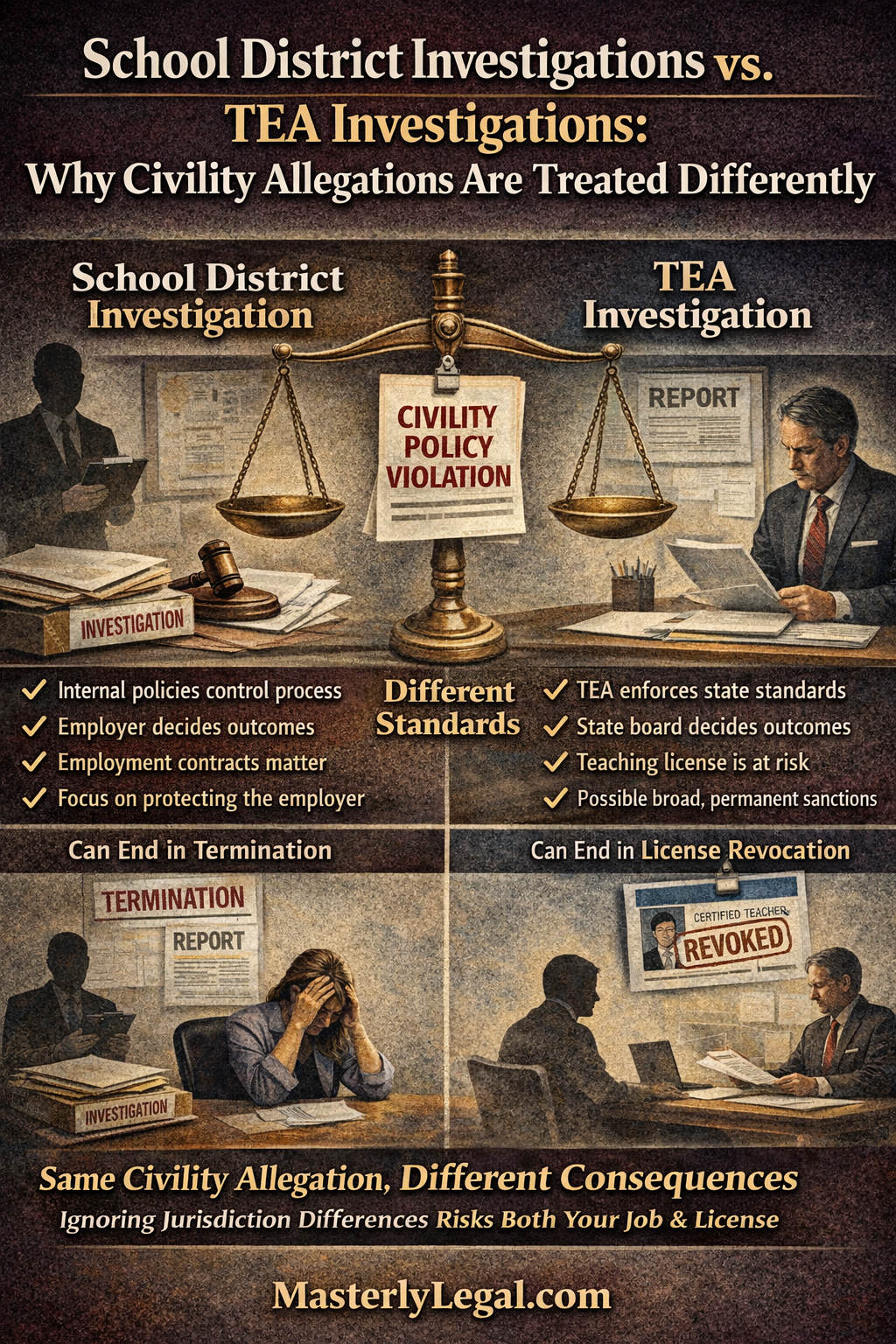
School District Investigations vs. TEA Investigations: Why Civility Allegations Are Treated Differently
Teaching careers rarely end with a single dramatic moment. More often, they unravel quietly through reporting, internal reviews, and escalating scrutiny that feels confusing and overwhelming. A civility policy violation notice may appear minor at first, but depending on who is investigating, the consequences can be career-ending. At Masterly Legal Solutions, we regularly counsel educators who assumed all investigations were the same, only to discover too late that strategy must change when jurisdiction changes.
School district investigations and TEA investigations operate under very different authority, standards, and legal consequences. Understanding these differences is essential for any employee trying to protect their job, license, and future. When the employer controls the process, internal rules dominate. When TEA becomes involved, state regulation, public policy, and professional discipline take over.
Why Civility Allegations Are Treated So Differently
Civility allegations are not evaluated in a vacuum. They are interpreted through the lens of who is investigating and what authority they have. A school district employer focuses on internal policies and employment outcomes, while TEA focuses on educator conduct and licensing standards.
This distinction matters because the same alleged violation can lead to very different termination outcomes. One process may lead to wrongful termination internally, while the other may permanently affect your certification and job prospects statewide.
Understanding School District Jurisdiction
School districts act as employers managing workplace conduct. Their investigations are driven by internal policies, employment contracts, and risk management goals. These investigations often focus on whether the employer fired or disciplined an employee consistent with its own policies.
Districts have broad discretion to terminate under at will employment standards. However, that discretion is not unlimited, especially when public policy, federal laws, or state law are violated.
The Employer’s Focus on Control and Liability
A school district employer investigates with one goal in mind: minimizing exposure. This often leads to decisions that appear neutral but result in wrongful termination. Districts document conduct carefully to justify termination decisions later.
Many employees do not realize that these investigations are structured to protect the employer, not the worker. When the employer violates its own policies, it can still attempt to justify termination unless challenged.
TEA Investigations Operate Under a Different Authority
TEA investigations are not employment matters alone. They are regulatory actions governed by state regulation, public policy, and educator standards. TEA does not care whether the employer fired you fairly under internal rules.
Instead, TEA evaluates whether conduct violates professional standards, even if the employee quits or was forced into a worker's resignation. This is where constructive discharge and constructive termination issues become critical.
How Strategy Must Shift When TEA Is Involved
An employment strategy focused solely on wrongful termination may fail when TEA is investigating. Educators must address both termination and licensing risk. TEA reviews reporting records, employer statements, and evidence gathered during district investigations.
What you say to a school district investigator may later be reviewed by TEA. This overlap creates risk when strategy does not account for both jurisdictions.
Civility Allegations and Wrongful Termination Exposure
Civility allegations frequently lead to wrongful termination when employers act hastily. Wrongful termination occurs when an employer fired an employee for illegal reasons or in violation of public policy.
A wrongful termination claim may arise when an employer wrongfully terminated a worker after protected activity, reporting concerns, or refusing illegal conduct. These claims require careful documentation and legal positioning.
At Will Employment Does Not Mean Unlimited Power
Many educators are told they can be fired for almost any reason. While at will employment allows termination for almost any reason, it does not permit illegal termination.
Wrongful termination occurs when an employer violates federal laws, state law, or public policy exceptions. Civility allegations are often used as a pretext to fire employees unlawfully.
Constructive Discharge in Education Settings
When working conditions become so unbearable that a reasonable person would feel compelled to resign, this is known as constructive dismissal. When working conditions become so unbearable that a reasonable person would feel compelled to resign, this is known as constructive dismissal.. In education, this often follows investigations marked by retaliation and pressure.
Constructive discharge is treated as termination under the law. Constructive termination and constructive dismissal are frequently argued when employee quits due to employer conduct.
Forced Resignation Is Not Always Voluntary
Districts often pressure employees to resign quietly. A forced resignation may appear voluntary on paper, but legally it may qualify as constructive discharge.
Worker's resignation under coercion can support a wrongful termination claim when supported by strong evidence. This includes emotional distress, loss of benefits, and lost wages.
Wrongful Termination Claims and Legal Action
A wrongful termination claim can arise from termination, constructive discharge, or forced resignation. Wrongful termination claims often involve retaliation, discrimination, or refusal to engage in illegal activity.
Legal action may include a wrongful termination lawsuit seeking back pay, compensation, and punitive damages. These claims depend heavily on evidence and timing.
Public Policy Plays a Central Role
Public policy protects employees who report wrongdoing, refuse illegal activity, or engage in protected activity. Violations of public policy are a common basis for wrongful termination.
Educators are often disciplined for reporting concerns or refusing to violate regulations. When an employer violates public policy, termination may be illegal regardless of internal policies.
Reporting and Retaliation Risks
Reporting concerns often triggers retaliation. Retaliation may include discipline, termination, or constructive discharge. Reporting protected activity is a cornerstone of many wrongful termination claims.
Employers may attempt to mask retaliation as civility violations. This pattern is well established in employment law and frequently litigated.
Discrimination and Civility Allegations
Employment discrimination claims may arise when civility allegations are applied selectively. Discrimination may involve race, sex, age, disability, or other protected categories under title vii and the civil rights act.
The disabilities act also protects employees requiring medical care or accommodations. Termination tied to these factors may be illegal.
Illegal Reasons Hidden Behind Policy Violations
Employers sometimes fire employees for illegal reasons while citing policy violations. These illegal reasons may include retaliation, discrimination, or refusal to participate in illegal conduct.
When an employer fired a worker for such reasons, a wrongful termination lawsuit may follow.
Evidence Matters More Than Intent
Courts and agencies determine outcomes based on evidence, not explanations. Strong evidence includes documentation, witness statements, and patterns of conduct.
Jury believes claims when evidence shows that termination or constructive discharge resulted from illegal conduct rather than legitimate policy enforcement.
Internal Policies Are Not Absolute Shields
Internal policies do not override the law. Employers must follow their own policies consistently. When an employer violates its own policies, it strengthens a wrongful termination claim.
TEA also reviews whether internal policies were misused to justify termination or reporting.
Constructive Termination and Working Conditions
Constructive termination focuses on working conditions, not just termination letters. Harassment, isolation, pay reductions, and unreasonable demands may support a constructive discharge claim.
Following factors are often evaluated:
- Severity of conduct
- Duration of mistreatment
- Supervisor involvement
- Retaliation patterns
Compensation and Damages
Successful wrongful termination claims may recover back pay, lost wages, benefits, and punitive damages. Compensation reflects the harm caused by illegal termination.
Emotional distress damages may also be awarded when supported by evidence.
TEA Reporting Raises the Stakes
When districts report educators to TEA, the risk multiplies. Reporting may follow termination or forced resignation. TEA reviews whether conduct violated professional standards.
This process is separate from employment disputes but relies on the same evidence.
When the Employer Crosses Legal Lines
Employers sometimes engage in illegal activity during investigations. This may include false reporting, retaliation, or even employing undocumented workers while disciplining others.
Undocumented workers issues can complicate employer credibility when termination decisions are challenged.
Reasonable Person Standards Apply
Courts apply the reasonable person standard when evaluating constructive discharge. Would a reasonable person in the same circumstances feel forced to resign?
This standard protects workers from subtle but severe mistreatment.
Termination Is Not the End of the Story
Termination does not eliminate legal protections. Former employer conduct may still be challenged through claims and legal action.
Time limits apply, making early consultation critical.
Why Legal Strategy Must Adapt
School district investigations require employment law strategy. TEA investigations require regulatory defense. Failing to adapt can destroy otherwise valid claims.
An employment attorney or employment lawyer can align strategy across both processes.
The Importance of Legal Counsel
An attorney helps determine whether termination was legal, whether constructive discharge applies, and how to protect licensing. Counsel ensures evidence is preserved and reporting is managed.
Legal guidance changes outcomes.
Real-World Example of Jurisdictional Conflict
Example scenarios often involve a district terminating an employee while TEA investigates conduct. The employer claims policy violation, while the worker argues wrongful termination.
Different standards apply, requiring coordinated defense.
Established Patterns in Education Cases
These cases follow established patterns. Retaliation, discrimination, and policy misuse are common. Understanding these patterns strengthens claims.
Law recognizes these dynamics.
Why Teachers Must Act Early
Delay weakens claims. Evidence fades, reporting solidifies, and termination becomes harder to challenge. Early action preserves rights.
Consultation early protects employment and licensing.
How Masterly Legal Solutions Helps
Our founding partner and legal team focus on employment and educator defense. We evaluate termination, constructive discharge, and TEA exposure together.
We protect workers, not institutions.
Protecting Your Job and Your License
Your job and license are interconnected. Strategy must address both. A single mistake can cost everything.
Legal protections exist, but only when asserted correctly.
How Wrongful Discharge Is Evaluated in Education Investigations
Wrongful discharge claims in education settings generally fall into two categories, depending on whether the employer’s actions violated the law directly or created circumstances that forced an employee out over a defined period of time. In many cases, the issue is not a single incident but a pattern of conduct involving a supervisor or even a co worker that escalates pressure on the employee until termination or resignation becomes unavoidable. Courts generally examine how a reasonable employee would experience the situation, looking at documentation, consistency of discipline, and whether policies were applied fairly. Although employment law standards can vary by jurisdiction, including places like San Francisco, the underlying principles remain consistent nationwide when evaluating whether an employer crossed the line into wrongful discharge.
Contact Masterly Legal Solutions
If you have received a civility policy violation notice or are facing a school district or TEA investigation, now is the time to protect yourself. These matters move quickly, and waiting can cost you your job, your license, and your future. At Masterly Legal Solutions, we offer a free consultation to help you understand whether your termination, forced resignation, or working conditions may be unlawful and what steps to take next. Call (972) 236-5051 today to speak with our team and get clear answers before decisions are made without you.
This article is for informational purposes only and does not constitute legal advice. Reading this content does not create an attorney-client relationship. Every situation is different, and legal outcomes depend on specific facts and applicable law. If you need higher education law services or legal support for schools, consult a qualified attorney.

Teacher Rights When Assaulted by a Special Needs Student: Safety, Reporting and Investigation Issues


Looking for Legal & Business Solutions? Contact Us Now
Fill in the form or call us to set up a meeting