

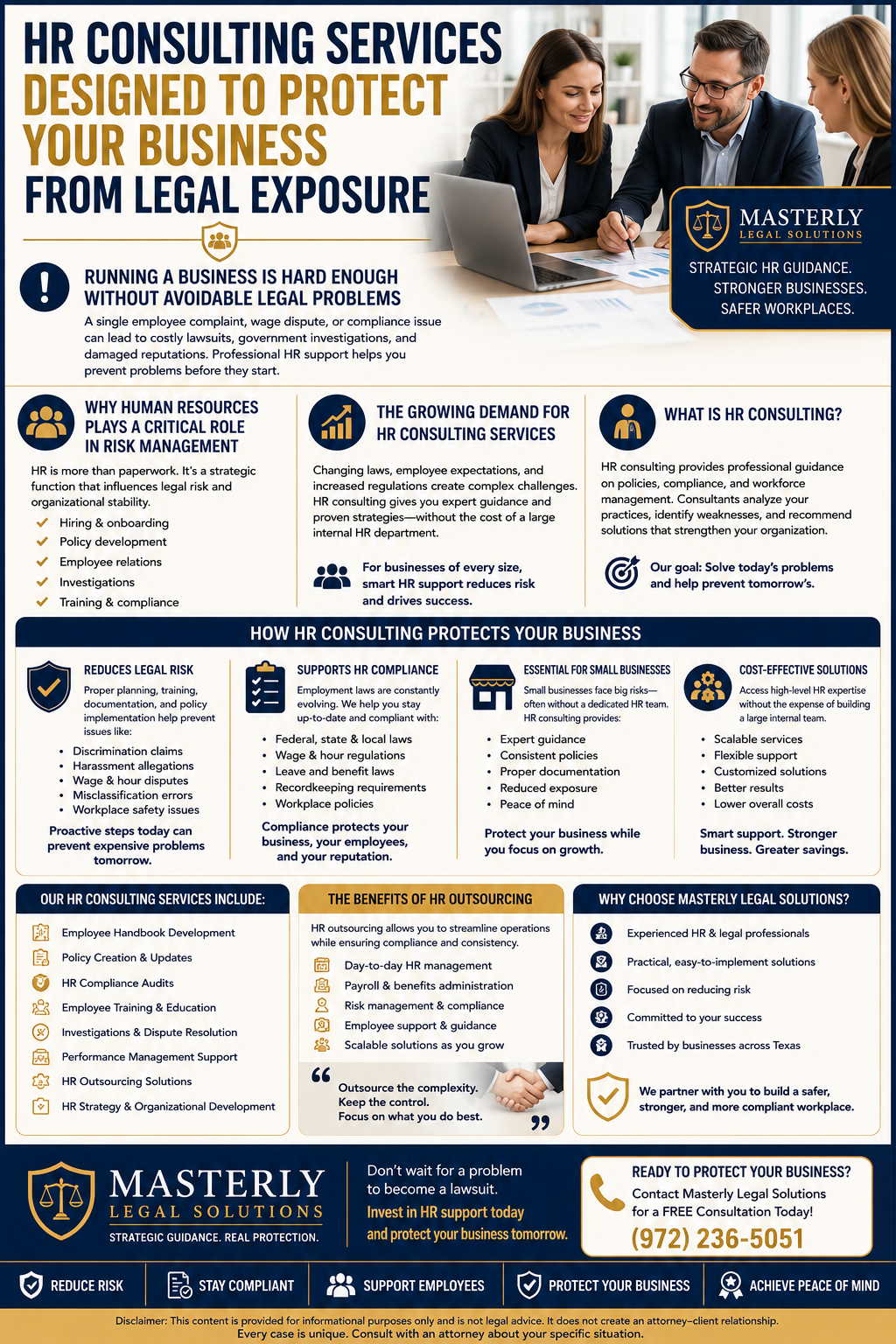
HR Consulting Services Designed to Protect Your Business From Legal Exposure
Running a Business Is Hard Enough Without Avoidable Legal Problems
Most business owners start their companies because they are passionate about a product, service, or vision. Very few launch a business because they want to spend their days reviewing employee documentation, updating workplace policies, handling investigations, or tracking changing employment laws. Yet these responsibilities can have a significant impact on the success or failure of an organization.
A single employee complaint, wage dispute, discrimination allegation, or compliance issue can create serious financial and legal consequences. Many companies discover too late that small human resources problems can quickly grow into expensive lawsuits, government investigations, and damaged reputations. This is one reason why hr consulting services have become an essential resource for organizations of all sizes.
At Masterly Legal Solutions, we understand that protecting a company involves far more than generating revenue. Businesses must also manage risk, support employees, maintain compliance, and build systems that reduce legal exposure. Effective hr consulting can help organizations accomplish these goals while creating a stronger and more productive workplace.
Why Human Resources Plays a Critical Role in Risk Management
Many organizations view human resources as an administrative function focused primarily on hiring paperwork and employee files. While those tasks remain important, modern human resources departments have evolved into strategic components of successful organizations.
Today, human resources professionals help businesses address hiring decisions, workplace investigations, employee relations, compensation concerns, training programs, policy development, and compliance issues. These responsibilities directly influence legal risk and organizational stability.
When businesses fail to prioritize human resources, they often create vulnerabilities that become apparent only after a dispute arises. Investing in professional guidance can help organizations identify concerns before they become costly legal problems.
The Growing Demand for HR Consulting Services
Businesses today operate in an increasingly complex legal environment. Federal, state, and local regulations continue to evolve, creating new compliance challenges for employers. At the same time, employee expectations regarding workplace culture, benefits, and accountability have changed dramatically.
As a result, many companies are turning to hr consulting services to strengthen operations and reduce exposure to risk. These services provide businesses with access to specialized expertise without requiring the expense of maintaining a large internal department.
Whether an organization employs ten workers or several hundred, strategic hr consulting services can help create systems that support compliance and operational success.
What Is HR Consulting?
HR consulting involves providing professional guidance regarding human resources practices, policies, compliance requirements, and workforce management. Consultants work with organizations to improve workplace operations while helping reduce legal and financial risk.
Unlike traditional administrative support, hr consulting often focuses on long-term strategy and organizational improvement. Consultants analyze existing practices, identify weaknesses, and recommend solutions designed to strengthen the organization.
The goal is not simply solving today's problems but creating systems that prevent future issues from developing.
How HR Consulting Protects Businesses From Legal Exposure
One of the primary benefits of hr consulting is risk reduction. Employers frequently face legal challenges involving wage disputes, discrimination allegations, harassment claims, classification errors, and workplace safety concerns.
Many of these issues can be avoided through proper planning, training, documentation, and policy implementation. Human resources consultants help businesses identify vulnerabilities and develop procedures that reduce risk.
When organizations proactively address potential problems, they are often able to avoid disputes that could otherwise result in significant expenses.
The Relationship Between HR Compliance and Business Success
HR compliance is one of the most important components of an effective risk-management strategy. Employers must comply with numerous laws governing wages, hiring practices, workplace conduct, employee benefits, leave policies, and recordkeeping.
Failure to maintain hr compliance can expose businesses to lawsuits, audits, penalties, and reputational harm. Compliance issues often arise not because employers intentionally violate laws but because they misunderstand requirements or fail to keep pace with changing regulations.
Professional guidance helps organizations stay informed and implement practices designed to ensure legal compliance throughout the company.
Why Small Businesses Need HR Support
Many smaller organizations assume that hr consulting is only necessary for large corporations. In reality, smaller companies often face greater risks because they may lack dedicated human resources personnel.
Without proper hr support, business owners frequently manage employment issues themselves while juggling numerous other responsibilities. This can lead to inconsistent policies, inadequate documentation, and preventable mistakes.
Professional HR consulting and training guidance allows smaller organizations to access expertise that would otherwise be unavailable, helping them protect both their employees and their business.
Understanding HR Outsourcing
HR outsourcing has become increasingly popular among businesses seeking efficient and cost-effective solutions. Rather than maintaining a large internal department, organizations can outsource certain functions to experienced professionals.
HR outsourcing allows businesses to access expertise while reducing overhead costs. It can also improve consistency and ensure that critical functions receive appropriate attention.
For many organizations, hr outsourcing creates opportunities to strengthen compliance while allowing leadership to focus on growth and profitability.
The Advantages of HR Outsourcing Services
Companies utilizing hr outsourcing services often discover significant benefits beyond cost savings. These arrangements provide access to experienced professionals who understand evolving workplace requirements and industry best practices.
Benefits may include:
- Improved compliance management.
- Enhanced documentation practices.
- Reduced administrative burdens.
- Greater consistency in workplace procedures.
- Access to specialized expertise.
Effective hr outsourcing services help organizations operate more efficiently while reducing exposure to legal and operational risks.
Outsourcing HR Functions Allows Leaders to Focus on Growth
Many executives spend substantial time addressing personnel issues that distract from strategic priorities. Outsourcing hr functions can free leadership teams to concentrate on serving customers, developing products, and expanding operations.
Rather than spending hours handling routine employment matters, leaders can focus on initiatives that drive business growth. This improved allocation of resources often produces measurable benefits throughout the organization.
When administrative demands are reduced, businesses are frequently able to operate more effectively and efficiently.
Human Resources Consulting and Strategic Planning
Human resources consulting extends beyond compliance and documentation. It also plays an important role in strategic planning and workforce development.
Organizations must anticipate future staffing needs, succession planning challenges, leadership development opportunities, and evolving workforce expectations. Consultants help businesses align workforce strategies with organizational objectives.
This proactive approach allows employers to make informed decisions that support long-term success.
Building Effective HR Processes
Strong hr processes create consistency and reduce uncertainty throughout an organization. Employees are more likely to understand expectations when procedures are clear and applied fairly.
Consultants often evaluate existing hr processes to identify inefficiencies, inconsistencies, and areas requiring improvement. Recommendations may include policy revisions, documentation standards, onboarding enhancements, and communication strategies.
Well-designed systems support both employee satisfaction and compliance objectives.
Why Every Business Needs Clear HR Policies
Policies establish expectations and provide guidance for employees and managers alike. Unfortunately, many organizations rely on outdated policies or fail to document expectations adequately.
Effective hr policies and compliant employee handbooks help businesses address workplace conduct, attendance, performance issues, harassment complaints, technology use, confidentiality obligations, and numerous other topics.
Clear policies not only improve consistency but also strengthen an organization's ability to defend decisions when disputes arise.
The Role of Human Resources Consultants in Workplace Investigations
Workplace complaints require careful handling. Allegations involving discrimination, harassment, retaliation, or misconduct often create significant legal risks for employers.
Human resources consultants assist organizations by developing investigation procedures, training managers, and helping ensure that complaints are addressed appropriately.
Prompt, objective investigations help organizations demonstrate accountability while reducing potential liability.
Employee Relations and Workplace Stability
Strong employee relations contribute directly to organizational success. Employees who feel respected, supported, and heard are generally more engaged and productive.
Poor employee relations, on the other hand, often lead to increased turnover, reduced morale, and a higher likelihood of disputes. Consultants help organizations identify and address issues before they become larger problems.
Creating a positive workplace culture benefits both employees and employers.
How HR Services Improve Employee Engagement
Employee engagement is closely connected to retention, productivity, and organizational performance. Employees who feel connected to their work are more likely to contribute positively to company objectives.
Professional hr services often include programs designed to enhance employee engagement through communication improvements, recognition initiatives, leadership development, and workplace culture enhancements.
Organizations that invest in engagement frequently experience stronger results across multiple performance indicators.
Performance Management as a Risk-Reduction Tool
Effective performance management protects businesses by creating clear expectations and documenting employee performance consistently.
Without proper performance management systems, organizations may struggle to justify disciplinary actions, promotions, or termination decisions. Inconsistent practices often create legal vulnerabilities.
Structured systems help managers provide feedback, address concerns, and document performance-related decisions appropriately.
Employee Performance Management and Documentation
Employee performance management requires more than annual evaluations. Ongoing communication, coaching, and documentation are essential components of a successful system.
Consultants often assist businesses in developing frameworks that support accountability while encouraging employee development. These systems benefit organizations by reducing misunderstandings and promoting fairness.
When documentation is consistent, employers are better prepared to address disputes if they arise.
Benefits Administration and Compliance Responsibilities
Managing employee benefits involves numerous legal and administrative obligations. Benefits administration requires careful attention to enrollment procedures, eligibility requirements, and documentation standards.
Errors in benefits administration can create significant compliance concerns and employee dissatisfaction. Consultants help organizations establish procedures that reduce mistakes and improve efficiency.
Well-managed benefits programs contribute to employee satisfaction while supporting organizational goals.
Benefits Management and Employee Satisfaction
An effective benefits management strategy does far more than provide healthcare coverage or retirement plans. Employee benefits often influence recruitment efforts, retention rates, workplace morale, and overall organizational stability. In today's competitive labor market, businesses that fail to offer attractive benefits may struggle to attract and retain qualified professionals.
Human resources consultants frequently help organizations evaluate benefit offerings and identify opportunities for improvement. The goal is to balance employee expectations with financial realities while maintaining compliance with applicable regulations. Strong benefits management practices often contribute directly to employee satisfaction and long-term workforce stability.
When employees understand and appreciate their benefits, they are more likely to remain engaged and committed to the organization.
Payroll Administration Requires Accuracy and Consistency
Payroll administration is one of the most important responsibilities within any organization. Employees expect to be paid accurately and on time, and even small mistakes can create frustration, distrust, and potential legal exposure.
Errors involving overtime calculations, deductions, employee classifications, or recordkeeping may result in significant compliance concerns. Human resources consulting professionals often help organizations evaluate payroll procedures and identify areas where improvements are needed.
Reliable payroll administration protects both employees and employers while supporting organizational credibility.
Payroll Processing and Risk Management
Accurate payroll processing is essential to maintaining compliance and operational efficiency. Businesses that rely on outdated systems or inconsistent procedures often experience avoidable payroll-related problems.
Professional hr services frequently include reviews of payroll processing systems to ensure proper documentation, reporting, and compliance with applicable requirements. Streamlined processes can reduce errors while improving overall productivity.
When payroll systems function effectively, organizations spend less time correcting mistakes and more time focusing on strategic priorities.
Talent Acquisition Is More Than Filling Open Positions
Successful organizations understand that talent acquisition involves much more than posting job advertisements and conducting interviews. Recruiting the right people requires planning, consistency, and a clear understanding of organizational needs.
Human resources consultants often assist businesses with talent acquisition strategies designed to attract qualified candidates while reducing hiring risks. This includes developing job descriptions, improving interview processes, and implementing fair hiring practices.
Strong talent acquisition efforts help organizations build teams capable of supporting long-term growth.
Recruiting Services Help Organizations Find Better Candidates
Many employers struggle to identify qualified applicants in competitive markets. Professional recruiting services can provide access to broader talent pools and more efficient hiring processes.
Consultants frequently assist organizations by evaluating recruitment practices and recommending improvements. These services help businesses identify candidates whose skills and experience align with organizational goals.
Improved recruiting outcomes often lead to stronger workforce performance and reduced turnover.
Leadership Development Strengthens Organizations
Strong leadership is essential to organizational success. Unfortunately, many businesses promote talented employees into management positions without providing adequate training or support.
Leadership development programs help managers improve communication, decision-making, accountability, and conflict-resolution skills. These programs often reduce workplace disputes while improving overall team performance.
Investing in leadership development benefits organizations at every level and contributes to long-term stability.
Leadership Transformation Through Strategic HR Consulting
Many businesses experience significant improvements when leadership transformation becomes a priority. Effective leaders create healthier workplace cultures, improve employee engagement, and support organizational objectives.
HR consulting professionals frequently work with executives and managers to strengthen leadership capabilities and improve organizational effectiveness. These efforts often result in better decision-making and stronger employee relationships.
Organizations that prioritize leadership growth are often better positioned to adapt to changing business conditions.
Employee Retention Saves Time and Money
High turnover creates significant costs for employers. Recruiting, onboarding, and training new employees require substantial investments of time and resources.
Consultants often help businesses identify factors affecting employee retention and develop strategies to address those concerns. Improving communication, career development opportunities, compensation structures, and workplace culture can significantly reduce turnover.
Retaining experienced employees frequently produces better outcomes than constantly replacing departing workers.
Employee Wellness Supports Productivity
Organizations increasingly recognize the importance of employee wellness programs. Physical and mental well-being directly affect productivity, engagement, attendance, and workplace morale.
Human resources professionals often help employers develop wellness initiatives that support employees while improving organizational performance. These programs may include health resources, stress-management tools, and workplace support systems.
A healthier workforce often contributes to stronger organizational outcomes.
Human Capital Is One of Every Business's Greatest Assets
Every organization depends on its people. Human capital represents the collective skills, experience, knowledge, and abilities of a workforce.
Businesses that invest in human capital often outperform competitors because they create environments where employees can thrive. Human resources consulting and broader legal business consulting help organizations maximize the value of their workforce through strategic planning and employee development initiatives.
Viewing employees as strategic assets rather than expenses often produces long-term benefits.
HR Advisory Services Provide Valuable Insight
HR advisory services help organizations navigate complex workplace challenges while minimizing risk. These services often focus on compliance concerns, employee relations issues, policy development, and strategic workforce planning.
Businesses frequently seek hr advisory support when facing difficult decisions involving employment practices, organizational restructuring, or workforce growth. Access to experienced guidance can help leaders make informed decisions with greater confidence.
Proactive advice often prevents issues from becoming larger problems later.
HR Operations and Organizational Efficiency
Strong hr operations support consistency throughout an organization. Effective systems help businesses manage employee records, hiring procedures, training programs, benefits administration, and compliance requirements.
Consultants often evaluate hr operations to identify inefficiencies that create unnecessary costs or risks. Streamlined processes improve service delivery while reducing administrative burdens.
Organizations that strengthen hr operations often experience improvements in productivity and overall performance.
Allowing Businesses to Focus on Their Core Business
Many employers find themselves overwhelmed by administrative requirements, compliance obligations, and workforce management challenges. These responsibilities can distract leaders from activities that directly generate revenue and support growth.
HR outsourcing and consulting services allow organizations to focus on their core business while experienced professionals manage complex human resources functions. This approach often improves efficiency while reducing risk.
By delegating specialized responsibilities, businesses can devote more energy to serving customers and achieving strategic objectives.
Federal Contractors Face Unique Compliance Challenges
Federal contractors operate under additional requirements that often extend beyond those applicable to other employers. These organizations must navigate specialized regulations involving employment practices, reporting obligations, and workforce management.
Human resources consultants with extensive experience working with higher education and federal contractor compliance can help organizations maintain compliance while reducing exposure to audits and enforcement actions. Proactive planning is essential in these environments.
Understanding these obligations helps contractors avoid costly mistakes and maintain eligibility for future opportunities.
Compliance Reviews Help Identify Problems Early
Many organizations do not discover compliance issues until after a complaint, audit, or lawsuit occurs. Compliance reviews provide an opportunity to identify vulnerabilities before they become significant liabilities.
Consultants often conduct assessments of policies, procedures, documentation practices, and workplace systems. These reviews help organizations understand where improvements may be necessary.
Addressing concerns proactively is often far less expensive than responding to legal disputes after they arise.
Strategic Guidance for Long-Term Success
Successful businesses recognize that workforce management should align with broader organizational goals. Strategic guidance helps organizations connect human resources initiatives with overall business objectives.
Consultants assist businesses in developing plans that support growth, improve workforce stability, and reduce legal exposure. These efforts often strengthen both operational performance and organizational resilience.
Long-term planning creates a foundation for sustainable success.
Supporting Business Growth Through Effective HR Solutions
Business growth creates exciting opportunities, but it also introduces new challenges. Expanding organizations often face increasing demands related to hiring, compliance, employee management, and operational consistency.
Professional hr solutions help businesses scale responsibly while maintaining compliance and workplace effectiveness. Consultants work closely with leadership to develop systems capable of supporting future growth.
Organizations that plan proactively and leverage ongoing outside general counsel support are often better prepared to manage expansion successfully.
Flexible Solutions for Medium Sized Businesses
Medium sized businesses frequently face unique challenges. They may be too large to manage human resources informally but not large enough to justify extensive internal departments.
Flexible business consulting solutions allow these organizations to access specialized expertise without incurring excessive costs. Human resources consultants can tailor services to meet specific organizational needs and objectives.
This approach provides valuable support while maintaining cost effectiveness.
Why Partnering With a Consulting Firm Creates Value
A qualified consulting firm brings objective insight, specialized expertise, and practical experience to organizational challenges. Rather than reacting to problems after they occur, consultants help businesses anticipate risks and implement preventive strategies.
Whether addressing compliance concerns, workforce planning, employee relations, benefits administration, talent acquisition, or broader business consulting needs, an experienced consulting firm can provide meaningful support. Organizations often discover that external expertise complements internal capabilities and strengthens overall performance.
The right consulting partner becomes a valuable resource for both immediate needs and long-term success.
Executive Compensation and Organizational Risk Management
As organizations grow, compensation decisions become increasingly important. Executive compensation plans should align with company goals while supporting fairness, transparency, and compliance. Poorly structured compensation arrangements can create disputes, regulatory concerns, and financial risks that affect the entire organization.
Human resources consultants often assist businesses in evaluating compensation structures and developing programs that support both performance and retention. When compensation strategies are tied to organizational objectives, they can strengthen leadership accountability and improve long-term stability.
Why Dedicated Support Matters for Employers
Workplace issues rarely occur at convenient times. A discrimination complaint, wage dispute, policy violation, or employee conflict can require immediate attention. Businesses that have access to dedicated support are often better prepared to respond effectively and reduce potential liability.
Professional HR consulting services provide ongoing guidance that helps organizations navigate complex situations before they escalate. Having experienced advisors available allows leaders to make informed decisions with confidence.
Strategic Planning for Long-Term Workforce Success
Strategic planning is not limited to financial forecasting or sales projections. Workforce planning is equally important because employees drive organizational performance. Businesses that fail to plan for future staffing needs often struggle with turnover, skill gaps, and operational disruptions.
Effective strategic planning helps organizations identify workforce needs, leadership development opportunities, succession concerns, and recruiting priorities. Human resources consulting professionals assist businesses in creating plans that support growth while minimizing risk.
Addressing the Unique Needs of Every Business Owner
Every business owner faces different challenges depending on the size of the organization, industry requirements, and workforce structure. Some companies need assistance with compliance issues, while others focus on recruitment, retention, or workplace culture.
Professional consultants evaluate each company's unique HR needs and develop solutions designed to support specific objectives. This customized approach often produces stronger results than relying on generic policies or one-size-fits-all recommendations.
Specialized Expertise Creates Better Outcomes
One of the greatest advantages of working with experienced HR consultants is access to specialized expertise. Employment regulations, workplace investigations, employee relations concerns, and compliance requirements continue to evolve. Keeping up with these changes can be difficult for organizations that lack dedicated human resources personnel.
Consultants provide practical recommendations based on real-world experience and industry knowledge, supported by a broad range of legal services and customized training. Their guidance helps businesses identify risks early and implement effective solutions before problems become costly.
Extensive Knowledge Helps Businesses Avoid Costly Mistakes
Employment-related decisions often have long-term consequences. A poorly handled termination, inadequate policy, or compliance oversight can expose a business to significant liability. Access to professionals with extensive knowledge of workplace practices can help employers avoid common mistakes.
Businesses benefit when decision-makers understand not only what actions should be taken, but also why those actions matter. Strong guidance often results in fewer disputes, improved documentation, and greater operational consistency.
Aligning Human Resources With Business Goals Through Strategic Planning
Successful organizations understand that human resources should support more than day-to-day administration. Modern hr professionals play a critical role in helping businesses connect workforce initiatives to overall business strategy. When companies align people management with organizational objectives, they often experience stronger performance, improved retention, and better long-term results.
Effective talent management requires more than filling open positions. It involves developing employees, identifying future leaders, and creating opportunities for growth throughout the employee lifecycle. Human resources consultants frequently help organizations evaluate workforce needs and implement tailored solutions designed to strengthen performance while supporting organizational goals. These customized approaches are often more effective than generic programs because they address the specific challenges facing each business.
A strong hr strategy also helps organizations manage the entire employee lifecycle, from recruitment and onboarding to development, retention, and separation. Throughout this process, hr professionals oversee important hr responsibilities that directly affect compliance, employee engagement, and workplace stability. By creating clear procedures, accountability measures, and leveraging comprehensive legal support, businesses can improve consistency while reducing unnecessary risk.
Many organizations also benefit from support with payroll services, employee development initiatives, and workforce planning. Rather than overwhelming internal staff with routine hr tasks, businesses can rely on experienced consultants to provide guidance across multiple hr areas. This allows the internal hr team to focus on core responsibilities that drive organizational performance while maintaining compliance with employment requirements.
Professional consulting services often provide cost effective services that improve operational efficiency without requiring the expense of expanding internal departments. Whether an organization needs assistance with workforce planning, performance improvement, or long-term talent management, strategic guidance can help create stronger outcomes while supporting sustainable growth. When human resources functions are aligned with broader business objectives, organizations are often better positioned to achieve long-term success.
How HR Works With Technology to Improve Efficiency
Modern businesses increasingly rely on technology to manage workforce responsibilities. When HR works effectively alongside technology, organizations often experience improvements in accuracy, communication, and productivity.
Digital tools can assist with payroll administration, benefits enrollment, performance management, recordkeeping, and employee communication. However, technology should complement strong policies and procedures rather than replace them.
The Value of a User Friendly Platform
Employees expect easy access to important information regarding payroll, benefits, training, and workplace resources. A user friendly platform helps streamline communication while reducing administrative burdens on managers and HR personnel.
Organizations that invest in accessible systems often improve employee experiences while increasing efficiency. These platforms can support compliance efforts and make workforce management more effective.
Helping Medium Sized Businesses Compete and Grow
Medium sized businesses frequently face challenges that differ from those encountered by small startups or large corporations. They often experience growth-related pressures while operating with limited internal resources.
HR consulting services provide medium sized businesses with access to expertise that supports expansion, workforce planning, compliance, and operational improvement. This assistance allows organizations to grow strategically while protecting against unnecessary legal exposure.
Contact Masterly Legal Solutions for HR Consulting Services
Protecting your business requires more than reacting to problems after they occur. Effective human resources practices, proactive planning, and strong compliance systems can significantly reduce risk while supporting long-term success.
At Masterly Legal Solutions, we provide HR consulting services designed to help businesses strengthen operations, improve compliance, and protect against costly employment-related disputes. Whether you need assistance with HR outsourcing, policy development, employee relations, workforce planning, or strategic guidance, our team is prepared to help.
Contact Masterly Legal Solutions today at (972) 236-5051 for a free consultation. We can evaluate your current practices, discuss your goals, and recommend solutions tailored to your organization's unique needs.
Disclaimer: This article is intended for informational purposes only and should not be considered legal advice. Reading this article does not create an attorney-client relationship with Masterly Legal Solutions. Employment laws and workplace requirements vary based on specific circumstances. Businesses should consult qualified legal counsel regarding their individual situations before making employment or compliance decisions.



Looking for Legal & Business Solutions? Contact Us Now
Fill in the form or call us to set up a meeting





